Shuai Jiao: Ancient Tradition, Global Evolution, and Modern Impact
Shuai Jiao is one of the oldest martial arts in the world. It combines strength, speed, and strategy. Originating in ancient China, this combat sport has transcended centuries and continents. Practiced in schools, communities, and professional arenas, Shuai Jiao continues to shape both cultural identity and physical discipline. In this blog post, you will explore the history, rules, social significance, and global presence of this fascinating martial art. Whether you’re a sports historian or a martial arts enthusiast, Shuai Jiao offers a compelling story worth telling.
Origins and Historical Development
Shuai Jiao dates back over 4,000 years to ancient China. Originally known as “Jiao Di,” the early version involved head-butting with horned helmets. These brutal competitions trained soldiers for close-quarters combat. Over time, this evolved into a wrestling style using throws, locks, and trips.
During the Qin Dynasty (221–206 BCE), the sport took on more structure. Warriors trained in Shuai Jiao for both battle and self-defense. The Han Dynasty (206 BCE – 220 CE) further refined the sport. It moved beyond military use and became a popular form of public entertainment. Kings and nobles frequently held wrestling competitions during festivals.
As dynasties changed, so did Shuai Jiao. By the Tang and Song periods, it was a respected skill among bodyguards and police officers. The Qing Dynasty (1644–1912) saw widespread popularity, with official schools established in Beijing and other major cities.
Different regions developed unique styles. Beijing, Tianjin, Baoding, and Mongolian variants each brought diverse techniques and philosophies. These styles eventually merged to form the contemporary version seen today.
Global Popularity and Presence
Shuai Jiao remained mostly within Chinese borders until the 20th century. As Chinese communities emigrated, they brought the art with them. In Taiwan, Shuai Jiao became a major competitive sport. Hong Kong and Singapore also developed local scenes.
Outside Asia, the United States embraced Shuai Jiao during the martial arts boom of the 1960s and 70s. Chinese-American masters began teaching it in major cities like San Francisco, Los Angeles, and New York. Today, clubs and dojos exist across North America.
Europe has also welcomed the sport. France, Italy, and Germany have Shuai Jiao federations. They organize tournaments and offer formal training. South America has seen growth, especially in Brazil and Argentina. Australia and New Zealand host exhibitions and offer classes at martial arts academies.
The World Shuai Jiao Federation, founded in 1984, promotes international tournaments. Its goal is to unify the sport under a shared set of rules while preserving regional identities. Their events attract athletes from over 30 countries. The federation also holds coaching and judging certifications to maintain high standards.
Amateur Participation and Youth Development
Youth involvement has been essential to the sport’s growth. In China, Shuai Jiao is part of many school physical education programs. Schools in Beijing, Tianjin, and Inner Mongolia often include it in their curriculum. Children start training as young as six.
The China Shuai Jiao Association works closely with education departments. It offers age-appropriate programs and competitions. Safety is a top priority. Coaches receive training in injury prevention and child psychology.
In the United States, amateur clubs offer classes to children and teens. Community centers, YMCAs, and private dojos host beginner and intermediate programs. Many use Shuai Jiao to improve coordination, confidence, and discipline.
Europe has embraced youth competition as well. France runs a national school league. Italian academies organize youth tournaments every spring. These events build camaraderie while teaching respect and sportsmanship.
Local and regional competitions serve as entry points. Winners often qualify for national tournaments. In some countries, high school and college teams now compete on a seasonal basis.
Professional Leagues and Competitive Circuits
Professional Shuai Jiao continues to expand its global footprint. China leads with its National Shuai Jiao League. The top athletes train year-round and compete in televised matches. Sponsorship and government funding support these athletes.
Taiwan operates its own professional circuit. Matches take place in gymnasiums and arenas. These events draw large crowds and are often broadcast nationally.
In the United States, several semi-professional leagues have emerged. The U.S. Shuai Jiao Federation organizes state and national events. While not fully professional, top fighters receive sponsorships and coaching stipends.
France and Italy host international open tournaments. These serve as qualifiers for the World Shuai Jiao Championships. Competitors from Africa, Eastern Europe, and Central Asia often participate. These regions bring a mix of folk wrestling techniques that enrich the sport.
The World Shuai Jiao Federation oversees the international rankings. It also sets standards for judging and officiating. World Championships are held every two years. These tournaments feature men’s, women’s, and junior divisions.
Prize money, media coverage, and corporate sponsorship continue to grow. This indicates a bright future for professional Shuai Jiao.
Political and Social Significance
Shuai Jiao has deep cultural roots. In China, it symbolizes strength, honor, and perseverance. It has appeared in folklore, theater, and traditional festivals. Some regional celebrations still include friendly matches as part of the festivities.
Politically, the sport has served as a tool for diplomacy. Cultural exchanges often include Shuai Jiao demonstrations. Chinese delegations have performed in the U.S., Europe, and Africa. These exchanges promote understanding and goodwill.
The sport also fosters community identity. In Inner Mongolia, local styles are a source of pride. Tournaments double as social gatherings. Families picnic while watching the matches.
For the Chinese diaspora, Shuai Jiao preserves heritage. It connects younger generations to their roots. Martial arts schools abroad often teach Shuai Jiao alongside Kung Fu or Tai Chi.
Socially, the sport promotes values like discipline, humility, and mutual respect. It breaks down barriers between people. Competitors often shake hands and bow before and after matches. These rituals reinforce the spirit of fair play.
In urban areas, Shuai Jiao offers youth a positive outlet. Programs targeting at-risk teens have shown success. Kids gain confidence while learning how to manage conflict constructively.
The sport has also helped promote gender equality. More women are training and competing than ever before. Female athletes have won major titles and earned international recognition.
Rules and Structure of Competition
Shuai Jiao focuses on throws. The goal is to unbalance and bring the opponent to the ground. Strikes, locks, and submissions are not allowed.
Competitions take place on a mat or platform. The surface usually measures 8–10 meters in diameter. Matches last two or three minutes, depending on the level.
Points are awarded for clean throws. A perfect throw, where the opponent lands flat on their back, earns the highest score. Partial throws and off-balance landings score lower.
If a competitor steps out of bounds, the opponent gains a point. Repeated infractions can lead to disqualification.
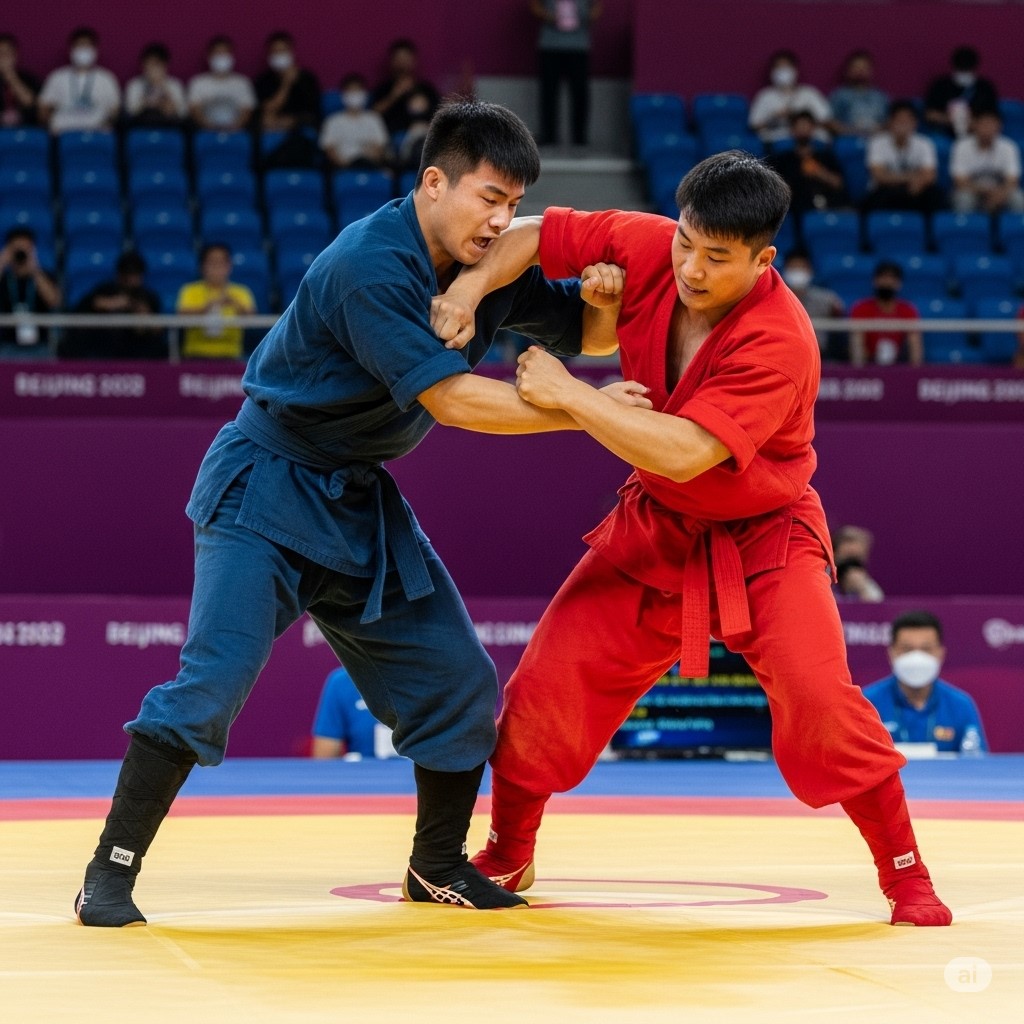
Gripping rules are strict. Competitors must grip the jacket (a uniform similar to a judo gi). Grabbing the pants, legs, or belt is prohibited. This emphasizes technical skill and timing.
Illegal techniques include joint locks, chokes, and strikes. Pushing the opponent’s face or neck is not allowed. Sweeps must be executed cleanly and safely.
A match can end early with an ippon (decisive victory). This occurs when one competitor executes a perfect throw. If time runs out, judges determine the winner based on points.
Judges also score based on aggression, control, and technique. Passive behavior or stalling can result in penalties. Coaches may challenge calls, but only once per match.
Protective gear includes a padded jacket and wrestling shoes. Some leagues require mouthguards and optional headgear.
Training and Techniques
Training involves a combination of conditioning, technique drills, and sparring. Athletes build strength, flexibility, and balance. Common exercises include squats, lunges, and rope climbing.
Technical drills focus on footwork, grip control, and timing. Beginners learn basic throws like hip tosses and leg sweeps. Advanced students practice complex combinations and counters.
Sparring sessions simulate match conditions. These help athletes improve reflexes and decision-making. Coaches emphasize safety and sportsmanship.
Recovery plays a vital role. Athletes use stretching, massage, and rest days to prevent injury. Nutrition and hydration also contribute to peak performance.
Cross-training with other grappling arts is common. Many Shuai Jiao practitioners study judo, wrestling, or sambo. This broadens their skill set and prepares them for diverse opponents.
Conclusion
Shuai Jiao offers more than just physical benefits. It connects people to history, culture, and community. As it gains traction worldwide, its influence continues to grow.
The sport has adapted to modern times while preserving its ancient essence. Through youth programs, professional leagues, and international events, Shuai Jiao stands tall in the martial arts world.
Whether practiced for fitness, competition, or cultural pride, Shuai Jiao remains a vital and vibrant sport. Its global rise reflects a shared appreciation for discipline, honor, and the art of the throw.