
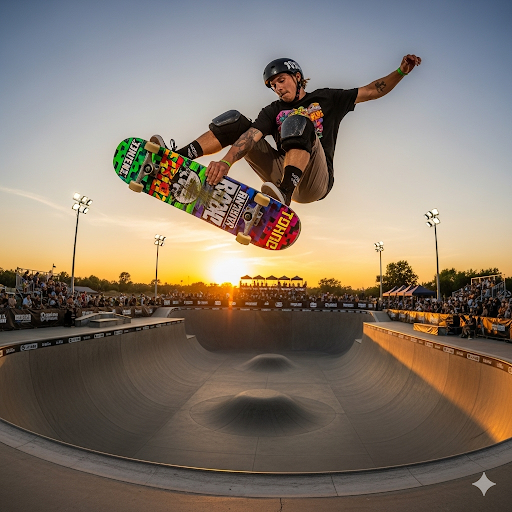
Skateboarding Big Air: A Complete Guide to the Extreme Sport
Skateboarding Big Air has become one of the most thrilling events in action sports. This discipline pushes athletes to launch themselves off enormous ramps, fly through the air, and land tricks that seem impossible. The sport combines daring, creativity, and technical skill in a way few others can match. As a result, fans around the world are captivated. The combination of extreme height, speed, and danger sets it apart. Skateboarding Big Air continues to grow in global popularity, from local skate parks to the biggest international competitions.
The Origin and History of Skateboarding Big Air
The roots of Skateboarding Big Air trace back to the birth of skateboarding itself in the 1950s. Surfers in California wanted to recreate wave riding when the ocean was flat. They attached roller skate wheels to wooden boards, sparking a movement. Early skaters rode on sidewalks and empty pools.
By the 1970s, skateboarding evolved beyond its surfing origins. Skaters began building ramps to mimic the flow of surfing. The first halfpipes and vert ramps appeared, allowing for aerial tricks. Professional skaters like Tony Alva and Stacy Peralta helped popularize this style.
In the 1980s and 1990s, vert skateboarding dominated competitions like the X Games. Ramps grew taller, and tricks grew bigger. Then came an idea that would transform the sport forever. In the early 2000s, skateboarding legend Danny Way envisioned a mega ramp. He built ramps that were much larger than traditional vert ramps. These ramps included a huge drop-in, a gap jump, and a massive quarterpipe.
The first Mega Ramp was constructed in California in 1999. Danny Way stunned audiences by clearing a 50-foot gap and soaring over 20 feet high. This moment marked the birth of Skateboarding Big Air. It became a featured discipline at the X Games in 2004. Riders like Bob Burnquist, Jake Brown, and Elliot Sloan expanded the sport’s possibilities.
Skateboarding Big Air remains closely tied to its pioneer, Danny Way. He set world records for the longest jump, the highest air, and even jumped the Great Wall of China in 2005. These achievements cemented the sport’s place in extreme sports history.
Global Popularity of Skateboarding Big Air
Skateboarding Big Air has spread across continents. Fans admire the courage it takes to attempt massive jumps. Television and online platforms bring these incredible performances to global audiences.
In the United States, the sport remains strongest. The X Games have been a driving force in popularizing it. ESPN’s broadcasts showcase dramatic highlights that reach millions of viewers.
In Brazil, skateboarding has a passionate fan base. Bob Burnquist, a Brazilian-American skater, is one of the sport’s most decorated athletes. His success boosted interest in South America. Many young Brazilians dream of competing in Big Air events.
Australia has also embraced the sport. Jake Brown, an Australian skater, shocked the world in 2007 when he survived a 45-foot fall at the X Games. His recovery and return to competition inspired fans worldwide.
Europe has growing enthusiasm. Events in Spain and Sweden attract local crowds. Indoor facilities with mega ramps are becoming more common.
In Asia, the sport is gaining momentum. China hosted skateboarding events that introduced Big Air to large audiences. Japan, with its strong skateboarding culture, is also developing interest.
Online streaming plays a key role in the sport’s popularity. Social media platforms spread clips of jaw-dropping tricks. These short videos create instant excitement and attract new fans globally.
Amateur Skateboarding Big Air Around the World
At the amateur level, Skateboarding Big Air is less common due to its size and cost. Building a mega ramp requires significant resources and space. However, smaller versions of Big Air ramps are appearing.
Youth training programs introduce riders to large ramps gradually. Skaters often begin with vert ramps before progressing. Indoor skate parks in the U.S., Europe, and Japan sometimes feature scaled-down mega ramps. These facilities give young riders the chance to learn safely.
Some schools partner with local skate parks to encourage students to skate. While Big Air itself is rarely part of school programs, vert and park skating act as stepping stones. Young athletes inspired by professionals work their way up to larger ramps.
Amateur competitions sometimes include modified Big Air events. Smaller ramps allow younger skaters to attempt gap jumps and quarterpipe tricks. These events create pathways for future professionals.
In Brazil, youth programs are especially strong. Bob Burnquist’s foundation supports young skaters with facilities and coaching. Such programs aim to develop the next generation of Big Air athletes.
Although not every city has the infrastructure, the dream of riding Big Air ramps drives many amateurs. Videos of youth skaters training on custom ramps highlight the sport’s grassroots growth.
Professional Leagues and Competitions
The professional side of Skateboarding Big Air thrives in major leagues and events. The X Games remains the sport’s most prestigious stage. Since 2004, Big Air has been one of its headline competitions. Fans tune in worldwide to watch the best skaters push limits.
Athletes like Danny Way, Bob Burnquist, Jake Brown, Elliot Sloan, and Tom Schaar made history at the X Games. Their groundbreaking tricks set new standards each year. For example, Elliot Sloan mastered huge 720s and 900s on the Mega Ramp.
Red Bull also organizes Big Air events. These competitions often take place in unique locations, such as mountains or custom-built ramps in stadiums. Red Bull’s global reach helps expand the sport beyond the X Games.
Smaller leagues in Europe and South America host professional events too. These give local talent the chance to compete on mega ramps. Although not as high-profile as the X Games, they play a vital role in growing the sport.
Corporate sponsorship supports professional athletes. Companies like Monster Energy, Vans, and DC Shoes fund riders. These partnerships provide financial stability, allowing athletes to focus on training.
The Olympic Games included skateboarding for the first time in 2021. However, Big Air was not part of the program. Still, many believe it may appear in future editions as the Olympic committee explores new extreme events.
Political and Social Significance
Skateboarding Big Air carries social significance that extends beyond competition. The sport symbolizes freedom, creativity, and courage. Young people often see it as a way to express individuality.
In some cities, skateboarding helps revitalize communities. Building skate parks, including ramps, gives youth safe spaces. This reduces street skating conflicts with authorities. Governments sometimes fund these projects to support healthy lifestyles.
The sport also crosses cultural boundaries. Fans and athletes from different countries connect through shared passion. International competitions bring people together regardless of language or background.
Politically, skateboarding gained recognition when included in the Olympics. That decision represented a shift in how traditional sports bodies view action sports. It showed that youth culture has a place on the global stage.
Athletes use their platforms for advocacy. Some promote environmental awareness, while others support youth charities. By speaking out, Big Air professionals demonstrate the sport’s broader impact.
Rules of Skateboarding Big Air
The rules of Skateboarding Big Air ensure fairness and safety. Competitions usually take place on a mega ramp. The ramp includes three sections: a roll-in, a gap jump, and a quarterpipe.
Riders drop in from a massive starting platform, sometimes over 70 feet tall. They gain speed to clear a gap that ranges from 50 to 70 feet. After landing the gap, skaters ride up the quarterpipe to perform another trick.
Judges score each run based on difficulty, execution, height, and landing. Big tricks like 720s, 900s, or even 1080s earn higher points. Smooth landings without falls are crucial for strong scores.
Each skater gets multiple attempts. The best score from those attempts counts toward the final result.
Safety gear is mandatory. Skaters must wear helmets, and many also use pads. Given the height and speed, crashes can be severe. Event organizers maintain medical staff on site.
In some events, the format allows progression rounds. Riders attempt increasingly difficult tricks. This format adds drama as fans watch athletes push further.
Scoring systems may vary slightly between competitions, but the core remains the same. The athlete who combines difficulty, style, and consistency wins.
Conclusion
Skateboarding Big Air has transformed skateboarding into a breathtaking spectacle. From its humble surf-inspired roots to massive ramps, the journey has been extraordinary. Global popularity continues to grow through events, online media, and dedicated athletes.
Amateur pathways, though limited, are expanding. Youth programs and scaled-down ramps nurture the next generation. Professional leagues like the X Games and Red Bull events showcase the sport at its highest level.
Beyond competition, Skateboarding Big Air holds social and political value. It represents freedom, inspires youth, and connects cultures worldwide. With clear rules and thrilling performances, it captivates audiences everywhere.
The future of Skateboarding Big Air looks bright. As facilities grow and global interest rises, more athletes will chase the dream of flying higher, spinning faster, and pushing limits further.




