
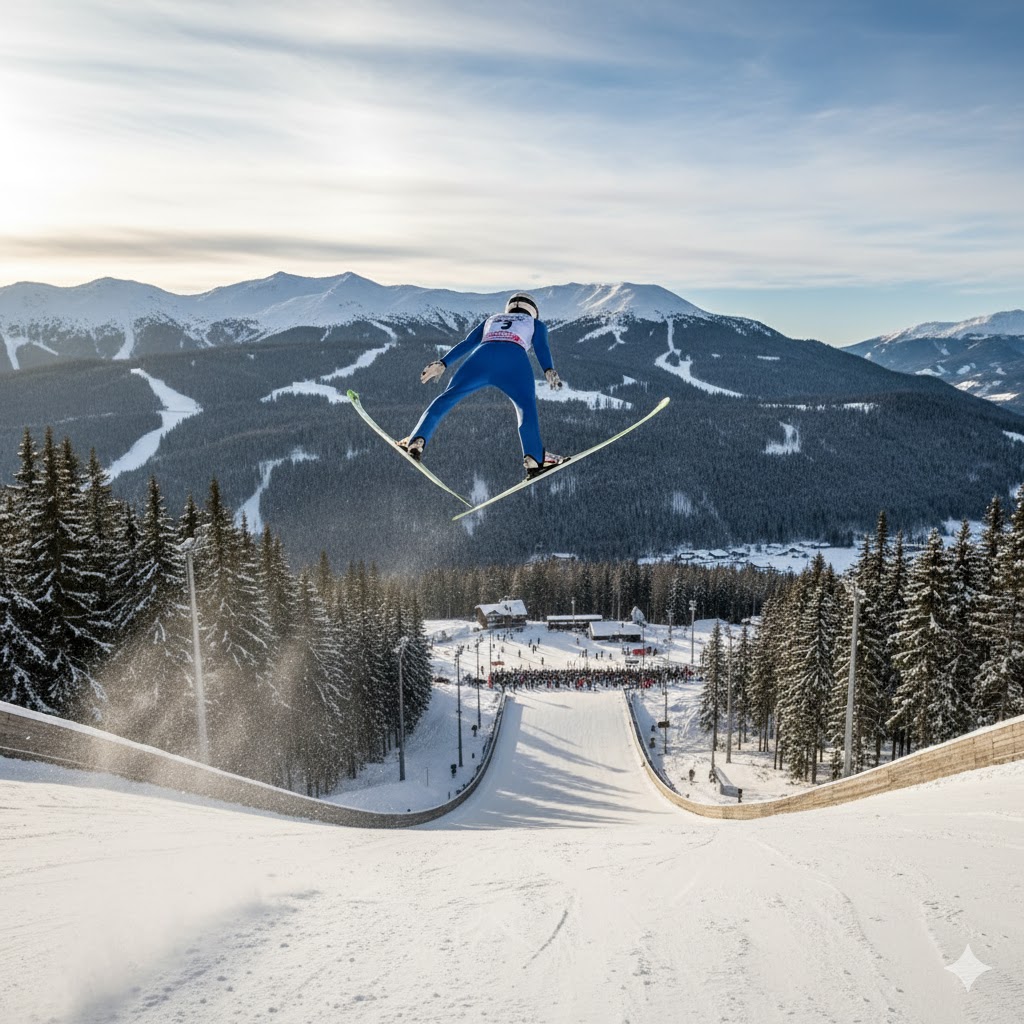
The story of Ski Jumping begins in Norway during the 19th century. The first recorded competition took place in 1808 when Norwegian lieutenant Olaf Rye amazed onlookers by leaping 9.5 meters through the air. This display of athletic daring marked the unofficial birth of the sport. Soon, Norwegians across the country began experimenting with similar feats, transforming simple snow play into organized competition.
By the late 1800s, the sport had grown immensely popular in Scandinavia. The first major organized competition was held in 1862 in Trysil, Norway. A decade later, the sport expanded when Sondre Norheim, often called the “father of modern skiing,” helped popularize techniques that made longer jumps possible. His innovations in ski design and jumping form revolutionized the sport, allowing athletes to gain more control and distance.
In 1892, the world-famous Holmenkollen Ski Festival was established in Oslo, Norway. This event became a cornerstone of Ski Jumping culture and remains one of the most prestigious competitions in the world. The festival drew competitors and spectators from across Europe, helping spread the sport internationally.
Ski Jumping reached North America in the early 1900s, brought by Scandinavian immigrants who settled in states like Wisconsin and Minnesota. They built early jumps from wooden scaffolds and snow ramps. Local competitions quickly gained popularity in cold-weather regions of the United States and Canada. By 1924, Ski Jumping was included in the first Winter Olympic Games in Chamonix, France, solidifying its place as a premier winter sport.
Throughout the 20th century, new technologies improved safety, distance, and performance. The introduction of inrun tracks, steel bindings, and aerodynamic suits pushed athletes to greater heights. By the 1950s, television broadcasts began to show Ski Jumping to audiences around the world, transforming it into a visual spectacle. The introduction of the V-style technique in the late 1980s by Swedish jumper Jan Boklöv changed the sport forever. His innovative method of spreading skis into a “V” shape during flight allowed for longer and more stable jumps, and soon became the global standard.
Today, Ski Jumping is a hallmark of the Winter Olympics and a beloved winter sport in many nations. Its combination of skill, bravery, and beauty has made it an enduring favorite among athletes and fans alike.
Global Popularity
Ski Jumping is most popular in countries with cold climates and a rich skiing tradition. Norway, Finland, Germany, Austria, Slovenia, and Japan stand out as leading nations in both participation and achievement. These countries maintain professional training facilities, national teams, and annual competitions that attract huge crowds.
Norway and Austria are often considered the heart of the sport. Both nations have produced countless world champions and Olympic medalists. Fans in these countries follow Ski Jumping with the same enthusiasm others reserve for football or basketball. Massive crowds attend winter tournaments, especially those that are part of the FIS World Cup circuit.
In Central Europe, Ski Jumping has become part of national culture. Germany and Poland, for example, host some of the largest events each year, such as the Four Hills Tournament. Tens of thousands of spectators gather to cheer their favorite jumpers, waving flags and chanting as athletes soar down the hills. Poland’s Adam Małysz and Germany’s Sven Hannawald remain national heroes for their achievements in the sport.
Japan has a long and proud history of Ski Jumping excellence as well. The country’s first ski jump was built in 1911 in Sapporo, and Japan has hosted numerous international competitions since. Japanese jumpers like Kazuyoshi Funaki and Ryoyu Kobayashi have become icons of the sport, inspiring younger generations throughout Asia.
In North America, Ski Jumping maintains a smaller but passionate following. The United States and Canada both have national programs that compete internationally. The Lake Placid Olympic Jumping Complex in New York and the Canada Olympic Park in Calgary are two of the continent’s key training centers. Although the sport does not attract massive television audiences in these regions, it remains an important part of winter sports culture.
Eastern Europe has also embraced Ski Jumping, with strong programs in countries like Poland, Slovenia, and the Czech Republic. These nations consistently produce world-class athletes who challenge traditional powerhouses.
Even in countries without snowy winters, indoor Ski Jumping simulators and artificial training facilities have made the sport more accessible. This global reach shows the dedication of fans and athletes who continue to push the sport forward.
Amateur Ski Jumping: Youth and School Involvement
Amateur Ski Jumping serves as the foundation of the sport’s future. Across the world, young athletes begin training as early as five or six years old. Many local ski clubs offer youth programs designed to teach technique, safety, and confidence on the slopes.
In Norway, Finland, and Austria, youth development programs are exceptionally strong. These countries have small training hills that allow children to practice jumping safely. Coaches emphasize proper posture, takeoff control, and landing form long before encouraging distance. Safety equipment such as helmets, suits, and bindings are strictly enforced from the start.
Schools in these regions often integrate Ski Jumping into physical education programs, especially in snowy regions. This integration allows more children to experience the thrill of flight and develop foundational skills early. Local and regional competitions provide motivation and exposure for young talent.
In the United States, ski clubs in states like Wisconsin, New Hampshire, and Minnesota maintain youth leagues. Events such as the Junior National Championships help identify promising athletes. These competitions are organized by governing bodies like the U.S. Ski & Snowboard Association, ensuring consistent standards across programs.
Amateur Ski Jumping also thrives in Japan, where local sports schools and ski academies develop future champions. Training is rigorous, focusing on both mental and physical preparation. Athletes learn the importance of balance, timing, and discipline from a young age.
The sense of community is a defining characteristic of amateur Ski Jumping. Parents, coaches, and volunteers play essential roles in maintaining training facilities and organizing events. This grassroots involvement helps sustain the sport’s tradition and ensures new generations continue to take flight.
Professional Leagues and Competitions
At the professional level, Ski Jumping is governed by the International Ski and Snowboard Federation (FIS). The FIS World Cup represents the highest level of competition, featuring events across Europe, Asia, and North America. The season typically runs from November to March, culminating in a World Cup champion based on accumulated points.
The Four Hills Tournament, held annually in Germany and Austria, is among the most prestigious events in the sport. Athletes compete at venues in Oberstdorf, Garmisch-Partenkirchen, Innsbruck, and Bischofshofen. Winning all four stages is a rare and celebrated achievement.
The FIS World Championships, held every two years, determine world champions in individual and team events. Meanwhile, the Winter Olympics stand as the ultimate stage for Ski Jumping excellence. Olympic medals in the sport are some of the most prestigious honors in all of winter sports.
Other professional circuits include the Continental Cup and the FIS Cup, which serve as stepping stones for athletes aspiring to reach the World Cup. These competitions allow emerging jumpers to gain international experience and exposure.
Women’s Ski Jumping has seen significant growth in recent decades. Though women faced long struggles for inclusion, the first Olympic women’s event was finally held in Sochi in 2014. Since then, female athletes have gained recognition and equality, competing in the same prestigious tournaments as men.
Professional jumpers receive admiration not only for their skill but for their courage. Each leap demands both physical mastery and mental toughness. Their performances inspire millions and push the boundaries of what is possible in human flight.
Political and Social Significance
Ski Jumping holds unique political and social importance, especially in nations where it symbolizes pride, unity, and national identity. In Norway, the sport is viewed as a reflection of the country’s close relationship with snow, nature, and adventure. Victories in international competitions foster a sense of national pride that transcends sports.
During the Cold War, Ski Jumping took on additional political symbolism. Eastern and Western bloc countries often viewed athletic success as proof of national superiority. Athletes from countries like East Germany and the Soviet Union received extensive support as part of broader political rivalries.
In Japan, the sport has contributed to national prestige and tourism. Hosting major events like the 1972 Sapporo Olympics boosted both national pride and economic growth. Today, Ski Jumping continues to be a symbol of perseverance and excellence.
The sport also promotes social unity. Fans from different regions gather at events to cheer together, waving flags and singing national anthems. This shared enthusiasm fosters a spirit of international friendship and respect. Despite fierce competition, athletes often display mutual admiration, shaking hands and celebrating each other’s achievements.
Ski Jumping also plays a social role in promoting youth health and outdoor activity. Programs encouraging children to ski and jump contribute to physical fitness and community engagement. In many areas, local ski clubs serve as social hubs where generations come together to share passion and knowledge.
Gender equality has been a key social issue within the sport. For many years, women were excluded from top competitions, facing arguments about safety and suitability. Persistent advocacy from female athletes eventually led to equal recognition. Their inclusion has strengthened the sport and inspired broader conversations about fairness in athletics.
Environmental awareness has also entered the conversation. Ski Jumping events increasingly emphasize sustainability, with efforts to reduce waste, conserve energy, and preserve mountain ecosystems. These initiatives reflect the sport’s connection to nature and its responsibility toward future generations.
The Rules of Ski Jumping
Understanding the rules of Ski Jumping reveals the precision behind the spectacle. Competitors are judged on both distance and style. Each jump consists of four main phases: inrun, takeoff, flight, and landing.
The inrun begins at the top of a steep ramp called the takeoff hill. Jumpers crouch low to minimize air resistance as they gain speed. At the edge of the ramp, they leap forward into the air, beginning the flight phase.
During flight, athletes assume an aerodynamic position, with skis spread in a “V” shape and bodies leaning forward. The goal is to maximize lift and stability while maintaining control. Judges and sensors measure the distance from the takeoff point to the landing spot, known as the “K-point.”
Landing is a critical aspect of scoring. Athletes aim to land smoothly with one ski slightly ahead of the other in a telemark position. This stance demonstrates balance and control. Any stumble or fall results in significant point deductions.
Scoring combines distance points with style points awarded by five judges. The two highest and two lowest style scores are discarded, and the remaining score is added to the distance score. Wind and gate compensation factors are applied to ensure fairness, as conditions can greatly affect flight distance.
Competitions typically consist of two rounds. The top 30 jumpers from the first round advance to the second. The athlete with the highest combined score wins the event. Team competitions follow similar rules, with the total of all team members’ scores determining the result.
Safety remains a priority. Athletes must wear aerodynamic suits, helmets, goggles, and gloves. Ski lengths are regulated based on body weight and height to prevent unfair advantages. Strict regulations govern hill sizes as well. Normal hills, large hills, and ski flying hills each require different techniques and produce varying distances.
Training for these jumps involves intense focus on strength, agility, and timing. Jumpers practice balance on dry-land simulators and use harness systems for controlled air training. The physical and mental preparation required for competition is immense.
The Enduring Appeal of Ski Jumping
Ski Jumping remains one of the most captivating sports in the world. Its blend of technical skill, athletic beauty, and human daring continues to attract audiences across continents. The sight of an athlete soaring silently through the winter air embodies freedom, courage, and grace.
Modern technology has only increased its appeal. High-definition broadcasts, drone footage, and instant replays allow fans to experience every moment of a jump. Social media now connects athletes with fans, spreading inspiration and fostering a global community.
The sport’s challenge continues to attract young athletes. They dream of standing atop icy ramps, staring down at the slope below, and feeling the rush of flight. For them, Ski Jumping is more than a competition—it is a way to defy gravity, overcome fear, and experience true exhilaration.
In the end, the sport reflects the human spirit’s endless desire to rise above limits. From the snowy hills of 19th-century Norway to the massive modern arenas of today, Ski Jumping continues to evolve while honoring its roots. It brings nations together, celebrates courage, and reminds us all that even in winter’s coldest air, there is beauty in flight