Introduction
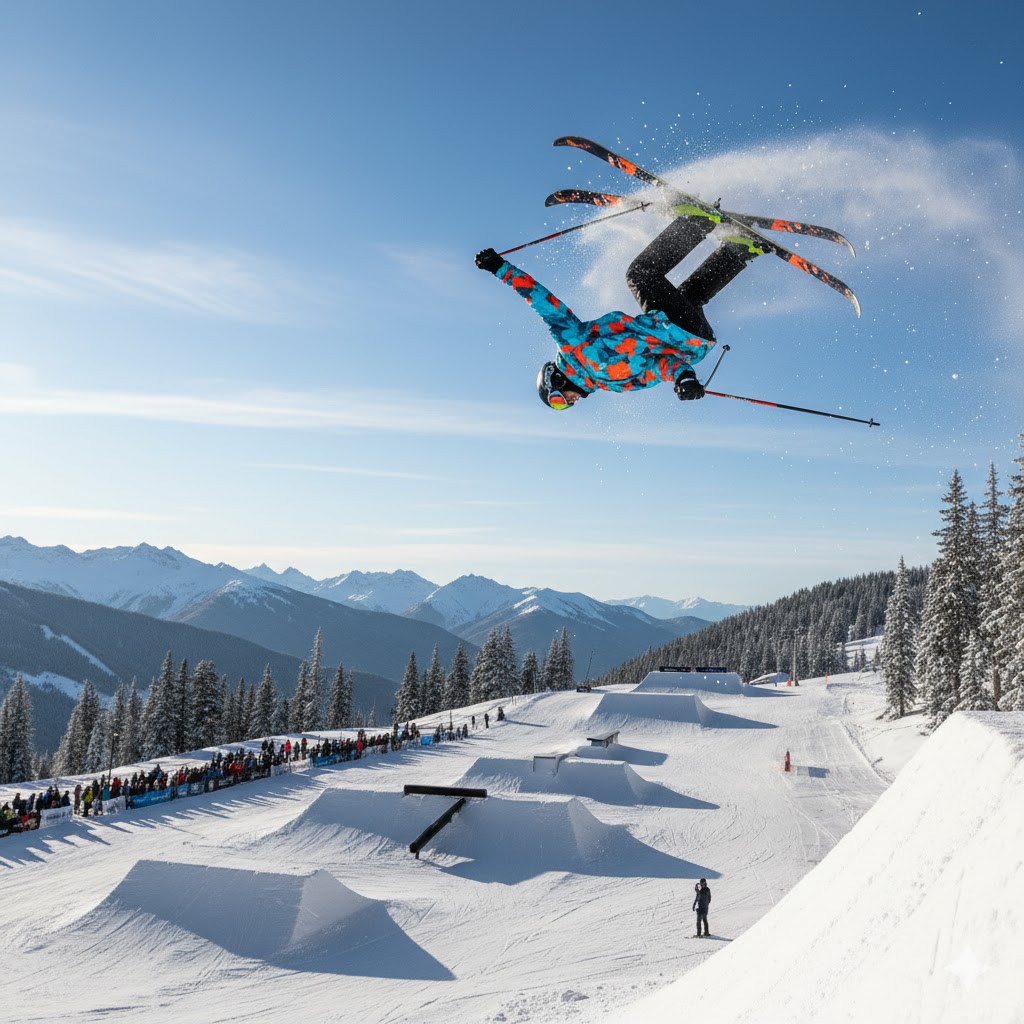
The world of Skiing Slopestyle sparks excitement and creativity on the snow. From rails and jumps to terrain-park style obstacles, the sport combines aerial tricks with technical flow. In this blog post I’ll explore the full story of Skiing Slopestyle: its origin and history, global popularity, how amateurs (youth and school levels) engage, the major professional leagues around the world, its political and social significance, and a detailed run-through of the rules.
Origin and History of Skiing Slopestyle
The roots of Skiing Slopestyle lie in broader freestyle skiing which itself began as stunt skiing in the early 20th century. In the 1950s and 1960s, skiers began incorporating acrobatic moves and jumps in exhibitions.
In Canada, for example, organized freestyle skiing took shape when the Canadian Freestyle Ski Association (CFSA) was founded in 1974. The governing body for skiing globally, International Ski Federation (FIS), recognised freestyle skiing as a discipline in about 1979.
As the terrain-park environment developed, skiers and snowboarders started to create courses with rails, boxes, jumps and other park features. The term “slopestyle” was adopted to describe a downhill run over a series of “style” elements: rails, jumps, boxes, obstacles. The word comes from “slope” (descent) + “style” (free expression).
Competitive slopestyle began to emerge in the 1990s. One source says competitive slopestyle started in 1997. By the early 2000s slopestyle events were appearing in major action-sports festivals. For example, a Red Bull article tracks “30 years of progression” in slopestyle.
The major milestone came when slopestyle skiing was entered into the Olympic programme for the first time in the 2014 Winter Olympics in Sochi, Russia. Since then the discipline has grown rapidly in the world of Freeski (freestyle skiing) events.
Thus, the trajectory went from informal stunt skiing → freestyle exhibitions → terrain-park features → formal slopestyle competitions → Olympic status. Along the way course design and judging criteria evolved significantly. For example, the FIS introduced a new judging system that evaluates each feature on the course (rails, jumps) in addition to overall impression.
Popularity of the Sport Globally & Where It Is Played
Today, Skiing Slopestyle enjoys considerable popularity worldwide. It appeals because of its mix of creativity, style and technical athleticism. Many ski resorts now include terrain parks with rails, boxes and jumps, and slopestyle competitions appear at national, continental and international level.
In North America (United States and Canada) terrain-parks are common in ski resorts, and slopestyle is a featured event at the X Games and other big action-sports gatherings. In Europe countries such as Switzerland, Austria, Sweden and Norway actively develop freeski athletes in slopestyle. For example, the Swedish athlete Jesper Tjäder is a major slopestyle competitor.
In Asia, while alpine skiing has been more traditional, freeski disciplines including slopestyle are gaining traction, especially with the Winter Olympics in Korea (2018) and China (2022) raising awareness. Many ski resorts in Japan, South Korea and China include terrain parks designed to host slopestyle-style runs. The FIS rulebook for international freestyle/freeski lists homologation guidelines globally.
In Oceania and the Southern Hemisphere, ski resorts in Australia and New Zealand also feature terrain parks and host slopestyle events, though the seasons are opposite to the northern hemisphere. Thus the sport enjoys year-round interest via hemispheric alternation.
The global popularity is further reinforced by the Olympic staging and media coverage. The inclusion of slopestyle skiing in the Olympics in 2014 gave it a boost internationally.
As a result, many ski resorts now use terrain-parks not just for recreational shredding but as training grounds for slopestyle. This means participants of all levels, from amateurs to professionals, can engage in slopestyle activity across continents.
Amateur Play: Youth, Schools, and Entry-Level Slopestyle
Amateur participation in Skiing Slopestyle has expanded significantly in the last decade. Youth ski clubs, school ski teams, and regional development programmes include slopestyle as part of their training curricula.
In many countries, ski academies and club programmes teach young athletes terrain-park fundamentals, rail-rides, small jumps and basic grabs/spins. These progression steps lead into slopestyle runs. Recreational terrain parks provide a safe environment for this practice.
Schools near ski resorts sometimes incorporate slopestyle into their winter sports programmes. For example, ski-and-snowboard schools may run learning modules focused on boxes, rails and jumps in a controlled terrain-park. These modules build confidence for young skiers to attempt slopestyle style elements.
Youth competition circuits exist in many countries. For instance, the U.S. guide for freestyle/freeskiing covers slopestyle among other disciplines in youth and junior nationals. Those young athletes get exposure to slopestyle format: qualifying rounds, finals, judged runs. Through this, a pathway to national teams and international events is created.
In club-level and local events, rules are often modified to reduce risk: smaller jumps, gentler rails, mandatory helmets, and age-appropriate gear. Safety protocols emphasize progression rather than extreme tricks. The emphasis is on fun, development and style rather than elite performance.
For many recreational participants the goal is to enjoy the terrain-park and attempt fun slopestyle lines with friends. Thus slopestyle fosters a culture of creativity and expression—valuable especially for youth engagement.
Schools and ski clubs often use slopestyle as a gateway discipline to attract younger skiers. Because it blends elements of skateboard/BMX style trick culture with skiing, it resonates with teenagers and younger demographics. This trend helps drive resort investment in terrain-parks and slopestyle training zones.
In summary, amateur Skiing Slopestyle is accessible, fun, and developmental. Youth and school programmes worldwide adopt it to engage participants, refine technique and create a pipeline into the more serious competition world.
Professional Leagues Globally Associated With the Sport
At the professional level, Skiing Slopestyle features in several major event series and leagues globally. The governing body FIS runs World Cup events in Freeski Park & Pipe (which include slopestyle) and hosts the FIS Freeski World Championships.
Specifically, the FIS calendar lists World Cups for freeski / park & pipe disciplines. Countries host stops of the World Cup and athletes accumulate points toward a crystal globe.
The inclusion of slopestyle in the Winter Olympics adds huge prestige. Since 2014, skiers compete for Olympic medals in men’s and women’s slopestyle.
In North America, events like the X Games (for skiing and snowboarding) include slopestyle freeski events. These events attract top professionals and major sponsorship deals. There are also regional professional tours such as NorAm (North American Cup) and Europa Cup for Europe that feed into World Cup qualification.
Furthermore, many resorts host big slopestyle festivals (often with prize money) which create opportunities for independent professional athletes and media exposure. These festivals sometimes operate outside formal league structures but play a big role in athlete branding and growth.
Athletes who perform strongly in slopestyle can secure sponsorships, media appearances and often crossover into snowboard slopestyle or big air events, broadening their professional portfolios. The commercial aspect (brands, gear, filming) is strong in slopestyle due to its visually exciting tricks.
Each professional leg uses a format: qualification rounds, finals; judged runs; overall series standings. The judging systems use criteria such as progression, amplitude, variety, execution, difficulty (often abbreviated PAVED in commentary).
In short, the professional landscape of Skiing Slopestyle is wide-reaching: Olympic, World Cup, X Games, regional circuits, and independent festival tours. The sport now supports full professional athlete careers, brand partnerships and media content.
Political and Social Significance
The sport of Skiing Slopestyle carries noteworthy political and social significance. On a social level, it appeals to younger generations and urban-style action sports fans. It helps ski resorts diversify beyond traditional alpine racing and family runs, encouraging terrain-parks, trick styles and creative zones. That shift reflects broader cultural trends in youth sports: emphasis on self-expression, creativity, lifestyle as well as competition.
Politically, inclusion of slopestyle in the Olympics reflects the push by international sport bodies to modernise and attract younger audiences. The decision to add slopestyle skiing (and snowboarding) in 2014 demonstrated that the governing bodies prioritise disciplines with broader appeal and media value.
On a national level, countries seeking winter-sports relevance invest in freeski infrastructure (including slopestyle terrain-parks) to nurture talent and national pride. For example, nations that traditionally focused on alpine racing now allocate resources to freeski and slopestyle to diversify medal potential.
There is also a social-inclusion dimension. Terrain-parks and slopestyle style skiing often draw participants who might not have followed classical ski racing. The mix of skate/BMX culture with skiing opens the sport to non-traditional backgrounds. Thus slopestyle can serve as a vehicle for widening participation in skiing, especially among youth, minorities or urban populations who may find conventional ski racing less accessible.
Environmentally and economically, ski resorts adding terrain-parks and slopestyle zones stimulate winter tourism and youth engagement, which helps local mountain communities. Politically, the growth of freestyle skiing disciplines including slopestyle supports mountain-region economies and encourages local government investment in snow sport infrastructure.
Further, the sport’s media appeal (videos, social platforms, sponsorship) contributes to the branding of winter sports as modern, exciting and youth driven—this has political implications in terms of sports funding, tourism strategy and national sporting identity.
In sum, Skiing Slopestyle is more than just a discipline — it links youth culture, tourism, national sport strategy and social inclusion in meaningful ways.
Rules of Skiing Slopestyle
Now let’s dive into a detailed look at how Skiing Slopestyle is run and judged. The rules vary somewhat between organising bodies (e.g., FIS, national bodies) but the core structure remains similar.
Course and Format
A typical slopestyle course includes a sequence of features: rails (boxes, rails, pipe sections) and jumps (kickers). According to the Olympic freeski slopestyle guide, a course must have at least six sections and at least three jumps. There must be multiple lines (at least two) that athletes may choose between.
Runs typically begin at the top of the terrain-park course. Skiers may drop in, follow the line, hit rails and boxes, launch off jumps, perform tricks and land clean, then ski to the finish. Usually athletes have two or three timed runs; the best score counts. Qualifying rounds may reduce the field to finals.
Equipment and Safety
Though rules differ, helmets are mandatory in most sanctioned events. In youth programmes, smaller features are used and jump sizes are scaled for safety. The official rulebook emphasises body position, form breaks, tuck/pike/ layout positions, etc. Skis used are often twin-tip (allowing switch landings/backwards) and terrain-park boots compatible with park features.
Judging Criteria
Judges score each run against set criteria. In many professional events the criteria include: progression (new tricks), amplitude (height/air), variety (different features/tricks), execution (clean landings), difficulty (technical level) — sometimes remembered by the acronym PAVE-D or “PAVED”.
For each feature (rail/box/jump) judges may evaluate the trick independently in some systems: e.g., FIS introduced a system where each feature is individually judged rather than just a holistic impression.
Scoring is often on a 0-100 scale or similar. The highest scoring run wins. Some youth/amateur events adopt simpler or scaled scoring systems.
Run Structure, Finals, and Scoring
In many major events, qualifying is held first; skiers typically get two runs, best counts, top-X move to finals. In finals, again skiers may get two or three runs and the best run determines medal or placings.
Course inspectors and jury ensure the features meet homologation standards (jump angles, take-off geometry, landing slopes, rail profiles). The jury also handles tie-breaks and protests (see rulebooks).
Disqualifications and Form Breaks
Competitors may be disqualified for missing mandatory features, not completing the course, using prohibited equipment, or failing safety requirements (helmets, bindings etc). The rulebook discusses form breaks: minor, medium and major; correct body position is defined (layout, tuck, pike) and deviation can reduce score.
In slopestyle, clean landings (no hand touches, no falls) are critical. Rail slides must maintain control; jump landings require stability and flow into the finish. Varied trick selection helps avoid repetition penalties.
Specific Feature Rules
- Jumps: Take-off must be from an authorised kicker. Landing zone must meet angle and length criteria. The athlete must land and continue skiing without pause.
- Rails/Boxes: Approaches must be completed in control. Slide, grind or other rail trick is judged on style, control, exit.
- Line choice: Athletes often choose among different feature lines; judges expect strategic use of course.
- Best run counts: Usually only the best of multiple runs counts. Some events may discard the worst run.
- Score breakdown: In FIS slopestyle, each section may receive a sub-score; overall impression counts for large portion of final.
Summary of Key Rules
- Course must contain minimum features (e.g., six sections, at least three jumps).
- Athletes perform one line descending the course with rails/boxes/jumps in one continuous run.
- Multiple runs allowed; best run wins.
- Judging uses criteria: progression, amplitude, variety, execution, difficulty.
- Equipment and safety standards must be met (helmet, course homologation, approved skis/boots).
- Disqualifications for falls, missed features, equipment infractions.
- Form and body positions defined; form breaks penalise score.
Why Skiing Slopestyle Matters
Beyond the thrill and spectacle, Skiing Slopestyle matters in multiple ways. It serves as a bridge between traditional skiing and action sports culture. Its youth appeal helps ski resorts and national federations remain relevant to new generations. The sport promotes creativity, risk-management skills, style and personal expression. It also helps multiply winter sports participation and open up pathways for younger athletes.
On the professional side, slopestyle offers media-friendly content (big airs, rails, trick combos) which helps promote skiing to broader audiences. That has implications for tourism, resort investment and winter-sport economies. Politically, by being included in major international events (Olympics, World Championships) it helps shape national sport strategies, funding and resource allocation.
Socially, slopestyle connects with urban youth, action-sports culture and cross-discipline athletes (skate/skatepark backgrounds). That crossover potential fosters broader participation and diversity. This social dimension helps skiing as a sport evolve beyond the old model of alpine racing only.
Thus, Skiing Slopestyle is a dynamic force in winter sports—one that drives innovation, engages youth, supports mountain-economies, and enriches the sporting ecosystem globally.
Conclusion
In this blog post I’ve covered the full panorama of Skiing Slopestyle: from its roots in freestyle skiing, to global popularity, its presence at amateur youth and school levels, the professional leagues and competitions, the political and social significance, and finally the detailed rules. As ski resorts continue to invest in terrain-parks and national federations push for freeski growth, Skiing Slopestyle stands poised to grow further in the coming years. Whether you’re a young aspirant, a recreational skier, or a spectator of high-flying competition, slopestyle offers a thrilling blend of skill, creativity and style. Enjoy the ride—and maybe hit a rail or two!