
Introduction
When I first discovered the world of Sledge Hockey, I was immediately drawn to its intensity and spirit. This fast-paced version of ice hockey wrestles with barriers and redefines what “adaptive sport” means. Players sit on specially designed sleds and propel themselves across the ice with two sticks. The key phrase here — Sledge Hockey — appears because it signals the unique nature of the sport. In the paragraphs that follow, I’ll explore the origin and history of the sport, delve into its global popularity, look at how amateur levels operate (including youth and schools), examine professional leagues around the world, discuss its political and social significance, and lay out the rules of Sledge Hockey in detail. Let’s get started.
Origin and History of Sledge Hockey
The story of Sledge Hockey begins in the early 1960s at a rehabilitation centre in Stockholm, Sweden. A group of physically disabled athletes refused to give up the sport they loved — ice hockey — and so they invented a way to keep playing. They mounted two skate blades under a metal frame (a “sled” or “sledge”) so that the puck could pass underneath. They also used two sticks with metal “picks” at one end for propulsion and blades at the other for puck handling.
By around 1969, this new game had grown enough in Stockholm to support a five-team league involving both disabled and able-bodied players. The first international match took place in Stockholm that same year against a team from Oslo, Norway.
In the 1970s and 1980s, the sport spread: teams appeared in Great Britain in 1981, Canada in 1982, and what would become the United States in 1990. The demonstration of Sledge Hockey at the 1976 Winter Paralympics in Örnsköldsvik, Sweden, marked the sport’s first appearance on that major stage, albeit in exhibition form.
Then in 1994 at the Winter Paralympics in Lillehammer, Norway, Sledge Hockey became an official medal sport. From that moment, the sport has grown dramatically in terms of competitiveness, global reach, and recognition.
Equipment and style of play have evolved since those early days. The sleds have become lighter, more durable, and tailored to the athlete. Picks and sticks are refined. Overall gameplay has moved closer to the speed and physicality of stand-up ice hockey.
Thus, the history of Sledge Hockey spans from a small rehabilitation centre innovation in Sweden to a globally played, highly competitive adaptive sport.
Global Popularity and Where It Is Played
Today, Sledge Hockey enjoys significant global popularity, especially within the Paralympic movement. Countries across Europe, North America, and Asia field national teams and maintain domestic leagues or club programs. The major powerhouses include the United States and Canada, both of which consistently medal at major international events.
In Europe, nations such as Sweden, Norway, Great Britain, Estonia, and others have participated for decades. Sweden, the country of origin, laid the groundwork and still maintains strong programs. In Asia, Japan fields teams, and more countries are developing infrastructure.
Participation numbers at the Winter Paralympics reflect this global reach: in 1994, five countries competed, while by 2014, the number had grown to eight. The sport is also accessible in many local communities, particularly in countries with cold climates and established ice-hockey traditions. Schools, local clubs, and adaptive sport organisations often host “learn to play” sessions for Sledge Hockey.
While the sport remains most concentrated in countries with ice-hockey culture, its growth trajectory is upward. The fact that many national ice hockey federations now include Sledge Hockey under their umbrella further broadens its reach. For example, in Canada, the national federation formally recognised “para hockey” (i.e., Sledge Hockey) as a national sport component in 1993.
Typically, arenas that already host ice hockey can accommodate Sledge Hockey with moderate adjustments such as sled-accessible benches. This lowers the barrier to adoption and enhances the sport’s global viability.
In short, Sledge Hockey is played broadly across continents, at club, school, and national levels. Its popularity is rooted in inclusion, high-intensity competition, and the fact that it offers physically disabled athletes a thrilling athletic experience parallel to stand-up ice hockey.
Amateur Play: Youth, Schools, and Grassroots
Amateur Sledge Hockey constitutes a vital part of the sport’s ecosystem. Many local clubs operate programs for beginners, youth, schools, and recreational players. These programs are essential to both athlete development and broader inclusion. Adaptive sport organisations note that Sledge Hockey increases upper-body strength, coordination, and fosters community for players with lower-body physical impairments.
At the youth level, children as young as elementary or middle-school age can participate in introductory clinics. Schools with inclusive sport programs sometimes integrate Sledge Hockey as part of physical education or adaptive sport modules. The key is that the equipment — the sled and two sticks — and rink modifications allow the game to approximate “regular” hockey in feel, making it engaging and authentic.
Many amateur leagues include mixed-ability participants. Although official classification systems may apply only at elite levels, at the local level recreational Sledge Hockey is open to individuals with a permanent lower-body disability as well as able-bodied participants in some inclusive formats.
Typical structure of amateur play: teams consist of up to six players on the ice (including goalie), similar to stand-up hockey, with substitutions, line changes, and periods of play scheduled much like the adult-competitive game. In some jurisdictions, youth games may use shorter periods or smaller ice surfaces. Equipment is adapted — sleds sized for younger players, sticks adjusted for length and pick design. Coaching emphasises skating via the sled, puck handling, teamwork, and game sense.
Schools and youth programs benefit from Sledge Hockey because it fosters resilience, teamwork, and gives students with disabilities a chance to play a high-level sport rather than a purely recreational activity. It also raises awareness among peers, promoting inclusion. In many communities, “try-hockey” days or “learn to sled hockey” clinics are used to recruit athletes, volunteers, and build local programs.
To summarise: amateur Sledge Hockey is structured, inclusive, and growing. Youth players and school programs are increasingly involved. The sport serves both competitive aspiration and broader social inclusion.
Professional Leagues and Competitive Structure Globally
While Sledge Hockey is most visible at the national team and Paralympic levels, it also includes competitive leagues and championships across the globe.
At the international level, the governing body World Para Ice Hockey manages the sport’s regulations and world championships. The first official world championship occurred in 1996 in Sweden.
National programs compete at major events such as the Paralympics and biennial or quadrennial world championships. The United States and Canada are perennial contenders, while European nations like Norway, Italy, and the Czech Republic have fielded strong teams.
On the domestic side, countries like the United States host national championships for sled hockey clubs, including adult and youth levels. In Canada, the sport is governed under the umbrella of its national hockey federation, with national-level development formalised since the early 1990s.
Although there are comparatively fewer fully professional leagues — meaning athletes paid full-time salaries — than in mainstream ice hockey, there exists a tiered competitive model: local club leagues feed into regional and national competitions, which in turn feed into international championships. Some players compete full-time, supported by their national programs. Many national teams offer stipends or athlete funding, especially in countries with strong para sport frameworks.
In Europe and Asia, national championships and club tournaments exist. Great Britain’s national association supports domestic competition and development. Because the sport requires specialised equipment and rink access, growth of domestic professional leagues is slower but steady.
The focus remains on high-performance international competition rather than large commercial leagues. Nevertheless, for elite athletes the pathway is well-established: club → domestic league → national team → world championships/Paralympics.
Political and Social Significance
The sport of Sledge Hockey carries substantial political and social significance. From a social perspective, it represents inclusion, empowerment, and a challenge to stereotypes. Athletes with physical disabilities participate in a high-contact, high-speed team sport that mirrors mainstream ice hockey in intensity. That sends a strong message: disability does not equal inability.
Programs in local communities that offer Sledge Hockey allow children and adults with disabilities to access sport, build friendships, develop skills, and expand social networks. The visibility of Sledge Hockey promotes adaptive sport as a serious competitive field. Organisations use it to advance broader societal goals of accessibility, equity, and anti-discrimination.
Politically, Sledge Hockey is linked to the global disability rights movement and national sport policy. Governments and sport federations often allocate funding to adaptive sport programs, including Sledge Hockey. The presence of the sport at the Paralympics means that national Olympic and Paralympic committees and their governments pay attention — medals and representation are politically symbolic. Nations invest in training, infrastructure, and athlete development to increase Paralympic success, which in turn raises national prestige and demonstrates commitment to inclusive sport.
Moreover, Sledge Hockey acts as a bridge between disability sport and mainstream sport. When ice hockey federations integrate Sledge Hockey as part of their wider programs, they signal institutional support for athletes with disabilities. That has ripple effects: improved rink accessibility, coach education, equipment subsidies, and greater integration of adaptive sports within youth development programs.
On the international level, the sport contributes to the global dialogue about sport participation for people with disabilities. It demonstrates what adaptive sport can achieve and underscores the importance of equal competition opportunities. In countries where Sledge Hockey is less developed, the sport can be used as a tool for advocacy — improving ice-sports access for people with disabilities, shifting cultural perceptions, and influencing disability policy.
Finally, on a personal level for athletes, the sport enables identity, achievement, and autonomy. For many participants, being part of a team and competing at high levels is transformative. This has ripple effects for employment, education, and community inclusion. In sum, politically and socially, Sledge Hockey resonates far beyond the rink.
Rules of Sledge Hockey
Basic Setup
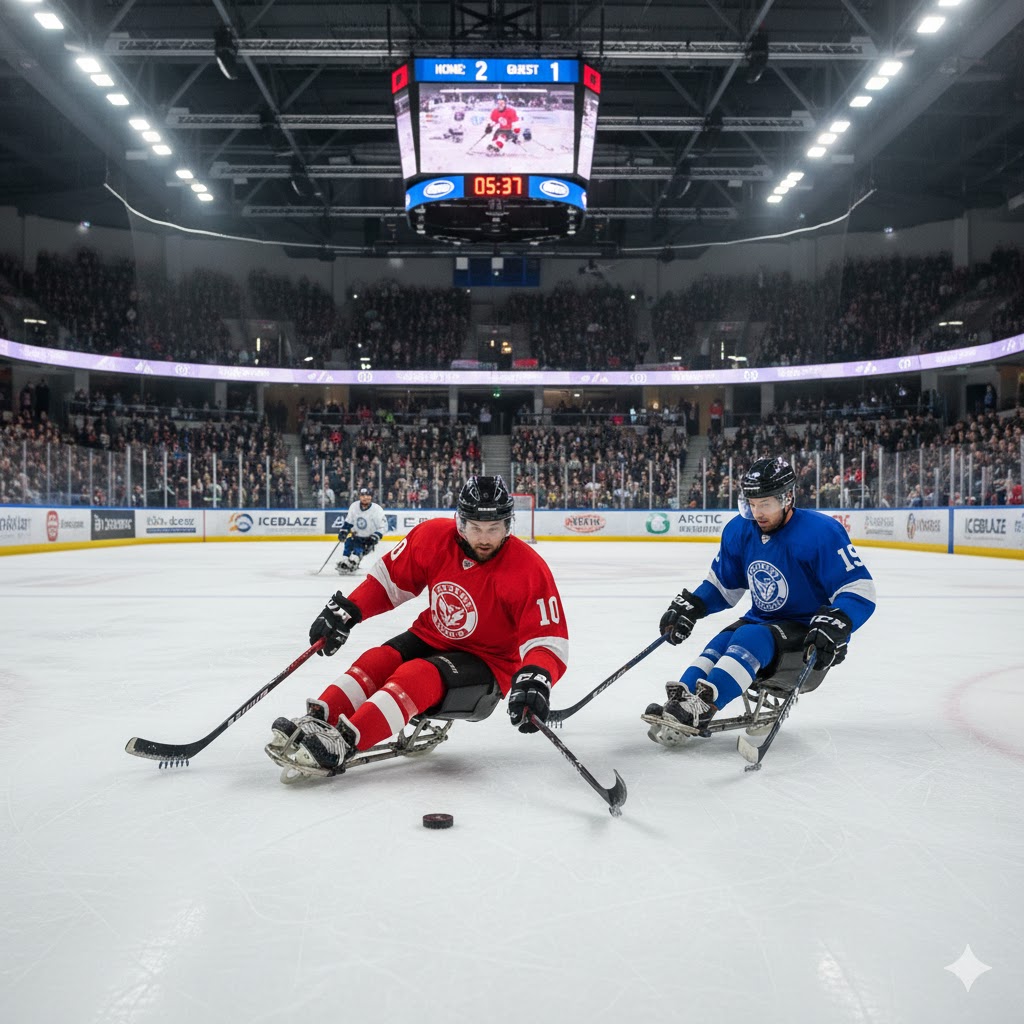
Each team fields six players on the ice at one time: five skaters plus one goalie. The game is played on a standard ice-hockey rink with regulation line markings, goals, and pucks. Players sit in sleds (also called sledges) mounted on two skate blades; the puck must be able to pass beneath the sled. Each player uses two sticks — one in each hand. One end of the stick has a metal pick used to propel the sled across the ice; the other end has a blade for puck handling and shooting.
Equipment
Sleds are made of aluminium or steel, with blades about three millimetres thick. The height above the ice ranges between eight and ten centimetres. Sticks measure up to one metre, with a blade end up to thirty-two centimetres long. Protective gear includes a helmet with a full cage or mask, shoulder and elbow pads, gloves, and a neck guard. Goalies often use modified sleds and gloves suited for mobility and blocking.
Game Periods and Play
Games consist of three periods — typically fifteen to twenty minutes each. Substitutions can be made on the fly or during stoppages. Checking is permitted, keeping the sport full contact and competitive.
Specific Rules and Differences
Offsides are judged using the sled’s blades. Icing is similar to stand-up hockey, but certain youth leagues may adjust this rule. Face-offs occur in the standard circle locations, and referees drop the puck closer to the ice for accessibility.
Penalties mirror those in traditional hockey — holding, tripping, and high-sticking — but there are some unique infractions. “T-boning,” when one sled’s front impacts another’s side, results in major penalties. Picks must never damage the ice or another player. Falling on the puck to delay the game is also penalised.
Bench accessibility is crucial. Sled-accessible rinks provide ramps or flush benches so players can enter and exit the ice safely.
Gameplay Flow and Strategy
Players propel themselves using the pick ends of their sticks, transitioning quickly to blade use for puck control. Because backward skating is limited, defensive players rely on tight angles and anticipation. The sport demands balance, upper-body power, and coordination.
Team strategy often focuses on speed through short passes and constant movement. Because turning is slower than on skates, positioning and teamwork matter even more. Physical play is central — collisions are part of the excitement but must be well-timed and controlled.
Concluding Rule Notes
Sledge Hockey replicates most aspects of standard ice hockey — the rink, the puck, the goal, and team structure. Its unique sleds, dual sticks, and specific safety rules adapt it perfectly for athletes with lower-body disabilities. The sport remains fast, strategic, and thrilling for players and fans alike.
Conclusion
In this post, I have covered the full breadth of Sledge Hockey — its origin in Sweden, its spread around the world, its presence at youth and amateur levels, how competitive structures and professional pathways develop, its social and political importance, and the official rules that shape gameplay. The sport stands as a compelling example of adaptive athletics done right: inclusive, challenging, high-level, and impactful. Whether you are a potential athlete, coach, fan, or simply curious, Sledge Hockey offers a rich and rewarding story.