
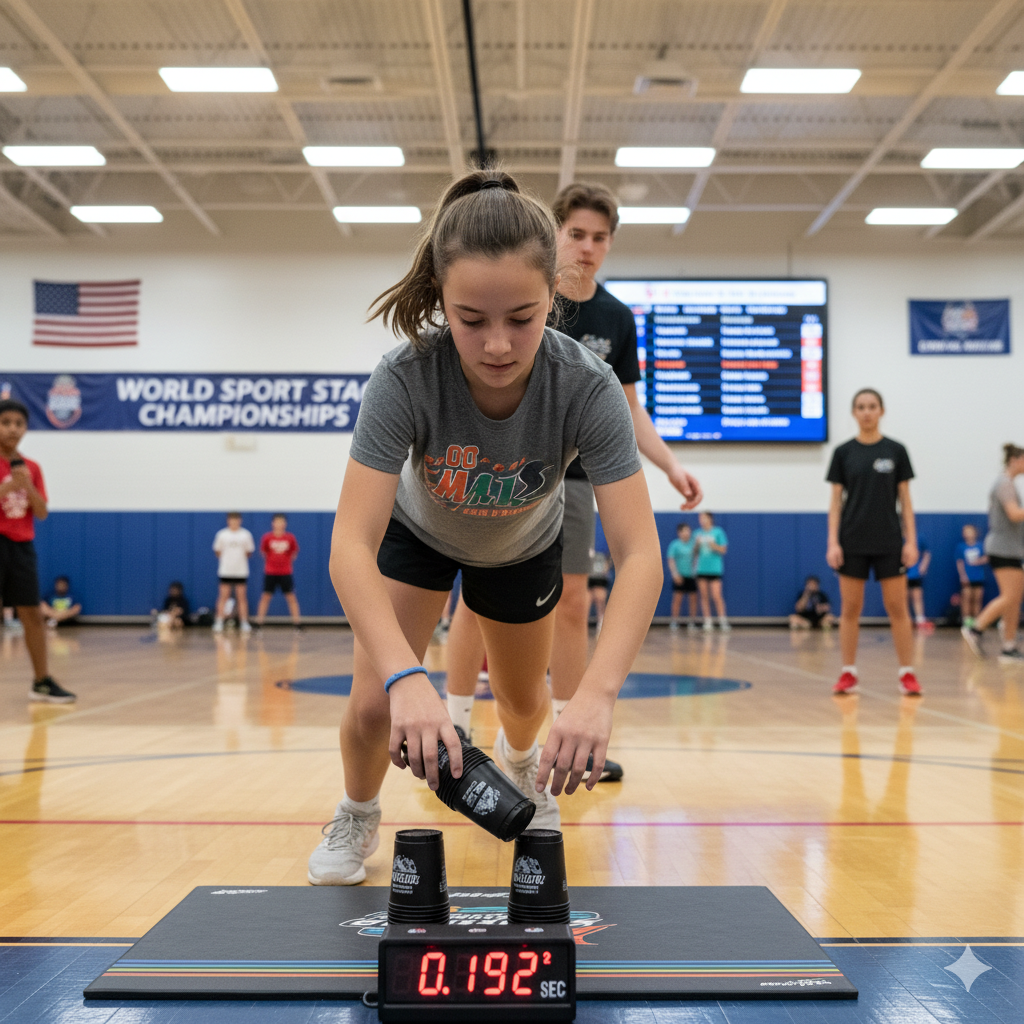
The Fast-Paced World of Sport Stacking
Sport Stacking is one of the fastest-growing coordination-based sports in the world. It blends speed, accuracy, rhythm, and concentration into one exciting challenge. Participants stack and unstack specialized cups in specific sequences as quickly as possible. The simplicity of the equipment contrasts with the complexity of the movement. This sport, which began as a small classroom activity, has evolved into a global phenomenon. Sport Stacking has transformed from a fun learning tool into a competitive pursuit with world records, professional leagues, and international tournaments. Its rise demonstrates the power of creativity, dexterity, and human focus.
The Origin and History of Sport Stacking
The story of Sport Stacking began in the early 1980s in Southern California. Physical education teacher Wayne Godinet introduced a cup stacking activity to his students. He noticed that stacking and unstacking cups quickly helped children develop hand-eye coordination, timing, and ambidexterity. What started as a fun classroom exercise soon became something much bigger.
In 1985, Godinet appeared on the television show That’s Incredible! to showcase the sport. The audience loved the concept. This appearance ignited interest nationwide. Kids began asking their teachers to include cup stacking in gym classes. Physical educators saw its developmental benefits. It wasn’t long before it spread across the country.
By the early 1990s, cup stacking had evolved into an organized activity. A Colorado physical education teacher named Bob Fox took it to another level. He refined the rules, standardized the cup designs, and renamed it “Sport Stacking.” Fox later founded Speed Stacks Inc., the company that became the official equipment supplier. The term “Sport Stacking” replaced “Cup Stacking” to emphasize its athletic elements.
Fox and his team began promoting the activity through workshops and tournaments. They encouraged schools across the United States to adopt it as part of physical education programs. Soon, the sport grew internationally. The first official world championship was held in 2001, marking a major milestone. What began as a local innovation had now achieved global recognition.
The introduction of specialized stacking cups was another turning point. These cups are designed with small holes to prevent air locking and to ensure faster stacking times. The equipment standardization helped level the playing field and allowed fair global competition. From that point, Sport Stacking became a legitimate sport with official rules, governing bodies, and record-keeping organizations.
The Global Popularity of Sport Stacking
Today, Sport Stacking is played in more than 60 countries. It has reached every continent except Antarctica. Schools, youth centers, and sports clubs all embrace it for its inclusivity and accessibility. Anyone, regardless of athletic ability, can participate. This universal appeal drives its rapid global growth.
In North America, Sport Stacking thrives in schools across the United States and Canada. Physical education teachers incorporate it into fitness programs because it enhances focus, coordination, and agility. Annual tournaments draw competitors from coast to coast. The World Sport Stacking Association (WSSA) hosts regional and national competitions with thousands of participants.
In Europe, countries such as Germany, the United Kingdom, and Switzerland have developed strong stacking communities. German stackers, in particular, dominate many international competitions. Their training programs are intense, often starting at a young age. European schools frequently host inter-school tournaments, further popularizing the sport.
Asia has also embraced Sport Stacking with enthusiasm. South Korea, Japan, Taiwan, and China have vibrant stacking cultures. Korean and Chinese teams have consistently placed high in international events. Asian players often emphasize precision and speed through disciplined practice methods. National federations promote the sport through schools and media campaigns, increasing awareness and participation.
In Australia and New Zealand, Sport Stacking clubs host regular meetups and championships. The sport’s low cost and educational benefits make it ideal for schools. It continues to attract young players eager to set personal and national records.
Even in South America and Africa, interest is rising. Countries like Brazil, Mexico, and South Africa have started local leagues. Social media plays a huge role in spreading the sport globally. Viral videos of incredible stacking times have inspired countless new participants.
The World Sport Stacking Championships now feature competitors from every corner of the globe. These events foster cross-cultural friendships and international collaboration. Global popularity continues to rise each year, supported by online competitions, tutorials, and community engagement.
Amateur Sport Stacking in Schools and Youth Programs
Amateur Sport Stacking is the heart of the sport’s community. It thrives in schools, after-school programs, and local clubs. Children learn the basics through physical education classes, often starting as early as kindergarten. Teachers appreciate how stacking improves fine motor skills and bilateral coordination. It challenges both sides of the brain, enhancing cognitive function and problem-solving.
Schools integrate Sport Stacking into lessons beyond physical education. Some teachers use it in math classes to teach counting, timing, and pattern recognition. Others include it in teamwork and focus-building exercises. Students find the activity fun and engaging, which helps with classroom motivation.
Youth tournaments are held throughout the year. They usually begin with local competitions, leading to state or national events. Young participants often train at home, using official cups and timers. They set personal goals, such as breaking their own time records. These milestones encourage persistence and discipline.
Amateur stackers compete in multiple categories. The most common are the 3-3-3, the 3-6-3, and the Cycle. Each sequence challenges different aspects of coordination. Beginners often start with the 3-3-3, while advanced players move to the Cycle, which combines several patterns.
Many schools organize “Stack Up! Day,” an annual global event promoted by the WSSA. On this day, students around the world stack simultaneously to set a Guinness World Record for the largest sport stacking event. The activity unites millions of children, reinforcing teamwork and community spirit.
Parent involvement also plays a key role. Families often participate in stacking challenges together. This shared experience strengthens relationships and promotes healthy competition. The ease of setup makes it an ideal family sport.
Youth clubs and summer camps frequently include Sport Stacking in their programs. It fits well with activities that emphasize coordination, focus, and fun. These amateur programs feed into larger competitive circuits, helping young athletes progress toward professional levels.
Professional Leagues and Competitive Circuits
As the sport matured, professional Sport Stacking leagues emerged. The World Sport Stacking Association (WSSA) serves as the primary governing body. It oversees global rankings, sets official rules, and organizes international competitions. The WSSA ensures consistency in timing systems and stack sequences across countries.
The World Championships, held annually, are the sport’s biggest event. Competitors from dozens of nations gather to test their skills. Events include individual, doubles, and relay competitions. Categories are based on age and skill level, making it fair for all participants. The championships are streamed online and draw thousands of viewers worldwide.
Several countries also have national Sport Stacking federations. Germany’s Speed Stacking Germany organization manages professional tournaments and rankings. South Korea, Japan, and China host their own professional leagues. These associations promote the sport through televised events and national tours.
Professional stackers train daily. They use advanced techniques to shave milliseconds off their times. Many use slow-motion video analysis to study their movements. Training sessions focus on rhythm, breathing, and precision. Like traditional athletes, they follow strict routines to maintain consistency under pressure.
Sponsors have begun to recognize the marketing potential of the sport. Companies that make stacking equipment, sports drinks, and educational tools support top players. Endorsements and prize money, while modest compared to mainstream sports, continue to grow.
Online tournaments have expanded professional opportunities. During the pandemic, virtual competitions became essential. Players competed from their homes using verified cameras and official timers. The WSSA validated results and maintained global rankings. This hybrid model now remains part of the competitive structure, allowing broader participation.
Professional Sport Stacking events attract significant media attention. Networks and streaming platforms showcase the lightning-fast performances. Record-breaking runs often go viral on social media, generating millions of views. These moments inspire younger players and raise the sport’s global profile.
The Social and Political Significance of Sport Stacking
Sport Stacking’s impact extends beyond the competitive arena. Socially, it fosters inclusion, confidence, and collaboration. Unlike many sports, it doesn’t depend on height, strength, or physical endurance. Anyone can excel with practice. This inclusivity allows students of different abilities to compete on equal terms.
Teachers have reported positive behavioral changes among students who stack regularly. The activity promotes patience and focus. Children who struggle with attention find stacking helpful because it channels their energy productively. It also bridges gaps between athletic and non-athletic students, promoting unity.
Special needs programs worldwide have embraced Sport Stacking. It benefits children with coordination challenges, autism spectrum disorders, and developmental delays. The rhythmic nature of stacking can calm anxiety and improve concentration. The WSSA and Speed Stacks Inc. actively support inclusive programs, ensuring accessibility for all.
Politically, Sport Stacking has gained recognition as a legitimate athletic discipline. Governments in several countries, such as Germany and South Korea, have included it in national youth sports initiatives. Ministries of Education endorse it for school curricula due to its educational value. These endorsements give the sport credibility and open funding opportunities for clubs and competitions.
In the United States, some lawmakers have acknowledged the positive role of Sport Stacking in schools. The sport promotes physical activity without requiring expensive facilities. This aligns with public health initiatives focused on reducing childhood obesity and screen time.
Culturally, Sport Stacking serves as a global connector. International tournaments encourage travel and cultural exchange. Teams from different nations collaborate and share training techniques. These friendships transcend language barriers and foster mutual respect.
Online communities further amplify the social significance. Stackers from around the world share videos, tips, and motivation. Many young players develop confidence through online exposure and recognition. The sport has created a worldwide network built on positivity and encouragement.
Rules and Gameplay of Sport Stacking
The rules of Sport Stacking are standardized globally by the WSSA. Competitions test precision, speed, and accuracy under strict guidelines. The basic goal is simple: stack and unstack cups in specific sequences as fast as possible without errors.
Each competitor uses a set of 12 specially designed cups. These cups are lightweight and made of durable plastic. Small ventilation holes allow air to escape quickly, reducing resistance. The cups rest on a non-slip mat with a digital timer attached.
There are three main stacking sequences: the 3-3-3, the 3-6-3, and the Cycle.
1. The 3-3-3 Stack
Players arrange three sets of three cups each. They stack and unstack each set sequentially from left to right. The goal is to complete the entire sequence flawlessly and quickly. Beginners usually start with this pattern to develop rhythm and control.
2. The 3-6-3 Stack
This sequence uses three stacks—one with three cups, one with six, and one with three. It requires more coordination and planning. Players must manage transitions efficiently to avoid fumbles. Accuracy and smooth motion are essential.
3. The Cycle Stack
The Cycle is the most challenging event. It combines multiple stacking patterns into a continuous sequence. Players perform the 3-6-3, then the 6-6, and finally the 1-10-1. The sequence ends by downstacking everything into one pile. It tests endurance, focus, and advanced technique.
Competitors must follow several key rules. Both hands must be used equally. Cups must be stacked on the mat, not held in the air. If a cup falls, players must restack it correctly before continuing. The timer starts when the first cup is touched and stops when the final cup returns to its original position.
Judges oversee every attempt to ensure fairness. Infractions such as missed cups or incorrect formations result in disqualification or time penalties. Official timers record results to the thousandth of a second.
Competitions include individual, doubles, and relay events. In doubles, two players alternate hands to complete the sequences together. This format emphasizes communication and teamwork. Relays involve teams of four completing a sequence in turns, passing the stacking area like a baton race.
Age divisions range from under-6 to senior categories. Each division awards medals and maintains separate records. The structure encourages lifelong participation.
Video verification is mandatory for record attempts. The WSSA reviews footage to confirm legitimacy. World records often reach astonishing speeds. Top professionals can complete a full Cycle in under six seconds.
Training Techniques and Strategy
While Sport Stacking may seem simple, elite performance requires strategy and discipline. Players focus on hand placement, rhythm, and timing. Many follow structured training plans similar to traditional athletes.
Warm-up routines are critical. Stackers stretch fingers, wrists, and forearms to prevent strain. They then practice slow repetitions to build consistency. Speed develops only after the movements become automatic.
Visualization helps competitors plan their runs mentally. They imagine flawless sequences to reinforce muscle memory. Breathing control also plays a major role. Staying calm prevents shaking hands during high-pressure moments.
Coaches emphasize symmetry. Both hands must move at the same speed. Practicing with the non-dominant hand strengthens balance and reduces hesitation. Top athletes often train using metronomes to maintain perfect rhythm.
Video analysis technology has revolutionized training. Slow-motion replay reveals inefficiencies in motion. Small corrections—like adjusting finger angles or stack heights—can shave milliseconds off times. Data tracking allows stackers to measure improvement precisely.
Mental preparation separates champions from competitors. Focus, patience, and composure determine success in final rounds. Meditation, visualization, and mindfulness exercises are common among top players.
The Future of Sport Stacking
Sport Stacking continues to evolve rapidly. Advancements in digital timing systems, mobile apps, and online platforms make participation easier than ever. Virtual competitions connect players across continents instantly. The sport’s digital presence keeps expanding through YouTube, TikTok, and Twitch.
Educational institutions increasingly recognize stacking’s cognitive benefits. Studies show that it improves reaction time, bilateral coordination, and academic performance. As more schools adopt it, the youth base grows, ensuring the sport’s future.
Professional leagues are exploring sponsorships and television partnerships. Competitive stacking could soon join mainstream esports and alternative athletic circuits. The blend of physical and mental skill makes it perfect for modern audiences.
Inclusivity remains a cornerstone of the sport’s philosophy. New initiatives aim to make Sport Stacking accessible to underprivileged and differently-abled youth. The WSSA and partner organizations continue to promote global unity through friendly competition.
Technological innovation will further shape the sport. Smart cups with built-in sensors, augmented reality training, and virtual coaching systems are being developed. These tools promise to refine technique and increase engagement.
As the community grows, so does its cultural influence. The spirit of Sport Stacking—precision, perseverance, and fun—embodies the best aspects of modern athleticism. Its continued expansion proves that passion and creativity can transform even the simplest ideas into worldwide movements.
Conclusion
Sport Stacking began as a classroom experiment and became a global sporting sensation. Its blend of coordination, speed, and concentration appeals to players of all ages. From local school gyms to world championship arenas, the sport has united people through shared excitement and discipline. It promotes inclusivity, mental sharpness, and international friendship.
Every stack, every motion, and every record attempt tells a story of human focus and perseverance. The sport’s journey from simple cups to global competition is a testament to creativity and community. As technology and participation expand, Sport Stacking stands as proof that athletic brilliance can come in the most unexpected forms.