Introduction
The sport of Static Trapeze is an intriguing aerial discipline that blends artistry, strength, and daring. Over time it has evolved from simple circus apparatus to a structured sport enjoyed worldwide. In this blog post, we explore the origin and history of Static Trapeze, examine its global popularity and venues, describe how amateur and youth participants engage in the sport, investigate any professional leagues, consider the social and political significance of the discipline, and finally explain its rules in detail.
1. Origin and History of the Sport
The roots of what we now call Static Trapeze trace back to 19th-century circus and gymnastic developments. The aerial bar suspended by ropes or straps is known in general as a trapeze.
Early precursors and invention
The famed French acrobat Jules Léotard is often credited with inventing the first flying trapeze act in 1859 in Toulouse, France. He practised over his father’s pool in order to attempt his aerial leaps. While his focus was on the flying trapeze (i.e., launch, swing, catch), the apparatus and notion of suspense in the air inspired subsequent variations including static forms.
Before Léotard, there are mentions of trapeze-like apparatus in gymnastic manuals from the 1830s and earlier. For example, George Roland’s “An Introductory Course of Modern Gymnastic Exercises” (1832) references a trapeze.
Emergence of static and fixed trapeze
As aerial arts evolved, performers began using a trapeze bar and ropes that remained relatively still rather than swinging dramatically. The term “static trapeze” (or “fixed trapeze”) refers to an apparatus whose bar and ropes largely remain at fixed length and position, and the performer moves around the bar/ropes.
This form allowed more control and the opportunity to execute poses, balances, transitions, and manipulations of the bar and ropes themselves. Over time it became distinct from flying or swinging trapeze.
Growth through circus and aerial arts
Static trapeze found its niche in circus shows, theatrical aerial performances and later in aerial fitness/studio settings. For example, aerial arts histories note that in the late 19th and early 20th century aerial acrobatics proliferated across Europe and North America, and apparatus like the static trapeze were adopted.
By the late 20th and early 21st centuries, studios offering aerial arts began offering classes to non-circus audiences, helping the discipline transition from spectacle to participatory sport/fitness.
Thus the history of Static Trapeze shows a trajectory from circus spectacle to structured aerial discipline to sport/fitness application.
2. Popularity Globally and Where It Is Played
Static Trapeze enjoys growing popularity, both within the professional/circus world and among recreational aerial arts participants.
Global presence
Because it requires less horizontal swing space than flying trapeze and can be rigged in studios, it has spread across continents. Aerial arts studios in Europe (UK, France, Germany), North America (USA, Canada), Australia and Asia now offer static trapeze classes. For instance, the UK aerial fitness company XPERT notes static trapeze as a valuable new offering for instructors.
In North America, aerial festivals and competitions include static trapeze categories. One organization stipulates rigging two-point rope setups for static trapeze at 20-foot heights.
Audience and participant growth
Studio-based aerial arts attract participants seeking strength, flexibility and novelty. Static trapeze appeals as it can operate at lower heights (for beginners) and offers both artistic and athletic challenge. For example, aerial arts websites note that static trapeze uses the ropes, bar and the body in various ways that engage more than just swing momentum.
While concrete global participation data is scarce, anecdotal evidence suggests that aerial studios offering static trapeze are increasingly common in major cities. The discipline may still be niche compared to mainstream sports, but its growth is evident in fitness, circus arts and youth programmes.
Regional strongholds
- North America: Numerous aerial studios in the U.S. and Canada teach static trapeze; aerial competitions include it.
- Europe: UK, France and Germany have circus schools and aerial centres offering this discipline.
- Australia & New Zealand: Aerial arts festivals and competitions mention static trapeze and include youth categories.
- Asia: While less documented, aerial and circus schools in cities such as Singapore, Hong Kong and Tokyo include trapeze work (including static) as part of aerial arts.
Thus Static Trapeze has a fairly wide global footprint, particularly in urban centres with aerial arts infrastructure.
3. How Amateur Static Trapeze Is Played (Including Youth and Schools)
At the amateur level, it is accessible to a wide range of participants, from youth in circus-arts education to adults in fitness studios.
Youth programmes and schools
Many circus schools and youth aerial programmes include static trapeze as part of their curriculum. For instance, a session guide for a youth intermediate category lists “STAT 0000-01 Static Trapeze ages 13+” etc.
In such programmes, students progress through levels: beginner, intermediate, advanced. They learn fundamentals: climbing the rope, mounting the bar, basic poses and transitions, then higher-level skills like drops, holds in ropes, bar transitions. The static nature means the bar stays relatively still and the performer creates movement.
Schools emphasise proper rigging, safety mats, coaching. For example one festival’s rigging guidelines for static trapeze recommend a crane bar height of 20ft and two-point rigging for stability.
Youth classes may use lower heights and extra coaching supervision. The focus is more on form, strength, artistry, and less on high-risk releases.
Amateur adult participation
For adults seeking aerial arts fitness or expressive movement, static trapeze offers a structured class format. Many aerial studios offer beginner series then open classes, allowing participants to learn core skills and progress at their pace. As one blog notes, static trapeze may require more control of body weight since the apparatus does not swing.
Amateurs may perform in showcases, school recitals or local aerial festivals. Competitions often include amateur divisions. Competitions include time limits, required skills, scoring deductions for infractions such as mat clearance, costume entanglement, non-aerial content, or overstepping vertical clearance. For example, one aerial festival lists amateur rules with infractions for act duration, vertical space, mat coverage etc.
Structure of amateur routines
- Warm-up and conditioning: Before mounting the bar, participants train strength, flexibility, grip, rope climbs.
- Mounting and dismounting: Basic mounting (climbing rope next to trapeze), mounting the bar or ropes, safe dismount.
- Skills and transitions: Poses on bar (sits, balances), rope work above bar (bird’s nest, splits under bar), transitions between zones (bar↔ropes). Wikipedia lists common repertoire: sitting, ankle hang, one-arm hang, flag, Russian rolls, etc.
- Routine composition: Amateurs compose a routine of defined duration (2-4 minutes in many competitions) that includes set skills, fluid transitions, aesthetic quality, plus maybe creative sequence.
- Safety and supervision: Crash mats, spotters, height adjustment for skill level, rigging inspection. E.g., requirement of mat thickness depending on rope length.
Youth and school integration
In circus arts schools, static trapeze may serve as one of several aerial disciplines offered. Students can choose static trapeze after foundational training in aerial basics. They often perform in end-of-season shows. For example the youth intermediate session guide includes static trapeze among other acts.
Schools emphasise progressive skill levels, peer modelling, performance opportunities, and safety. That exposure creates pathways for some youth to move into circus training, professional tracks or tertiary education in circus arts.
In summary, amateur Static Trapeze provides a disciplined, creative aerial activity for youth and adults alike, structured through classes, progressions, performance opportunities and competitions.
4. Professional Leagues and Global Associations
When one thinks of “leagues” in the sense of mainstream professional sport (e.g., basketball, soccer), static trapeze is more niche, overlapping with circus, performing arts and aerial sport competitions. There are not widely publicised large-scale professional leagues exclusively for static trapeze, but there are competitions, festivals, and associations that treat aerial disciplines (including static trapeze) with sport-style structures.
Aerial festivals and competitive events
For example:
- The West Coast Aerial Arts Festival includes compliance and infractions pages for aerial acts, including static trapeze, with divisions from novice to professional.
- The Aerialympics event mentions apparatus requirements: “If you have an apparatus that requires 2 points (e.g., static trapeze), please bring a spreader bar”.
These events treat static trapeze as a category alongside other aerial apparatus, with competitive divisions, scoring and judging.
Circus companies and professional performers
Major contemporary circus companies such as Cirque du Soleil use static trapeze in performance shows. Wikipedia notes that trio or multiple static trapeze acts are common in Cirque du Soleil’s repertoire. While this is performance rather than league competition, it shows professional opportunities within the discipline.
Associations and certification
Some aerial arts organisations or fitness certification programmes include static trapeze teacher training (for example, the UK’s XPERT offering). This reflects professionalisation of instruction.
Challenges toward full “league” status
While static trapeze has competitive elements, the absence of standardized global governing body or league akin to major sport federations limits its classification as a traditional professional league sport. The scale of competition is smaller, and many participants are amateurs, fitness enthusiasts or performing artists rather than full-time athletes earning league salaries.
Nevertheless, within the aerial arts world, there is a growing ecosystem of competitions, festivals, divisions (novice → amateur → pro), judges and scoring. For example the infractions list from West Coast Aerial Arts Festival shows a structured judging system.
Thus, while maybe not “professional league” in mainstream sport sense, static trapeze has competitive circuits globally, professional performance opportunities, and increasing institutional structure.
5. Significance Politically and Socially
Static Trapeze has significance beyond athletics and performance. It intersects with politics, gender, body culture, social inclusion, education and community building.
Gender, body image and physical culture
Historical studies of aerial acrobatics show that early trapeze acts challenged Victorian gender norms, showcased female strength and the muscular female body, and entered public discussion about physical culture. For instance, the article on trapeze performer Charmion (1897) argues that her trapeze act “flew in the face of Victorian values”.
Static trapeze — as an apparatus that emphasizes artistry, strength and balance — affords female and male performers opportunities to showcase athleticism and flexibility, thereby contributing to broader narratives about gender and body representation in sport and performance arts.
Education, empowerment and community
Circus schools and aerial arts studios that offer static trapeze often serve diverse populations: youth, adults, people seeking fitness alternatives, or those looking for creative expression. Participation offers unique empowerment: mastering aerial skills, overcoming fear of height, building confidence, community belonging. For example, aerial studio blogs highlight that static trapeze builds core strength and mental capacity.
Socially, these programmes can be inclusive of diverse ages and backgrounds. Youth circus programmes use static trapeze as part of their offering and provide performance and progression pathways. This contributes to social inclusion, youth engagement and alternative sports pathways.
Political and cultural visibility
While not politically dominant like some major sports, static trapeze and aerial arts intersect with cultural policy, arts funding, urban development and community arts. For instance, aerial performances feature in festivals, public art events and social programmes. They contribute to cultural economies, tourism and urban arts scenes. The presence of aerial arts studios supports creative industries and workforce (teachers, riggers, performers).
Furthermore, the inclusion of aerial arts in youth education (static trapeze classes in schools of circus arts) reflects broader policy interest in non-traditional sports, physical literacy and arts education.
Health, wellness and fitness culture
Socially, static trapeze taps into the wellness movement. Studios market aerial arts as an alternative to gym workouts. The discipline offers both strength training and creative movement. Thus static trapeze intersects with societal trends around fitness, body positivity and alternative sport.
Access and risk management
From a policy perspective, there are regulatory issues around rigging safety, training accreditation, certification of instructors, and facility insurance. Safety guidelines for aerial arts (including static trapeze) are part of social frameworks ensuring participant protection. For example the guide “Safety in Circus” lists static apparatus among risk categories.
In summary, the social and political significance lies in its contribution to creative sport, body culture, community education, arts sector, and alternative fitness, rather than as a mainstream competitive sport.
6. Rules of Static Trapeze
Although rules vary depending on studio, competition or show, the discipline of static trapeze shares a set of commonly accepted guidelines, apparatus specifications, safety requirements and judging criteria.
Apparatus and rigging
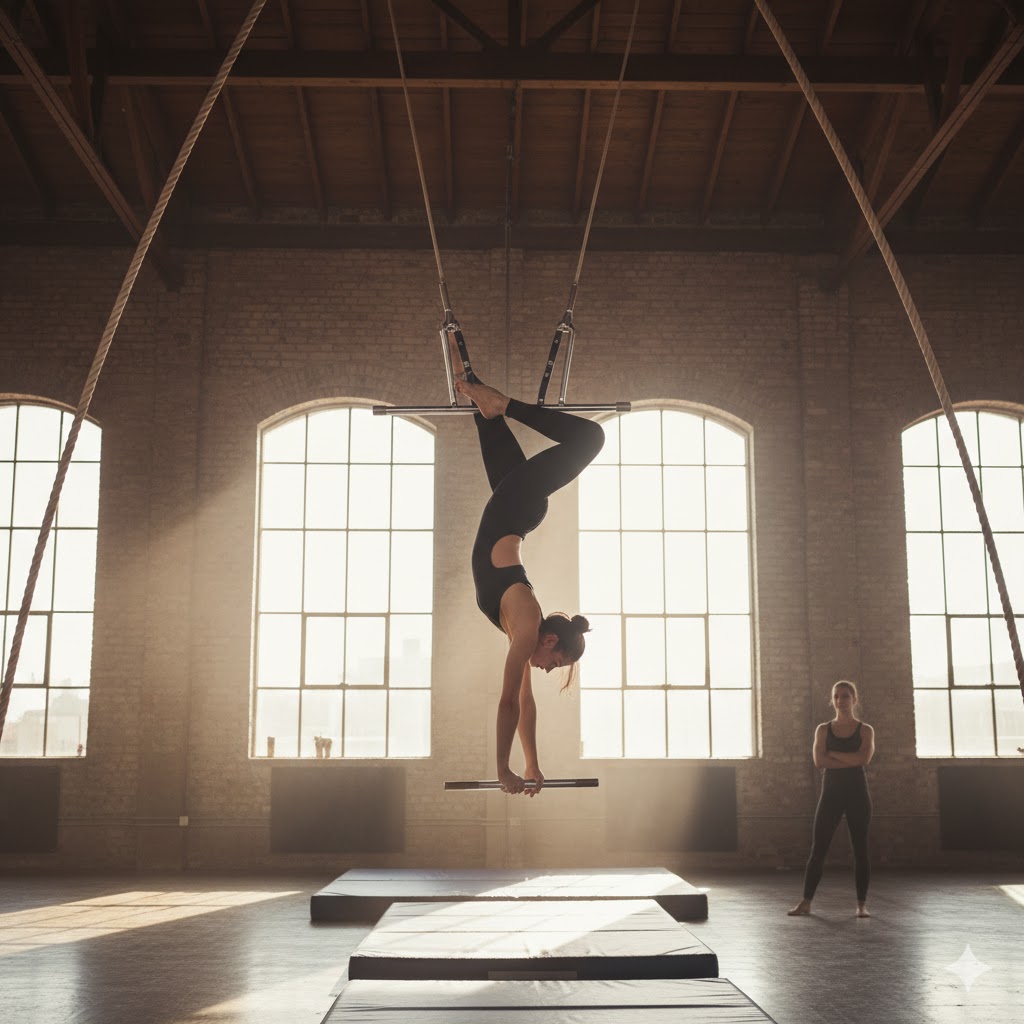
- A static trapeze typically consists of a horizontal bar suspended by two ropes (parallel or spread) from fixed rigging points (often two anchor points). The bar and ropes remain largely still during performance.
- Rope length, bar width and height may vary. Wikipedia states most static trapeze ropes are 3–5 metres long and bar width about 2 ft; bar diameter ~1-1.5 inches.
- Rigging guidelines: For competitions, one fest suggests a crane bar height at ~20 feet, ropes ~9-10 feet in one example.
- Safety mats/crash padding are mandatory. For example if rope length is short, a thicker crash pit may be required.
Competition structure and rules
In competitions and festivals, rules often cover divisions (novice, amateur, elite/professional), routine duration, apparatus clearance, scoring and infractions.
Routine Duration
- e.g., one event lists individual routines 2-3 minutes, duo routines 4 minutes, group routines 5 minutes.
Vertical Space
- Routines must maintain a minimum vertical clearance from rigging point to mat. An aerial festival states novice vertical space max 15 ft, others up to 18 ft.
Judging/Scoring
Judges evaluate on: difficulty of skills, execution (clean transitions, body lines, control), aesthetics (flow, choreography, musicality), amplitude (if applicable), and adherence to safety and time. Deductions (infractions) apply for specific breaches:
Common infractions
- Exceeding time: e.g., 5 pts for over 6-10 seconds, 10 pts for over 16 seconds.
- Costume issues: No clear face when inverted, costume entanglement → 5-10 pts.
- Mat coverage issues: Poor mat set-up or going beyond safety radius → deduction.
- Non-aerial content too high: e.g., routine must have aerial percentage content (APC) of at least 85%; if non-aerial exceeds threshold → deduction.
- Vertical clearance infraction: If head almost touches mat or part of body does unintentionally → deduction.
- Lifts: On novice level, lifts (cue lifts) may be prohibited; each unauthorized lift may incur 5 pts.
Common Skills and Repertoire
Per Wikipedia’s static trapeze page, the following are typical skills:
- Sitting: On the bar, shoulders parallel, legs in front.
- Full beats: Hanging from bar by hands, feet raised up to bar level then swinging downward through vertical and back up.
- Knee beats: Hanging from knees, hands up above bar, then straightening and swinging backward and back.
- Catcher’s lock (catches): Hanging upside down, bar across thighs, ropes inside bent knees — often used in duo work.
- Ankle hang, toe hang, neck hang: Variations of hanging positions as described.
- Around the world, Russian rolls, windmill, meathook, toysoldier, crucifix, inverted crucifix, handstand on the bar, layout in the ropes, etc.
Participants in competitions must include elements of difficulty, transitions, and artistry.
Safety and Performance Rules
- Equipment must pass rigging inspection. For example one festival requires all aerial equipment to be inspected before use.
- Height and risk must match skill level; rope lengths, bar height and mat thickness must adapt to participant level.
- Participants under age (e.g., under 18) may require coach on stage/backstage. Example: youth under 10 may require coach onstage.
- Costume, mat, rigging compliance form part of scoring infractions. (See above).
Amateur vs Professional divisions
- Novice: Strict limitations (no lifts maybe, lower heights, simpler skills)
- Amateur/Intermediate: Allowed more complex tricks, lifts, greater height
- Professional/Elite: Highest difficulty, full performance length, minimal restrictions (but still safety rules apply)
Summary of rule sets
Although each competition may have its unique rulebook, the key points to remember for static trapeze: stable rigging, defined apparatus dimensions, routine duration limits, required aerial content percentages, judging on difficulty/execution/aesthetics, and clear infraction penalties for safety or procedural breaches.
Conclusion
The sport has evolved from 19th century aerial spectacle into a modern aerial discipline that spans fitness studios, youth circus schools and competitive aerial events around the world. Its global reach is growing and it offers pathways from amateur participation to professional performance. While it may not yet have the mass-market league structure of other major sports, it functions as a vibrant niche with worldwide appeal. Socially and politically, it contributes to body culture, creative sport, youth empowerment, arts communities and alternative fitness movements. The rules of static trapeze provide structure for safety and scoring while preserving the artistry and athleticism that make it compelling.