
How MLB Teams Develop Power Hitters
How MLB Teams Develop Power Hitters
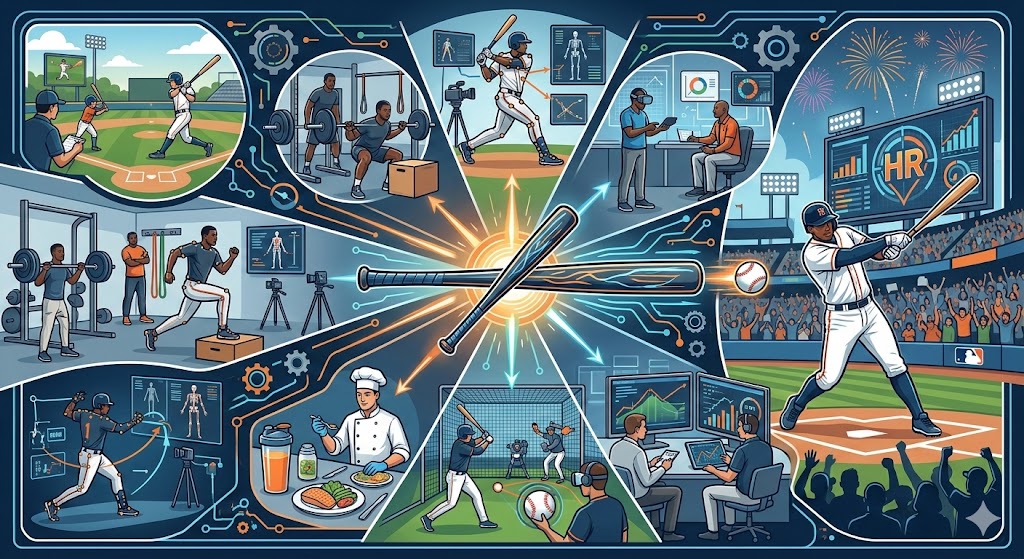
Walk into any Major League clubhouse during batting practice and you’ll see the spectacle—balls flying into the upper deck, exit velocities flashing across screens, coaches studying tablets like lab technicians. Power hitting isn’t an accident anymore. It’s engineered.
In today’s Major League Baseball, teams don’t just wait for a naturally strong slugger to show up. They identify traits and build bodies. They reshape swings and redesign approaches. Increasingly, they do it years before a player ever debuts.
So how do MLB teams actually develop power hitters? Let’s break it down.
It Starts With Identification, Not Just Home Runs
Fans assume power hitters are obvious. Big frame. Massive batting practice shots. Tape-measure blasts in college.
But MLB front offices look deeper.
Scouts and analysts now prioritize:
- Exit velocity potential
- Bat speed
- Launch angle consistency
- Barrel rate
- Hand speed and hip rotation metrics
- Ball flight efficiency
A prospect might only hit 10–12 home runs in college. But if his average exit velocity sits above 92 mph with elite bat speed, development staffs see untapped power.
Organizations like the Los Angeles Dodgers and Houston Astros built reputations on identifying hitters with underlying metrics that suggested more power was coming—even when the box score didn’t scream “slugger.”
Power today is projected before it’s visible.
Swing Path: The Launch Angle Revolution
The biggest shift in the last decade? Teaching hitters how to elevate the baseball intentionally.
Before the mid-2010s, many organizations preached “hit it hard on the ground.” Then analytics departments realized something simple: ground balls rarely become home runs.
The “launch angle revolution” changed development philosophy across baseball.
Teams now work on:
- Creating an upward attack angle
- Matching bat path to pitch plane
- Increasing pull-side fly balls
- Reducing weak contact on the ground
You can see this philosophy in players like Aaron Judge and Kyle Schwarber. Both generate natural loft through optimized bat paths and elite bat speed.
It’s not about swinging harder. It’s about swinging smarter.
Strength Training Built for Explosiveness
Power doesn’t come from biceps.
Modern MLB strength programs emphasize:
- Rotational explosiveness
- Core torque
- Hip mobility
- Lower-body force production
- Grip strength
Minor league strength coaches build customized programs around biomechanics. Olympic lifts, medicine ball rotational throws, resisted band work, and sprint training are standard.
The Atlanta Braves and Tampa Bay Rays are especially known for integrating strength science with swing mechanics early in player development.
When a hitter adds 10–15 pounds of functional muscle the right way, exit velocity can jump 2–3 mph. That small increase often means the difference between a warning-track out and a 420-foot homer.
Data-Driven Feedback Every Day
In today’s MLB, hitters get instant feedback on almost every swing.
Technology commonly used:
- Rapsodo
- TrackMan
- Hawk-Eye
- High-speed video
- Bat sensors
Players see real-time data on:
- Launch angle
- Exit velocity
- Spin rate
- Contact point
- Attack angle
This creates deliberate practice.
Instead of guessing what felt good, hitters know precisely which swing produced a 103 mph exit velocity at 28 degrees—the sweet spot for power.
Development isn’t random reps anymore. It’s targeted improvement.
Approach at the Plate: Hunting Damage
Raw power means nothing without the right approach.
Teams teach hitters to:
- Hunt pitches in specific zones
- Lay off borderline offerings early in counts
- Attack mistakes aggressively
- Understand situational leverage
Look at Yordan Alvarez. His power isn’t just physical—it’s selective. He rarely expands the zone and punishes mistakes.
The modern power hitter combines patience with violence.
That mental discipline is coached from the low minors upward.
Minor League Labs: Where Power Is Built
Development truly happens in the minors.
Organizations create controlled environments where hitters:
- Face high-velocity machines daily
- Train against advanced breaking-ball simulators
- Review swing data between rounds
- Make micro-adjustments in real time
The New York Yankees have heavily invested in minor league analytics systems to refine power traits early. The San Diego Padres focus on individualized swing plans for each prospect.
Power development is no longer one-size-fits-all.
Every hitter gets a customized blueprint.
The Mental Side of Power
Here’s what doesn’t show up in analytics dashboards: confidence.
Many players struggle when trying to “become” power hitters. They overswing. Strikeouts spike. Confidence drops.
Good organizations protect hitters from that spiral.
They emphasize:
- Process over results
- Controlled aggression
- Swing decisions over pure output
- Long-term growth curves
The best power hitters trust their training. They don’t chase home runs—they create the right conditions for them.
The Role of Ballparks and Environment
Not all power development happens in a vacuum.
Ballpark dimensions, altitude, and even climate influence approach.
Teams like the Colorado Rockies must account for altitude effects on ball flight. Meanwhile, teams in pitcher-friendly parks emphasize gap power and opposite-field carry.
Development plans adjust to environment.
Power is contextual.
Why Not Every Team Develops Power Equally
Some organizations consistently produce sluggers. Others lag behind.
Why?
- Investment in analytics
- Quality of hitting coordinators
- Communication between front office and field staff
- Willingness to modernize
Clubs that resist change often fall behind. Power development today requires collaboration between scouts, analysts, coaches, strength staff, and players.
It’s an ecosystem.
The Future of Power Development in MLB
Expect even more refinement ahead.
Emerging trends include:
- AI swing modeling
- Virtual reality pitch recognition
- Personalized bat optimization
- Genetic and muscle-fiber analysis
- Advanced fatigue tracking
Power won’t disappear from baseball. If anything, it will become even more specialized.
The next generation of sluggers won’t just be strong—they’ll be engineered.
Final Thoughts: Power Is Built, Not Born
Yes, some hitters are naturally gifted.
In modern Major League Baseball, power is developed intentionally.
It’s data plus biomechanics and it’s strength plus approach. It’s confidence plus repetition.
The home runs we see under the lights start years earlier—in minor league cages, weight rooms, and analytics labs.
Power may look effortless.
However, behind every towering shot is a blueprint.