
How Racing Teams Use Data Analytics
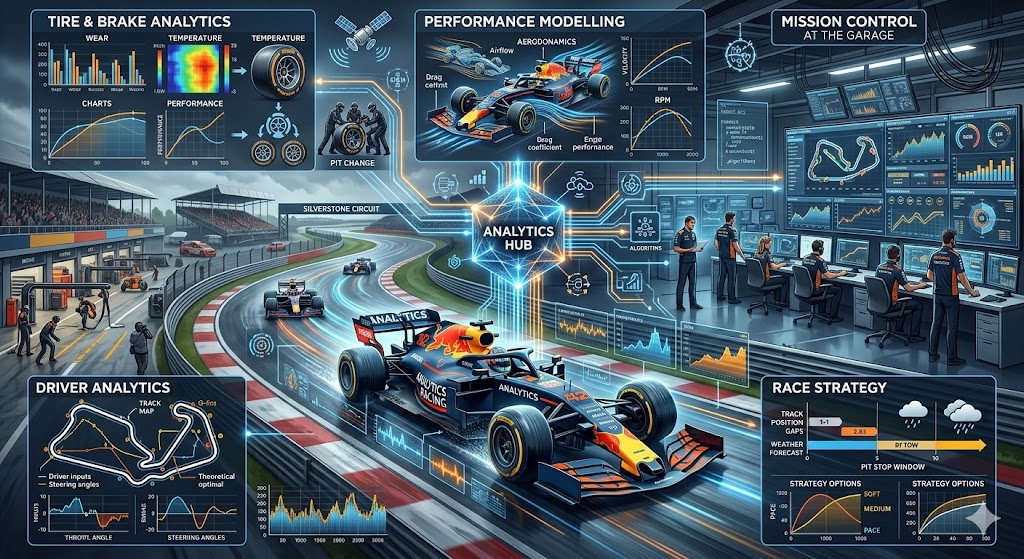
How Racing Teams Use Data Analytics
Speed used to be mechanical.
Now it’s mathematical.
Modern racing teams don’t just build fast cars — they build data ecosystems. Every lap generates thousands of data points, and the teams that interpret that information fastest and most accurately often control the race.
In today’s motorsports landscape, data analytics isn’t a support tool.
It’s a competitive weapon.
From real-time race strategy to predictive maintenance and driver performance optimization, analytics influences nearly every decision made on and off the track.
Let’s break down how racing teams use data analytics to win — and why the smartest team often beats the fastest car.
The Modern Race Car Is a Rolling Supercomputer
Today’s race cars are loaded with sensors.
They continuously monitor:
- Tire temperature and degradation
- Brake pressure and wear
- Fuel flow and consumption rate
- Throttle and steering input
- Suspension travel
- Aerodynamic load
- Engine vibration and stress
Each lap produces massive telemetry streams. That information is transmitted in real time to engineers on pit lane and often to remote operations centers where additional analysts evaluate performance.
The car is no longer just mechanical hardware.
It’s a live data generator.
And every sensor reading tells a story.
Real-Time Strategy: Decisions Backed by Algorithms
Race strategy has evolved dramatically.
In the past, teams relied heavily on intuition and experience. Today, predictive modeling drives decisions.
Data analytics helps determine:
- Optimal pit stop windows
- Undercut or overcut opportunities
- Tire compound selection
- Fuel-saving strategies
- Weather impact probabilities
- Safety car risk modeling
If a rival’s lap times begin to drop, software models estimate whether it’s tire degradation or fuel load changes. Teams simulate multiple race outcomes instantly before committing to a pit stop.
That level of precision turns race strategy into a dynamic, data-driven chess match.
And mistakes get punished immediately.
Tire Degradation Modeling: Where Races Are Won
Tire performance defines modern racing.
Teams build detailed degradation curves using historical data, practice sessions, and simulation tools.
Analytics answers critical questions:
- When does grip begin to decline?
- How fast will lap times fall off?
- Is temperature exceeding optimal range?
- Does camber adjustment extend performance life?
Drivers provide feedback. Data confirms or challenges it.
When teams understand the exact performance window of a tire compound, they can stretch stints strategically or attack at the right moment.
That timing often decides podium positions.
Driver Performance Analytics: Micro-Improvement at Scale
Elite drivers already operate near physical limits.
Data helps refine the final percentage.
Engineers compare telemetry to identify:
- Braking consistency
- Throttle modulation efficiency
- Steering smoothness
- Corner entry speed differences
- Time lost in micro-sectors
Overlay tools allow teams to compare laps corner by corner.
If a driver loses two-tenths in one braking zone, the data reveals whether the issue was brake pressure timing, entry angle, or exit throttle delay.
Performance improvement becomes measurable — not subjective.
And measurable improvements compound over a race weekend.
Simulation Before the Green Flag
One of the most powerful uses of data analytics happens before race day.
Teams run thousands of race simulations based on:
- Historical track data
- Weather forecasts
- Fuel consumption models
- Traffic scenarios
- Safety car likelihood
These simulations generate decision trees.
If a safety car appears between laps 20–25, this is the optimal strategy.
If degradation exceeds projections, switch to this plan.
By race day, teams aren’t improvising.
They’re selecting from pre-modeled scenarios.
Preparation reduces chaos.
And chaos is where championships slip away.
Aerodynamics and Setup Optimization
Wind tunnels still matter. But computational analysis has expanded the engineering toolbox dramatically.
Teams use advanced modeling to analyze:
- Downforce balance
- Drag reduction
- Airflow disruption
- Ride height sensitivity
- Track-specific setup configurations
Small aerodynamic adjustments can yield tenths of a second per lap.
Data analytics identifies which setup changes produce sustainable gains versus temporary speed spikes.
Consistency wins seasons.
Not just single laps.
Pit Stop Analytics: Efficiency Under Pressure
Even pit crews are evaluated through data.
Teams track:
- Reaction times
- Tire gun efficiency
- Wheel change consistency
- Release timing
- Position gained or lost in pit cycles
Video analysis pairs with time metrics to refine movement patterns.
When margins between teams are razor-thin, shaving two-tenths off a pit stop can be the difference between clean air and traffic.
And traffic kills lap time.
Predictive Maintenance: Avoiding Catastrophe
One mechanical failure can erase a weekend of performance.
Data analytics helps prevent it.
Sensors detect abnormal vibration patterns, temperature spikes, or pressure irregularities before failure occurs.
Teams monitor stress loads across components and predict lifespan.
Instead of reacting to breakdowns, they anticipate risk.
Reliability is often invisible to fans — but it’s built on analytics.
Championship teams finish races.
Competitive Intelligence: Studying the Field
Teams don’t only analyze themselves.
They study competitors relentlessly.
Using publicly available data like sector times, speed trap readings, and pit cycles, analysts reverse-engineer rival strengths and weaknesses.
Patterns emerge:
- Which team manages tires best
- Who runs aggressive fuel maps
- Where competitors struggle in specific sectors
Strategic decisions are made not just on internal performance — but relative performance.
Because racing isn’t about being fast.
It’s about being faster than everyone else.
The Human Element: Data vs. Instinct
Despite all the technology, racing still depends on human judgment.
The best teams balance:
Driver instinct
Engineer interpretation
Data modeling
If telemetry suggests pushing harder but the driver feels grip fading, communication becomes critical.
Data informs decisions.
It doesn’t replace experience.
The synergy between driver feel and analytical insight defines elite programs.
Why Data Analytics Is Now the True Competitive Advantage
Regulations often standardize engines, aerodynamics, and budgets.
That limits mechanical separation.
So teams search for gains elsewhere.
Analytics becomes the differentiator.
The team that processes information faster:
- Makes smarter pit calls
- Optimizes tire life better
- Adjusts setup more precisely
- Avoids mechanical failure
In modern motorsports, information speed equals track speed.
The Future: AI and Machine Learning in Racing
The next phase is already unfolding.
Artificial intelligence systems are improving:
- Predictive race modeling
- Automated setup recommendations
- Real-time strategy recalibration
- Driver coaching simulations
Machine learning will continue refining performance trends across seasons.
The teams that integrate AI effectively will gain compounding advantages.
Because in modern racing, evolution never stops.
Final Thought: Racing Is Now an Intelligence Sport
Yes, drivers still need courage.
Yes, cars still need power.
But championships increasingly belong to the smartest operations.
Data analytics has transformed racing from purely mechanical competition into a technological arms race.
The checkered flag still waves the same.
But the path to it is now paved with algorithms.