
Disc Golf Discs Explained – Drivers, Midranges, and Putters
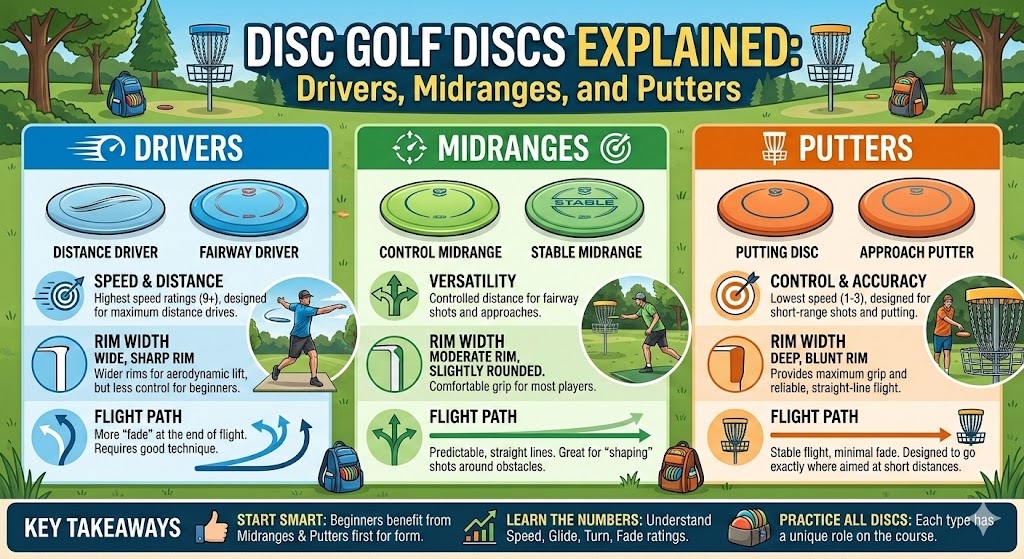
Disc Golf Discs Explained – Drivers, Midranges, and Putters
If you want to improve quickly, you must understand your equipment. And in Disc Golf, nothing matters more than the disc itself.
Many beginners assume all discs fly the same. They don’t. In fact, using the wrong disc can add strokes to your score before you even realize what happened.
That’s why this guide breaks down Disc Golf discs in detail — how they fly, how they differ, and how beginners should choose them.
If you are brand new to the sport, start with The Ultimate Beginner’s Guide to Disc Golf before diving deeper here. That article covers the full foundation. This one focuses specifically on discs.
Let’s build your understanding from the ground up.
Why Disc Selection Matters More Than Most Beginners Realize
Every throw in Disc Golf depends on three things:
- Your form
- Your angle of release
- Your disc selection
You control the first two. However, the disc’s design controls the rest.
Different Disc Golf discs are engineered to:
- Fly farther
- Fade harder
- Hold straight lines
- Turn right during flight
- Resist wind
If you mismatch the disc to the shot, you create unnecessary difficulty.
Smart players learn their discs. Better players choose discs strategically.
The Three Main Types of Disc Golf Discs
All Disc Golf discs fall into three primary categories:
- Drivers
- Midranges
- Putters
Each type serves a distinct purpose.
Let’s break them down in detail.
Drivers in Disc Golf
Drivers are built for distance. They have sharper rims and aerodynamic edges that allow them to cut through the air efficiently.
However, they demand speed.
If you cannot throw with proper velocity, drivers will not fly as intended.
Distance Drivers vs Fairway Drivers
There are actually two subcategories.
Distance Drivers
- Wide rim
- High speed rating
- Maximum distance potential
These discs require strong arm speed. Beginners often struggle to control them.
Fairway Drivers
- Slightly narrower rim
- More control
- Straighter flight paths
Fairway drivers suit beginners much better than high-speed distance drivers.
If you are new, start with fairway drivers. Build control first.
When to Use Drivers
Drivers work best:
- Off the tee
- On long open holes
- In tailwinds
- When you need maximum carry
However, beginners frequently overuse drivers. That mistake often leads to inconsistency.
For strategy advice, review Winning Disc Golf Strategies for Beginners to learn when distance actually helps your score.
Midrange Discs in Disc Golf
Midrange discs are the backbone of controlled play.
They fly slower than drivers but offer greater accuracy.
In fact, most beginners improve faster when they rely heavily on midranges.
Why Midranges Are Ideal for Beginners
Midranges:
- Expose form flaws
- Fly straighter
- Hold lines longer
- Require less power
Because of this, they teach proper mechanics.
Many experienced players can complete entire rounds using only midranges.
That tells you how valuable they are.
When to Use Midranges
Midranges shine:
- On approach shots
- On short par 3 holes
- In wooded fairways
- When accuracy matters more than power
If you constantly miss fairways with drivers, switch to a midrange.
It will lower your score immediately.
Putters in Disc Golf
Putters are not just for putting.
Yes, they dominate inside the circle. However, skilled players use putters for:
- Short drives
- Controlled approaches
- Tight technical shots
Putters fly slower and land softer.
That makes them incredibly reliable.
Characteristics of Putters
Putters typically:
- Have deeper rims
- Offer excellent control
- Fade gently at low speeds
Because they resist dramatic turns, they build confidence inside 30 feet.
For scoring insights, see How Disc Golf Scoring Works to understand how putting consistency impacts total strokes.
Understanding Flight Ratings in Disc Golf
Most Disc Golf discs include four flight numbers:
- Speed
- Glide
- Turn
- Fade
These numbers help predict behavior.
However, beginners often misunderstand them.
Let’s simplify.
Speed
Speed measures how fast the disc must be thrown to achieve its intended flight.
Higher speed = more power required.
Beginners should stay below speed 9 until form improves.
Glide
Glide indicates how long the disc stays in the air.
Higher glide discs carry farther with less effort.
Beginners benefit from moderate glide.
Turn
Turn describes how much the disc moves right (for right-hand backhand throws) during high-speed flight.
Negative numbers mean more turn.
Beginners often prefer slight turn for easier distance.
Fade
Fade measures how strongly the disc hooks left at the end of flight.
Higher fade numbers create sharper finishes.
Too much fade can sabotage beginner throws.
Stability in Disc Golf Discs
Stability determines how a disc resists turning.
There are three stability categories:
- Overstable
- Stable
- Understable
Understanding stability changes everything.
Overstable Discs
- Resist turning
- Finish left hard
- Handle wind well
These discs suit advanced players and windy conditions.
Stable Discs
- Fly mostly straight
- Finish with moderate fade
These are ideal beginner choices.
Understable Discs
- Turn right more easily
- Require less power
- Help beginners gain distance
Understable discs often work best early in your development.
For avoiding poor equipment decisions, see Common Disc Golf Mistakes Beginners Should Avoid.
Plastic Types and Their Impact
Not all Disc Golf discs use the same plastic.
Plastic affects:
- Grip
- Durability
- Flight stability
- Price
Base Plastic
- Affordable
- Wears quickly
- Changes flight faster
Great for beginners on a budget.
Premium Plastic
- More durable
- Maintains stability longer
- Offers better grip in wet conditions
As you improve, premium plastics become worthwhile.
How Many Discs Does a Beginner Really Need?
You do not need a large bag.
Start with:
- One fairway driver
- One midrange
- One putter
That’s it.
Master those three before expanding.
Buying too many discs too early creates confusion.
How Disc Choice Affects Scoring
Disc selection influences:
- Fairway accuracy
- Approach consistency
- Putting confidence
- Wind control
Poor disc decisions often lead to:
- Out-of-bounds throws
- Missed landing zones
- Unnecessary penalty strokes
That’s why understanding Disc Golf discs directly improves scoring.
Common Disc Mistakes Beginners Make
Let’s eliminate them early.
Throwing High-Speed Drivers Too Soon
This creates poor habits.
Ignoring Midranges
Midranges build skill faster.
Carrying Too Many Discs
Too many choices reduce confidence.
Choosing Discs Based on Looks
Performance matters more than design.
Avoid these errors and improvement accelerates.
Building a Smart Beginner Disc Setup
If you’re just starting:
- Choose a neutral fairway driver
- Add a straight midrange
- Pick a comfortable putter
- Practice field throws weekly
That foundation supports long-term growth.
As your skill improves, you can explore:
- Specialty drivers
- Overstable wind discs
- Utility discs
But keep it simple at first.
Final Thoughts: Master the Disc, Master the Game
Disc Golf rewards smart decisions.
When you understand Disc Golf discs — drivers, midranges, and putters — you gain control over your development.
Instead of fighting your equipment, you work with it.
If you’re still new to the sport, revisit The Ultimate Beginner’s Guide to Disc Golf for full context.
Then explore:
- Winning Disc Golf Strategies for Beginners
- How Disc Golf Scoring Works
- Common Disc Golf Mistakes Beginners Should Avoid
Together, these articles form your Disc Golf authority foundation.
And that foundation lowers scores.