
Disc Golf Rules Explained for Beginners
Disc Golf Rules Explained for Beginners
Disc Golf looks simple at first glance. You throw a disc toward a basket and count your strokes. However, once you step onto a real course, questions start immediately.
Where do I stand?
What happens if my disc lands in the road?
Can I move a branch?
When does a hole officially count as finished?
That’s why understanding Disc Golf rules early prevents frustration and unnecessary penalty strokes.
If you are completely new to the sport, start with The Ultimate Beginner’s Guide to Disc Golf. That article covers the foundation. This one breaks down the rules in detail so you can play confidently from day one.
Let’s clarify everything.
The Objective of Disc Golf
The goal in Disc Golf is simple:
Complete each hole in the fewest number of throws.
Every hole begins at a designated teeing area and ends when your disc comes to rest inside the target basket.
Lowest total score wins.
While that sounds straightforward, the details matter.
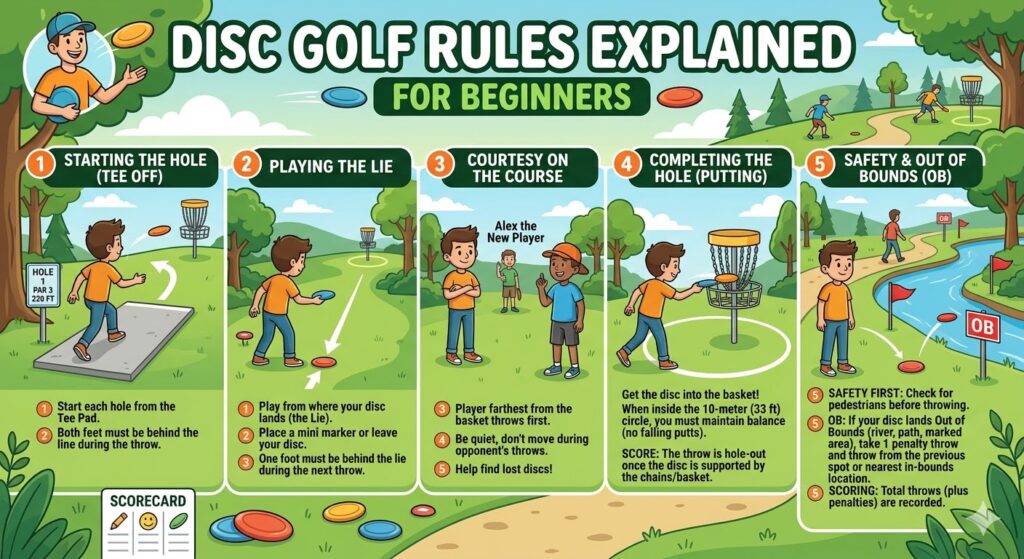
Starting the Hole: Tee Pad Rules
Every Disc Golf hole begins at a tee pad or marked teeing area.
When throwing from the tee:
- At least one supporting point (usually a foot) must be inside the tee pad boundaries.
- You may use a run-up.
- You must release the disc before stepping completely past the front of the tee pad.
If you step outside the teeing area before release, it becomes a foot fault.
Why Tee Pad Rules Matter
Improper footing can:
- Invalidate a throw
- Add penalty strokes
- Disrupt rhythm
Develop clean mechanics early. It prevents problems later.
Order of Play
Disc Golf follows structured throwing order.
On the first hole:
- Order is typically determined randomly or by scorecard position.
After that:
- The player with the lowest score on the previous hole throws first.
- On subsequent throws within a hole, the player farthest from the basket throws next.
This system keeps play organized and fair.
Understanding the Lie
Your lie is the spot from which you throw your next shot.
After each throw:
- Locate where the disc came to rest.
- Place a mini marker at the front edge of the disc.
- Pick up the disc.
- Throw from directly behind the marker.
You must keep at least one supporting point within 30 centimeters directly behind the lie.
Failing to do so results in a stance violation.
Foot Faults and Stance Violations
Foot faults are among the most common rule violations in Disc Golf.
They occur when:
- You release the disc while stepping outside legal throwing space.
- You step past your lie before demonstrating balance on putts inside 10 meters.
Inside 10 meters (about 33 feet), players must show balance after releasing a putt. You cannot fall forward toward the basket.
These details matter more in competitive rounds than casual play, but learning them early builds good habits.
Out of Bounds (OB) Rules
Courses often designate certain areas as out of bounds.
Common OB areas include:
- Roads
- Sidewalks
- Water hazards
- Parking lots
- Private property
If your disc lands out of bounds:
- Add one penalty stroke.
- Throw from the last in-bounds position.
Some courses provide drop zones. In those cases, you must throw from the designated drop area.
OB rules can dramatically affect scoring. To understand how penalties influence totals, review How Disc Golf Scoring Works.
Mandatory Routes (Mandatories or “Mandos”)
Some holes require the disc to pass a specific side of a marked object.
For example:
- A tree may require the disc to pass left of it.
- A pole may require a right-side pass.
If you miss the mandatory route:
- Add a penalty stroke.
- Throw from a drop zone or previous lie, depending on course rules.
Mandatories shape the hole’s intended design and increase strategic complexity.
Lost Disc Rule
If you cannot locate your disc within three minutes:
- The disc is declared lost.
- Add one penalty stroke.
- Return to your previous lie and rethrow.
This rule encourages players to watch each other’s throws carefully.
Bright-colored discs reduce this risk.
Relief from Obstacles
Sometimes obstacles interfere with your stance.
According to Disc Golf rules:
- You may move casual obstacles like loose branches or small rocks.
- You may not move fixed objects such as trees, bushes, or permanent structures.
If your lie is obstructed by an immovable object, limited relief may be allowed depending on local course rules.
Always check posted signage.
Courtesy Rules in Disc Golf
Beyond throwing mechanics, Disc Golf emphasizes sportsmanship.
Players should:
- Remain quiet during others’ throws.
- Avoid standing in someone’s line of sight.
- Maintain pace of play.
- Allow faster groups to play through.
Courtesy rules preserve the welcoming culture of the sport.
Completing the Hole
A hole is complete when:
- The disc comes to rest supported by the chains or tray of the basket.
If a disc hangs on top or rests against the side without support from chains or tray, the hole does not count as finished.
Once all players hole out, record scores and move to the next tee.
Practice Throws and Penalties
Practice throws during a competitive round count as penalty strokes.
However, in casual rounds, groups often relax this rule.
In sanctioned play:
- Every throw counts.
- Even accidental practice tosses can result in penalties.
Develop awareness early to avoid costly mistakes.
For a deeper look at errors beginners commonly make, read Common Disc Golf Mistakes Beginners Should Avoid.
Time Limits and Pace of Play
Players typically have 30 seconds to throw once:
- They arrive at their lie.
- The area is clear.
- It is their turn.
Slow play disrupts the round and frustrates others.
Move efficiently while remaining focused.
Weather and Environmental Considerations
Weather does not change core Disc Golf rules, but it affects play.
Wind may:
- Push discs out of bounds.
- Increase fade.
- Change shot selection.
Rain may:
- Reduce footing stability.
- Affect grip.
Understanding how weather interacts with rules improves course management. For strategy adjustments, see Winning Disc Golf Strategies for Beginners.
Competitive vs Casual Play
Many beginners worry about strict enforcement.
Here’s the reality:
Casual rounds emphasize fun and learning.
Competitive rounds emphasize strict adherence.
However, building rule knowledge early makes the transition smooth if you ever enter tournaments.
Why Disc Golf Rules Build Better Players
Understanding Disc Golf rules does more than prevent penalties.
It:
- Builds confidence
- Speeds up rounds
- Improves decision-making
- Enhances sportsmanship
- Reduces disputes
Knowledge creates control.
Control lowers scores.
Putting It All Together
Disc Golf rules are not complicated. They simply require attention.
Remember the fundamentals:
- Throw from the tee pad correctly.
- Mark your lie properly.
- Stay in bounds.
- Respect mandatory routes.
- Demonstrate balance inside 10 meters.
- Count every throw.
Master those principles and you will avoid most beginner mistakes.
If you still need the full foundation of the sport, revisit The Ultimate Beginner’s Guide to Disc Golf.
From there, expand your knowledge with: