
Winning Disc Golf Strategies for Beginners
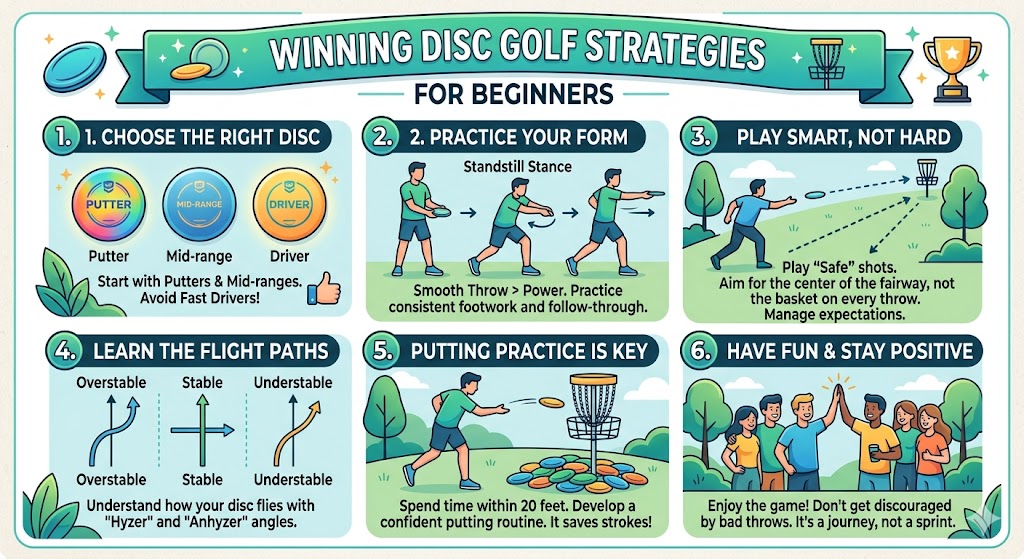
Winning Disc Golf Strategies for Beginners
Most beginners believe distance wins in Disc Golf.
It doesn’t.
Control wins. Patience wins. Smart decisions win.
In fact, the fastest way to lower your score is not throwing harder. It’s thinking better.
That’s where Winning Disc Golf Strategies for Beginners becomes essential. If you are brand new to the sport, start with The Ultimate Beginner’s Guide to Disc Golf first. That guide explains the foundation. This article builds on it by teaching you how to compete smarter.
Let’s turn raw throws into strategic scoring.
Strategy #1: Play for Position, Not Power
Distance looks impressive.
However, distance without accuracy creates problems.
Every throw should answer one question:
Where do I want my next shot to be?
Instead of trying to park every hole, focus on landing in safe, controllable positions.
Smart positioning:
- Avoids trees
- Avoids out-of-bounds
- Creates easy approach angles
- Reduces stress
Aggressive distance often adds strokes.
Controlled placement removes them.
Strategy #2: Use the Right Disc for the Shot
Disc selection directly affects scoring.
Many beginners grab high-speed drivers on every tee. That mistake leads to early fades, missed fairways, and lost strokes.
Instead:
- Use fairway drivers for control.
- Lean on midranges for straight shots.
- Throw putters for short technical drives.
For a detailed breakdown of disc types, review Disc Golf Discs Explained: Drivers, Midranges, and Putters.
Choosing the correct disc simplifies execution.
Strategy #3: Avoid the Hero Shot
Every round presents temptation.
You land behind a tree. The basket sits far ahead. A narrow window appears.
Your instinct says: go for it.
Pause.
Hero shots succeed occasionally. However, when they fail, they compound mistakes.
Instead:
- Pitch out to safety.
- Reset your position.
- Take the easy par.
Disc Golf rewards patience. It punishes ego.
Strategy #4: Master the Hyzer Release
Release angle changes everything.
A hyzer release (outer edge tilted downward) produces:
- Predictable fades
- Safer landing zones
- Controlled flight paths
Beginners often throw flat or anhyzer unintentionally.
Practicing consistent hyzer angles builds reliability.
Consistency wins rounds.
Strategy #5: Manage Risk Around Out-of-Bounds
Out-of-bounds areas destroy scorecards.
Roads, water, sidewalks, and parking lots demand caution.
Instead of throwing aggressively toward OB lines:
- Aim center fairway.
- Play away from hazards.
- Accept longer putts over risky approaches.
To understand how penalties impact totals, see How Disc Golf Scoring Works.
Avoiding OB often saves multiple strokes per round.
Strategy #6: Build a Reliable Putting Routine
Putting separates casual players from competitors.
Inside 30 feet, confidence matters more than power.
Create a routine:
- Set your feet.
- Take a breath.
- Visualize the chains.
- Commit to the throw.
Repeating this process reduces anxiety.
In Disc Golf, missed short putts inflate scores quickly.
For rule details inside the circle, review Disc Golf Rules Explained for Beginners.
Strategy #7: Play Within Your Skill Level
Beginners often compare themselves to advanced players.
That comparison leads to poor decisions.
Instead:
- Throw shots you can execute consistently.
- Avoid high-speed discs too early.
- Focus on straight, safe lines.
Improvement comes from repetition, not imitation.
Strategy #8: Learn Course Management
Course management means thinking ahead.
Before throwing:
- Study the fairway.
- Identify landing zones.
- Locate hazards.
- Plan your second shot.
Good course management turns average throws into strong scoring positions.
For deeper understanding of layout impact, see Disc Golf Course Design and Layout Explained.
Strategy begins before the throw.
Strategy #9: Understand Wind Adjustment
Wind changes everything.
Headwind:
- Increases turn.
- Reduces stability.
Tailwind:
- Increases fade.
- Drops discs faster.
Crosswinds:
- Push discs off line.
Instead of fighting wind, adjust disc stability.
Throw more overstable discs in headwinds. Throw smoother lines in tailwinds.
Wind awareness prevents disaster holes.
Strategy #10: Focus on Pars, Not Birdies
Beginners chase birdies.
Smart players chase consistency.
Pars win more rounds than risky birdie attempts.
If a hole demands perfection for birdie, accept par and move on.
Scorecards improve when mistakes decrease.
Strategy #11: Short Game Over Long Game
You may throw 300 feet occasionally.
However, you throw short approaches every hole.
Therefore:
- Practice 100–200 foot shots.
- Practice upshots from awkward lies.
- Practice putting daily.
Strong short game minimizes damage.
Weak short game magnifies errors.
Strategy #12: Track Your Weaknesses
After each round, ask:
- Where did I lose strokes?
- Was it putting?
- Was it OB penalties?
- Was it poor disc selection?
Tracking mistakes leads to targeted improvement.
For common beginner errors, read Common Disc Golf Mistakes Beginners Should Avoid.
Awareness accelerates progress.
Strategy #13: Slow Down Your Tempo
Rushed throws create inconsistency.
Instead:
- Take a breath before each shot.
- Visualize the flight path.
- Commit fully.
Calm mechanics produce cleaner releases.
Disc Golf rewards rhythm.
Strategy #14: Play the Smart Side of the Fairway
Many holes offer a safer side.
Study the hole.
If OB runs down the left, aim right.
If thick woods guard the right, play left.
Position beats distance every time.
Strategy #15: Practice Field Work
Field work builds skill faster than casual rounds.
In an open field:
- Throw multiple discs.
- Test release angles.
- Compare stability differences.
- Focus on form.
Then take those improvements back to the course.
Strategy #16: Keep Your Bag Simple
Beginners often carry too many discs.
Too many choices slow decision-making.
Start with:
- One fairway driver
- One midrange
- One putter
Master those first.
Complexity can wait.
Strategy #17: Mental Discipline Wins Rounds
Disc Golf tests patience.
One bad hole should not ruin the next.
After a mistake:
- Reset mentally.
- Focus on the next shot.
- Avoid emotional throws.
Emotional decisions create double bogeys.
Discipline prevents them.
Strategy #18: Play the Percentage Shot
Percentage play means choosing the shot with the highest success probability.
Even if it looks less impressive.
Even if it feels conservative.
Disc Golf rewards players who eliminate low-percentage risks.
Strategy #19: Respect Elevation
Elevation affects distance and stability.
Uphill:
- Discs act more overstable.
- Distance decreases.
Downhill:
- Discs glide longer.
- Stability decreases.
Adjust accordingly.
Ignoring elevation costs strokes.
Strategy #20: Think Two Shots Ahead
Every throw should set up the next.
Ask yourself:
If I land here, what is my next angle?
Strategic thinking compounds advantages over 18 holes.
Final Thoughts: Strategy Lowers Scores Faster Than Strength
Winning Disc Golf Strategies for Beginners do not require elite athleticism.
They require awareness.
They require patience.
They require discipline.
If you apply even half of these principles consistently, your scores will drop.
For full context on the sport itself, revisit The Ultimate Beginner’s Guide to Disc Golf.
Then continue building your foundation with:
- Disc Golf Discs Explained: Drivers, Midranges, and Putters
- Disc Golf Rules Explained for Beginners
- How Disc Golf Scoring Works
Together, these articles build true Disc Golf understanding — not just participation.