
Disc Golf Course Design and Layout Explained
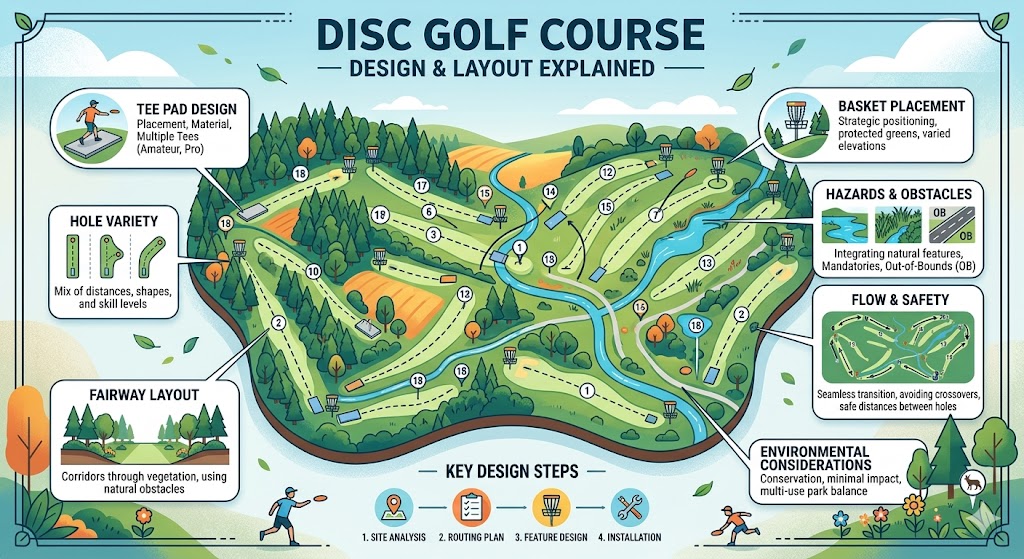
Disc Golf Course Design and Layout Explained: A Beginner’s Guide
Disc Golf is more than throwing discs toward a basket. The course itself shapes your strategy, challenges your skills, and determines how enjoyable your round will be.
Understanding course design early helps beginners:
- Make better throw decisions
- Avoid common mistakes
- Plan for obstacles
- Improve scoring
If you’re brand new to the sport, start with The Ultimate Beginner’s Guide to Disc Golf. That article covers the basics. This guide focuses entirely on the course — how it’s built, why it matters, and how beginners can navigate it effectively.
Why Course Design Matters
Not all Disc Golf courses are created equal. Differences in layout affect:
- Throw strategy
- Disc selection
- Scoring potential
- Safety
A well-designed course challenges players without being unfair. Poorly designed courses frustrate beginners and even experienced players.
By understanding course design, you can make smarter decisions on every hole.
The Basics: Hole Structure
Most Disc Golf holes share a similar structure:
- Tee Pad
- Fairway
- Basket / Target Area
Each component plays a role in how you approach the hole.
Tee Pads
Tee pads mark the starting point of each hole. They come in different forms:
- Concrete pads (most common)
- Rubber mats
- Natural grass or dirt
Key considerations:
- Alignment markers help you aim toward the fairway.
- Tee pad length affects run-up and power.
- Width ensures safe spacing for multiple players.
Proper use of the tee pad prevents foot faults and optimizes throws. For rules on throwing from the tee, see Disc Golf Rules Explained for Beginners.
Fairways
The fairway is the primary throwing corridor between the tee and the basket. Fairway design influences:
- Shot selection
- Disc speed requirements
- Landing zones
Course designers often use natural features such as:
- Trees
- Bushes
- Hills
- Water hazards
Fairway Types
- Open Fairways
- Fewer obstacles
- Emphasis on distance
- Great for beginners
- Wooded Fairways
- Requires accuracy
- Focuses on control over power
- Teaches line management
- Mixed Fairways
- Combines open areas with strategic obstacles
- Balances skill and challenge
Beginners should identify fairway type before throwing. This awareness guides disc choice and strategy. See Disc Golf Discs Explained: Drivers, Midranges, and Putters for guidance.
Baskets and Target Zones
The basket is the end of the hole. Proper basket placement ensures challenge and fairness.
Basket design considerations:
- Height: Standard is ~52 inches off the ground.
- Chains: Chains slow the disc and guide it into the basket.
- Positioning: Placed to require thought in approach shots.
Basket visibility affects play. Hidden baskets require strategic planning. Learning to “read the basket” is a skill beginners develop with practice.
Common Course Features and Obstacles
Trees and Vegetation
Natural obstacles force players to focus on accuracy rather than distance. Beginners often struggle but gain skill quickly by navigating wooded holes.
Tip: Use midrange discs and controlled throws in tight fairways.
Elevation Changes
Hills, slopes, and valleys influence flight and disc choice:
- Uphill throws reduce distance.
- Downhill throws increase glide and risk overshooting.
- Side slopes affect stance and balance.
Reading elevation improves throw planning and scoring.
Water Hazards
Some courses include ponds, lakes, or streams. Water hazards create:
- Risk of disc loss
- Penalty strokes
- Strategic decision-making
Tip: Aim for safe landing zones. Avoid hero shots over water until confidence and accuracy improve.
Mandatories (Mandos)
Mandos are objects or markers that discs must pass on a designated side. Missing a mando results in penalty strokes.
Beginners should pay close attention to course signage. For full rules, see Disc Golf Rules Explained for Beginners.
Out-of-Bounds Areas
Roads, sidewalks, and private property are common OB areas. Designating OB zones maintains safety and fairness.
Beginners often underestimate OB risks. For scoring impact, review How Disc Golf Scoring Works.
Hole Length and Par
Courses include holes of varying length:
- Par 3: ~200–300 feet; most beginner-friendly
- Par 4: ~300–450 feet; introduces multi-shot strategy
- Par 5: Rare; advanced challenge with multiple obstacles
Hole length impacts disc selection, throw strategy, and mental approach.
Flow and Pace of Play
Good courses maintain a natural flow:
- Tees positioned logically for next hole
- Avoiding excessive walking between holes
- Safe spacing between fairways
Poor flow causes slow play and frustration, especially for beginners. Understanding pace helps maintain rhythm and reduces pressure.
Course Difficulty Ratings
Some courses assign difficulty ratings, often based on:
- Obstacle density
- Hole length
- Elevation changes
- Weather exposure
Difficulty ratings guide beginners to courses suited to skill level. Start with beginner-friendly layouts before advancing.
Common Beginner Challenges on Courses
- Misreading fairways
- Underestimating elevation
- Overthrowing into hazards
- Ignoring OB and mando rules
- Poor disc selection
Solution: Study the hole before throwing, select discs wisely, and focus on placement over distance. See Winning Disc Golf Strategies for Beginners.
How to Navigate Courses Efficiently
- Walk the hole briefly before throwing if unsure
- Identify safe landing zones first
- Plan approach throws in advance
- Consider wind and weather
- Communicate with group to avoid disruptions
Smart navigation improves scoring and confidence.
Course Types: Beginner vs Advanced
Beginner Courses:
- Open fairways
- Fewer hazards
- Shorter hole length
- Minimal elevation
Advanced Courses:
- Tight wooded fairways
- Mandatories and OB
- Longer hole length
- Multiple hazards
Beginners should start simple and progress gradually.
Course Design and Strategy Integration
Understanding course design complements other Disc Golf knowledge:
- Smart disc selection reduces penalties
- Awareness of fairways improves placement
- Anticipating elevation and wind improves throw success
For strategy alignment, review:
- Winning Disc Golf Strategies for Beginners
- Disc Golf Discs Explained: Drivers, Midranges, and Putters
- How Disc Golf Scoring Works
Key Tips for Beginners on Any Course
- Walk holes to plan throws.
- Choose discs based on hole layout.
- Play safe lines to avoid hazards.
- Track scoring accurately.
- Practice patience and consistency.
Applying these tips consistently accelerates skill development and scoring improvement.
Final Thoughts: Course Awareness is Skill
Disc Golf isn’t just about throwing discs. It’s about understanding the course and playing strategically.
Beginner-friendly courses teach the fundamentals. Advanced courses challenge precision and decision-making.
By mastering course layout, fairways, obstacles, and flow, you gain a significant edge over casual players.
For full Disc Golf foundation and cluster linkage, explore:
- The Ultimate Beginner’s Guide to Disc Golf
- Disc Golf Discs Explained: Drivers, Midranges, and Putters
- Winning Disc Golf Strategies for Beginners
- Disc Golf Rules Explained for Beginners
- How Disc Golf Scoring Works
Understanding course design transforms your perspective and improves your scoring — and it’s essential for progressing from beginner to advanced player.