
How College Football Walk-Ons Make the NFL
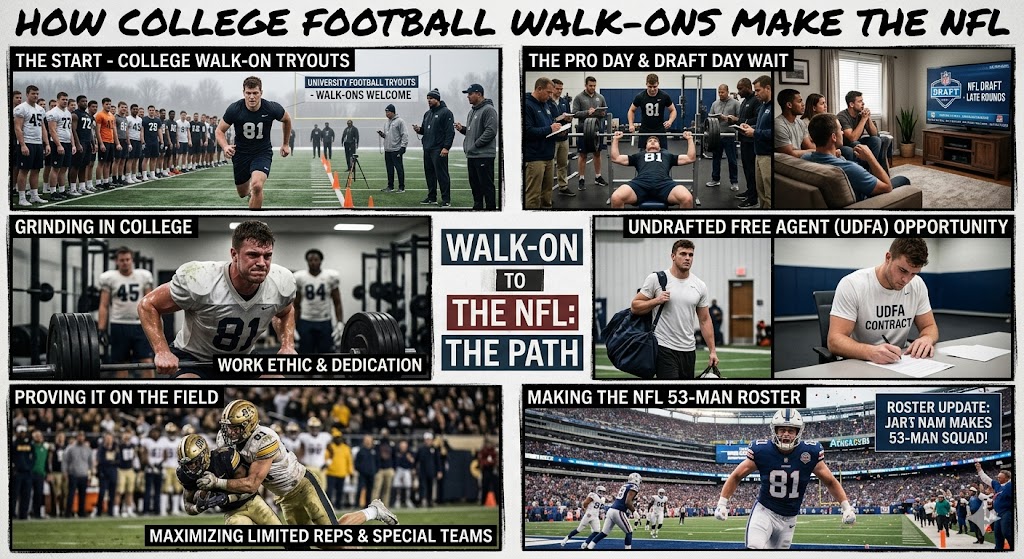
How College Football Walk-Ons Beat the Odds and Make the NFL
Every year thousands of athletes play college football hoping to reach the professional level.
Only a small percentage will ever hear their name called during the draft.
An even smaller group starts their college careers without a scholarship at all.
They are known as walk-ons.
Despite the long odds, a surprising number of walk-ons eventually make it to the National Football League. Some even become stars. Their journeys are rarely easy, but they highlight one of the most compelling realities in football: talent, persistence, and opportunity can come from anywhere.
Understanding how college football walk-ons make the NFL reveals a lot about the structure of modern player development.
What Exactly Is a Walk-On?
In NCAA Division I Football programs, most players arrive on scholarship. These athletes are heavily recruited and their roster spots are secured before they ever step on campus.
Walk-ons are different.
They join the team without an athletic scholarship and must earn their place through tryouts, practice performance, and sheer persistence.
There are two common types:
Preferred walk-ons
- Recruited lightly by the coaching staff
- Guaranteed a roster spot but no scholarship initially
- Often receive scholarships later if they prove themselves
Regular walk-ons
- Attend open tryouts or attempt to join after enrolling
- No guarantees of playing time or long-term roster status
Both paths are extremely challenging. College football rosters are large, but competition is intense at every position.
The Long Odds Walk-Ons Face
Making a college roster is only the first hurdle.
Walk-ons typically begin their careers:
- Buried on the depth chart
- Practicing on scout teams
- Playing little or no game snaps
Meanwhile scholarship players receive most of the early opportunities.
The reality is simple: coaches invest recruiting resources into scholarship athletes. Naturally, those players receive the first chances to develop.
Walk-ons must outperform expectations consistently to move up.
But when they do, coaches take notice.
Development Often Takes Longer
One common trait among successful walk-ons is patience.
Because they usually start behind scholarship players, development often happens gradually.
A typical walk-on progression might look like this:
- Redshirt season while developing physically
- Scout-team contributor during early years
- Special teams role
- Rotational playing time
- Starting position
Once a walk-on becomes a starter at a major college program, professional scouts start paying attention.
Performance matters more than recruiting rankings at that stage.
Special Teams Become a Gateway
Many walk-ons first earn playing time on special teams.
These units value:
- Effort
- Physicality
- Discipline
- Reliability
Walk-ons often thrive in these roles because they bring relentless effort and understand the opportunity in front of them.
Special teams performance can quickly build trust with coaching staffs.
And trust leads to bigger opportunities.
Film Is What NFL Scouts Care About
When scouts evaluate players for the NFL, recruiting history matters very little.
What matters is game film.
If a walk-on becomes a productive starter against high-level competition, scouts will notice.
Professional teams analyze:
- Game performance
- Athletic traits
- Football intelligence
- Consistency under pressure
Once a player demonstrates those qualities at the college level, their walk-on background becomes less relevant.
Production changes everything.
Famous NFL Stars Who Started as Walk-Ons
Several major NFL stars began their careers without scholarships.
J.J. Watt
Watt originally attended Central Michigan University on scholarship as a tight end before leaving the program.
He later walked on at University of Wisconsin and eventually became one of the most dominant defensive players of his generation before starring with the Houston Texans.
Baker Mayfield
Mayfield famously walked on at Texas Tech University before transferring to University of Oklahoma.
He later won the Heisman Trophy and became the first overall pick in the NFL Draft.
Clay Matthews III
Matthews began as a walk-on at University of Southern California.
After years of development, he became a star linebacker for the Green Bay Packers.
These stories show that the path may be unconventional, but it remains possible.
Work Ethic Often Separates Walk-Ons
Many coaches say walk-ons bring a different mentality.
They play with urgency.
Every practice and rep matters. Every opportunity matters.
Scholarship athletes may arrive with expectations and recruiting hype. Walk-ons arrive knowing nothing is guaranteed.
That mentality often produces:
- Exceptional preparation
- Strong leadership qualities
- High effort levels
Those traits translate well to the professional level.
The Transfer Portal Changed the Path
The modern NCAA Transfer Portal has also created new opportunities.
Walk-ons who prove themselves can transfer to programs where playing time is more available.
In the past, athletes often remained buried on depth charts.
Now they can move to situations that better showcase their talent.
More exposure means more chances for NFL scouts to evaluate them.
The NFL Still Values Underdog Stories
Professional teams care about talent first, but they also respect resilience.
Walk-ons have already proven they can overcome adversity.
They’ve earned their way onto college rosters, earned playing time, and often developed into leaders.
That type of journey often reveals something important about a player’s character.
And character matters in a league where the difference between success and failure is often razor thin.
Final Thoughts
The road from college walk-on to the NFL is one of the most difficult paths in sports.
It requires patience, relentless work ethic, and the ability to seize every opportunity that appears.
Most players never reach that point.
But every season a few do.
Their stories remind fans that football development isn’t always predictable. Recruiting rankings fade. Depth charts change. And sometimes the player nobody expected becomes the one everyone notices.
For walk-ons chasing the NFL dream, the path may start without a scholarship—but it doesn’t have to end there.