
Why Sim Racing Is Producing Real Champions
Why Sim Racing Is Producing Real Champions
Not long ago, sim racing was seen as a game.
Fun? Sure. Competitive? Maybe.
But relevant to real-world racing? Not really.
That mindset is gone.
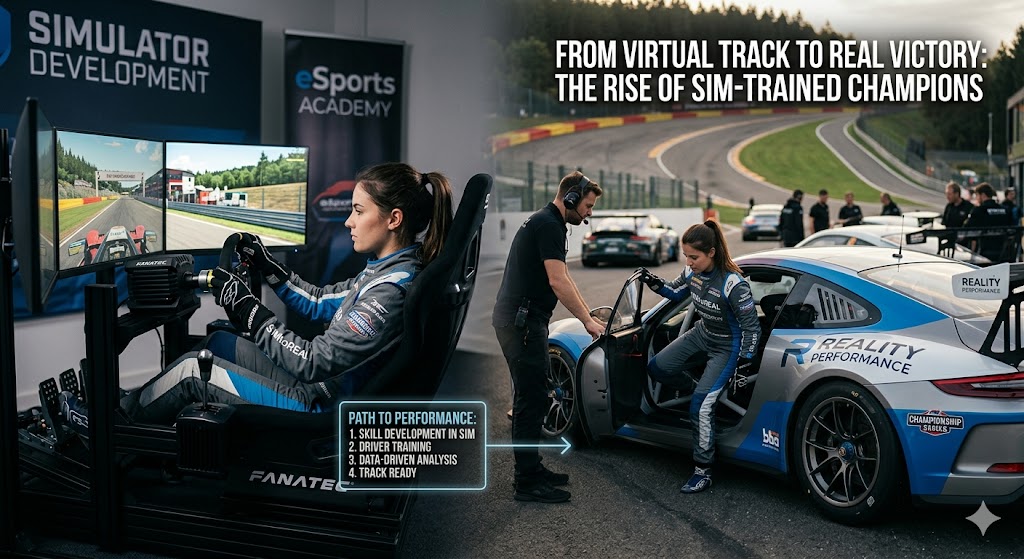
Today, sim racing has become a legitimate training ground—and in some cases, a direct pipeline—for real-world motorsport talent. Drivers are no longer just transitioning from karting to cars. Some are going from a simulator straight into professional racing series.
And they’re not just participating.
They’re winning.
The Line Between Virtual and Real Has Disappeared
Modern racing simulators are nothing like the arcade-style games people remember.
Platforms like iRacing and Assetto Corsa replicate real-world physics with incredible detail.
They simulate:
- Tire wear and grip levels
- Track temperature changes
- Aerodynamics and downforce
- Suspension behavior
- Weather conditions
Drivers aren’t just playing—they’re learning how cars behave under real racing conditions.
That realism is what makes sim racing a powerful development tool.
Repetition Without Risk
One of the biggest advantages of sim racing is something real-world drivers rarely get: unlimited repetition.
In real racing, track time is expensive.
Mistakes cost money—or worse, cause injuries.
In a simulator, drivers can:
- Practice the same corner hundreds of times
- Experiment with different racing lines
- Push the limits without consequences
That kind of repetition builds muscle memory and decision-making speed.
It’s like getting years of track experience in a fraction of the time.
Racecraft Transfers Surprisingly Well
There’s a common assumption that sim racing only teaches technical driving.
But it goes far beyond that.
Sim racers develop real racecraft skills like:
- Overtaking under pressure
- Defending position
- Managing tire wear
- Reading opponents’ tendencies
These are the same skills required in real racing.
And because sim racing competition is so intense, drivers often face high-pressure situations regularly.
That experience translates directly to real-world racing environments.
Reaction Time and Precision Improve
Sim racing demands extreme precision.
At high levels, drivers are making split-second decisions at speeds that leave no room for hesitation.
They learn to:
- React instantly to changes
- Control the car with fine inputs
- Maintain focus over long sessions
These skills carry over to real cars, where reaction time can be the difference between winning and crashing.
Real Examples Are Changing Perception
This isn’t theoretical anymore.
Drivers like Jann Mardenborough proved that sim racers can succeed in real motorsports after earning a professional career through the GT Academy program.
More recently, Max Verstappen—already one of the best drivers in the world—has openly embraced sim racing as part of his training routine.
When elite professionals take sim racing seriously, the entire industry pays attention.
Teams Are Paying Attention
Professional racing teams now actively scout sim racing talent.
Why?
Because simulators reveal important traits:
- Consistency
- Focus
- Adaptability
- Decision-making under pressure
These qualities are hard to teach—but easy to identify in competitive sim environments.
Some teams even use simulators as part of their official driver development programs.
Lower Barriers to Entry
Traditional motorsports have always been expensive.
Karting, travel, equipment—it adds up quickly.
Sim racing lowers that barrier.
A talented driver with the right setup can compete from home and still gain recognition.
That accessibility is expanding the talent pool.
Drivers who might never have had the financial means to enter racing now have a pathway to prove themselves.
Data-Driven Improvement
Sim racing is built on data.
Every lap produces detailed feedback on:
- Lap times
- Racing lines
- Braking points
- Throttle inputs
Drivers can analyze performance instantly and make adjustments.
That constant feedback loop accelerates development.
In real racing, gathering and analyzing that level of data can take much longer.
The Mental Game Is Real
Sim racing may be virtual, but the mental pressure is very real.
Competitive events often involve:
- Long race durations
- High-stakes competition
- Intense focus requirements
Drivers must stay sharp, avoid mistakes, and manage stress.
Those mental skills are critical in real racing—and sim racing builds them effectively.
The Future Is Hybrid Development
The future of driver development is likely a combination of sim and real-world experience.
Young drivers can:
- Build foundational skills in simulators
- Transition to real cars with better preparation
- Continue using sims for practice and analysis
This hybrid approach is faster, more efficient, and more accessible.
Final Thoughts
Sim racing has evolved from entertainment into a legitimate training ground for real-world champions.
It teaches precision, racecraft, and mental toughness—all without the financial and physical risks of traditional racing.
And as technology continues to improve, the connection between virtual and real racing will only get stronger.
The next generation of motorsport champions won’t just come from kart tracks.
Some of them will come from behind a screen—already prepared for the real thing.