
Youth Soccer Development Models Compared Worldwide
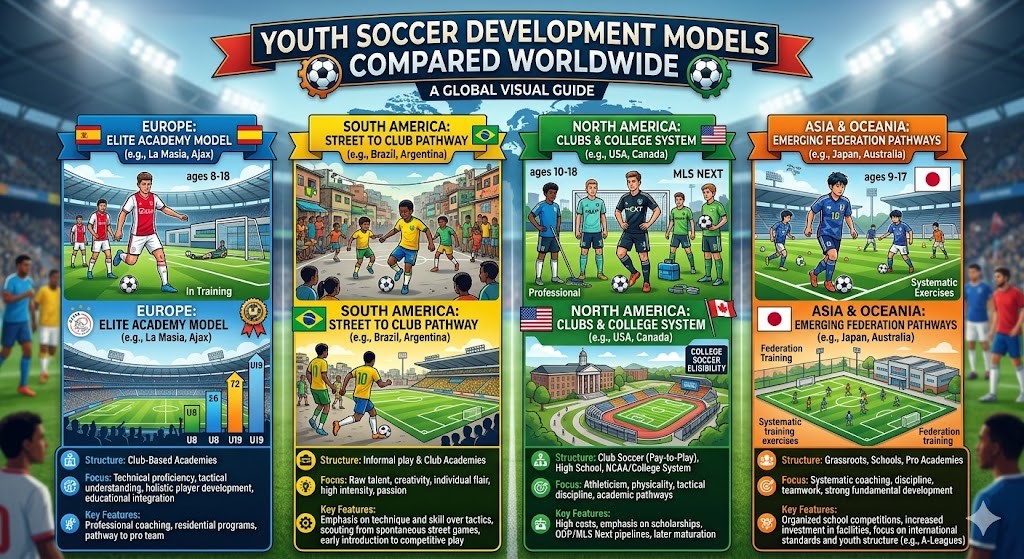
Youth Soccer Development Models Compared Worldwide
Youth soccer development has become one of the most important topics in global sports. Countries invest heavily in developing young talent, knowing that strong youth systems lead to long-term success at the professional and international levels.
However, not all development models are the same.
Different regions approach youth soccer in unique ways. Some prioritize technical skill. Others emphasize physical play. Some rely on club academies, while others build around schools or national systems.
So, how do these models compare—and which ones are producing the best results?
Let’s take a global look.
What Is a Youth Soccer Development Model?
A youth soccer development model is the system a country or organization uses to train and develop young players.
These systems typically include:
- Coaching philosophy
- Training structure
- Competition formats
- Talent identification processes
- Pathways to professional soccer
The goal is simple. Develop skilled, intelligent, and well-rounded players.
However, how that goal is achieved varies widely.
The European Academy Model
Europe is widely considered the gold standard in youth soccer development.
Top clubs operate professional academies that train players from a very young age.
Key Features
- Players join academies as early as age 6–10
- Daily, high-level training environments
- Direct pathway to professional clubs
- Emphasis on technical and tactical development
Countries like Spain, Germany, France, and England all use variations of this model.
Why It Works
The academy system provides:
- Consistent coaching
- Elite competition
- Early exposure to professional standards
Players grow within a structured environment designed for long-term success.
The South American Street-to-Club Model
South America has a very different approach.
While clubs still have academies, many players develop their skills informally before entering structured systems.
Key Features
- Heavy emphasis on street soccer and small-sided games
- Creativity and flair encouraged
- Less rigid early structure
- Players often join clubs later than in Europe
Countries like Brazil and Argentina are known for producing highly skilled, creative players through this model.
Why It Works
This system develops:
- Exceptional ball control
- Improvisation and creativity
- Natural attacking instincts
Players often arrive at academies with unique skill sets that are hard to teach in structured environments.
The U.S. Pay-to-Play Model
The United States has traditionally used a pay-to-play system, although this is evolving.
Key Features
- Families often pay for club participation
- Strong emphasis on organized leagues and tournaments
- Development tied to school and college systems
- Growing presence of professional academies
Major League Soccer clubs have begun investing heavily in youth academies to compete with global standards.
Challenges
The pay-to-play model can:
- Limit access for lower-income players
- Prioritize results over development in some cases
- Create inconsistent coaching quality
Recent Improvements
The U.S. is shifting toward:
- Free academy systems
- Increased professional pathways
- Better coaching education
This evolution is helping close the gap with top soccer nations.
The African Raw Talent Model
Many African nations rely heavily on natural talent and informal development systems.
Key Features
- Limited infrastructure in some regions
- Strong physical and athletic development
- Informal training environments
- Talent often discovered through local competitions
Despite fewer resources, African countries consistently produce elite players.
Why It Works
This model develops:
- Athleticism and resilience
- Passion and competitiveness
- Raw, unpolished talent
However, lack of infrastructure can limit long-term development.
The Asian Discipline and Structure Model
Countries in Asia often emphasize discipline, structure, and technical precision.
Key Features
- Strong focus on repetition and fundamentals
- Organized school and club systems
- High emphasis on teamwork and discipline
- Rapidly improving professional leagues
Japan and South Korea are standout examples of successful development systems.
Why It Works
This approach builds:
- Tactical awareness
- Technical consistency
- Strong team-oriented play
Players are highly disciplined and well-coached from a young age.
The Hybrid Model (Modern Approach)
Many countries are now blending elements from different systems.
This hybrid approach combines:
- Structured academy training
- Creative, small-sided play
- Improved access and inclusivity
- Advanced sports science and analytics
The goal is to create more complete players.
Key Differences Between Models
Structure vs. Freedom
- Europe: Highly structured
- South America: More freedom and creativity
Access and Cost
- U.S.: Historically expensive
- Europe: Often free through academies
Coaching Quality
- Europe: Standardized and elite
- Other regions: Varies widely
Pathways to Professional Soccer
- Europe: Clear and direct
- U.S.: Often indirect (college route)
- Africa: Less formal, more unpredictable
Talent Identification Systems
Finding talent is just as important as developing it.
Different regions use different methods:
- Europe: Scouting networks and academy trials
- South America: Local tournaments and street play
- U.S.: Club and school competitions
- Africa: Regional showcases and informal scouting
Early identification is critical. However, late bloomers must also be supported.
The Role of Coaching
Coaching is one of the biggest factors in player development.
Top systems invest heavily in:
- Coach education programs
- Standardized training methods
- Long-term player development philosophies
Better coaches lead to better players. It’s that simple.
The Importance of Small-Sided Games
Across all successful models, one common element stands out—small-sided games.
These games:
- Increase touches on the ball
- Improve decision-making
- Develop creativity
Even structured systems now incorporate small-sided play to balance development.
Physical vs. Technical Development
Different models prioritize different aspects:
- Europe: Balanced development
- South America: Technical skill
- Africa: Physical ability
- U.S.: Historically physical, now becoming more technical
The best systems combine all three.
Psychological Development
Modern youth systems also focus on mental development.
This includes:
- Confidence building
- Handling pressure
- Decision-making under stress
Players must be mentally strong to succeed at higher levels.
The Impact of Professional Clubs
Professional clubs play a major role in development.
Their academies:
- Provide elite training environments
- Offer clear pathways to professional soccer
- Invest in long-term player growth
Clubs with strong youth systems often enjoy sustained success.
Globalization of Youth Soccer
Youth soccer is becoming more connected globally.
Players now:
- Train in different countries
- Compete internationally at younger ages
- Learn from multiple coaching styles
This globalization is leading to more well-rounded players.
Challenges Across All Models
Despite progress, challenges remain:
- Access and affordability
- Uneven coaching quality
- Overemphasis on winning at young ages
- Burnout and overtraining
Addressing these issues is critical for continued growth.
Which Model Is the Best?
There is no single “best” model.
Each system has strengths:
- Europe: Structure and consistency
- South America: Creativity and flair
- U.S.: Resources and organization
- Africa: Raw talent and athleticism
- Asia: Discipline and technical precision
The most successful approach may be a combination of all these elements.
The Future of Youth Soccer Development
Youth soccer will continue to evolve.
Future trends include:
- Greater use of technology and analytics
- Increased focus on individual development
- More inclusive and accessible programs
- Continued blending of global styles
The goal remains the same—develop better players.
Final Thoughts
Youth soccer development models vary widely across the world, but they all aim to produce skilled, intelligent, and competitive players.
Some systems rely on structure. Others rely on creativity. The best results often come from balancing both.
As the game continues to grow globally, these models will continue to influence one another.
In the end, the countries and clubs that adapt, innovate, and invest in their youth systems will lead the future of soccer.