
Why Defense Matters More Than Batting Average in Baseball
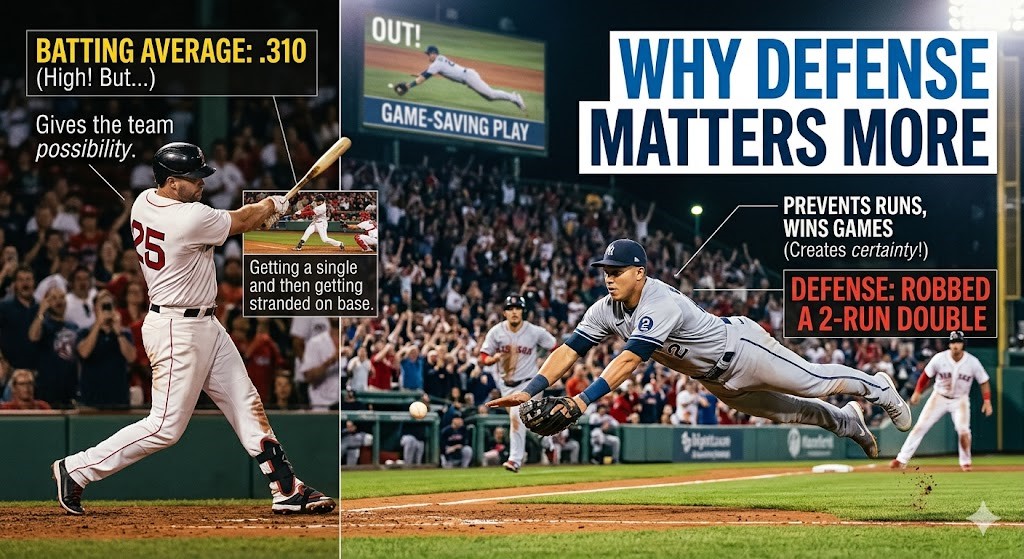
Why Defense Matters More Than Batting Average in Baseball
For decades, batting average was one of the most important statistics in baseball. If a player hit .300, they were considered elite. However, the modern game has evolved—and so has the way teams evaluate players.
Today, defense plays a far greater role in winning than batting average alone.
That doesn’t mean hitting isn’t important. It absolutely is. But when it comes to consistently winning games, preventing runs is often more valuable than simply getting hits.
Let’s break down why defense now matters more than batting average in modern baseball.
The Problem With Batting Average
Batting average is simple. It measures how often a player gets a hit.
However, it has major limitations.
It does NOT account for:
- Walks
- Extra-base hits vs. singles
- Situational hitting
- Defensive value
- Run prevention
A player can hit .300 and still not contribute as much as a player hitting .250 with power, plate discipline, and strong defense.
In other words, batting average tells only part of the story.
Run Prevention Wins Games
Baseball ultimately comes down to one thing—runs.
You need to score runs to win. However, you also need to prevent them.
Defense directly impacts run prevention by:
- Turning balls in play into outs
- Preventing extra bases
- Reducing scoring opportunities
A strong defense can save multiple runs in a single game.
Over a full season, that adds up in a big way.
Every Ball in Play Matters
Unlike strikeouts or home runs, most plays in baseball involve the defense.
That means:
- Ground balls must be fielded cleanly
- Fly balls must be tracked and caught
- Throws must be accurate
A single defensive mistake can lead to:
- Extended innings
- Additional runs
- Momentum shifts
Consistent defensive execution is critical.
Advanced Metrics Show Defensive Value
Modern baseball uses advanced analytics to measure defense more accurately.
Some key defensive metrics include:
- Defensive Runs Saved (DRS)
- Ultimate Zone Rating (UZR)
- Outs Above Average (OAA)
These stats estimate how many runs a player saves compared to an average defender.
In many cases, elite defenders save 10–20 runs per season.
That’s a huge impact—often greater than what batting average alone provides.
Defense Is More Consistent Than Hitting
Hitting can be streaky.
Even great hitters go through slumps.
Defense, on the other hand, is more consistent.
A strong defender:
- Makes routine plays every game
- Maintains positioning and awareness
- Contributes regardless of offensive performance
This consistency provides stability for a team.
Pitching Depends on Defense
Pitchers rely heavily on their defense.
Not every pitcher is a strikeout artist. Many rely on inducing weak contact.
When that happens:
- Fielders must convert balls into outs
- Double plays become critical
- Range and positioning matter
A poor defense can make a good pitcher look average.
A great defense can make a good pitcher look elite.
Preventing Extra Bases Is Critical
Defense is not just about making outs. It’s also about limiting damage.
Great defenders:
- Cut off balls in the outfield
- Hold runners to singles
- Prevent advancement on throws
Saving an extra base can be the difference between:
- A runner scoring or staying on base
- Winning or losing a close game
These small moments add up quickly.
Positional Value Matters
Not all defensive positions are equal.
Premium defensive positions include:
- Shortstop
- Center field
- Catcher
Players at these positions must cover more ground and make more difficult plays.
A strong defender at a premium position provides significant value—even if their batting average is lower.
The Importance of Catchers
Catchers play a unique defensive role.
They impact the game by:
- Framing pitches
- Calling games
- Controlling the running game
- Managing pitchers
A great defensive catcher can improve an entire pitching staff.
This value goes far beyond what batting average can measure.
Range and Athleticism Change Games
Modern defense emphasizes range more than ever.
Players who can cover more ground:
- Turn more hits into outs
- Prevent extra-base hits
- Create highlight-reel plays that shift momentum
Athletic defenders give teams an edge.
They make plays others simply cannot.
Shifts and Positioning
Analytics have also changed defensive strategy.
Teams now use:
- Defensive shifts
- Advanced positioning
- Data-driven alignments
These strategies rely on players who can execute defensively.
Good positioning only works if players have the skill to make the play.
Defense in the Postseason
Defense becomes even more important in the playoffs.
Why?
Because:
- Games are closer
- Runs are harder to score
- Mistakes are magnified
One defensive error can decide an entire series.
Championship teams almost always play strong, consistent defense.
Batting Average vs. Overall Offensive Value
Modern metrics like on-base percentage (OBP) and slugging percentage (SLG) provide a better picture of offensive value.
A player with:
- Lower batting average
- Higher OBP and power
- Strong defense
is often more valuable than a high-average hitter with weak defense.
Teams now evaluate players more holistically.
Examples of Defensive Impact
Consider two players:
Player A:
- Hits .300
- Average defense
Player B:
- Hits .250
- Elite defense
If Player B saves 15–20 runs defensively, they may provide more total value—even with a lower batting average.
This is why teams prioritize defense more than ever.
Building a Balanced Team
The best teams balance offense and defense.
However, modern roster construction often prioritizes:
- Up-the-middle defense (catcher, shortstop, center field)
- Athleticism and range
- Versatility
Teams can find ways to generate offense. But elite defense is harder to replace.
Versatility Increases Defensive Value
Players who can play multiple positions are extremely valuable.
They allow teams to:
- Adjust lineups
- Cover injuries
- Optimize matchups
Defensive versatility adds flexibility and depth.
The Evolution of the Game
Baseball has shifted toward analytics and efficiency.
Teams now understand that:
- Preventing runs is just as important as scoring them
- Defense is measurable and impactful
- Batting average alone is outdated
This evolution has changed how players are evaluated and developed.
The Future of Defense in Baseball
Defense will continue to grow in importance.
Future trends include:
- More advanced tracking data
- Improved defensive metrics
- Increased emphasis on athleticism
Teams that excel defensively will continue to have a competitive advantage.
Final Thoughts
Batting average may still grab headlines, but it no longer defines player value.
Defense plays a critical role in winning games. It prevents runs, supports pitchers, and provides consistency over time.
In today’s game, a player who excels defensively can be just as valuable—if not more—than a high-average hitter.
The smartest teams understand this balance.
And more often than not, they are the ones still playing when it matters most.