
HYROX Divisions Explained
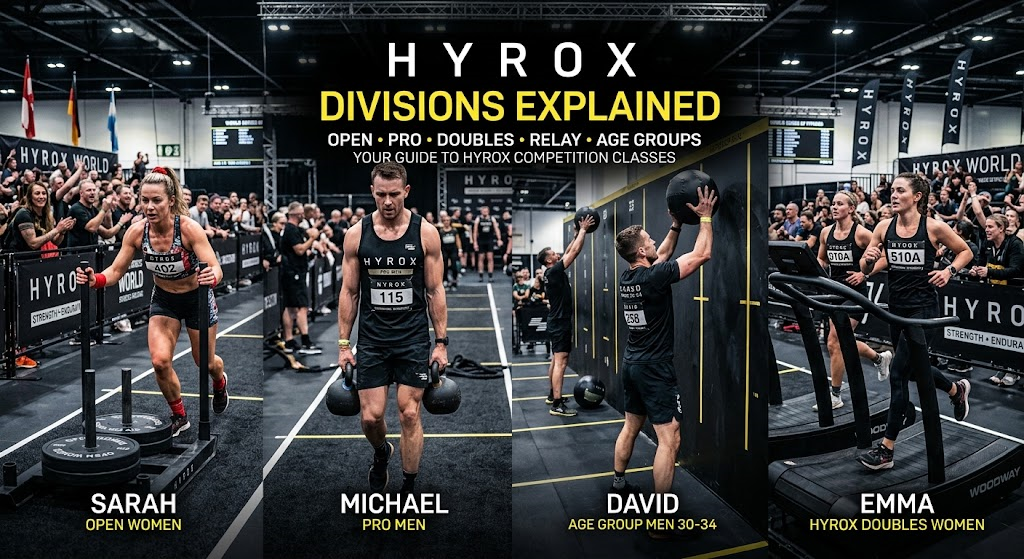
HYROX Divisions Explained: Open, Pro, Doubles, Relay, Age Groups, and What They Mean
Choosing the right HYROX division is one of the most important decisions to make before registering for a race. The division you select affects the competitive experience, the workout requirements, the way you approach training, and the people you compete alongside.
HYROX is designed to accommodate a wide range of fitness levels and competitive ambitions. Some participants want to complete their first fitness race and experience the atmosphere. Others want to challenge themselves against experienced competitors, improve their personal bests, or pursue qualification for higher-level competition. Many prefer sharing the challenge with a partner or a team.
Understanding the available divisions helps you choose an event that matches your goals without making your first race unnecessarily intimidating or selecting a category that does not provide the challenge you want.
The main formats include individual competition, Doubles, and Relay. Depending on the event and season, participants may also have access to Open and Pro categories, mixed-gender team options, adaptive competition, and age-group classifications.
These categories are related, but they do not all mean the same thing. For example, Open and Pro describe competitive categories, Doubles describes a two-person format, and age groups organize competitors by age. Understanding those differences makes registration much easier.
This guide explains the major HYROX divisions, how they differ, what to consider before registering, and how to choose the right option for your first race or your next competitive goal.
What Are HYROX Divisions?
HYROX divisions organize competitors according to the race format and applicable competitive requirements. They help ensure participants understand which rules, workout standards, and classifications apply to their event.
The standard HYROX fitness race follows a recognizable structure: eight 1-kilometer runs combined with eight functional workout stations. The fundamental format remains similar across the main race categories, but the workload, team arrangements, and eligibility requirements can differ.
The most important formats to understand are:
- Open: An individual race category intended to make the standard HYROX challenge accessible to a broad range of competitors.
- Pro: An individual competitive category with more demanding workout requirements, including heavier prescribed loads where applicable.
- Doubles: A two-person team format in which partners run together and share the workout workload according to the rules.
- Doubles Pro: A Pro-level Doubles option available in specified categories and events.
- Relay: A four-person team format in which teammates divide the running and workout responsibilities.
- Age groups: Classifications that organize eligible competitors into age-based categories for results and competition.
- Adaptive: A category with applicable rules and provisions for eligible athletes with disabilities or physical limitations.
Not every format or category is necessarily offered at every event. Eligibility, registration options, championship opportunities, and division-specific standards depend on the current rules and event arrangements.
The best starting point is the official HYROX Rulebook page, which provides the applicable rulebooks for individual, Doubles, Relay, and Adaptive competition. Always check the version for your event and season before making a final decision.
HYROX Open Division: The Standard Individual Challenge
The Open division is a popular choice for athletes who want to experience the full HYROX race individually without entering the Pro category.
Open is not simply a casual or noncompetitive event. Participants still complete the required running segments and workout stations, and results can be compared within the applicable competitive classifications.
It is suitable for people with different athletic backgrounds, provided they prepare appropriately for the event and meet the participation requirements.
What Happens in Open?
In an individual Open race, you complete the running and workout requirements yourself. You are responsible for managing your pace, controlling your effort, and completing each station according to the relevant rules.
There is no teammate to take over when your legs become tired or your grip begins to fail. This makes individual racing a useful way to test your overall fitness and learn how your running ability interacts with strength and endurance.
Open competitors should not assume that the event will be easy. Eight kilometers of running combined with demanding functional exercises can be challenging, particularly for someone who has trained in only one area of fitness.
The division provides an opportunity to test yourself against the full race format while developing experience.
Who Should Consider Open?
Open may be appropriate if you:
- Are preparing for your first individual HYROX race.
- Want to experience the complete event independently.
- Have developed a reasonable foundation in running and functional fitness.
- Want to establish a baseline finishing time.
- Prefer to focus on your own performance rather than coordinate with a partner.
- Want a competitive challenge without choosing the Pro category.
You do not need to be an elite athlete to enter an Open race. However, you should prepare for the event’s physical demands rather than assuming that general gym experience alone will be enough.
Is Open Only for Beginners?
No. Experienced athletes may choose Open for several reasons, including testing their performance, returning after a break, or pursuing a particular competitive objective.
The category is not defined solely by experience level. Participants may have very different backgrounds and finishing times.
A beginner who completes Open has still undertaken the full individual race. An experienced athlete may complete the same format much faster, but both must satisfy the applicable standards.
If you are uncertain about which category suits you, consider your current fitness, experience with the workout stations, and goals for the event rather than judging yourself by the fastest athletes you see online.
HYROX Pro Division: A Greater Competitive Challenge
The Pro division is intended for athletes seeking a more demanding competitive experience. Its workout requirements include heavier prescribed loads than the corresponding Open category where the rules specify those differences.
The precise standards depend on the division, the exercise, and the applicable season’s rulebook. Competitors should not rely on a weight chart from a previous season without checking whether it remains current.
What Makes Pro Different?
The overall race structure is familiar, but the increased workload can make individual stations substantially more demanding.
Heavier sled work, loaded carries, and other prescribed exercises can place greater demands on strength and muscular endurance. Athletes must still run the required distance and manage the cumulative fatigue created by the full sequence.
This means that Pro is not merely an opportunity to lift heavier weights. It requires the ability to use strength repeatedly while maintaining enough cardiovascular fitness to keep moving between stations.
An athlete who is very strong but struggles to run under fatigue may find the Pro division challenging. Likewise, an excellent runner may need additional strength preparation before the increased station demands become manageable.
Who Should Consider Pro?
Pro may be appropriate for athletes who:
- Have previous HYROX experience or substantial preparation for the format.
- Can complete the relevant workout standards safely and consistently.
- Have developed adequate running endurance.
- Want a more demanding individual competition.
- Have specific performance goals that align with the Pro category.
- Are interested in higher-level competitive opportunities, subject to qualification and eligibility requirements.
You do not need to have won an Open event to consider Pro. However, you should have a realistic understanding of your capabilities and the demands of the applicable standards.
Should You Move From Open to Pro?
Moving up should be based on preparation rather than pride.
A strong Open result can be one useful indicator, but your overall finishing time does not tell the entire story. Consider how you handled each station, whether your technique remained reliable, and whether you could recover sufficiently to run well afterward.
If the heavier Pro requirements would force you to use poor technique or take excessive breaks, additional training may be more productive than an immediate division change.
Practice the relevant movements with appropriate loads, develop strength progressively, and evaluate how well you can maintain performance under fatigue.
For more guidance, read HYROX Strength Training: How to Get Stronger for Sleds, Carries, Lunges, and Wall Balls and How to Train for HYROX: Strength, Running, Endurance, and Functional Fitness.
HYROX Doubles: Competing With a Partner
Doubles offers a different experience from individual racing because two athletes complete the event as a team.
Partners run together and share the prescribed workout workload according to the applicable rules. The format introduces a strategic element: competitors must coordinate their efforts, communicate effectively, and divide work in a way that suits both athletes while satisfying the movement and participation requirements.
Doubles can appeal to friends, couples, training partners, and athletes who enjoy working toward a shared result.
How Does Doubles Work?
In Doubles, both partners complete the required running segments together, subject to the event rules. At workout stations, partners divide the workload according to the permitted work-sharing rules.
This does not mean that one partner can simply complete the entire race while the other rests. Both athletes must follow the relevant requirements, and the team must complete the full prescribed workload.
The opportunity to share station work can change how the race feels. One partner might perform a portion of a station while the other recovers, then switch roles when appropriate.
The best arrangement depends on the exercise, each athlete’s strengths, and how quickly each person recovers.
Open Doubles
Open Doubles is a useful option for athletes who want to experience HYROX with a partner while following the Open requirements for their selected category.
The pair may have different strengths. One person might be a better runner, while the other has greater muscular endurance or handles certain stations more comfortably.
However, the running requirement means partners must be able to stay together. A very fast runner paired with someone who cannot maintain the required pace may need to adjust expectations.
Open Doubles can be particularly appealing for people who find the idea of an individual race intimidating but still want to complete the HYROX format.
Pro Doubles
Where offered, Pro Doubles combines the two-person format with the applicable Pro workout standards.
This option is intended for teams prepared to handle the more demanding requirements. Both partners should understand the relevant standards and train with the actual expectations of their division in mind.
A team should not assume that sharing the work automatically makes Pro easy. The prescribed workload remains demanding, and both partners must contribute within the permitted format.
Pro Doubles eligibility and competitive pathways can also differ from individual Pro competition. Check the current Doubles rulebook before registering.
Choosing the Right Doubles Partner
Your partner can have a major influence on the race experience.
A useful partner is not necessarily the strongest person you know. Reliability, compatible goals, communication, and a willingness to prepare together can be equally important.
Before committing to a team, discuss:
- Your expected finishing-time range.
- Your current running ability.
- Your experience with the workout stations.
- Your preferred division and competitive goals.
- How you intend to divide the work.
- How often you can train together.
- How you will communicate when one partner becomes fatigued.
A partner who is slightly less experienced but trains consistently may be a better choice than someone who is stronger but unreliable.
How Should Doubles Partners Divide the Work?
The best approach is to develop a plan during training rather than improvising throughout the race.
For example, one partner may handle a larger share of a station that suits their strengths, while the other contributes more at a different station. The plan should remain flexible enough to account for fatigue.
Do not assume that the same division of work will be ideal for every exercise. Some movements may favor one partner, while another station may be more comfortable for the other.
Practice the relevant movements together and confirm which work-sharing arrangements are permitted under the current rules.
For additional preparation, review HYROX Race Strategy: How to Pace Yourself, Manage Transitions, and Finish Strong. Its pacing principles can help Doubles teams coordinate their running and station efforts.
HYROX Doubles Categories: Men, Women, Mixed, and Pro Options
Doubles is a race format, but it can also include different competitive categories based on team composition and the applicable rules.
Common categories have included Women’s Doubles, Men’s Doubles, and Mixed Doubles, with Pro options available in specified men’s and women’s categories and events.
The exact list of available categories must be confirmed for the season and event you intend to enter.
Women’s and Men’s Doubles
These categories organize teams according to the applicable competition rules.
Partners should confirm the requirements for their selected category, including workout standards, equipment, and any relevant registration or age-group classifications.
Do not assume that all Doubles categories use identical loads or that a standard from one category automatically applies to another.
Mixed Doubles
Mixed Doubles provides an opportunity for partners of different genders to compete together under the applicable mixed-category rules.
The appeal is straightforward: teammates can combine different athletic strengths and work toward a shared result. However, the category still requires both partners to understand the race structure, the work-sharing rules, and the standards that apply to their team.
Before registering, confirm the current Mixed Doubles requirements. A team should not rely on information from a different division or season.
Can Doubles Partners Have Different Fitness Levels?
Yes, partners can have different fitness backgrounds, but those differences must be considered during preparation.
If one athlete is substantially faster, the pair should practice running together at a pace that both can sustain. If one partner is stronger at the stations, they may be able to take a larger permitted share of certain tasks.
The goal is to develop a balanced team performance rather than force both athletes to perform identically.
Training together also helps partners recognize when a teammate needs encouragement, when a planned switch is appropriate, and when the original strategy needs to change.
HYROX Relay: Competing as a Four-Person Team
Relay is a team format designed around sharing the event among four participants. Instead of every athlete completing the entire race individually, teammates divide the running and workout responsibilities according to the Relay rules.
For many participants, this creates a more social way to experience HYROX while still providing a meaningful physical challenge.
Relay can appeal to workplace teams, gym groups, friends, family members who meet eligibility requirements, and athletes who want to compete collectively.
How Does HYROX Relay Work?
In the standard Relay concept, each of the four teammates is assigned portions of the running and workout sequence. The current Relay rulebook specifies how the running segments and stations are allocated and how the team must complete the event.
HYROX Relay has commonly been structured so that each team member completes two 1-kilometer runs and two workout stations. However, competitors should verify the current format and assignment requirements in the official Relay rulebook before their event.
The essential difference is that each athlete is responsible for a portion of the race, while the team’s overall result reflects the combined performance.
Who Should Consider Relay?
Relay may be appropriate if you:
- Want to experience HYROX with friends or teammates.
- Prefer a shared team challenge over an individual race.
- Have a group with different strengths and experience levels.
- Want to introduce people to fitness racing in a team setting.
- Enjoy communicating and working toward a collective goal.
Relay is not automatically easy. Individual responsibilities can still be demanding, and a team benefits from preparation and coordination.
How Should a Relay Team Choose Its Members?
Look for a group that can prepare together and communicate reliably.
A team might include a strong runner, an athlete with excellent functional strength, and two well-rounded participants. However, the ideal arrangement depends on the event rules and which stations each member must complete.
Do not build the team entirely around a single impressive athlete. Everyone needs to be capable of performing their assigned responsibilities safely and to the required standard.
Discuss goals, training availability, and expectations before registering. A team seeking a competitive result may organize preparation differently from a group whose main objective is participation and enjoyment.
Can Relay Teammates Specialize?
Team members can consider their individual strengths when preparing, but station assignments and the required sequence must follow the official rules.
Before race day, establish who is responsible for each section, confirm any permitted assignment choices, and rehearse the handoffs or transitions required by the event.
A well-organized Relay team can avoid confusion and unnecessary delays. A team that has not discussed its responsibilities may waste valuable time deciding what to do during the event.
HYROX Age Groups Explained
Age groups are separate from the basic race format. They allow eligible competitors to be classified against others in defined age ranges, providing another way to compare results.
For example, an individual athlete may enter an Open or Pro category and also be classified within an applicable age group. In team formats, age-group classification and eligibility follow the relevant Doubles or Relay rules.
The precise age bands and the way age is calculated can vary according to the applicable rulebook and competition system.
Why Do Age Groups Matter?
Age-group classifications can help competitors compare their performances with athletes of similar ages.
This can be especially useful for people who do not expect to rank near the top of the overall field but want a meaningful competitive target.
An age-group result may also matter for championship qualification or other competitive opportunities when those are offered under the applicable rules.
However, age-group classification does not necessarily change the basic race format. Competitors must still complete the prescribed running and workout requirements for their division.
How Is Your Age Group Determined?
Do not assume that the age you are when you purchase a ticket is necessarily the age used for classification.
The applicable rules explain how age is calculated for the event and which age bands apply. Your classification may depend on your age on a specified date associated with the competition.
Because the details matter, check the current rulebook rather than relying on a previous event’s age-group chart.
Are Age Groups the Same as Open and Pro?
No. Open and Pro identify competitive categories with different requirements where specified. Age groups organize eligible athletes by age for classification and results.
An athlete may therefore compete in a particular division and also appear in an age-group ranking, provided the event’s rules and ranking system allow it.
Understanding this distinction prevents a common registration mistake: treating an age group as if it were a separate workout format.
HYROX Adaptive Competition
HYROX also provides Adaptive competition categories for eligible athletes with disabilities or physical limitations, subject to the applicable rules.
Adaptive competition is intended to support participation while establishing the relevant requirements and procedures for the athlete and event.
The precise categories, permitted adaptations, equipment considerations, and eligibility processes should be checked in the official Adaptive rulebook.
Why the Adaptive Rulebook Matters
Adaptive competition may involve requirements that differ from the general individual format. Athletes should not assume that the standard Open or Pro rules fully describe what applies to them.
The official rules provide the appropriate starting point for understanding eligibility, competition procedures, and any permitted adaptations.
If you are considering an Adaptive event, review the current documentation and contact the event organizer or official HYROX support if you need clarification about a particular requirement.
The objective is to understand the rules before registration so you can prepare for the event with accurate information.
How to Choose the Right HYROX Division
Choosing the right division begins with an honest assessment of your goals, fitness, and preferred competitive experience.
There is no universal best option. The right choice is the one that provides an appropriate challenge while matching your preparation and the experience you want.
Choose Open If You Want to Test Yourself Individually
Open is worth considering if you want to complete the full race independently and establish a personal benchmark.
It can be a strong starting point for a first-time competitor who has prepared for the running and workout demands but does not yet have a reason to select Pro.
Choose Pro If You Are Prepared for the Increased Demands
Pro may be suitable if you have trained for its specific standards and want a more demanding competitive experience.
Review the relevant loads and movement requirements, assess your training results, and make sure your preparation reflects the actual division you intend to enter.
Do not select Pro solely because you feel that Open is not challenging enough in theory. Choose it because you are ready for the requirements.
Choose Doubles If You Enjoy Shared Competition
Doubles is a strong option for people who want to compete with a partner and divide the workout responsibilities within the rules.
It can be especially appealing if you enjoy training with someone else or want a shared goal. However, make sure your partner is committed to preparing for the event and that both of you understand the selected category.
Choose Relay If You Prefer a Team Experience
Relay may be the best fit if you want to share the challenge with a group of four.
It provides an opportunity to coordinate with teammates and contribute to a collective result. Confirm the current assignment rules and make sure every member is prepared for their responsibilities.
Consider Age-Group Goals Separately
If competing against athletes of similar ages matters to you, check the applicable age-group classifications and ranking rules.
Remember that age group and division are different concepts. Your primary registration choice still needs to reflect the format and standards you want to complete.
How Your Division Should Affect Your Training
Your division choice should influence how you prepare.
Although many training principles overlap, different categories can create different demands. Training should reflect the running, workout standards, and team responsibilities that apply to your intended event.
Training for Open
Open preparation should develop a balanced foundation of running endurance, functional strength, and muscular endurance.
Practice the complete sequence of running and workout stations so you understand how your performance changes under fatigue.
If you are new to the format, focus on consistent technique and sustainable effort rather than trying to train at maximum intensity every session.
Training for Pro
Pro preparation should include the specific strength and endurance demands of the prescribed standards.
Progressively develop the ability to handle the required loads while maintaining sound technique. Also practice running after demanding station work, because strength alone will not carry you through the full event.
Avoid testing your maximum capabilities in every workout. Build capacity progressively and allow adequate recovery.
Training for Doubles
Doubles partners should practice individually and together.
Individual sessions help each athlete develop personal fitness, while shared sessions build coordination, establish work-sharing strategies, and test the pace both partners can sustain.
Practice the permitted station arrangements and discuss how to respond if one partner becomes more fatigued than expected.
Training for Relay
Relay teams should prepare for the sections assigned to each member under the event rules.
Each teammate should understand their responsibilities and develop the capacity to complete them safely. Group practice can help the team rehearse assignments, transitions, and communication.
The team should also establish realistic expectations. A successful Relay experience depends on the collective performance, not just the strongest member.
Build a Structured Preparation Plan
Whatever division you choose, a structured program can help you balance running, strength, station practice, and recovery.
Use HYROX Training Plan: How to Build a Race-Ready Program From Beginner to Competition as a companion resource for organizing your preparation. The parent guide, The Ultimate Beginner’s Guide to HYROX: Events, Workouts, Training, Rules, and How to Get Started, also provides a broader introduction to the event.
Common Mistakes When Selecting a HYROX Division
A few avoidable mistakes can lead to disappointment or unnecessary stress before race day.
Choosing a Division Based on Ego
Some athletes choose a more demanding category because they believe it will look more impressive.
Your division should reflect the challenge you want and the standards you are prepared to meet. A well-executed Open race can be a meaningful achievement, just as a prepared Pro performance can be a rewarding competitive goal.
Assuming Doubles Is Half the Race
Sharing workout responsibilities does not mean that Doubles requires no preparation. Partners still need to run together and complete their portions of the stations according to the rules.
A team with poor coordination or insufficient running fitness can struggle even if one partner is exceptionally strong.
Treating Relay as a Casual Activity
Relay can be social and accessible, but it still involves a demanding event format. Teammates should understand their responsibilities and train appropriately.
Using Outdated Rules
Loads, division availability, eligibility requirements, and competitive pathways can change between seasons.
Always check the current official rulebook and event information. Do not assume that a chart or article from a previous season describes the requirements for your upcoming race.
Ignoring Team Compatibility
For Doubles and Relay, athletic ability is only one part of the decision. Reliability, communication, training commitment, and compatible goals also matter.
A team that prepares together and understands its responsibilities is better positioned to enjoy the experience and perform consistently.
Frequently Asked Questions About HYROX Divisions
What is the difference between HYROX Open and Pro?
Open and Pro are individual competitive categories with different workout requirements where specified. Pro generally involves heavier prescribed loads and is intended for athletes seeking a more demanding challenge. Check the current rulebook for the exact standards that apply to your event.
Is HYROX Open suitable for beginners?
Open can be suitable for beginners who have prepared for the event’s physical demands. It is not necessary to be an elite athlete, but participants should develop sufficient running endurance, functional strength, and familiarity with the stations before racing.
What is the difference between Doubles and Relay?
Doubles involves two partners who run together and share the workout workload according to the rules. Relay involves a team of four that divides the running and workout responsibilities. The precise allocation and requirements are described in the applicable rulebooks.
Can I compete in HYROX Doubles with a friend?
Yes, subject to the event’s eligibility and registration rules. You should choose the appropriate Doubles category, understand the relevant standards, and prepare together so you can coordinate your running and station strategy.
Does HYROX have mixed-gender Doubles?
Mixed Doubles has been an available category, allowing eligible partners to compete together. Confirm the current category options and requirements for your particular event and season before registering.
What is HYROX Doubles Pro?
Doubles Pro is a Pro-level team option available in specified categories and events. It combines the two-person format with the applicable Pro requirements. Review the current Doubles rulebook to confirm which options are offered and what standards apply.
How many people are on a HYROX Relay team?
The standard Relay format uses four teammates. Each member completes assigned portions of the race under the applicable rules. Confirm the current allocation and participation requirements before your event.
Does HYROX have age-group competition?
Yes, HYROX uses age-group classifications under its applicable competition rules. Age groups are distinct from categories such as Open and Pro. The exact bands and classification procedures should be checked in the current rulebook.
Can I switch from Open to Pro after registering?
Whether a change is permitted depends on the event’s registration policies, deadlines, and availability. Contact the organizer or official support before assuming you can change divisions. It is best to select the intended category carefully at registration.
Which HYROX division is best for my first race?
For many first-time individual competitors, Open is a reasonable place to start. Doubles or Relay may be more appealing if you prefer sharing the experience. Pro is worth considering when your preparation matches its requirements. The best choice depends on your goals, fitness, and the experience you want.
Final Thoughts: Select the Division That Matches Your Goals
HYROX offers different ways to experience fitness racing, from completing the full event individually to sharing the challenge with a partner or a four-person team.
Open can provide a meaningful individual test for a wide range of athletes. Pro offers a more demanding competitive challenge. Doubles combines individual effort with teamwork, while Relay allows four teammates to divide the event. Age groups provide another way to classify results, and Adaptive competition has its own applicable rules and provisions.
The most important step is to understand the differences before registering. Review the current standards, evaluate your preparation, and choose the format that fits your goals.
Once you have selected your division, use that decision to guide your training. Practice the appropriate movements, develop your running endurance, and prepare for the specific requirements of your event.
HYROX is a challenge that rewards preparation, consistency, and smart decisions. Choose the division that motivates you, train for the standards you will face, and arrive on race day ready to give your best performance.