
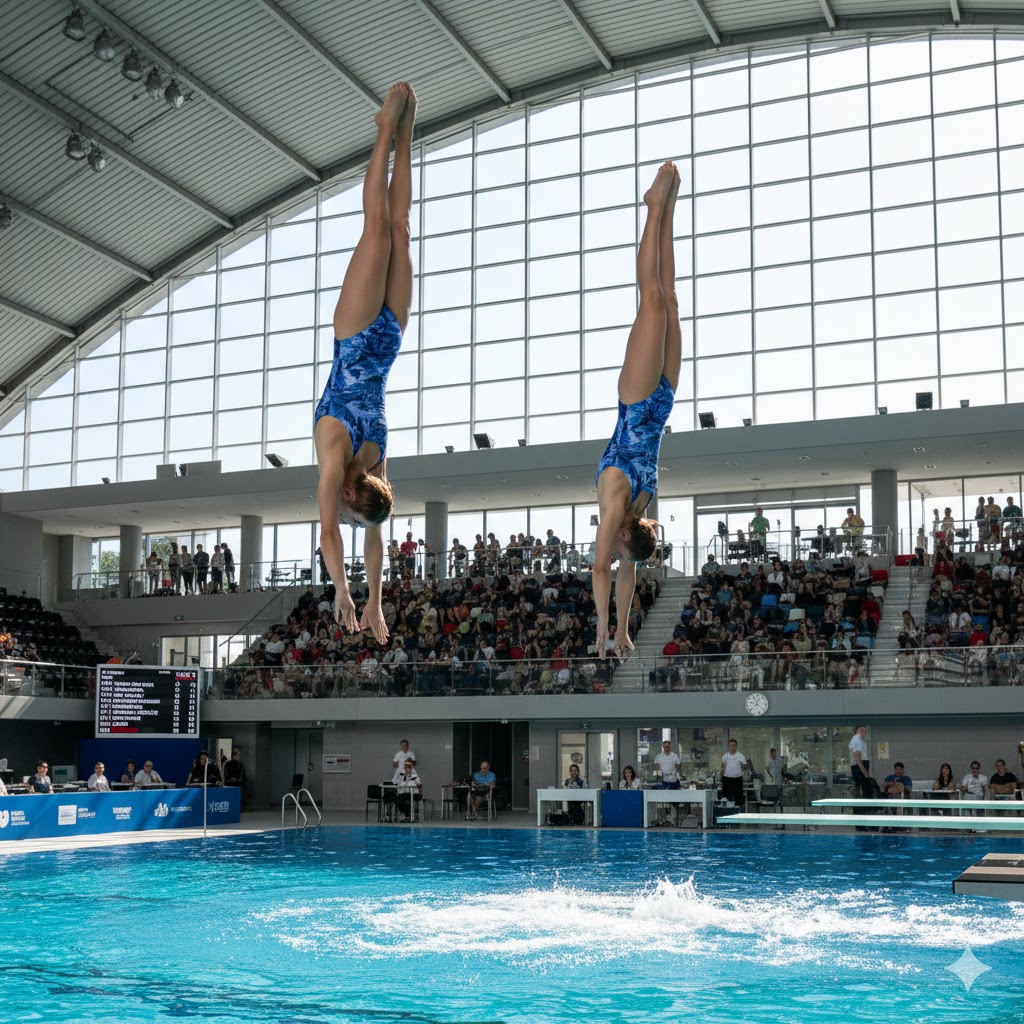
The Art and Athleticism of Synchronized Springboard Diving
Synchronized Springboard Diving is one of the most visually captivating sports in the world. It combines precision, timing, and artistic expression. Every movement demands focus and trust between partners. The sport is a thrilling mix of grace and discipline. It has grown from simple beginnings into a global competition that attracts fans and athletes alike.
In this post, we’ll explore the fascinating history of the sport, its worldwide popularity, how amateurs participate, professional organizations that govern it, its social and political impact, and the detailed rules that define it.
The Origin and History of Synchronized Springboard Diving
The roots of diving date back to the late 19th century in Europe. Early divers were gymnasts who began performing acrobatic stunts into the water. The idea of synchronizing two divers, however, came much later.
By the early 20th century, springboard diving had already become part of the Olympic Games. Athletes performed solo routines judged for form and entry. Coaches soon noticed that pairs of divers training side by side often mirrored each other naturally. That observation sparked the concept of synchronized diving.
The first official synchronized diving exhibitions took place in the 1950s. They were primarily entertainment acts at aquatic shows. Audiences loved watching two divers leap simultaneously, twisting and flipping in perfect unison. This response encouraged the sport’s formal development.
Throughout the 1980s and 1990s, diving federations began experimenting with competition formats for synchronized events. The International Swimming Federation (FINA), which oversees aquatic sports, officially recognized synchronized diving as a discipline in the mid-1990s.
By the 2000 Sydney Olympics, synchronized events were included for both men and women on the 3-meter springboard and 10-meter platform. That debut drew massive attention. Viewers admired the perfect harmony and precision required to succeed.
Since then, the sport has evolved rapidly. Training has become more scientific, with biomechanics and video analysis improving synchronization accuracy. Today, synchronized diving represents one of the highest expressions of teamwork in aquatic sports.
Global Popularity of Synchronized Springboard Diving
Synchronized diving’s beauty lies in its universal appeal. Nearly every major diving nation participates in international competitions.
China dominates the sport and is often the gold standard. The country’s athletes have set records for precision and control. They train in specialized aquatic centers that emphasize synchronization from an early age.
The United States and Russia also maintain strong traditions in springboard diving. American universities offer world-class training programs, producing Olympic-caliber athletes. Russia’s diving schools focus heavily on artistic synchronization and choreography.
Across Europe, countries like Germany, Great Britain, and Italy have built impressive synchronized diving programs. These nations regularly appear in World Championships and European Aquatics events.
In Asia, Japan and Malaysia have gained global respect. Their disciplined approach and technical finesse have brought them to podium finishes in recent years. Australia, too, has emerged as a powerhouse with its dedicated diving academies and ocean-inspired culture.
Even smaller nations are joining the stage. Nations such as Mexico, Canada, and Ukraine continue to produce competitive synchronized divers. Their participation shows the sport’s worldwide reach.
Television coverage and social media have expanded its visibility. Highlight reels of perfectly timed dives circulate online, inspiring new generations of athletes. Each competition showcases not only athleticism but also the beauty of human coordination and trust.
Amateur Synchronized Springboard Diving Around the World
Synchronized diving begins long before athletes reach professional status. Around the globe, countless young divers practice in community pools, schools, and local clubs.
In many countries, children start in basic swimming and gymnastics programs. These early skills build the foundation for future diving success. Once they demonstrate aptitude, coaches introduce them to springboard techniques.
Amateur programs focus heavily on fundamentals. Divers learn approach steps, takeoffs, and body alignment before they even attempt synchronization. After mastering solo dives, pairs are formed. Coaches carefully match athletes of similar height, strength, and timing instincts.
In the United States, many high schools include diving in their sports programs. However, synchronized events are more common at the club and collegiate level. The Amateur Athletic Union (AAU) and USA Diving host regional and national meets where youth teams compete.
Across Europe, diving academies are widespread. In the United Kingdom, for example, city programs supported by British Diving provide structured pathways for children. Germany and Italy run similar initiatives through their national sports federations.
Asian countries are especially rigorous. In China, promising athletes are often selected for sports schools at a young age. There, synchronized training begins alongside individual practice. Coaches use synchronized drills to enhance timing and rhythm even before full routines are introduced.
Amateur competitions emphasize learning and fun as much as performance. Judges encourage synchronization, control, and clean entries rather than complexity. As athletes mature, their dives grow more ambitious.
Community and youth-level synchronized diving builds essential life skills. Athletes develop trust, communication, and patience. Each practice reinforces the idea that two people can move as one when dedication meets teamwork.
Professional Leagues and International Competitions
The highest level of synchronized springboard diving features some of the most skilled athletes in the world. FINA (Fédération Internationale de Natation), now rebranded as World Aquatics, oversees international rules and competitions.
The most prestigious event is the Olympic Games. Every four years, pairs from around the globe compete for gold on the 3-meter springboard. Olympic synchronized diving events attract millions of viewers worldwide.
The FINA World Championships are another major stage. Held every two years, they bring together elite divers to showcase innovation and artistry. Winning at this level signifies mastery of the sport.
The FINA Diving World Series, launched in 2007, offers annual competition between the top-ranked teams. It travels to multiple host cities, promoting global engagement. This series allows athletes to refine techniques between major tournaments.
Each continent also has its own regional championships. Europe hosts the European Aquatics Championships, while Asia and the Americas conduct their respective continental events.
Professional divers often belong to national teams. These organizations provide full-time coaching, nutrition, physiotherapy, and performance analysis. The commitment required is immense. Many athletes train six days a week, performing hundreds of dives in preparation for competition.
Sponsorship has become vital to professional success. Companies linked to sportswear, nutrition, and fitness support elite divers. This financial backing helps maintain the demanding training schedules needed to compete internationally.
Even outside FINA’s framework, professional exhibitions and invitationals highlight synchronized diving’s artistry. Some nations host televised diving galas that combine athletic performance with entertainment.
Professional synchronized springboard diving thrives on precision and showmanship. Each dive tells a story of mutual trust and countless hours of shared discipline.
Social and Political Significance of the Sport
Sports often reflect broader social themes, and synchronized diving is no exception. Its essence—two individuals moving in harmony—symbolizes cooperation and balance.
Politically, the sport serves as a bridge between nations. International competitions encourage diplomacy through athletic exchange. Athletes from diverse backgrounds compete respectfully, fostering mutual admiration.
During the Cold War, diving competitions between the United States and the Soviet Union became a stage for soft power. Victories were seen as demonstrations of national excellence. Yet, beneath the rivalry lay mutual respect for technical skill.
Today, synchronized diving continues to promote unity. Mixed-gender exhibition events, though unofficial, have increased calls for greater gender inclusivity in aquatic sports. The synchronized nature of the sport reinforces equality—each diver holds equal responsibility.
Socially, synchronized diving has opened opportunities for youth worldwide. Many community pools now offer affordable diving lessons. For children from disadvantaged backgrounds, these programs provide purpose and potential pathways to scholarships.
In addition, the sport has broken stereotypes about physicality and beauty. Male divers display grace once associated only with female athletes. Female divers exhibit power traditionally admired in men’s sports. Together, they redefine athletic aesthetics.
The sport also promotes mental health awareness. Synchronization requires emotional stability and calm under pressure. Teams often speak about mindfulness and trust as keys to success. These lessons carry over into everyday life.
Finally, synchronized diving contributes to cultural diplomacy. Nations often exchange coaching expertise and training programs. These collaborations strengthen international friendship beyond politics.
Through its elegance and discipline, the sport mirrors society’s desire for cooperation, balance, and shared success.
Rules and Scoring in Synchronized Springboard Diving
While synchronized diving may appear simple to spectators, its rules are detailed and precise. Every aspect—from takeoff to entry—is carefully judged.
The Equipment
Synchronized springboard events are performed on 3-meter flexible boards. Both boards must be identical and adjusted to the same tension. The pool depth is at least 5 meters to ensure safety.
The Dive Routine
Each pair performs a set number of dives—usually five or six—depending on the competition level. These include both required and optional dives.
Divers must choose from a list of predefined groups: forward, backward, reverse, inward, and twisting. The degree of difficulty (DD) is assigned to each dive based on its complexity.
Execution and Synchronization
Judges evaluate two main elements: execution and synchronization.
- Execution refers to each diver’s technique, form, and control.
- Synchronization covers timing, height, distance, and angle alignment.
For each dive, 11 judges are typically used. Five focus on synchronization, and three judge each diver’s execution. The highest and lowest scores in each category are dropped to reduce bias.
The remaining scores are averaged, multiplied by the degree of difficulty, and then doubled (to account for both divers).
Entry and Splash
The entry is critical. Judges look for vertical entry and minimal splash. Clean entries demonstrate control and precision. Even a slight timing difference between divers can cost points.
Approach and Takeoff
Before takeoff, divers must perform identical approaches. Steps, arm swings, and board bounces should match perfectly. Any visible difference reduces synchronization marks.
Rotation and Twist
During flight, divers must maintain equal speed and rotation. Synchronization depends on spatial awareness and trust. Many teams use peripheral vision and rhythm counting to maintain timing midair.
Penalties
Penalties occur for early or late takeoffs, differing board positions, or missed synchronization. Miscommunication or hesitation can drastically reduce a team’s score.
Time Limits
Competitors must perform within specific time limits after the referee’s signal. Delays can lead to point deductions.
Attire and Presentation
Uniforms must be identical in color and design. Presentation also counts; confident posture and team composure affect overall impression.
Victory and Advancement
The team with the highest combined score after all dives wins. In multi-round competitions, cumulative scores determine advancement.
These rules highlight how detail-oriented the sport is. Even the smallest imperfection can separate champions from contenders.
The Science Behind Perfect Synchronization
Modern synchronized diving relies heavily on biomechanics and physics. Coaches analyze dives using high-speed video and motion sensors.
Timing is measured in milliseconds. Successful pairs often train together for years to develop identical instincts. They learn to breathe, jump, and rotate as one.
Body positioning determines success. The center of gravity, angular momentum, and entry angle are calculated for maximum performance. Athletes spend hours refining these mechanics on dryland boards before moving to the pool.
Strength training focuses on core stability, leg power, and flexibility. Meanwhile, psychological conditioning helps divers maintain calm under intense pressure.
Technology has revolutionized preparation. Virtual reality simulations now allow divers to visualize synchronization without water. This innovation reduces injury risk while improving accuracy.
Training and Preparation for Competition
The road to becoming a synchronized diver is long and demanding. Training typically begins at dawn and continues for several hours.
Sessions start with stretching and warm-ups to prevent injury. Divers then practice individual techniques before performing paired routines.
Coaches record every dive for review. Slow-motion playback identifies minute timing differences. Teams adjust angles, arm positions, and entry points until they achieve perfect alignment.
Mental preparation is equally crucial. Visualization exercises help athletes synchronize mentally before physical execution. Many teams meditate together to build mutual awareness.
Nutrition and recovery are carefully managed. Balanced diets, hydration, and rest optimize performance. Physiotherapists monitor joint health since repetitive impacts can strain the knees and shoulders.
Championship preparation involves travel and adaptation to new pools. Divers must quickly adjust to differences in lighting, board elasticity, and pool depth. Adaptability often separates good teams from great ones.
The Future of Synchronized Springboard Diving
As the sport continues to evolve, new innovations are emerging. Mixed-gender events are gaining interest and may one day become official Olympic competitions. This inclusion would reflect society’s progress toward equality in sports.
Youth participation is also expanding thanks to digital inspiration. Social media highlights have inspired countless young athletes. Many now view synchronized diving as both a sport and an art form.
Environmental sustainability is entering the conversation too. Pool facilities worldwide are adopting green technologies, reducing water waste and energy use. This shift ensures that aquatic sports align with environmental responsibility.
Additionally, new scoring technologies are being tested. Artificial intelligence and automated motion tracking may assist judges, ensuring more consistent results.
The global diving community remains strong and cooperative. Nations share research, training methods, and technology, enhancing competition standards for everyone.
Ultimately, the sport’s future looks bright. It will continue to mesmerize audiences with its combination of athletic power, trust, and synchronized beauty.
Conclusion
Synchronized Springboard Diving has grown from a creative experiment into one of the world’s most respected aquatic sports. Its history reflects decades of innovation and international cooperation. From school pools to Olympic arenas, the sport inspires unity, discipline, and elegance.
Every synchronized dive represents the triumph of teamwork. Two individuals commit to perfect timing and shared vision. Together, they remind the world that harmony—whether in sport or society—is worth striving for.