
How Disc Golf Scoring Works
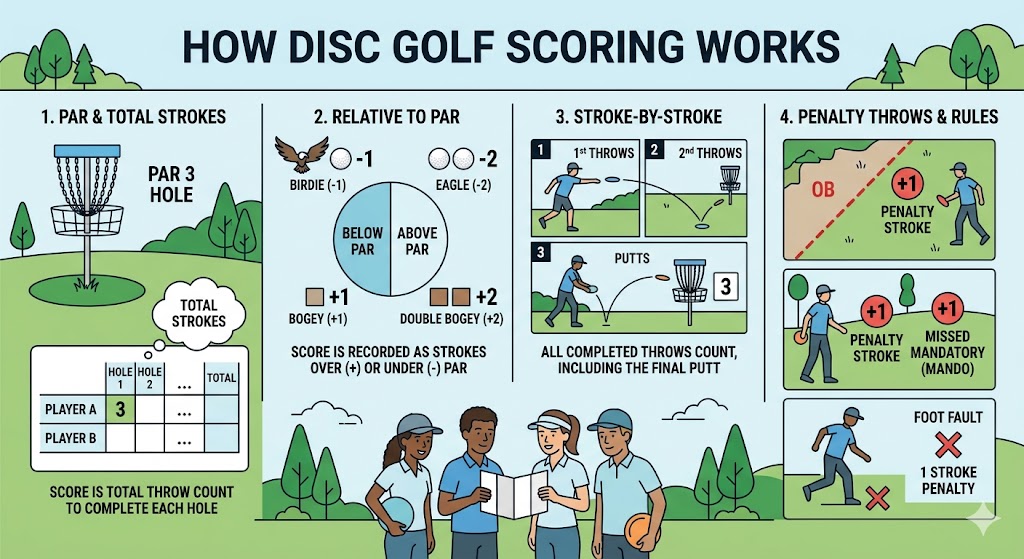
How Disc Golf Scoring Works: A Complete Beginner’s Guide
If you want to improve at Disc Golf, you must understand how scoring actually works.
Many beginners focus on distance or flashy throws. However, scoring determines success. You can throw shorter than your competitors and still win — if you manage strokes wisely.
This guide explains how Disc Golf scoring works, from basic stroke counting to advanced competitive formats.
If you’re brand new to the sport, start with The Ultimate Beginner’s Guide to Disc Golf. That article explains the fundamentals. This one focuses entirely on scoring structure, terminology, penalties, and strategy.
Let’s break it down clearly.
The Foundation: Stroke Play
Most Disc Golf rounds use stroke play.
Stroke play is simple:
Every throw counts as one stroke.
At the end of the round, the player with the lowest total number of strokes wins.
There are no bonus points. No style points. No distance multipliers.
If you throw 72 strokes and your opponent throws 70, they win.
Understanding that simplicity helps beginners avoid overcomplicating strategy.
What Counts as a Stroke?
In Disc Golf, a stroke includes:
- Every intentional throw toward the target
- Tee shots
- Approach shots
- Putts
- Penalty throws
- Re-throws after out-of-bounds
If you release the disc forward with intent to advance play, it counts.
Even short tap-ins count.
Nothing is free.
Understanding Par in Disc Golf
Par represents the expected number of throws a skilled player should need to complete a hole.
Most beginner-friendly courses include:
- Par 3 holes (most common)
- Occasional Par 4 holes
- Rare Par 5 holes
On a Par 3:
- One throw to reach putting range
- One putt to complete
That equals three strokes.
Par sets the benchmark.
Your goal is to meet or beat it.
Birdies, Bogeys, and Eagles Explained
Scoring terminology mirrors traditional golf.
Here’s how it works:
- Birdie – One stroke under par
- Eagle – Two strokes under par
- Bogey – One stroke over par
- Double Bogey – Two strokes over par
For example:
If you complete a Par 3 hole in two throws, you scored a birdie.
If you complete it in four throws, you scored a bogey.
These terms allow players to evaluate performance relative to course expectations.
Why Par Matters — But Isn’t Everything
Many beginners obsess over birdies.
However, Disc Golf scoring often rewards consistency more than aggression.
A round full of pars frequently beats a round filled with birdies and double bogeys.
That’s why understanding strategy is critical. Review Winning Disc Golf Strategies for Beginners to see how smart decisions lower scores faster than risky attempts.
Penalty Strokes and How They Affect Scoring
Penalties directly increase your stroke total.
Common penalty situations include:
- Out-of-bounds throws
- Missed mandatory routes
- Lost discs
- Foot faults (in competitive play)
Most penalties add one stroke.
However, that single stroke often creates a chain reaction:
- You throw OB.
- You add a penalty stroke.
- You rethrow from a worse position.
- You scramble to save bogey.
That’s how one mistake becomes two or three strokes.
For full rule clarity, review Disc Golf Rules Explained for Beginners.
Out-of-Bounds (OB) Scoring Impact
Out-of-bounds can devastate scoring.
Here’s an example:
You throw off the tee on a Par 3. The disc lands OB.
Now:
- You count the original throw (1).
- Add a penalty stroke (2).
- Throw again from the previous lie (3).
You are throwing your third shot from the tee.
Par becomes difficult. Bogey becomes likely.
Avoiding OB often lowers scores more than adding distance.
The Importance of Putting in Disc Golf Scoring
Putting determines score separation.
Inside 30 feet, every missed putt adds unnecessary strokes.
Two common beginner mistakes:
- Rushing putts
- Underestimating short distances
If you miss a 20-foot putt:
- First putt (1)
- Comeback putt (2)
That’s two strokes instead of one.
Multiply that by several holes and scoring balloons.
Strong putting creates scoring stability.
Scoring Across 9 vs 18 Holes
Disc Golf courses typically include:
- 9 holes
- 18 holes
- Occasionally 27 or more
An 18-hole course provides greater scoring separation and strategic depth.
On 9-hole courses:
- Mistakes carry greater weight.
- There is less opportunity to recover.
On 18-hole courses:
- Consistency matters more.
- Players can recover from early errors.
Understanding course length influences scoring expectations.
For course structure insights, see Disc Golf Course Design and Layout Explained.
Scorecards and Tracking
Players track strokes per hole.
Traditional scorecards include:
- Hole number
- Par
- Individual player scores
- Running totals
Many players now use scoring apps.
However, the principle remains the same:
Every throw must be recorded honestly.
Disc Golf emphasizes integrity.
Match Play vs Stroke Play
While stroke play dominates, match play offers an alternative scoring format.
In match play:
- Players compete hole-by-hole.
- The player with the lower score on a hole wins that hole.
- Total strokes do not matter.
For example:
You may lose one hole by four strokes. It still counts as only one lost hole.
Match play changes strategy.
Aggression sometimes increases because one bad hole does not destroy the round.
However, stroke play remains the most common competitive format.
Tournament Scoring and Leaderboards
In competitive Disc Golf:
- Scores are recorded hole-by-hole.
- Totals determine rankings.
- Ties may require playoff holes.
Playoffs typically use sudden death:
- Lowest score on a designated hole wins.
Tournament scoring demands rule precision and discipline.
Casual rounds allow flexibility. Competitive rounds do not.
Course Rating and Difficulty
Not all pars are equal.
Course difficulty depends on:
- Length
- Obstacles
- Elevation
- Wind exposure
Two Par 3 holes may feel entirely different.
Advanced courses often feature:
- Tight wooded fairways
- Elevated baskets
- Long carries over hazards
Difficulty influences average scoring.
That’s why comparing raw stroke totals between courses can be misleading.
How to Lower Your Score Immediately
Understanding how Disc Golf scoring works allows you to make smarter decisions.
Here are practical ways to lower scores:
1. Eliminate OB Throws
Play safe lines.
2. Improve Putting Inside 25 Feet
Practice daily.
3. Avoid Hero Shots
Take easy pars.
4. Use Appropriate Discs
Review Disc Golf Discs Explained: Drivers, Midranges, and Putters to improve selection.
5. Track Mistakes
Identify patterns in lost strokes.
Small improvements compound quickly.
Scoring Strategy for Beginners
Beginners should focus on:
- Minimizing double bogeys
- Playing center fairway
- Avoiding penalties
- Taking smart layups
Birdies will come naturally as skill improves.
For now, protect par.
Mental Approach to Scoring
Disc Golf scoring tests emotional control.
One bad hole should not define your round.
Instead:
- Reset mentally.
- Focus on the next tee.
- Avoid chasing lost strokes.
Chasing birdies after mistakes often creates larger problems.
Steady scoring wins long-term.
The Relationship Between Strategy and Scoring
Scoring does not improve randomly.
It improves when:
- Strategy improves.
- Disc selection improves.
- Rule knowledge improves.
That’s why this article works together with:
- Winning Disc Golf Strategies for Beginners
- Disc Golf Rules Explained for Beginners
- Disc Golf Discs Explained: Drivers, Midranges, and Putters
Together, they form a complete scoring system.
Common Scoring Mistakes Beginners Make
Let’s eliminate them early.
Counting Incorrectly
Always confirm totals at the end of each hole.
Ignoring Penalties
All throws must count.
Playing Too Aggressively
Safe pars beat risky bogeys.
Letting One Hole Ruin the Round
Emotional decisions inflate totals.
Awareness prevents repetition.
Final Thoughts: Master Scoring, Master Disc Golf
Distance impresses spectators.
Scoring wins rounds.
When you fully understand how Disc Golf scoring works, you gain clarity.
You begin thinking in strokes saved rather than throws attempted.
You value safe landing zones.
You prioritize putting.
You avoid unnecessary penalties.
If you still need the foundation of the sport, revisit The Ultimate Beginner’s Guide to Disc Golf.
Then continue building your Disc Golf authority knowledge through:
- Winning Disc Golf Strategies for Beginners
- Disc Golf Rules Explained for Beginners
- Disc Golf Discs Explained: Drivers, Midranges, and Putters
Scoring awareness transforms casual players into competitive ones.