
How Equipment Technology Changed Racquet Sports
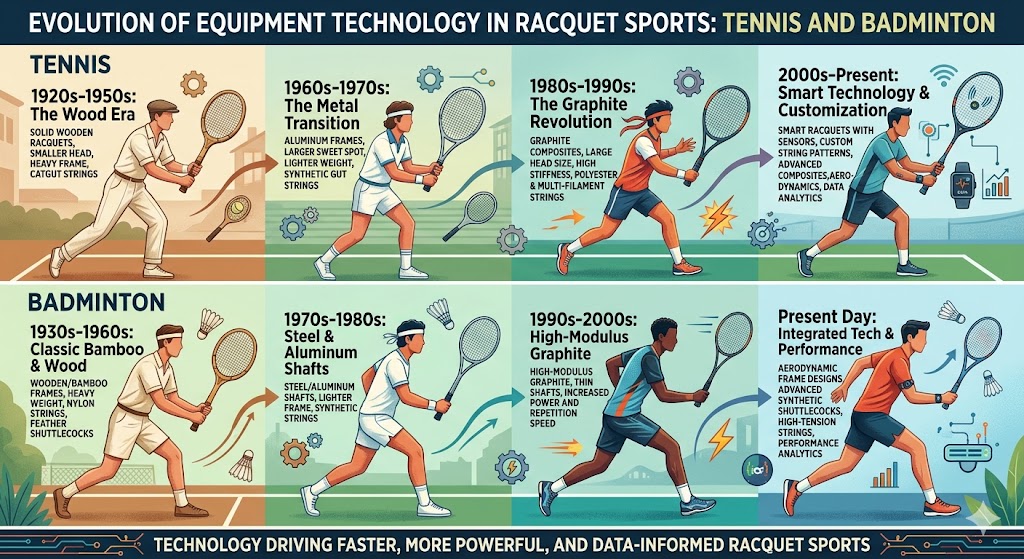
How Equipment Technology Transformed Racquet Sports
If you really want to understand how racquet sports evolved, don’t just watch the players.
Look at the equipment.
Because over the last few decades, advancements in racquet and string technology haven’t just improved performance—they’ve completely changed how sports like tennis, badminton, and squash are played.
In many ways, today’s game would be unrecognizable to players from 30 or 40 years ago.
And the changes didn’t happen overnight. They came in waves—each one pushing the limits of speed, spin, power, and control.
From Wood to Graphite: The First Major Shift
There was a time when racquets were made almost entirely of wood.
They were heavier, smaller, and far less forgiving.
Players had to rely on precision and timing because the sweet spot was tiny. Off-center hits were punishing, and power was harder to generate.
Then came graphite.
Graphite racquets introduced:
- Larger head sizes
- Lighter frames
- Increased stiffness
- More power with less effort
This shift changed everything.
Suddenly, players could swing faster, hit harder, and generate more consistent shots. The game became more aggressive almost immediately.
The Rise of Power and Spin
Once racquets became lighter and stronger, players began to experiment with how they hit the ball.
Modern racquet design allows for:
- Faster swing speeds
- Greater topspin generation
- More control on high-velocity shots
Topspin, in particular, became a defining feature of modern tennis.
Players like Rafael Nadal built entire playing styles around heavy topspin, something that would have been far more difficult with older wooden racquets.
The ability to hit with both power and spin allows players to keep the ball in play while still playing aggressively.
That balance has reshaped match strategy.
String Technology Quietly Changed Everything
Racquets get most of the attention, but strings may be even more important.
Modern string materials—especially polyester blends—allow players to grip the ball and generate extreme spin.
Compared to older natural gut strings, today’s strings offer:
- More durability
- Increased spin potential
- Greater control under high power
This combination lets players swing harder without losing accuracy.
In practical terms, it means rallies can be faster and more explosive while still staying within the lines.
That wasn’t always possible in earlier eras.
Different Sports, Same Technological Impact
While tennis gets most of the spotlight, equipment innovation has influenced all racquet sports.
In Badminton, ultra-light racquets allow for incredible reaction speed and rapid-fire exchanges.
For Squash, improved materials have increased ball speed and shot precision in tight spaces.
In Pickleball, paddle technology continues to evolve with composite materials that balance touch and power.
Each sport has adapted differently, but the underlying trend is the same: better equipment leads to faster, more dynamic play.
Players Had to Adapt Their Techniques
As equipment improved, players had to adjust their technique.
Old-school, flat hitting styles became less effective compared to modern topspin-heavy approaches.
Training now emphasizes:
- Spin generation
- Footwork to handle faster rallies
- Strength and conditioning for higher intensity play
The modern athlete is built differently because the game demands more.
You can’t just rely on touch anymore—you need power, endurance, and adaptability.
The Debate: Technology vs Skill
Not everyone agrees that all these changes are positive.
Some critics argue that technology has made the game too power-driven. Others believe it reduces the importance of finesse and creativity.
But here’s the reality:
Technology doesn’t replace skill—it shifts what skill looks like.
Today’s players still need elite timing, coordination, and strategy. They just apply those skills in a faster, more physically demanding environment.
In many ways, the margin for error is actually smaller now because the game moves so quickly.
Governing Bodies Try to Keep Balance
Organizations like the International Tennis Federation monitor equipment standards carefully.
They regulate:
- Racquet size and dimensions
- String materials
- Ball specifications
The goal is to maintain a balance between innovation and fairness.
If equipment advances too far, it can fundamentally alter the nature of the sport.
So far, governing bodies have managed to keep that balance, even as technology continues to evolve.
The Future of Racquet Technology
Looking ahead, equipment innovation isn’t slowing down.
We’re already seeing developments like:
- Smart racquets with built-in sensors
- Advanced composite materials
- Data-driven customization
Players can now analyze swing speed, spin rate, and impact points in real time.
That kind of feedback accelerates development and gives athletes new ways to improve.
The next generation of players will likely grow up with tools that today’s pros never had.
Final Thoughts
Racquet sports have always been about skill, strategy, and competition.
But equipment technology has quietly shaped how those elements come together.
From wooden racquets to advanced composites, from basic strings to high-performance materials, every innovation has pushed the game forward.
The result is a faster, more powerful, and more exciting version of racquet sports.
And as technology continues to evolve, one thing is certain:
The way these games are played will keep changing right along with it.