
Pickleball Court Dimensions and Layout Explained
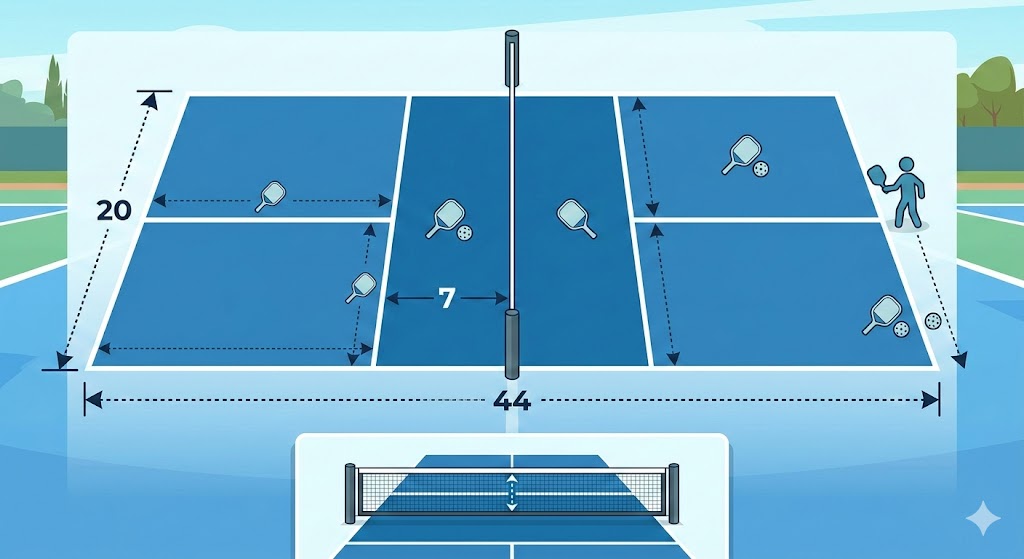
Pickleball Court Dimensions and Layout Explained: Lines, Zones, and the Kitchen Rule
Understanding the Pickleball court is one of the fastest ways for beginners to improve. While the sport is easy to learn, confusion about court lines, zones, and positioning often leads to unnecessary mistakes. Players who clearly understand the layout gain confidence, move more efficiently, and avoid common rule violations.
This guide explains Pickleball court dimensions, line markings, service areas, and the non-volley zone—better known as the kitchen. By the end, beginners will know exactly where to stand, where to serve, and how proper positioning supports winning strategy.
If you are brand new to the sport, begin with our Ultimate Beginner’s Guide to Pickleball, which introduces the rules, scoring, equipment, and fundamentals before diving deeper into court structure and tactics.
Official Pickleball Court Size
A standard Pickleball court measures 20 feet wide by 44 feet long. These dimensions remain the same for both singles and doubles, which makes court setup simple and consistent across all levels of play.
This smaller size is one reason Pickleball feels accessible to beginners. Players cover less ground than in tennis, allowing longer rallies and reduced physical strain. At the same time, the compact court increases the importance of precision, placement, and positioning.
Because every regulation court shares these exact measurements, learning one layout prepares you to play anywhere.
Net Height and Placement
The Pickleball net stretches fully across the 20-foot court width. However, its height changes slightly depending on location.
- 36 inches high at the sidelines
- 34 inches high at the center
This subtle dip in the middle encourages controlled, strategic shots rather than pure power. Beginners who aim toward the center often find it easier to clear the net while keeping the ball low.
Net awareness quickly becomes an essential part of smart Pickleball strategy.
Key Lines and Zones on a Pickleball Court
Several painted lines divide the Pickleball court into functional playing areas. Each line has a specific purpose that directly affects rules and positioning.
Baseline
The baseline marks the back boundary of the court. Serves must be struck from behind this line, and any ball landing beyond it is out of bounds.
Beginners often stand too close to the baseline when returning serves. Leaving a small cushion of space improves reaction time and consistency.
Sidelines
The sidelines define the court’s left and right boundaries. Balls landing outside these lines are out.
Because the court is narrow, accurate cross-court placement becomes a powerful beginner strategy. Smart angles create pressure without requiring extra power.
Centerline
The centerline divides each side into left and right service courts. Serves must travel diagonally across this line into the correct receiving area.
Understanding the centerline prevents one of the most common beginner faults—serving to the wrong box.
Non-Volley Zone Line
Seven feet from the net on both sides sits the non-volley zone line, which marks the beginning of the kitchen. This line is critical because it determines where volleys are legal.
Even stepping on this line during a volley results in a fault. Awareness of this boundary is essential for clean, confident play.
The Kitchen Rule Explained Simply
The non-volley zone, commonly called the kitchen, extends seven feet from the net on each side of the court. Players may enter the kitchen at any time, but they cannot volley the ball while standing inside it.
This rule prevents dominant net smashes and keeps rallies balanced. Instead of pure power, Pickleball rewards:
- Soft control shots
- Patience
- Precise placement
- Strategic timing
Beginners who respect the kitchen rule quickly become more consistent players.
Why the Kitchen Shapes Pickleball Strategy
Although small in size, the kitchen has an enormous impact on gameplay. Most winning rallies occur near this zone.
Strong beginner strategy includes:
- Moving safely to the kitchen line after the serve return
- Hitting soft dinks that land inside the opponent’s kitchen
- Avoiding high balls that allow easy attacks
These ideas connect directly to the concepts explained in winning Pickleball strategies for beginners, where positioning and patience form the foundation of success.
Service Courts and Serving Direction
Each side of the court contains two service areas—right and left. The serve must follow three simple rules:
- Travel diagonally across the net
- Land beyond the kitchen line
- Stay within the correct service box
Failure to meet any of these conditions results in a fault.
Because only the serving team can score, accurate serving becomes one of the most valuable beginner skills.
Singles vs Doubles Court Positioning
Even though court size remains identical, positioning differs between singles and doubles.
Singles Positioning
Singles players must cover the entire court alone. This makes:
- Deep serves
- Controlled placement
- Efficient footwork
especially important.
Doubles Positioning
Doubles teams typically move side-by-side to the kitchen line after the return of serve. From there, they defend the court together and look for attack opportunities.
Good doubles positioning reduces open space and forces opponents into difficult shots.
Indoor vs Outdoor Court Surfaces
Pickleball can be played on several surfaces, including:
- Indoor gym floors
- Outdoor concrete courts
- Asphalt recreational courts
Surface type affects ball bounce, speed, and footwear needs. Beginners should pair the correct surface with the proper indoor or outdoor Pickleball balls and wear supportive Pickleball shoes designed for court movement.
Matching equipment to the court improves both safety and performance.
Common Beginner Mistakes Related to Court Awareness
New players frequently struggle with positioning and line recognition.
The most common mistakes include:
- Stepping into the kitchen during volleys
- Serving into the wrong service box
- Standing too far back after returning serve
- Ignoring sideline boundaries during rallies
Simply learning the court layout eliminates many early frustrations.
How Court Knowledge Improves Confidence
Confidence in Pickleball often begins with spatial awareness. When players know exactly where to stand and aim, decision-making becomes faster and more natural.
Court knowledge helps beginners:
- Move efficiently
- Avoid rule violations
- Anticipate opponent shots
- Apply smart strategy
This foundation supports long-term improvement far more than raw athletic ability.
Final Thoughts on Pickleball Court Dimensions and Layout
The Pickleball court may look simple, but every line and zone serves a purpose. Understanding dimensions, boundaries, service areas, and the kitchen rule gives beginners a powerful advantage from the very first match.
With clear court awareness, players can position themselves correctly, apply winning strategy, and enjoy longer, more competitive rallies. Combined with proper equipment and smart tactics, this knowledge forms the true starting point for lasting Pickleball success.
Learn the court, trust your positioning, and the game will open up in exciting new ways.