
Pickleball Rules Explained Simply for Beginners
Pickleball Rules Explained Simply for Beginners: Serving, Scoring, and Common Faults
Pickleball is known for being easy to learn, yet many beginners feel confused during their first few games. Questions about serving order, scoring calls, kitchen violations, and faults can slow down confidence on the court. Fortunately, the core Pickleball rules are straightforward once they are explained clearly.
This beginner-friendly guide breaks down the official Pickleball rules in simple language. You will learn how to serve correctly, keep score, avoid common faults, and understand the flow of a real match. If you are completely new to the sport, start with our Ultimate Beginner’s Guide to Pickleball, which introduces equipment, court layout, and basic strategy before diving deeper into the rules themselves.
The Objective of Pickleball
The goal in Pickleball is simple: win rallies and score points by hitting the ball over the net so your opponent cannot return it legally.
However, only the serving team can score points. This single rule shapes the rhythm and strategy of every match.
Games are typically played to 11 points, and a team must win by at least two points.
Basic Court Rules Every Beginner Should Know
Before discussing serves and scoring, beginners should understand a few foundational court rules.
- The ball must land inside boundary lines to be in play.
- Players may not volley inside the kitchen (non-volley zone).
- Each rally continues until a fault occurs.
If you still feel unsure about court markings or the kitchen line, see our full guide to Pickleball court dimensions and layout, which explains every line and zone in detail.
Serving Rules Made Simple
Serving begins every rally, and Pickleball uses a few unique serving rules that differ from tennis.
Underhand Contact Only
The serve must be hit underhand, with paddle contact below the server’s navel. This keeps serves controlled and beginner-friendly.
Feet Behind the Baseline
At least one foot must remain behind the baseline when the paddle contacts the ball. Stepping on or over the line during the serve is a fault.
Diagonal Service Direction
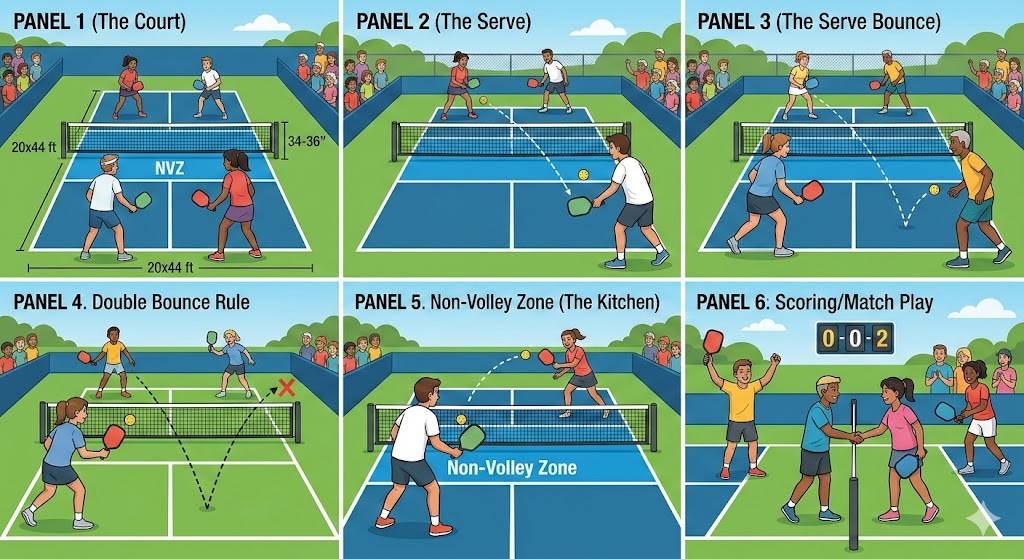
Serves must travel diagonally across the court and land beyond the kitchen line inside the correct service box.
Failure to meet any of these conditions results in a lost serve.
Understanding the Double-Bounce Rule
One of the most important Pickleball rules is the double-bounce rule.
- The returning team must let the serve bounce.
- The serving team must let the return bounce.
Only after these two bounces may either team volley the ball in the air.
This rule prevents immediate net attacks and encourages longer rallies, which is a major reason beginners enjoy Pickleball so quickly.
How Pickleball Scoring Works
Scoring is often the most confusing part for new players, but it becomes easy with repetition.
Only the Serving Team Scores
If the receiving team wins a rally, they do not score a point. Instead, they gain the right to serve.
Games to 11 (Win by 2)
Most recreational games end at 11 points, though tournaments may use 15 or 21. A team must always win by two points.
The Three-Number Score Call in Doubles
In doubles, the score is announced using three numbers:
Serving team score – Receiving team score – Server number
Example: “5-3-1” means
- Serving team has 5
- Receiving team has 3
- First server is serving
This system becomes natural after only a few games.
Kitchen (Non-Volley Zone) Rules
The kitchen is one of the most unique parts of Pickleball.
Players cannot volley the ball while standing inside the kitchen or touching the kitchen line. Doing so results in a fault.
However, players may enter the kitchen to hit a ball that has already bounced. Afterward, they must re-establish position before volleying again.
Because the kitchen strongly influences positioning and patience, it connects directly to the tactics explained in winning Pickleball strategies for beginners.
Common Faults Beginners Should Avoid
Understanding faults prevents unnecessary lost points.
Serve-Related Faults
- Ball lands outside the correct service box
- Ball lands in the kitchen
- Paddle contact above the navel
- Foot on the baseline
Rally Faults
- Ball hit out of bounds
- Volley taken inside the kitchen
- Ball bounces twice before return
- Ball struck before clearing the net
Most beginner errors involve serving or kitchen awareness, which improve quickly with practice.
Singles vs Doubles Rule Differences
The core rules stay the same, but a few differences exist.
Singles
- Only one server per side
- Server position depends on even or odd score
Doubles
- Two servers per team before serve changes sides
- More emphasis on communication and positioning
Because doubles is more social and less physically demanding, most beginners start there.
Let Serves, Line Calls, and Fair Play
Pickleball emphasizes sportsmanship and honesty, especially in recreational play.
- A serve that clips the net and lands in is still playable.
- Players are responsible for their own line calls on their side.
- Close calls typically favor fairness over argument.
This culture of respect is one reason Pickleball communities grow so quickly.
How Equipment Supports the Rules
Following the rules becomes easier with the right equipment.
- Control-focused Pickleball paddles for beginners improve legal shot placement.
- Proper indoor or outdoor Pickleball balls create predictable bounce.
- Supportive Pickleball shoes and apparel help maintain safe positioning near the kitchen line.
Good gear does not replace skill, but it supports rule-consistent play.
Why Learning the Rules Builds Confidence Fast
Many beginners worry about slowing down games because they do not know the rules. In reality, most players are welcoming and happy to help.
Once you understand:
- Serving order
- Scoring calls
- Kitchen restrictions
- Basic faults
your confidence rises immediately. From there, improvement becomes much more enjoyable.
Final Thoughts on Pickleball Rules for Beginners
Pickleball rules may seem unfamiliar at first, but they are designed to create fair, social, and exciting gameplay. With simple serving mechanics, clear scoring, and unique kitchen strategy, the sport offers a welcoming learning curve for players of all ages.
By mastering the basic rules early, beginners unlock the full enjoyment of Pickleball and prepare themselves for smarter strategy, better positioning, and more competitive matches ahead.
Learn the rules, step onto the court with confidence, and enjoy one of the fastest-growing sports in the world.