
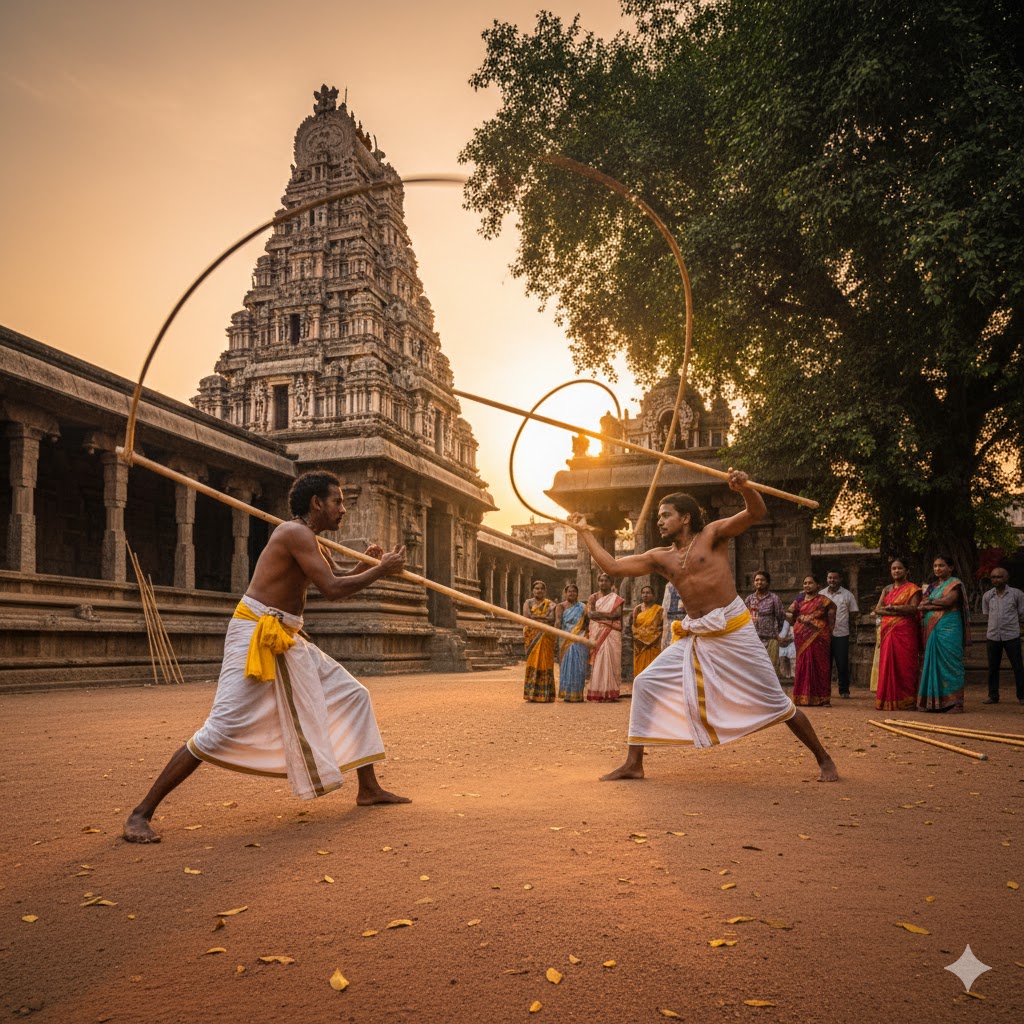
Origin and History of Silambam
Silambam is rooted in the classical traditions of the Tamil region in southern India. The word “Silambam” comes from Tamil — silam meaning hill and kambu/kambam meaning staff or stick. It refers to the use of the bamboo staff or other weapons in combat and movement art. Early literature from the Tamil Sangam era (circa 4th century BCE) contains references to this martial art.
In ancient times the martial discipline served practical purposes. Warriors of the Chera, Chola and Pandya dynasties trained with Silambam staff techniques, particularly in territorial defence. According to academic work, the art featured in royal warfare and in soldier training. The treatise also suggests that Silambam evolved from methods of defending against wild animals and intruders in the hill regions, where bamboo sticks were readily available.
During the 18th century the art became associated with resistance against colonial rule. Figures such as Veerapandiya Kattabomman and the Maruthu brothers used staff-fighting and Silambam techniques in guerrilla warfare against the British. Consequently the British colonial government in some regions banned or discouraged the practice of native weapon arts including Silambam.
In more recent times the art has been revived and organised into a sport. The formation of federations and formal rules has helped Silambam transition from traditional martial art into competitive discipline. For instance, the World Silambam Association (WSA) was founded in 1999 to govern international development of the practice. The same sources note that by 2004 the All India Silambam Federation was registered.
Thus the story of Silambam spans millennia — from the hills of southern India to global federated sport. This layered history gives the discipline both cultural depth and modern relevance.
Global Popularity and Where Silambam Is Played
Silambam is rooted in India, especially the state of Tamil Nadu, but its reach has expanded globally. In Tamil Nadu cities such as Chennai host academies that train youth and adults in Silambam. For example, a recent article states that Silambam enjoys revival in Chennai with dedicated training centres.
Beyond India the diaspora of Tamil communities and martial arts enthusiasts have carried Silambam to countries like Malaysia, Singapore, Sri Lanka and even further afield. For instance, Singapore and Malaysia host branches of Silambam federations. The Wikipedia article remarks that the art “extended into … South-east Asia” through Tamil cultural influence.
On the organisational front the World Silambam Association (WSA) recognises more than 25 countries as members. It further states an ambition to make Silambam globally visible, including efforts at UN recognition.
In Europe and North America the awareness of Silambam remains more modest compared with mainstream martial arts like karate or taekwondo. But martial-arts blogs and articles note growing interest, online instruction and cross-training.
In school systems in Tamil Nadu the art has been incorporated into physical culture programmes. The article on Chennai noted that school-going students are introduced to Silambam to develop discipline, agility and fitness.
The global popularity of Silambam is thus emerging rather than mature, but it shows genuine growth. Because of its unique heritage and weapon-based system, it attracts both martial-arts purists and culture-heritage advocates. The sport’s presence in Asia is strongest, with growing—but still small—footprints beyond.
Amateur Silambam: Youth, Schools and How It Is Played
Amateur Silambam delivers both competitive and training pathways for youth, schools and local clubs. In the youth context, the emphasis typically lies on foundational movement, weapon-handling and footwork, before sparring or formal bouts.
Youth & School Programmes
In school settings, particularly in Tamil Nadu, Silambam is used to teach physical fitness, coordination and self-defence. The Chennai-based article reported that parents enrol their children to help channel excess energy, boost flexibility, and instil discipline. Many academies offer after-school sessions for children, integrating Silambam training alongside regular athletics or martial arts. For example, a training centre (Simashan Institute, Madurai) lists Silambam classes for school students.
In these programmes instructors introduce basic footwork (“kaaladi”), staff-spinning drills, blocking and striking movements, and coordination exercises. As skills mature the student may learn pairs work, short-stick drills, or demonstrate forms.
Amateur Competitions
Amateur competitions for youth may include two broad categories: artistic (demonstration) and combat (sparring). The rules of the WSF show categories for “Sub-Junior”, “Junior”, “Senior” and weight divisions. Youth participants under a certain age require parental consent.
In schools or local clubs, tournaments may be organised by state associations or school sports boards. Participants compete in forms (solo or pair) or stick-fighting events. They may also perform skills sets, demonstrating speed, style and technique. The scoring may emphasise speed (vegam), style (alagu), power (nerthi). For example the rules book lists “vegam (Speed)”, “alagu (Style)”, “nerthi (Power)”.
Safety is emphasised at the amateur level. Protective gear for sparring (stick-fights) includes headguard, chest guard, gloves, and appropriate mat surface.
Training Focus
Amateur training emphasises footwork, coordination, spin-techniques, weapon control and agility. One article describes that beginners often spend large sessions simply practicing 16 foot-positions before weapon-work. For younger students, the aesthetic and movement form is stressed more than heavy contact.
Schools often use Silambam as a cross-training tool. It may replace or augment traditional stick-games, helping to improve reflexes and core strength.
Pathway to Higher Levels
For committed youth athletes in Silambam, state-level championships lead to national or continental events. For example, the All India Silambam Federation organises national tournaments. From there athletes may be selected for international competitions under the WSA or continental federations. Thus amateur clubs and schools serve the talent pipeline.
In short, amateur Silambam offers a dual benefit: cultural heritage training plus athletic competition. It gives youth an option that blends martial art, sport and discipline.
Professional Leagues and Competitive Structures Globally
While Silambam is still emerging as a competitive sport, organised structures and federation-governed championships exist. These serve effectively as “professional” or semi-professional frameworks even if full commercially-sponsored leagues are limited.
Governing Bodies
The main international body is the World Silambam Association (WSA) founded in 1999. A continental body, Silambam Asia (SILA), exists for the Asian region and has recognition from UN-level forums. National federations include the All India Silambam Federation (AISF), which is affiliated to WSA.
These federations organise championships with categories in artistic and combat formats. The 2020 WSF rules specify various event formats, weight divisions, equipment standards and the structure of championship events.
Major Championships
Although there are not yet huge commercial “leagues” in the way of football or basketball, Silambam hosts world championships, continental championships and national championships. For example, WSF rules document the “World Championship” heading and outline the event structure.
At each event athletes compete in categories such as:
- Single Artistic (Kambu Veechu, long stick rotation)
- Doubles Artistic (Jodi)
- Team Artistic (Kulu Ayutha Veechu)
- Combat (Kambu Sandai, stick fight)
Weight divisions apply for combat events. For example Junior Boys under-18 have classes: Under-40 kg, Under-45 kg, etc.
Professional-Level Aspirations and Emerging Leagues
The sport is striving toward professionalisation. The WSA states a mission to gain recognition in global multi-sport events (such as Asian Games, Olympics). Some promoters are exploring league format events featuring short-form Silambam bouts or performance showcases, although documentation is still thin.
One can view the competitive structure as akin to a semi-professional circuit: national champions, continental championships, and world championships feeding into higher-profile events. As media coverage grows, commercial sponsorship may follow. Currently much of the competitive structure is amateur or semi-professional, but the form is clearly organised and globally regulated.
Key Features of Professional Events
- Weight- and age-based divisions to ensure fairness and safety.
- Standard equipment and arena rules (for example, for stick-fight the contest area may be a 10 × 10 m square mat).
- Scoring systems for artistic routines and combat bouts (for instance, ten movements categories and specific scoring criteria).
- International referees, jury panels, and standardised rules of conduct including yellow/red cards for fouls.
In summary, while Silambam does not yet have large-scale commercial leagues akin to major mainstream sports, it possesses a structured professional competitive ecosystem with world championships, federated governance and athlete progression. With growth, full-fledged professional leagues may evolve.
Political and Social Significance of Silambam
The sport and martial art of Silambam carries substantial political and social resonance.
Cultural Identity and Heritage
Silambam is a core element of Tamil martial heritage and South Indian culture. The Madras Musings article describes it as “not a mere fighting skill but a representation of Tamil culture and discipline.” For practitioners and communities, Silambam links modern athletic training with ancient cultural roots. It serves as an identity marker, especially for the Tamil diaspora abroad.
Social Empowerment and Youth Discipline
In schools and youth programmes, Silambam serves as a tool for discipline, physical fitness and character building. The same article notes that parents enrol children in Silambam “to keep addiction at bay” and instil responsibility. It thus functions socially as a constructive outlet and greater than merely sport.
Gender Inclusion and Self-Defence
Silambam’s modern revival includes women’s self-defence programmes using staff techniques. The martial art’s weapon-based and movement-rich system adapts well to training for empowerment. The rejuvenation of Silambam in Chennai mentions the role of women’s self-defense.
Political History and Anti-Colonial Legacy
The political significance of Silambam is evident in its historical use as a tool of resistance. The British ban of the practice under colonial rule underscores the perceived political power of indigenous martial arts. Thus Silambam retains symbolic weight as a resistance tradition and cultural assertion.
Heritage Preservation and Soft Power
On a broader level, Silambam offers a vehicle of soft-power for India and Tamil culture. The formation of federations like WSA and Silambam Asia, the pursuit of UN recognition and multi-sport event inclusion reflect the ambition to globalise the art form. This carries political weight in the sense of cultural diplomacy, heritage tourism and national identity.
Health & Community Development
Socially the art also contributes to fitness, coordination, and community sports programmes. Because Silambam blends martial art, sport and movement aesthetics, it is used in health and wellness initiatives. For instance, WSA describes its work in “education, health, fitness, culture, nature, climate change, recreation”.
In sum, Silambam is far more than a sport. Politically it is anchored in heritage, resistance, identity and cultural expression. Socially it issues discipline, empowerment, community and wellness. As it globalises, the art will likely carry increased cultural and political significance for Tamil communities and for the broader martial-arts world.
Rules of Silambam
The sport rules of Silambam vary by discipline (artistic vs combat) and by governing body, but the main features are standardised under the World Silambam Federation (WSF) or affiliated national bodies. Below is a detailed breakdown of how the sport is governed and played.
Competitions and Event Types
The principal event types are:
- Artistic / demonstration (forms, weapon-spinning, solo, doubles, teams)
- Combat (sparring) — primarily stick fight “Kambu Sandai” and other weapon-based bouts.
Age & Weight Categories
Competitors are divided by age groups (Mini Sub-Junior, Sub-Junior, Junior, Senior) and by weight classes for combat events. For example, Junior Boys under-18 weight divisions: Under-40 kg, Under-45 kg, Under-50 kg, etc. Athletes under 13 years are not allowed in official world-championship combat tournaments.
Equipment and Uniform
- For artistic routines and combat events uniforms must comply with federation specifications: e.g. white T-shirt with V-shape collar, arm band, red pants, waist band; shoes optional.
- Weapon equipment: Staff-length sticks vary by age group; e.g. Senior stick might be 5.5 ft or 6 ft long for stick fight, weight ~400–450 g.
- Combat arenas: For stick fight the arena may be a 10-metre × 10-metre square mat with warning zone and combat zone defined.
Artistic Event Rules
During artistic routines athletes (solo, pairs or teams) execute set movements (vanakkam, varisai, padam), weapon spinning, footwork, speed (vegam), style (alagu), power (nerthi). Each routine is timed: often 2 minutes for solo or doubles; 3 minutes for team events. Scoring criteria allocate specific point values for various components (e.g. 10 points for vanakkam varisai, 40 for Pathinaram (16) kaladi veechu, etc).
Combat Rules for Stick-Fight (Kambu Sandai)
Key combat rules include:
- Direct hits to prohibited target zones (head, lower abdomen) may result in deduction.
- Fouls include stick-drop, leaving the ring, unsportsmanlike conduct. Third yellow card → red card, disqualification.
- Matches typically have rounds; each competitor uses staff (stick) of prescribed length/weight for their category. For example mini sub-junior stick: 4 ft length, circumference 2″-2.5″, weight 300-350 g. Senior stick: 5.5-6 ft.
- Arena layout: Starting zone, combat zone, warning zone are defined; referees, jury and ring chairman positions fixed.
- Referees and jury use signals: e.g. “Tuvakku” (Start), “Niruttu” (Stop) in Tamil.
Victory Conditions
- In artistic events the highest-score athlete wins; deductions for faults apply.
- In combat events victory may come by points, knock-down, opponent disqualification, or if opponent exits the ring or commits multiple fouls.
Safety & Fair Play
- Medical check-ups and parental consent are required (especially for minors).
- Officials must be trained. Coaches are allowed defined rights; misuse of appeals may be penalised.
- Equipment must be approved; unsafe weapons or modifications not permitted. For example, rouge blades are disallowed.
Other Notable Rule Elements
- Sole participation in artistic or combat event may be mandated (athletes cannot enter unlimited events.
- Uniforms for referees, jury and athletes must adhere to design and symbol standards.
- For weapon-forms (Ayutha Jodi, Teams) synchronisation and rhythm matter as much as technical accuracy.
In essence, the rules of Silambam bring together fluid movement and precise weapon technique under competitive regulation. They allow the martial art to function as sport while preserving cultural authenticity.
Conclusion
In summary, the sport of Silambam represents a fascinating synergy of ancient martial tradition and modern competitive sport. From its roots in the forests and battlefields of ancient Tamil Nadu, through its colonial suppression and subsequent revival, to its current global federated form, Silambam draws rich historical and cultural meaning. Globally the art is growing, particularly in Asia, and amateur pathways in schools and youth programmes are flourishing. Although it does not yet enjoy large commercial professional leagues, structured championships and federations provide serious competitive outlets. Politically and socially the discipline touches upon identity, empowerment, health and heritage. The detailed rules governing artistic and combat formats demonstrate that Silambam is now firmly a sport while retaining its martial roots.