
Introduction
Snow Skating is a fascinating winter sport that blends elements of snowboarding, skateboarding and pure gliding down snow-covered slopes. In this post I explore how Snow Skating originated and evolved. I also dive into its global popularity and where it is played. Moreover I examine how amateur Snow Skating is practiced in youth and school settings. Then I unpack professional leagues around the world. I further explain the political and social significance of Snow Skating. Finally, I detail the rules of the sport.
Origin and History
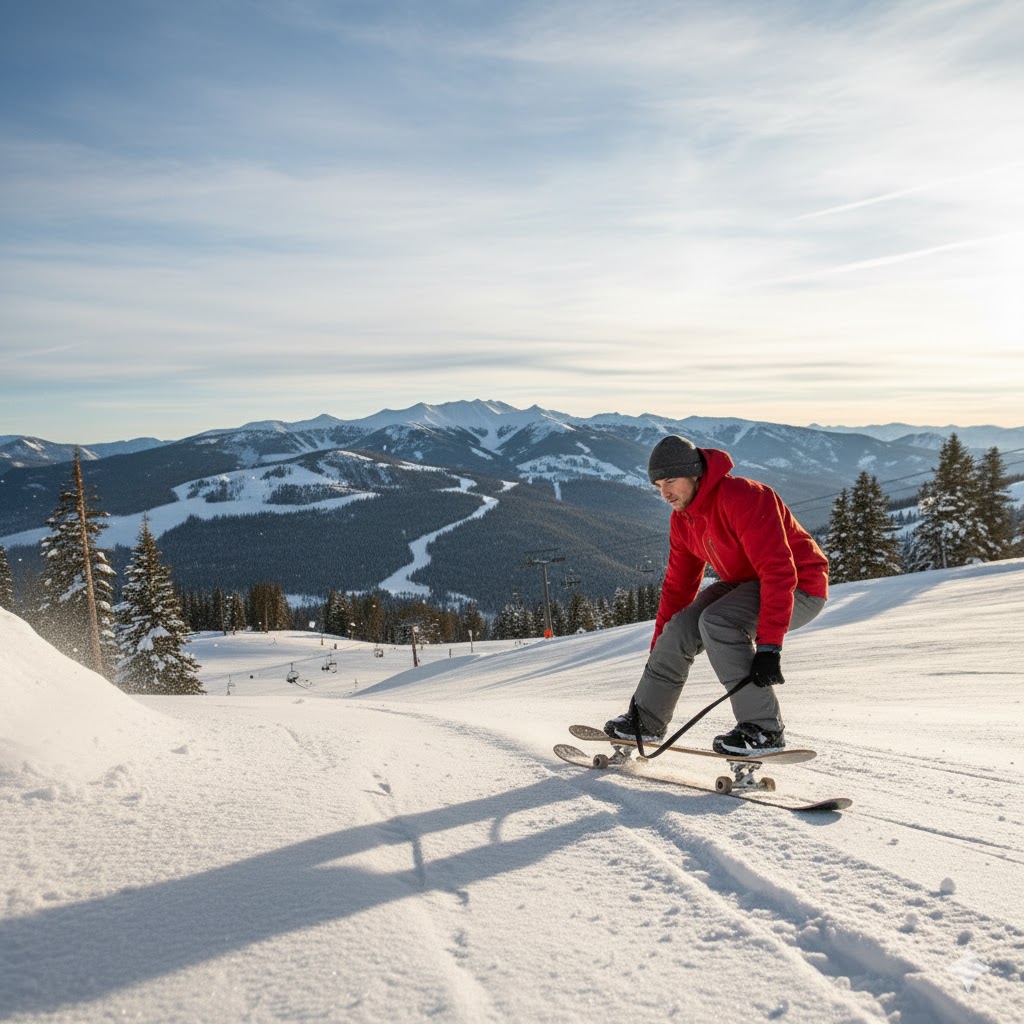
The earliest roots of Snow Skating lie in the experimental merging of board sports and snow sports. Many enthusiasts in the 1990s and early 2000s sought binding-free sliding devices that could mimic skateboard tricks on snow. For instance, a device known as a “snowskate” appeared, described as a hybrid of a snowboard and a skateboard.
Initially, the single-deck snowskate emerged. Riders stood on a board similar to a skateboard but traveled on snow. In time the bi-level snowskate (also called a “bideck” or “snowdeck”) appeared: a skateboard-style top deck coupled via trucks to a ski-type sub-deck.
Over the decades the sport evolved. It moved from urban terrain parks and specialized snow-parks to wider acceptance at certain ski resort areas. The shift allowed more riders to test sliding tricks on snow without bindings. Equipment improvements followed. Manufacturers innovated with plastic bottoms, grooves, metal edges and safety leashes.
Thus Snow Skating matured from a niche board-sport offshoot into a more accepted snow-sliding discipline. The idea of “skateboarding on snow” captured the imagination of board sports fans. Meanwhile ski resorts gradually developed policies and terrain to permit snowskates.
Global Popularity and Where It’s Played
Today Snow Skating has pockets of popularity around the world. In North America, several resorts in Colorado, Utah and Oregon permit bi-level snowskates with metal-edged sub-decks and safety leashes.
In Europe many board-sport enthusiasts in Norway, Sweden, Germany and Liechtenstein have embraced snowskating. A reported World Championships of Snowskating was held in April 2024 at Solheisen in Hemsedal, Norway, with competitors from eight countries including the USA, Canada and South Africa.
While Snow Skating remains more underground than mainstream ski or snowboard disciplines, its global footprint keeps growing. Urban terrain-park riders in colder climates experiment with snowskates. Meanwhile deep-snow riders test powderskates (a variant designed for surf-style flow in deep snow).
Because the sport uses snow as the sliding surface, its growth correlates with winter snowfall, resort terrain and boardsport culture. Regions with active board-sport scenes and snow availability tend to host it. Over time more resorts worldwide have permitted snowskate use.
Amateur Play: Youth and Schools
At the amateur level Snow Skating offers appealing access to younger riders and school programmes. Instead of traditional skis or snowboards, youth can learn on snowskates which often require less specialised boots and bindings. For example, the binding-free nature of many snowskates means younger participants can transition from skateboarding to snow-sliding more easily.
Schools in snow-rich regions sometimes include snowskate sessions in their winter sports curricula or club activities. In those contexts, the sport places emphasis on balance, terrain awareness and board control rather than high-speed descent alone. Because the equipment tends to cost less than full snowboard rigs, more youth can participate. Additionally, terrain parks and snow tubing hills have been adapted to allow snowskate sessions for beginners.
Transition-wise, newcomers may start on gentle slopes or in terrain parks and gradually move to steeper runs or trick-focused set-ups. Many amateur riders practice flip-tricks, rails, jumps or carving turns, especially in urban snow-park settings. These setups provide an inclusive entry point into winter board sports beyond skiing.
Moreover, youth involvement helps to build community culture around Snow Skating. Schools may host snowskate contests, rail jams or friendly slope-competitions. These grassroots efforts often cultivate interest in the sport and feed into local clubs and regional events.
Professional Leagues and Competition
While Snow Skating is not yet as institutionalised as major winter sports like skiing or snowboarding, there are emerging professional and semi-professional competitions. The aforementioned 2024 World Championships of Snowskating in Norway is one example of formal competition.
In addition, certain resorts hold rail-jam events, trick-competitions and park-style contests specific to snowskates. These events draw board-sport athletes who specialise in binding-free snow sliding and trick execution. Because riders can perform skateboard-style flips and rails on snow, the competitive scene often emphasises creativity, style and technical trick execution rather than purely speed.
While there is no widely-recognized global league with broad TV coverage, the growth of social media, action sports video content and snow-park events fuels the sport’s visibility. Many resorts and snowskate brands sponsor riders, host demo days and run amateur-to-pro pathways. Over time we can expect more formal circuits, ranking systems and possibly inclusion in larger board-sport festivals.
Thus, although the professional tier remains niche compared to alpine skiing or snowboarding, Snow Skating’s competitive structure is evolving steadily. Riders now travel internationally to compete, train on terrain designed explicitly for snowskates and align with brands that support this emerging discipline.
Social and Political Significance
Snow Skating carries social significance by broadening access to winter board sports. It lowers the barrier to entry for riders who may feel intimidated by ski or snowboard equipment. Because many snowskates forgo bindings, the sport appeals to skateboarders, younger athletes and urban board-riders looking to translate their skills to snow. This inclusive orientation fosters community and cross-discipline crossover.
Politically, Snow Skating highlights important issues in winter recreation: access, terrain-policy, sustainability and resort inclusion. For example, ski resorts must determine whether to permit binding-free snowsliding devices, adapt terrain parks and enforce safety policies. These decisions affect how inclusive winter sports can become for non-traditional participants.
Moreover, environmental and climate-change issues intersect with Snow Skating. As winter snow conditions become less predictable globally, the viability of many snow sports faces pressures. Snow Skating, by sometimes utilising terrain parks and smaller slopes, may adapt more flexibly than large ski runs. Yet the political challenge remains: how to maintain winter recreation, infrastructure and access in changing climates.
Socially, the sport fosters a sense of community among board-sport enthusiasts. It bridges summer board sports (skateboarding) and winter settings, thus building a year-round board-culture. It also creates niches within youth programmes, urban terrain parks and boarding camps. These communities often emphasise creativity, self-expression, and inclusive culture rather than elite competition alone.
In addition, Snow Skating promotes physical activity in winter months and diversifies winter sports participation. It can be marketed as a fun, accessible alternative to skiing or snowboarding for those seeking board-based sliding without the full traditional gear investment. In that sense the sport holds promise for expanding winter sports participation across socio-economic groups.
Rules of the Sport
While rules can vary by event, terrain park or resort policy, the core rules of Snow Skating revolve around equipment safety, course setup, participant conduct, trick execution and judging criteria in competitions. Below is a detailed breakdown.
Equipment Rules
- Snow skates may be single-deck (skateboard-style) or bi-level (board + ski sub-deck) devices.
- For resort permission, many bi-level snowskates must include a metal-edged sub-deck and a safety leash to prevent runaway boards.
- Boots may be standard snowboard boots or specialized board-riding shoes. Bindings are often absent or minimal on many snowskates.
- Riders must wear protective gear (helmet, pads) especially in trick-zones or rail-jams.
- The device must meet any resort-approved standards for slope use (e.g., width, edge design, leash).
Course Setup & Environment
- A terrain park for Snow Skating may include rails, boxes, jumps and carve zones, similar to snowboard parks but adapted for binding-free sliding.
- The competition or recreational slope should be groomed, free of obstacles or hazards unapproved for snowskate use.
- Event organisers or resorts must clearly mark boundaries, drop-zones and run-in areas.
- In trick-competitions, riders often have set runs (timed or judged) and may perform multiple attempts.
Participant Conduct
- Riders must adhere to resort safety rules, slope etiquette and device-permission policies.
- During competitions riders must respect others on the slope, avoid endangering bystanders and follow event officials’ instructions.
- Any interference with another rider’s run may lead to penalties or disqualification.
- Equipment inspection may occur to ensure compliance with device rules (e.g., leash, metal edge, width).
Competition Rules & Judging
- In a contest the rider may have 1-3 runs through the course. Judges score based on tricks executed, amplitude, style, execution, smoothness of landing and use of terrain features.
- Runs may be timed or purely judged by trick points. For example, a rail-jam event may focus on the number of clean grind-rail locks, flips or transitions rather than descent speed.
- Scoring systems may allocate points for: difficulty of trick, originality, flow (how smoothly the rider links features), consistency (multiple attempts), and landing stability.
- Ties may be broken by difficulty of highest trick landed or by “style score” from judges.
- In more downhill-carve format events, times may be recorded and fastest descent wins, but this is less common in snowskate trick competitions.
- Safety rules take precedence: any fall causing hazard, or equipment failure, may result in run cancellation or penalty.
Additional Rules for Youth/Amateur Play
- For youth sessions schools or clubs may restrict terrain size, limit speed zones, assign supervision, and use beginner-friendly snowskate devices.
- Novice riders often begin with flat-ground carving or gentle slopes before attempting rails or jumps.
- Youth competitions may emphasise participation, technique, fun and progression rather than purely performance-outcome.
- Event organisers may enforce age categories, device size limits and mandatory helmets across youth classes.
Conclusion
In summary, Snow Skating is an emerging winter board sport that blends skateboard-style freedom with snow-terrain adventure. Its history traces back to the early snowskate devices and binding-free designs in the late 20th century. Globally the sport enjoys interest across North America, Europe and beyond, though it remains niche compared to mainstream skiing or snowboarding.
Amateur Snow Skating opens doors for youth and school programmes by offering lower-barrier equipment and board-riding crossover. Professional leagues and competitions are still developing, but events like the 2024 World Championships highlight the sport’s growth. From a social and political perspective, Snow Skating promotes access, community culture and winter-activity diversification, while also intersecting with climate and terrain-policy issues.
Regarding rules, riders must adhere to equipment standards, course safety, conduct guidelines and judging criteria when in competition. Whether in a youth rail-jam or an international snowskate contest, the core ethos remains creativity, sliding freedom and snow-board-style expression.
For those seeking a fresh winter board-sport experience, Snow Skating offers a compelling alternative. It brings the feel of skateboarding into snowy terrain, encourages innovation and fosters inclusive participation. As the sport continues to grow, more resorts, schools and events will embrace it—so now may be a perfect time to give it a try.