
The Art of Base Stealing in Today’s MLB Game
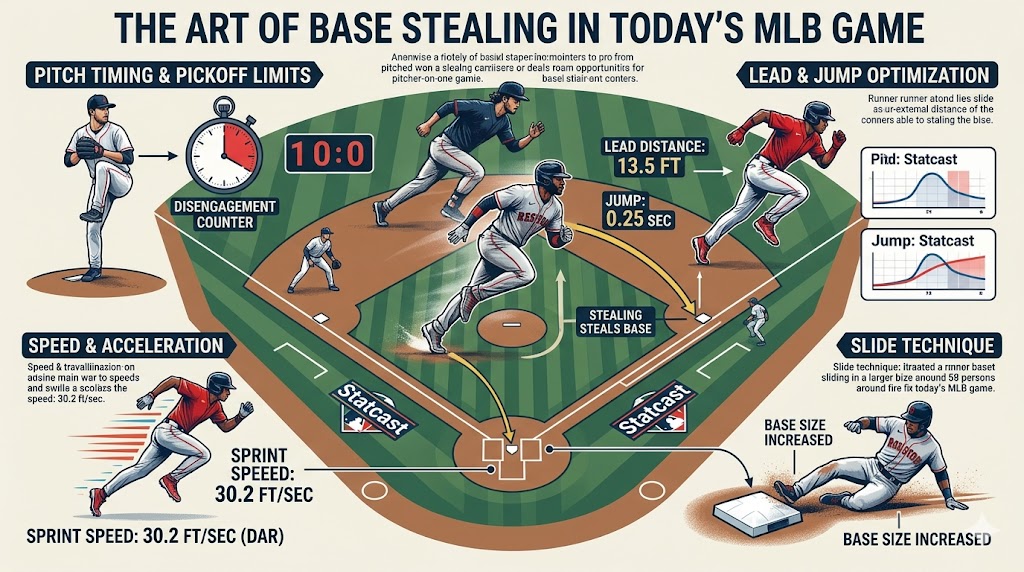
The Art of Base Stealing in Today’s MLB Game
For several years, stolen bases seemed like a fading skill in Major League Baseball.
Analytics pushed teams toward power hitting and on-base percentage. Risking an out on the bases often didn’t align with the numbers-driven strategies dominating the game.
But something interesting has happened recently.
Base stealing is making a comeback—and it’s becoming one of the most exciting parts of modern baseball again.
Speed, timing, and baseball IQ are once again turning aggressive baserunners into game-changers. Yet today’s stolen base is not just about raw speed. It’s about precision, preparation, and understanding the rhythm of the game.
In many ways, stealing a base has become a true art form.
The New MLB Rules Changed the Game
Recent rule changes dramatically reshaped how often teams attempt stolen bases.
Major League Baseball introduced:
- Larger bases
- Limits on pitcher pickoff attempts
- A pitch clock
Each of these adjustments subtly favors the baserunner.
Larger bases shorten the distance between first and second by a few inches. It may sound minor, but at full sprint that difference matters.
Meanwhile, pickoff limits prevent pitchers from endlessly keeping runners close to the bag.
The result? Runners now have clearer opportunities to attack.
Speed Is Only the Beginning
The best base stealers in today’s game aren’t simply the fastest players.
Elite runners combine several key skills:
- Explosive first-step acceleration
- Perfect timing on their jump
- Advanced knowledge of pitcher tendencies
- Fearless decision-making
Players like Ronald Acuña Jr. and Trea Turner demonstrate this perfectly.
They’re fast, but they’re also incredibly smart baserunners.
They study pitchers, anticipate movements, and often start their sprint before the ball even leaves the pitcher’s hand.
Reading the Pitcher Is Everything
Great base stealers often focus more on the pitcher than the catcher.
Pitchers vary their delivery times, leg kicks, and pickoff moves. Some are easy to run against, while others are extremely difficult.
Elite runners watch for subtle signals such as:
- Shoulder movement
- Head position
- Glove timing
- Set position rhythm
Once runners detect predictable patterns, they can time their jump with remarkable precision.
That mental preparation is often the difference between safe and out.
The Jump Determines the Outcome
Base stealing is often decided in the first fraction of a second.
The best runners explode the moment the pitcher commits to home plate. A strong jump can give a runner a full step advantage before the catcher even receives the ball.
That advantage is critical.
A catcher may have a powerful arm, but if the runner gets an elite jump, the throw often arrives just a moment too late.
Many coaches believe the jump accounts for more than half of successful steals.
Catchers Still Play a Major Role
Even in an era favoring base runners, elite defensive catchers can slow the running game.
Quick pop times—the speed from receiving the pitch to releasing the throw—are critical.
Catchers with strong arms and fast mechanics can erase runners quickly.
But even the best catchers rely heavily on the pitcher’s ability to control the running game.
If the pitcher is slow to the plate, stopping a steal becomes much harder.
Analytics Still Guide When Teams Run
Despite the renewed popularity of stolen bases, teams still rely heavily on analytics when deciding when to run.
Coaches evaluate:
- Catcher arm strength
- Pitcher delivery time
- Game situation
- Score and inning
- Hitter at the plate
If the probability of success isn’t high enough, teams often hold the runner.
Modern baseball still values efficiency. A successful steal must justify the risk of making an out.
Aggressive Baserunning Changes Defensive Pressure
Even when runners don’t steal, their threat can disrupt defenses.
Pitchers must divide their focus between the hitter and the runner. Infielders may adjust positioning. Catchers must prepare to throw at any moment.
That pressure can create:
- More fastballs for hitters
- Defensive mistakes
- Pitcher distractions
In this way, a dangerous baserunner can influence the entire inning.
Young Players Are Reviving the Skill
A new generation of MLB stars is embracing aggressive baserunning again.
Speed-focused athletes are entering the league with a mindset that values taking extra bases and forcing defenses to react.
Many teams are encouraging players to run more often, especially under the newer rules that reward aggressive decisions.
Fans have responded positively as well.
A close play at second base remains one of baseball’s most thrilling moments.
Final Thoughts
Base stealing once appeared to be fading from modern baseball strategy.
But recent rule changes and a new generation of dynamic players have brought the skill roaring back.
Today’s stolen base combines athleticism, intelligence, and timing. The best runners treat it like a chess match, studying pitchers and choosing the perfect moment to strike.
When executed perfectly, stealing a base can shift momentum, energize a crowd, and completely change the direction of a game.
That’s why—even in the analytics era—the art of base stealing still holds a special place in Major League Baseball.