
The Ultimate Beginner’s Guide to Disc Golf
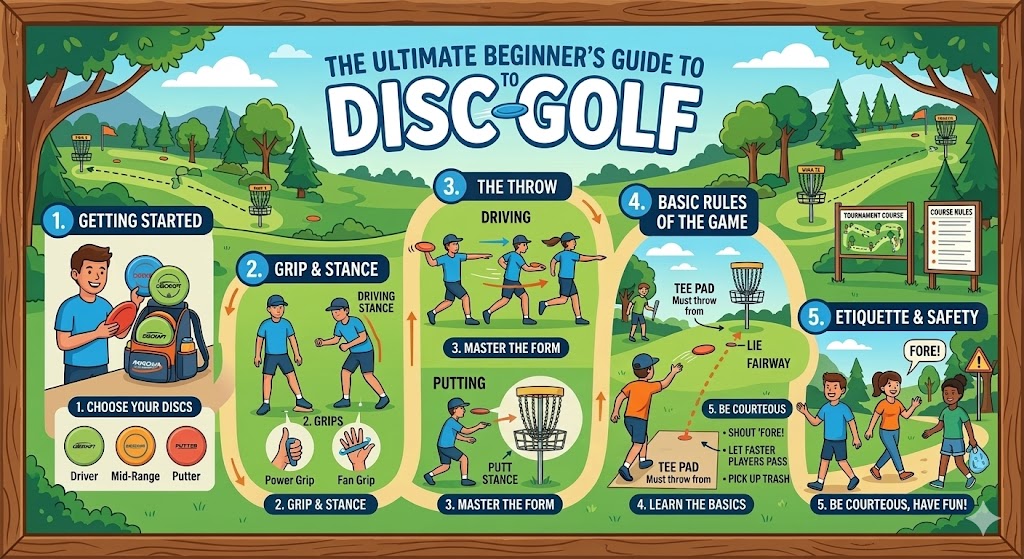
The Ultimate Beginner’s Guide to Disc Golf
Disc Golf is one of the fastest-growing outdoor sports in the world. It combines the precision of traditional golf with the accessibility of a casual park activity. Players throw flying discs toward metal baskets instead of hitting balls toward holes. The objective is simple: complete each hole in the fewest throws possible.
Unlike many sports, Disc Golf requires minimal equipment, offers low barriers to entry, and welcomes players of all ages. Whether you are looking for a competitive challenge or a relaxed outdoor activity, Disc Golf provides both.
This Ultimate Beginner’s Guide to Disc Golf explains everything new players need to know. From basic rules and equipment to terminology, throwing techniques, and strategy, this guide builds the foundation for confident play.
What Is Disc Golf?
Disc Golf follows the same scoring principle as traditional golf. Instead of clubs and balls, players use specialized flying discs. Instead of holes in the ground, courses feature elevated metal baskets with hanging chains that catch the disc.
Each hole begins at a designated tee area. Players throw toward the target basket. The lie, or where the disc lands, determines the next throw. The player continues until the disc rests inside the basket.
The player with the lowest total score after completing all holes wins.
Simple structure. Endless strategy.
The History of Disc Golf
Disc Golf began to take shape in the 1960s and 1970s as flying discs became more popular recreationally. Ed Headrick, often called the “father of Disc Golf,” standardized many of the sport’s rules and developed the first permanent basket targets.
Over time, courses expanded across public parks, campuses, and recreational areas. Organized tournaments followed. Eventually, governing bodies formalized rules and competitive play.
Today, thousands of courses exist worldwide. Professional tours offer significant prize money. Despite that growth, Disc Golf retains its relaxed and welcoming culture.
Why Disc Golf Is Growing So Quickly
Several factors fuel Disc Golf’s rise.
First, it is affordable. A beginner can start with only one or two discs. Many courses are free to play.
Second, courses are widely available in public parks. This accessibility lowers the entry barrier dramatically.
Third, Disc Golf blends competition with outdoor recreation. Players enjoy nature while improving skill.
Finally, the learning curve feels manageable. Beginners can have fun immediately while gradually developing advanced techniques.
Basic Disc Golf Equipment
Disc Golf equipment differs significantly from traditional Frisbees. While discs look similar at first glance, they are engineered for specific flight patterns and distances.
Drivers
Drivers are designed for maximum distance. They have sharper edges and thinner profiles. Beginners often struggle with high-speed drivers at first, so selecting the right type matters.
Midrange Discs
Midranges offer control and moderate distance. They are ideal for approach shots and shorter holes.
Putters
Putters are used near the basket. They provide precision and soft landings.
New players benefit from understanding how each disc type functions. Our guide to best Disc Golf discs for beginners breaks down which discs to choose and why.
Understanding a Disc Golf Course
Disc Golf courses typically include 9 or 18 holes. Each hole features:
- A tee pad
- Fairway
- Obstacles (trees, elevation, water)
- Target basket
Courses vary in difficulty. Some are beginner-friendly with open fairways. Others demand advanced shot shaping and distance control.
If you want a detailed breakdown of course features and terminology, see our guide to Disc Golf course layout and terminology explained.
Basic Rules of Disc Golf
The rules of Disc Golf are straightforward.
- Each throw counts as one stroke.
- The player farthest from the basket throws next.
- Discs must be thrown from directly behind the previous lie.
- Out-of-bounds throws add penalty strokes.
The objective remains the same as golf: lowest score wins.
For a complete explanation of penalties, tee order, and official play, refer to Disc Golf rules explained simply for beginners.
How to Throw a Disc Golf Disc
Throwing technique determines success more than strength.
Backhand Throw
The backhand throw is the most common technique for beginners. Players grip the disc firmly, rotate the torso, and release with controlled snap.
Forehand Throw
The forehand, or sidearm, provides different angles and shot shapes. It requires wrist control and proper balance.
Learning both techniques expands course options dramatically.
Basic Disc Golf Terminology
New players quickly encounter specialized terms.
- Par – Expected number of throws to complete a hole
- Birdie – One throw under par
- Bogey – One throw over par
- Ace – Completing a hole in one throw
- Hyzer – A throw that curves left (for right-handed backhand players)
- Anhyzer – A throw that curves right
Understanding terminology enhances communication and enjoyment on the course.
Beginner Strategy for Lower Scores
While Disc Golf appears casual, strategy matters.
Smart beginners focus on:
- Accuracy over distance
- Controlled release angles
- Avoiding unnecessary risks
- Playing for safe landing zones
Distance develops naturally. Control builds scores.
For deeper insights, explore winning Disc Golf strategies for beginners, which explains positioning, shot selection, and course management.
Disc Golf Etiquette and Sportsmanship
Disc Golf emphasizes respect and pace of play.
Players should:
- Allow faster groups to play through
- Remain quiet during throws
- Repair course damage
- Keep the environment clean
This culture of courtesy strengthens the community atmosphere.
Fitness and Mental Benefits of Disc Golf
Disc Golf provides moderate cardiovascular exercise. Walking full courses improves endurance and coordination. Repeated throwing builds arm strength and balance.
Mentally, the sport promotes focus and patience. Players learn to manage mistakes and adapt to conditions.
These benefits contribute to long-term enjoyment.
Why Disc Golf Is Ideal for Beginners
Few sports combine affordability, accessibility, and competitive depth like Disc Golf.
Beginners can:
- Start with minimal equipment
- Play casually or competitively
- Improve steadily with practice
- Enjoy outdoor environments
This flexibility fuels lifelong participation.
Getting Started with Disc Golf
To begin:
- Purchase a basic starter disc set.
- Locate a nearby course.
- Learn basic throwing mechanics.
- Play regularly and focus on control.
Improvement comes through repetition and patience.
Final Thoughts on Disc Golf
Disc Golf blends simplicity with strategy in a way that few sports achieve. It welcomes beginners while offering endless room for growth. From casual park rounds to competitive tournaments, the sport adapts to every level of commitment.
This Ultimate Beginner’s Guide to Disc Golf provides the foundation. With rules, equipment, technique, and terminology now clear, you are ready to step onto the course with confidence.
Grab a disc, find a fairway, and let the game begin.