
and Rules
Introduction
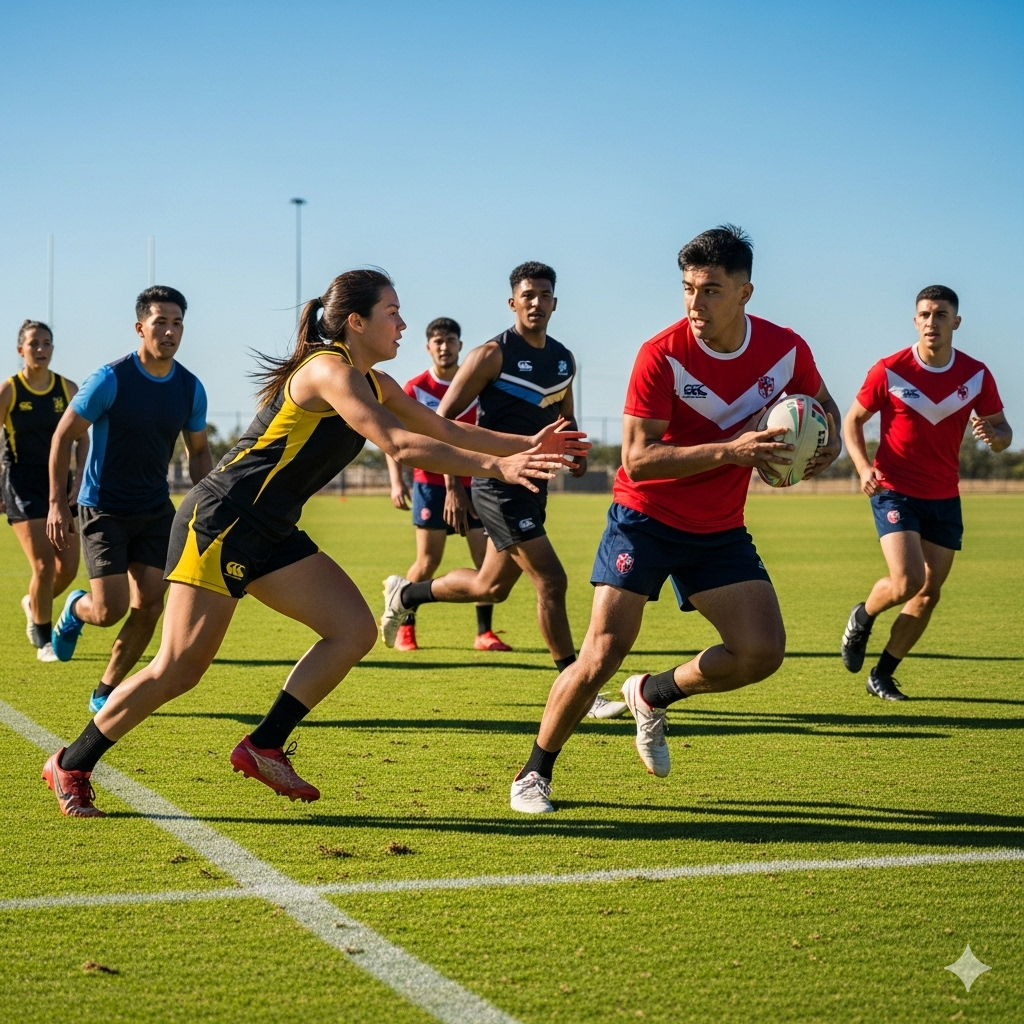
Touch Rugby is one of the fastest-growing team sports in the world. It combines speed, strategy, and inclusivity in a way that makes it appealing to players of all ages. Unlike traditional rugby, this game avoids heavy tackling and instead emphasizes agility, teamwork, and precision. From its humble beginnings to its current international presence, Touch Rugby has become both a recreational and competitive sport. It has also gained attention from schools, amateur clubs, and professional leagues worldwide. With its unique blend of physical fitness, social connection, and accessibility, Touch Rugby has carved a special niche in the sporting world.
The Origin and History of Touch Rugby
The story of Touch Rugby begins in Australia in the 1960s. Players originally developed it as a training activity for rugby league teams. Coaches wanted to maintain the intensity of drills while reducing the risk of injury. Instead of tackling, defenders simply touched the ball carrier.
Very quickly, the practice evolved from training sessions into a standalone game. By the 1970s, organized competitions emerged in Sydney. Enthusiasts formalized the rules, and leagues began spreading across New South Wales and Queensland. This period marked the birth of Touch Football Australia, the governing body that would shape the sport’s future.
The simplicity of the game attracted diverse participants. Women, children, and older athletes embraced the non-contact style. Families could play together without the fear of heavy collisions. By the 1980s, community leagues spread throughout Australia. International expansion soon followed.
New Zealand adopted the game enthusiastically. Maori and Pacific Island communities found it aligned well with their love of rugby-style sports. Within a decade, Touch Rugby reached the United Kingdom. Migrants from Australia and New Zealand introduced the sport to London’s parks, and British universities adopted it for intramural play.
The international governing body, the Federation of International Touch (FIT), was formed in 1985. Its establishment marked the true global recognition of the sport. FIT organized the first Touch World Cup in 1988 in Australia, with teams from several countries participating. Since then, the World Cup has been held every four years, showcasing the best players from across the globe.
Over the years, the game has continued to evolve. Variations of rules have emerged to accommodate different cultures and age groups. However, the core concept of replacing tackling with a simple touch has remained central. This unique feature makes the sport more inclusive than many other field-based games.
Global Popularity of Touch Rugby
Touch Rugby is now played in over 50 countries. It has become particularly strong in Australia, New Zealand, South Africa, the United Kingdom, and Singapore. Yet, it has also gained traction in countries like Japan, the United States, and the Middle East.
Australia remains the powerhouse of the sport. With hundreds of thousands of registered players, it boasts some of the most competitive leagues in the world. Schools integrate Touch Rugby into physical education programs. Community leagues operate in nearly every major city.
New Zealand stands close behind. The sport has deep cultural roots there. Maori and Pasifika communities play it both recreationally and competitively. The national team consistently ranks among the best in the world.
The United Kingdom has seen steady growth since the 1990s. England, Scotland, and Wales each have their own governing bodies. Parks in London, Manchester, and Cardiff host leagues that attract both expats and locals. University clubs also fuel the game’s expansion among young adults.
Singapore has emerged as a surprising hub for the sport in Asia. The city-state hosts numerous international tournaments, attracting teams from across the region. Japan has also embraced the game, particularly in schools and corporate leagues.
In the United States, Touch Rugby has gained momentum in cities with strong rugby communities. New York, Los Angeles, and San Francisco all host organized leagues. Military bases overseas have also played a role in spreading the sport.
The World Cup remains the pinnacle event. Countries such as South Africa, Fiji, France, and Papua New Guinea have all fielded strong teams. Each edition brings new levels of competitiveness and professionalism. The tournament has also increased the visibility of the sport in emerging regions.
Amateur Touch Rugby
At the amateur level, Touch Rugby thrives. Its accessibility makes it appealing for players of all skill levels. Unlike traditional rugby, no specialized equipment is needed. All that is required is a ball, a field, and participants.
Youth programs have become a major part of the sport’s growth. Schools introduce the game as part of physical education because it encourages teamwork and fitness while minimizing injuries. Teachers appreciate its simplicity, while students enjoy its fast pace.
Many community clubs run mixed-gender leagues. Families often join together, with parents and children competing on the same teams. This inclusivity strengthens social bonds. The absence of tackling also ensures that older players can continue participating long after they might retire from contact sports.
University leagues have also played an essential role in the sport’s expansion. Students enjoy the social aspect, and intramural programs provide a way to compete without the demands of professional-level play.
In countries like Australia and New Zealand, amateur participation is massive. Local clubs host seasonal competitions, often with hundreds of teams. These events bring entire communities together, with barbecues and festivals alongside the games.
The social benefits of amateur Touch Rugby cannot be overstated. It provides opportunities for networking, friendship, and fitness. For many, the sense of belonging is as important as the competition itself.
Professional Touch Rugby Leagues
Professional Touch Rugby has grown steadily, although it is not yet as widespread as rugby union or rugby league. Still, certain regions have developed organized professional competitions.
In Australia, the National Touch League (NTL) serves as the premier domestic competition. It brings together elite players from across the country. Teams represent their states in high-level tournaments broadcast on television and online platforms.
New Zealand also runs professional and semi-professional competitions. National championships feature top-level athletes and serve as pathways to international representation. Many of these players go on to compete in World Cup tournaments.
The United Kingdom has seen growth in professional structures as well. The England Touch Association oversees competitive leagues that feed into the national team system. Scotland and Wales run similar setups.
In Asia, Singapore has hosted international club competitions. These tournaments attract professional and semi-professional teams from around the region. Japan and Hong Kong are beginning to explore structured leagues.
While the sport does not yet have the commercial dominance of rugby union, professional Touch Rugby continues to grow. Increased sponsorship and media coverage are helping to raise its profile. The Federation of International Touch remains committed to developing professional pathways.
Political and Social Significance
Touch Rugby carries strong political and social significance. One of its greatest strengths is inclusivity. Unlike many contact sports, it allows men and women to compete together on equal footing. Mixed-gender leagues are common, making the sport a symbol of equality.
The sport also promotes health and fitness across all age groups. Governments and schools support it because it encourages active lifestyles without the high injury risks associated with contact rugby.
Culturally, the sport has united diverse communities. Migrants often use it as a way to connect with others. In the United Kingdom, Australian and New Zealand expatriates introduced it to locals. In return, it created a multicultural playing environment.
Politically, the game has been used to strengthen international relations. Touch Rugby tournaments have often coincided with cultural festivals. These events bring people together across borders, fostering mutual understanding and goodwill.
In South Africa, the sport has been part of programs promoting social unity after apartheid. Community initiatives use the game to bridge racial and economic divides. Similarly, in the Pacific Islands, it has become a way of preserving cultural identity while also connecting to global sporting networks.
Overall, Touch Rugby represents more than a game. It reflects values of inclusivity, health, cultural exchange, and equality.
Rules of Touch Rugby
The rules of Touch Rugby are straightforward but create a dynamic and strategic game.
- Teams: Each side usually has six players on the field. Substitutions are unlimited.
- Field: A standard field is 70 meters long and 50 meters wide.
- Ball: An oval-shaped rugby ball is used.
- Objective: Teams aim to score by grounding the ball over the opponent’s try line.
- Starting Play: The game begins with a tap from the halfway line.
- Touch: Instead of tackling, defenders touch the ball carrier with one or both hands.
- Downs: Teams have six touches (similar to downs in American football) to score. After six touches, possession changes.
- Passing: The ball must always be passed backward. Forward passes result in turnovers.
- Scoring: A try is worth one point. Some variations award extra points for female players in mixed games.
- Offside: Defenders must retreat at least five meters after a touch. Failure results in penalties.
- Substitutions: Players substitute on the fly through a designated box.
- Penalties: Infractions such as offside, forward passes, or unsportsmanlike conduct result in penalties. The non-offending team restarts play with a tap.
These rules create a fast-flowing, continuous game. Matches typically last 40 minutes, split into two halves. Fitness, agility, and communication are vital for success.
Conclusion
Touch Rugby has grown from a training drill in Australia into a worldwide sport with millions of players. Its emphasis on inclusivity, safety, and strategy has made it popular among youth, families, and professionals. Amateur leagues thrive in schools, universities, and community clubs. Professional competitions continue to grow in Australia, New Zealand, the United Kingdom, and Asia.
Beyond the field, the sport carries deep social and political importance. It fosters equality, strengthens cultural bonds, and promotes healthy lifestyles. With its simple rules and global reach, Touch Rugby will continue to inspire players and fans alike for generations to come.