
What Makes an Elite Power Play Unit in Hockey
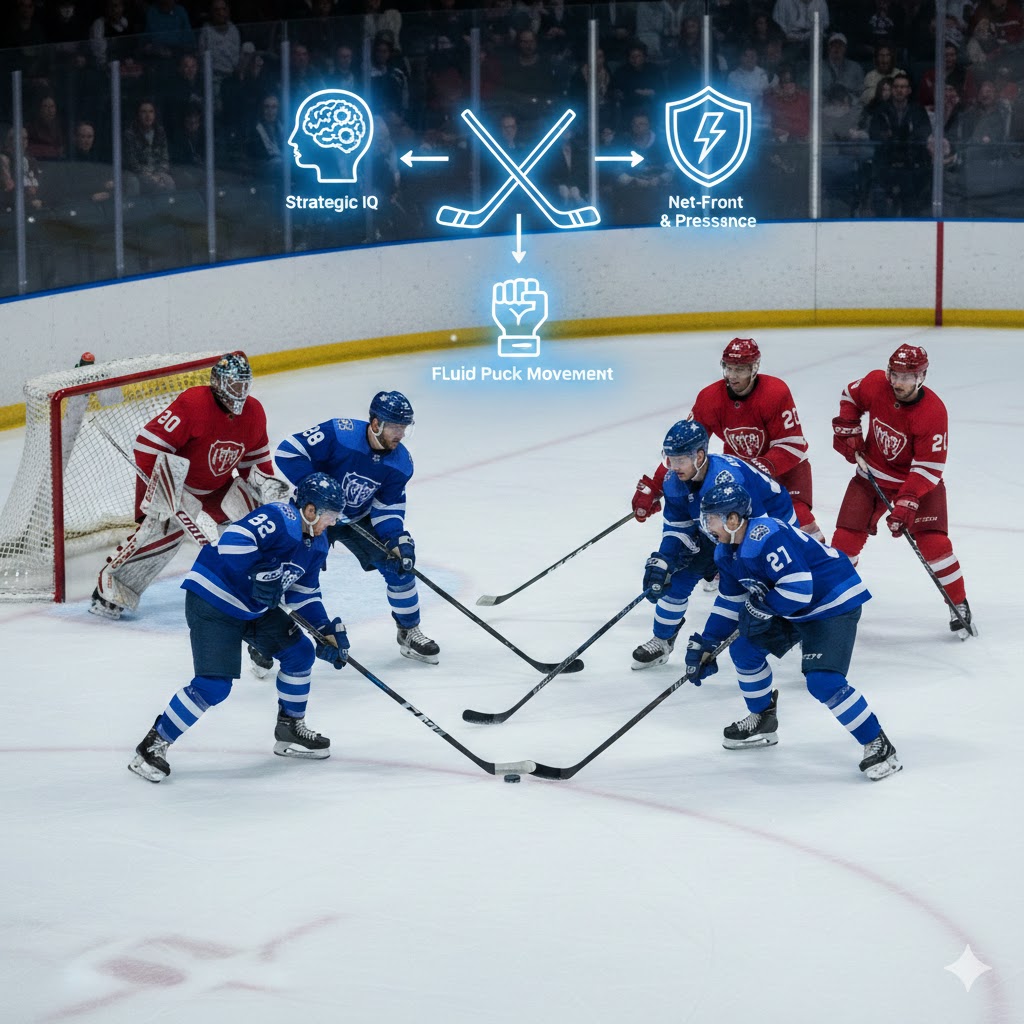
What Makes an Elite Power Play Unit in Hockey
There was a time when a two-minute power play felt almost automatic for great hockey teams. Fans would lean forward, expecting a goal. Today, it feels different. Faster. Smarter. More like a high-speed chess match than a simple numbers advantage.
And in my opinion, that evolution is exactly what makes the modern power play so fascinating.
Across the NHL and international hockey, elite power play units are no longer built on just one superstar or a booming slap shot from the blue line. There is a game plan blending skill, spacing, analytics, and instinct into something that looks effortless when it works and painfully obvious when it doesn’t.
So what truly separates an average power play from an elite one?
Let’s break it down.
Precision Puck Movement Changes Everything
Watch any dominant power play in the world, and one thing stands out immediately. The puck never stops moving.
Quick, decisive passing forces penalty killers to shift constantly. Even a half-second delay can open a shooting lane or create a back-door opportunity. International teams have emphasized this style for years, and the NHL has steadily followed.
But here’s something longtime fans know instinctively. Not all puck movement is equal.
Some teams pass just to look busy. Elite units pass with purpose.
Every touch has intent:
- Pull defenders out of position
- Change the angle of attack
- Set up the next scoring chance, not just the current one
You can feel the difference watching from the stands or the couch. One looks organized while the other can look chaotic.
Multiple Shooting Threats Keep Defenses Guessing
In the past, many power plays revolved around one elite shooter. Stop that player, and you stopped the unit.
That approach rarely works anymore.
Modern elite power plays feature several legitimate scoring threats:
- A one-timer option on either circle
- A net-front player who can finish rebounds
- A mobile defenseman who can shoot or distribute
- A bumper player in the slot ready to strike instantly
This balance creates hesitation in penalty killers and hesitation in hockey usually means trouble.
Personally, this is where I think fans notice greatness the fastest.
When every player on the ice looks like they might score, the tension builds with every pass.
Clean Zone Entries Start the Entire Sequence
Coaches and analysts talk about this constantly now, and for good reason.
If a team struggles to enter the offensive zone with control, the rest of the power play never gets a chance to develop. Dump-ins waste precious seconds. Failed entries drain momentum.
Elite units solve this with:
- Speed through the neutral zone
- Structured drop-pass or regroup systems
- Players confident enough to carry the puck under pressure
It may not be the flashiest part of the power play, but it might be the most important.
Because without possession, strategy means nothing.
Net-Front Presence Still Wins Ugly Goals
For all the talk about speed and skill, hockey still rewards toughness, especially on the power play.
Someone has to stand in front of the goalie.
Someone has to take cross-checks, battle for rebounds, and create chaos.
And here’s some truth that hasn’t changed in decades:
Pretty passing plays are great.
Ugly rebound goals win games.
International tournaments show this clearly as the most successful teams always combine finesse with grit. The NHL’s best power plays do the same.
In my view, this balance is what keeps the sport honest.
No matter how advanced systems become, effort still matters.
Coaching Structure Turns Talent Into Results
Talent alone doesn’t guarantee success. Every league in the world proves that each season.
Elite power plays are carefully designed:
- Set formations like the 1-3-1
- Pre-planned puck rotations
- Specific reads based on penalty-kill pressure
Great coaches also adjust quickly. If defenders overplay one option, the structure shifts to exploit another.
Fans may not always see these details live, but they absolutely feel the impact.
The smoothest power plays look almost inevitable and that usually starts behind the bench.
Analytics Add Insight Without Replacing Instinct
Modern hockey leans heavily on data:
- Expected goals
- Shot location quality
- Passing network efficiency
- Zone-time metrics
These tools help coaches refine strategy and identify hidden weaknesses.
But here’s where balance matters.
Numbers can explain what is happening.
They can’t fully capture momentum, confidence, or pressure. The emotional side is something every fan recognizes instantly.
The best organizations blend both worlds:
Smart analytics + real hockey sense.
That combination is where elite power plays truly emerge.
Real-World Examples of Power Play Excellence
Across today’s NHL and international scene, several teams consistently showcase these traits:
- Crisp puck circulation that stretches penalty kills
- Multiple elite finishers on the ice at once
- Reliable zone entries that waste no time
- Net-front players willing to do the hard work
- Coaching systems refined by analytics and experience
What stands out most isn’t just scoring totals. It’s confidence.
When these units jump over the boards, everyone in the arena senses something might happen.
That feeling is the real mark of an elite power play.
Why the Power Play Still Defines Championship Teams
Every era of hockey evolves.
Rules change. Speed increases. Strategies adapt.
But one constant remains:
Championship teams capitalize on advantages.
A dominant power play:
- Steals momentum
- Punishes undisciplined opponents
- Changes playoff series
And maybe most importantly, it energizes fans in a way few moments in sports can match.
Because when the puck starts moving quickly, defenders scramble, and a one-timer finds the net.
For a split second, the entire game feels inevitable again.
Just like it used to.