
Why Boxing Styles Make Fights
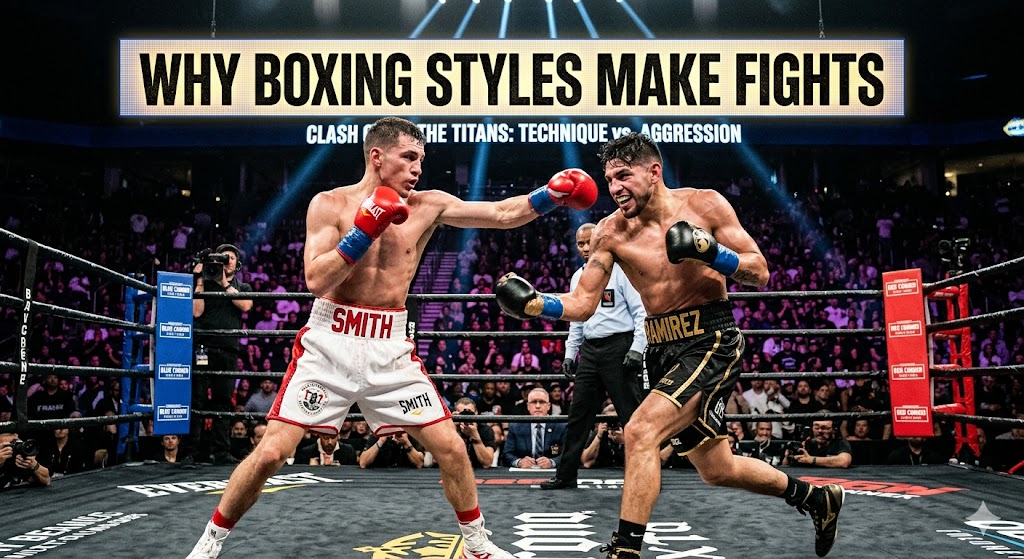
Why Boxing Styles Make Fights (and Decide Who Wins)
There’s a saying in boxing that never gets old:
“Styles make fights.”
It sounds simple, but it explains almost everything about why certain matchups turn into classics—and others fall flat.
Two fighters can both be elite. Both can be champions. But when their styles collide, the outcome often depends less on who is “better” and more on how their skills interact.
That’s what makes boxing so unpredictable—and so fascinating.
It’s Not Just Skill—It’s Matchups
In Boxing, fans often assume the more talented fighter should win.
But history tells a different story.
A technically superior boxer can struggle badly against an opponent whose style disrupts their rhythm. Meanwhile, that same fighter might dominate someone else with ease.
Think of it like rock-paper-scissors.
- One style applies pressure
- One controls distance
- One counters mistakes
When those styles clash, the dynamic determines everything.
The Classic Style Matchups
Over time, a few core boxing styles have defined the sport. And when they meet, the results can be dramatically different.
Pressure Fighter vs Outside Boxer
Pressure fighters push forward constantly, cutting off the ring and forcing exchanges.
Outside boxers rely on movement, footwork, and distance control.
When this matchup works, it’s a chess match.
If the pressure fighter closes distance, they can overwhelm. If the outside boxer maintains space, they can dominate with clean shots.
A great example is Floyd Mayweather Jr., who built a career controlling distance and neutralizing aggressive opponents.
Counterpuncher vs Aggressor
Counterpunchers thrive on mistakes.
They wait, read, and respond with precision.
Aggressive fighters throw volume and take risks to create openings.
This matchup often produces dramatic moments.
If the aggressor gets reckless, they walk into clean counters. But if they apply smart pressure, they can outwork the counterpuncher.
Power Puncher vs Volume Fighter
Power punchers look for knockouts.
Volume fighters focus on activity and scoring points.
This creates a constant tension.
- One clean punch can end the fight
- Or steady output can win round after round
Fights like this keep fans on edge because momentum can shift instantly.
Styles Create Strengths—and Weaknesses
Every boxing style comes with built-in advantages.
But it also comes with vulnerabilities.
For example:
- Pressure fighters can be exposed to counters
- Outside boxers can struggle if trapped
- Counterpunchers can fall behind on points
- Power punchers can tire if they miss
Great fighters understand both sides of their style.
They maximize strengths while minimizing risks.
Ring IQ Makes the Difference
Here’s where things get really interesting.
At the highest level, fighters don’t just rely on their natural style—they adjust.
That’s where “fight IQ” comes into play.
Elite fighters can:
- Change tempo mid-fight
- Adjust distance
- Switch tactics between rounds
- Exploit opponent weaknesses
Terence Crawford is a great example. He can switch stances, adapt strategies, and change the entire feel of a fight depending on his opponent.
That ability to adapt often determines who wins close matchups.
Game Plans Are Built Around Styles
Before every fight, trainers study film and design a strategy based on the opponent’s style.
They ask questions like:
- Can we control distance?
- Do we need to apply pressure or avoid it?
- Where are the defensive gaps?
- How do we win rounds consistently?
A strong game plan can neutralize an opponent’s strengths.
But executing that plan under pressure is a completely different challenge.
Why Some Fights Become Classics
When styles mesh perfectly, you get unforgettable fights.
These are the matchups where:
- Both fighters’ strengths are constantly tested
- Momentum shifts back and forth
- Adjustments happen in real time
That’s when boxing reaches its peak.
It’s not just about punches—it’s about strategy, timing, and mental toughness.
Why Some Great Fighters Avoid Certain Matchups
Here’s something fans don’t always like to hear.
Sometimes, elite fighters avoid certain opponents—not because they’re afraid, but because the style is dangerous.
A risky style matchup can:
- Expose weaknesses
- Hurt a fighter’s legacy
- Create a high chance of upset
Promoters and managers understand this.
That’s why not every dream fight gets made.
Styles don’t just influence results—they influence decisions.
The Modern Game Still Revolves Around Styles
Even with advances in training, analytics, and conditioning, boxing still comes down to style matchups.
You can have:
- Better conditioning
- More power
- Superior technique
But if your style plays into your opponent’s strengths, you’re in trouble.
That hasn’t changed—and probably never will.
Final Thoughts
“Styles make fights” isn’t just a cliché.
It’s the foundation of boxing.
Every matchup is a puzzle. Every round is an adjustment. And every fight tells a different story depending on how styles collide.
That’s what keeps fans coming back.
Because in boxing, it’s not always about who’s the best overall fighter.
It’s about who has the right style—on the right night—against the right opponent.