
Winning Pickleball Strategies for Beginners
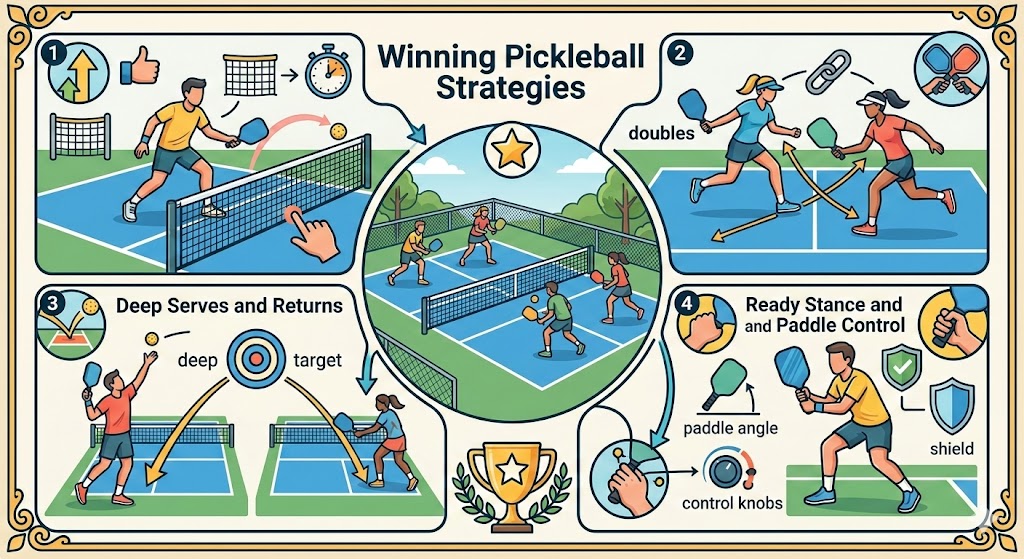
Winning Pickleball Strategies for Beginners
Pickleball may look simple at first glance, but winning consistently requires more than just hitting the ball over the net. Smart positioning, controlled shots, and patience separate beginners from skilled players.
Many new players rely only on power. However, experienced players know that placement, strategy, and teamwork win far more points.
If you’re just getting started, read The Ultimate Beginner’s Guide to Pickleball first. That guide explains the fundamentals of the sport. This article focuses on practical strategies that will help beginners win more points and improve faster.
Let’s explore the strategies that can immediately improve your Pickleball game.
Control the Kitchen Line
One of the most important strategies in Pickleball is controlling the non-volley zone, commonly called the kitchen.
Players who control the kitchen line usually control the rally.
Why? Because standing near the kitchen allows you to:
- Hit volleys earlier
- Cut off angles
- Put pressure on opponents
Beginners often stay near the baseline too long. This gives opponents time to attack.
Instead, move forward after your return and establish position near the kitchen line as quickly as possible.
Master the Dink Shot
The dink is a soft shot that lands in the opponent’s kitchen. It forces them to hit upward instead of attacking.
Although beginners often overlook the dink, it is one of the most powerful strategic tools in Pickleball.
Effective dinks:
- Land softly near the net
- Force opponents to move forward
- Create opportunities for attack
Long dink rallies may feel slow, but they often lead to mistakes from impatient players.
Learning to dink consistently will elevate your game quickly.
Keep the Ball Low
Shots that stay low are harder for opponents to attack.
High shots give opponents an easy opportunity to smash the ball.
Therefore, aim to keep most shots:
- Low over the net
- Controlled rather than powerful
- Placed away from opponents
Soft control shots usually win more points than aggressive swings.
Target Your Opponent’s Weakness
Every player has a weaker side.
For many beginners, the backhand is less consistent than the forehand.
During rallies, try to:
- Hit toward the opponent’s backhand
- Force movement
- Make them hit difficult returns
Strategic placement forces errors and creates scoring opportunities.
Communicate in Doubles Play
Most Pickleball games are played as doubles.
Strong communication between partners improves court coverage and reduces confusion.
Effective communication includes:
- Calling “mine” or “yours”
- Alerting partners to lobs
- Planning serve and return strategies
Teams that communicate clearly often outperform more talented but disorganized opponents.
Use the Third Shot Drop
One of the most important beginner strategies is the third shot drop.
Here’s how it works:
- Team A serves.
- Team B returns the serve.
- Then team A hits a soft shot that lands in the opponent’s kitchen.
This shot allows the serving team to move forward to the kitchen line safely.
Without the third shot drop, the serving team often gets stuck at the baseline while opponents control the net.
Mastering this shot greatly improves your ability to compete.
Avoid Unnecessary Power
Beginners often try to win every point with a hard shot.
However, excessive power usually leads to:
- Balls hitting the net
- Shots flying out of bounds
- Easy returns from opponents
Instead, focus on:
- Accuracy
- Ball placement
- Consistency
Controlled shots win far more rallies than reckless power swings.
Move Your Opponents Around the Court
Making opponents move creates mistakes.
Try to vary your shots by hitting:
- Crosscourt
- Down the line
- Short dinks
- Deep returns
Changing direction forces opponents to adjust quickly, increasing the chances of errors.
Good movement strategy also opens up the court for winning shots.
Stay Patient During Rallies
Pickleball rewards patience.
Beginners often lose points because they attempt risky shots too early in the rally.
Instead:
- Wait for the right opportunity
- Force opponents into difficult positions
- Attack only when you have a clear advantage
Patience often turns long rallies into easy scoring opportunities.
Improve Your Serve Placement
While the Pickleball serve must be underhand, placement still matters.
A well-placed serve can:
- Push opponents deep
- Limit their return options
- Set up your team for the next shot
Aim for:
- Deep serves near the baseline
- Opponents’ weaker side
- Areas that force movement
Strategic serving creates better rally conditions.
Protect the Middle of the Court
In doubles, many points are lost when partners leave the middle of the court open.
Opponents often target the center because:
- It causes confusion between teammates
- It reduces reaction time which creates easy scoring chances
Good doubles teams protect the middle while maintaining communication.
Reduce Unforced Errors
Most beginner Pickleball games are decided by mistakes rather than spectacular winners.
Common unforced errors include:
- Hitting the ball into the net
- Sending shots out of bounds
- Misjudging volleys
Reducing errors is one of the fastest ways to improve your win percentage.
Focus on consistency and smart decision-making.
Watch Your Opponents’ Positioning
Observing where opponents stand gives valuable clues about where to place your next shot.
For example:
- If opponents crowd the kitchen line, try a lob.
- If they stay deep, use a dink.
- When they shift too far to one side, hit to the open court.
Strategic awareness allows you to exploit weaknesses during rallies.
Practice Court Positioning
Positioning is critical in Pickleball.
Good players maintain strong positioning by:
- Moving forward quickly after returning serves
- Staying balanced at the kitchen line
- Adjusting positions as the rally develops
Poor positioning leads to rushed shots and defensive play.
Practicing movement patterns helps beginners develop better court awareness.
Learn from Common Beginner Mistakes
Many strategy problems come from simple beginner mistakes.
Examples include:
- Standing too far from the kitchen line
- Hitting balls too hard
- Failing to communicate with partners
Learning from mistakes accelerates improvement.
Choose the Right Equipment
Good equipment supports your strategy and performance.
The right paddle improves:
- Shot control
- Spin potential
- Comfort during long rallies
For guidance on selecting the best paddle, read How to Choose the Best Pickleball Paddle for Your Game.
Proper gear helps you execute strategies more effectively.
Final Thoughts
Winning Pickleball strategies rely on control, patience, and smart positioning.
Beginners who focus on placement rather than power usually improve faster and win more matches.
Remember these key ideas:
- Control the kitchen line
- Use soft shots like dinks and drops
- Keep the ball low
- Move opponents around the court
- Communicate with your partner
- Stay patient during rallies
As your skills develop, these strategies will become second nature.
To continue building your Pickleball knowledge, explore these related guides:
- The Ultimate Beginner’s Guide to Pickleball
- How to Choose the Best Pickleball Paddle for Your Game
- Pickleball Balls Explained – Indoor vs Outdoor
- Best Pickleball Shoes and Apparel for Comfort and Performance
Master these fundamentals and you’ll quickly move from beginner to confident competitor on the Pickleball court.