
Why Pickleball Strategy Is More Complex Than It Looks
Why Pickleball Strategy Is More Complex Than It Looks (And How to Improve Fast)
Pickleball looks simple at first glance. The court is small, the paddle is lightweight, and the rules are easy to learn. Many beginners assume it’s just a slower version of tennis.
However, once you start playing seriously, you quickly realize something important.
Pickleball strategy is far more complex than it appears.
If you’re new to the game, start with a Pickleball Beginner Guide to understand the basics. But once you move beyond that stage, strategy becomes the difference between winning and losing.
Let’s break down why.
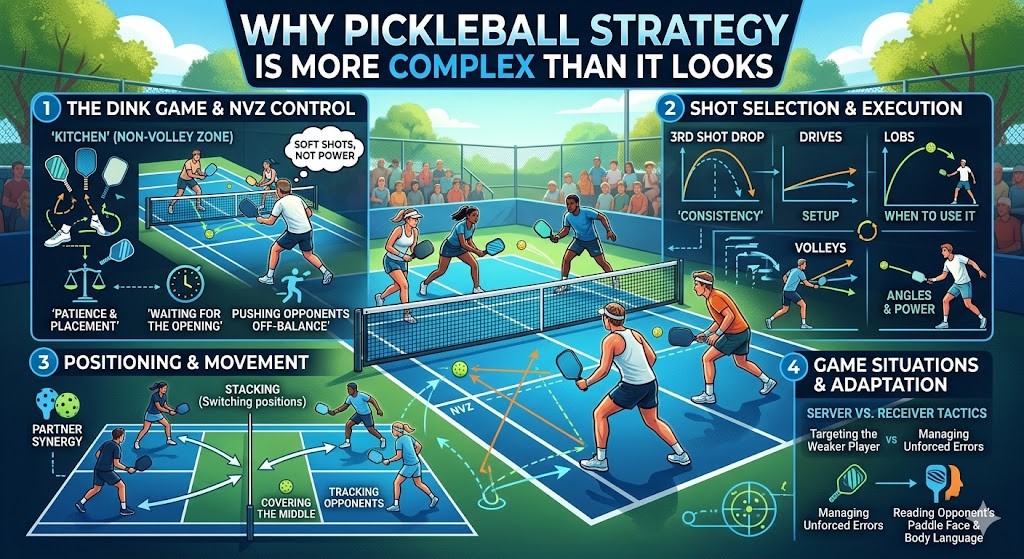
The Game Is Played at the Kitchen Line
One of the biggest strategic elements in pickleball is positioning.
The non-volley zone—commonly called the kitchen—controls the game.
Players who dominate the kitchen line:
- Control rallies
- Dictate pace
- Force opponents into mistakes
Beginners often stay back too long. Advanced players move forward quickly and hold their position.
That small adjustment changes everything.
Soft Game vs. Power Game
Many new players rely on power.
They try to:
- Hit hard drives
- End points quickly
- Overwhelm opponents
However, experienced players know that pickleball is a soft game first.
Dinking—soft shots just over the net—is a core strategy.
Why?
Because it:
- Forces patience
- Creates openings
- Reduces unforced errors
Power still matters, but timing is everything.
Shot Selection Is Critical
In pickleball, every shot has a purpose.
Good players constantly evaluate:
- When to attack
- When to reset
- When to slow the game down
Poor shot selection leads to easy points for your opponent.
Smart shot selection builds pressure over time.
Doubles Strategy Adds Complexity
Most pickleball is played in doubles.
This introduces a whole new layer of strategy.
Players must:
- Communicate effectively
- Cover the court as a team
- Avoid leaving gaps
Stacking, switching, and positioning all come into play.
If you’ve already played pickleball doubles, you know how quickly things can get complicated.
The Importance of the Third Shot
One of the most important shots in pickleball is the third shot.
After the serve and return, the serving team must decide:
- Hit a third-shot drive
- Or hit a third-shot drop
This decision determines whether you gain control of the point.
Mastering the third shot is essential for improving your game.
Unforced Errors Decide Matches
At higher levels, most points are NOT won—they’re lost.
Unforced errors include:
- Hitting the ball into the net
- Missing easy volleys
- Poor positioning
The team that makes fewer mistakes usually wins.
That’s why strategy matters more than raw skill.
Court Positioning Is Everything
Positioning in pickleball is dynamic.
Players must constantly adjust based on:
- Ball location
- Opponent movement
- Shot type
Good positioning:
- Closes gaps
- Reduces angles
- Creates offensive opportunities
Bad positioning leads to easy points for your opponent.
Reading Your Opponent
Advanced players don’t just react—they anticipate.
They watch for:
- Paddle angle
- Body positioning
- Shot tendencies
This allows them to:
- Predict shots
- React faster
- Stay one step ahead
This mental aspect adds another layer of complexity.
Tempo Control Wins Games
Pickleball is not just about shots—it’s about rhythm.
Good players control tempo by:
- Slowing the game with dinks
- Speeding it up with drives
- Mixing shots to disrupt timing
Changing tempo keeps opponents off balance.
Equipment Can Influence Strategy
Your paddle and gear can affect how you play.
For example:
- Control paddles favor soft play
- Power paddles favor aggressive shots
If you’re unsure what to use, check out your guide on the best pickleball paddles to match your playing style.
Strategy Evolves as You Improve
At the beginner level, strategy is simple.
At intermediate and advanced levels, it becomes layered:
- Shot combinations
- Player tendencies
- Situational awareness
The better you get, the more strategic the game becomes.
Why Pickleball Strategy Is Often Underestimated
Pickleball’s simplicity is deceptive.
Because it’s easy to learn, many assume:
- Strategy isn’t important
- Skill alone will win
In reality, strategy is what separates:
- Casual players
- Competitive players
How to Improve Your Pickleball Strategy Fast
If you want to level up quickly:
- Focus on consistency first
- Practice dinking regularly
- Improve your third shot
- Work on positioning
- Play with better players
Most importantly—think during the game.
Related Pickleball Articles
To improve your overall game, check out:
Final Thoughts
Pickleball may look simple, but its strategy is anything but.
From positioning and shot selection to teamwork and tempo, every aspect of the game requires thought and precision.
The players who understand this gain a major advantage.
And once you start seeing the game this way, you’ll never look at pickleball the same again.