
Why Motorsports Demand Elite Reaction Time
Why Motorsports Demand Elite Reaction Time
Motorsports can look deceptively simple from the outside.
A driver sits behind the wheel, presses the accelerator, turns the steering wheel and tries to complete a lap faster than everyone else.
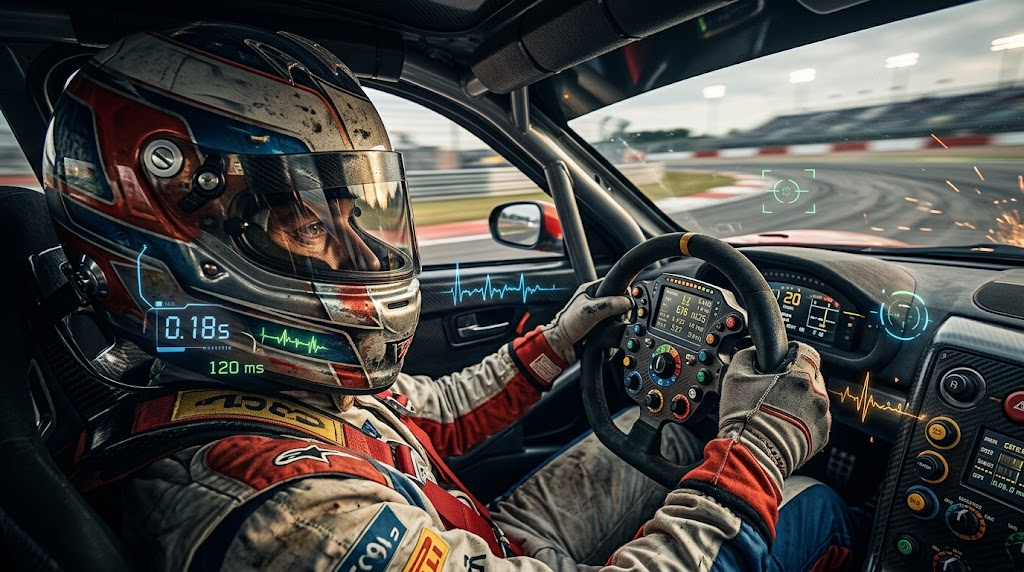
Inside the cockpit, however, that seemingly simple task becomes an extraordinary test of human reaction time.
A motorsports driver may have only fractions of a second to respond to a competitor’s move, a changing track condition, a mechanical problem, a yellow flag, a sudden loss of grip or an unexpected obstacle.
At high speeds, those fractions of a second can determine whether a driver gains a position, loses a position, saves a car or crashes.
And reaction time is only one part of the equation.
Drivers must recognize what is happening, determine what it means, select an appropriate response and execute that response through the steering wheel, pedals, switches or other controls.
Elite motorsports drivers aren’t simply reacting quickly. They are processing information, anticipating events and executing precise responses while traveling at extraordinary speeds.
That combination is what makes reaction ability so important in racing.
It also explains why elite motorsports requires much more than raw courage or a heavy right foot.
Reaction Time Is More Than Speed
Reaction time is commonly understood as the amount of time between a stimulus and a person’s response.
In everyday life, that might mean responding to a traffic light, catching a falling object or moving out of the way of something unexpected.
Motorsports magnifies the problem.
The stimulus might be another car moving across the racing line.
It might be a light changing.
It might be smoke appearing ahead.
It might be a tire losing grip.
It might be a car spinning several hundred feet ahead.
The driver’s response must then happen almost immediately.
But there is an important distinction between simply reacting and making a useful racing decision.
A driver who reacts extremely quickly but chooses the wrong response can still create a disaster.
The goal in motorsports isn’t merely the fastest possible reaction; it is the fastest correct reaction.
That distinction separates elite performance from simple reflexes.
Speed Changes Everything
The faster a vehicle travels, the less time the driver has to respond to an event occurring ahead.
Consider a vehicle traveling at 100 mph.
It covers approximately 147 feet every second.
At 150 mph, it covers approximately 220 feet every second.
At 200 mph, it covers approximately 293 feet every second.
That means a delay that sounds tiny in ordinary conversation can represent a tremendous amount of track distance.
A tenth of a second at 200 mph represents nearly 30 feet of travel.
Two-tenths represents almost 60 feet.
Half a second represents nearly 147 feet.
At racing speeds, fractions of a second become meaningful distances.
That is one reason reaction ability becomes such a critical performance characteristic.
Drivers Don’t Have the Luxury of Starting From Zero
One of the biggest misconceptions about motorsports reaction time is that elite drivers simply wait for something to happen and then react.
They don’t.
The best drivers anticipate.
They know where another car is likely to move.
They know where the track tends to lose grip.
They recognize braking zones.
They understand how a car behaves when tires begin to deteriorate.
They know how traffic tends to develop.
They recognize visual cues from other vehicles.
They understand what different engine sounds can indicate.
In other words, elite drivers reduce the amount of pure reaction required by predicting what is likely to happen next.
Anticipation allows a driver to begin responding before the event is fully developed.
That is one of the most important secrets behind elite reaction performance.
Anticipation and Reaction Work Together
Imagine two drivers approaching the same corner.
Both see an opponent move toward the inside.
Driver A is surprised and waits to determine what the opponent is doing.
Driver B anticipated that the opponent might attempt the move and was already preparing for it.
Even if both drivers have identical biological reaction times, Driver B can respond sooner because the brain was already preparing for the possibility.
That is why experienced drivers can sometimes appear almost impossibly quick.
They aren’t necessarily possessing superhuman reflexes.
They have developed the ability to recognize patterns before less experienced drivers do.
Experience effectively gives the brain a head start.
Braking Is a Reaction-Time Test
Few parts of racing demonstrate reaction ability more clearly than braking.
A driver approaching a corner must determine:
- When to begin braking
- How hard to brake
- How much grip is available
- Whether another car is nearby
- How the tires are behaving
- What the track surface is doing
- How much speed needs to be removed
- When to release the brakes
That entire sequence happens incredibly quickly.
Brake too early and the driver loses time.
Brake too late and the car may miss the corner.
Brake too aggressively and the tires can lock or the vehicle can become unstable.
Brake too gently and the driver may lose the position.
Elite braking is a combination of reaction, anticipation, judgment and precision.
The Start Is Another Reaction Challenge
Race starts can be among the most intense reaction-time situations in motorsports.
Drivers are waiting for a signal.
Then everything changes.
The car launches.
Competitors move.
Gaps appear.
Drivers choose lanes.
Cars accelerate toward the first corner.
The driver must respond to changing positions while avoiding contact.
A strong start can gain several positions before the first corner.
A poor response can lose them just as quickly.
In many forms of motorsports, reaction to the start signal is therefore an important competitive skill.
But again, the fastest response isn’t necessarily the best response.
A driver must balance acceleration with traction and positioning.
Drag Racing Makes Reaction Time Obvious
Few racing disciplines demonstrate reaction time more clearly than drag racing.
At the start, the driver’s response to the starting signal can be measured in extremely small increments.
A driver can have a technically superior car and still lose because the launch was poor.
The sport therefore provides an unusually clear demonstration of how reaction ability interacts with machinery.
But drag racing also reveals an important point:
Reaction time is only one component of performance.
A quick reaction doesn’t compensate for poor traction, inefficient gear changes or insufficient vehicle performance.
Motorsports is always a combination of human ability and machine performance.
Road Racing Requires Continuous Reactions
Circuit racing creates a different challenge.
The driver isn’t reacting to one start signal.
The driver is processing information continuously for an entire race.
Every corner creates new decisions.
Every straight presents new opportunities.
Every competitor creates potential changes.
Tire wear changes vehicle behavior.
Fuel load changes handling.
Weather changes grip.
Traffic changes racing lines.
The driver’s workload never truly disappears.
Road racing is less about one spectacular reaction and more about maintaining thousands of correct decisions throughout an event.
Rally Drivers Face an Even Different Challenge
Rallying provides another example of elite reaction demands.
Rally drivers often travel rapidly through environments where visibility can be limited and track conditions can change constantly.
They may encounter gravel, mud, snow, water, jumps and rapidly changing surfaces.
The driver must respond to information from the co-driver while simultaneously controlling the car.
The environment is fundamentally different from a permanent racing circuit.
Instead of memorizing every corner visually, the driver must rely heavily on communication, preparation and rapid interpretation.
That requires extraordinary mental processing.
Motorcycle Racing Adds Another Layer
Motorcycle racers face the same fundamental reaction challenges as car drivers, but with additional physical demands.
The rider must control the motorcycle using multiple inputs while managing balance and body position.
A small change in grip can have enormous consequences.
The rider must respond to movements from competitors while maintaining stability.
And unlike a driver sitting inside a vehicle, the rider’s body is directly involved in controlling the machine’s balance.
Motorcycle racing demands rapid reactions while simultaneously maintaining extremely precise physical control.
The Human Brain Is Doing More Than People Realize
Inside a racing cockpit, the brain is constantly processing information.
Visual information.
Auditory information.
Physical sensations.
Vehicle feedback.
Competitor positions.
Track conditions.
Instrument readings.
Radio communication.
The driver has to determine which information matters immediately and which can be ignored.
That ability is critical.
A driver who attempts to consciously process every piece of information would quickly become overwhelmed.
Elite drivers develop automatic responses and strong pattern recognition.
They learn which signals matter.
They learn what the car is telling them.
They learn how certain sounds correspond to mechanical conditions.
They learn how the vehicle feels when grip changes.
Experience turns enormous amounts of information into recognizable patterns.
Vision Is Critical
Reaction begins with perception.
If a driver doesn’t see an event, reaction cannot begin normally.
That makes visual ability extremely important.
Drivers need to recognize:
- Braking markers
- Corner entry points
- Apexes
- Competitor positions
- Flags
- Track debris
- Changing surfaces
- Traffic
- Vehicle movement
But elite drivers also use peripheral vision.
They don’t necessarily stare directly at every object.
They need to maintain awareness of what is happening around them.
That is particularly important in close racing.
Peripheral Vision Helps Drivers Maintain Awareness
A driver looking through a corner still needs to know where nearby competitors are.
A driver defending a position cannot stare exclusively at the mirror.
A driver entering a corner needs to understand what is happening beside the vehicle.
Peripheral awareness allows drivers to process more information without constantly shifting their primary visual focus.
This is one reason elite racing can look smooth even when the competition is extremely aggressive.
The driver’s attention is distributed.
Hearing Is Another Information Source
Motorsports is an extremely loud environment.
Yet experienced drivers learn to distinguish meaningful sounds from background noise.
Engine tone can change.
Tire noise can change.
Mechanical sounds can appear.
A competitor’s engine can suddenly sound different.
The driver’s radio can provide additional information.
These auditory cues can sometimes alert a driver to a problem before the driver sees it.
Elite drivers learn to listen to their vehicles as well as watch the track.
The Car Communicates Through the Body
Drivers also receive information through physical sensation.
They can feel:
- Steering resistance
- Braking behavior
- Tire grip
- Vehicle movement
- Suspension behavior
- Acceleration
- Vibration
This is why professional drivers often talk about “feel.”
They aren’t describing something mystical.
They’re describing a massive collection of physical signals being interpreted by the brain.
A driver may recognize that the car is beginning to lose grip before the slide becomes visually obvious.
That allows a response to begin earlier.
Reaction Time Changes With Fatigue
Racing isn’t simply a test of reflexes.
It’s a test of sustained performance.
Fatigue can affect concentration, decision-making and reaction ability.
A driver who performs perfectly for the first hour of a race still has to maintain that performance later.
Long endurance races can therefore be especially demanding.
Drivers must manage hydration, nutrition, temperature and mental fatigue.
The challenge becomes maintaining high-quality decisions even as the body becomes tired.
Elite racing requires repeatable reaction performance, not just one impressive burst of reflexes.
Heat Makes the Problem Worse
Race cars can become extremely hot environments.
The cockpit temperature can rise substantially depending on the vehicle, circuit and conditions.
Heat increases physical stress.
That can make concentration more difficult.
Drivers must continue processing information despite discomfort.
This is another reason conditioning matters.
A physically prepared driver has a better chance of maintaining mental performance throughout a race.
G-Forces Add Physical Stress
High-performance racing generates significant acceleration and cornering forces.
Drivers may experience heavy loads while braking and cornering.
Those forces affect the body.
The driver must maintain head position, control the steering wheel and operate pedals while experiencing those loads.
That means reaction isn’t happening in a relaxed environment.
Motorsports asks the human brain to make precision decisions while the human body is being physically pushed around by the vehicle.
That is an extraordinary combination.
Training Reaction Time
Drivers don’t simply hope their reaction ability is good enough.
Many train it.
Reaction-training systems can use lights, screens or other visual stimuli.
Drivers may work on hand-eye coordination.
They may use simulators.
They may practice decision-making under pressure.
They may train their peripheral awareness.
They may work on cognitive exercises.
But the best training doesn’t necessarily focus exclusively on making reactions faster.
It focuses on making reactions more accurate.
Simulators Are Extremely Valuable
Modern racing simulators allow drivers to practice scenarios without the physical and financial risks of a real vehicle.
Drivers can practice:
- Starts
- Braking
- Overtaking
- Wet conditions
- Different circuits
- Mechanical failures
- Traffic
- Race strategy
Repeated exposure builds pattern recognition.
The driver begins to recognize situations more quickly.
That can reduce the amount of conscious processing required during an actual race.
Repetition Builds Automatic Responses
Think about learning to drive a road car.
At first, operating the vehicle requires conscious attention.
Eventually, many actions become automatic.
Professional racing takes that process to another level.
Gear changes.
Braking points.
Steering inputs.
Throttle control.
Mirror checks.
Track positioning.
These actions become deeply practiced.
The goal is not to eliminate thought.
It’s to reserve conscious thought for the decisions that actually require it.
Automatic skills give elite drivers more mental capacity for unexpected events.
Reaction Time Isn’t the Same for Every Driver
Human reaction ability varies.
Age, fatigue, concentration, training and individual physiology can all influence performance.
But motorsports adds another factor:
experience.
A veteran may not have the fastest raw reaction time in a laboratory.
Yet that veteran can still respond faster on a racetrack because the brain recognizes the situation earlier.
This is one reason racing experience is so valuable.
Youth Provides One Advantage, Experience Provides Another
Younger drivers may have certain physical advantages.
Experienced drivers may have better pattern recognition.
Neither automatically determines performance.
The best drivers combine physical ability with experience.
That combination allows them to recognize situations quickly and respond appropriately.
The Difference Between Reaction and Reflex
Reflexes are largely automatic responses.
Reaction involves perception and decision-making.
Motorsports relies heavily on reaction rather than simple reflex.
A driver doesn’t merely respond to a light.
The driver interprets the light.
A driver doesn’t merely respond to another car.
The driver determines what that car is doing.
A driver doesn’t merely respond to rain.
The driver evaluates how much grip remains and adjusts accordingly.
Motorsports is fundamentally a decision-making sport performed at high speed.
Reaction Time Can Decide Overtakes
Overtaking provides another excellent example.
A driver may see a small gap.
The opportunity may exist for only a moment.
The driver must determine whether to commit.
Then the steering, throttle and braking inputs must be executed precisely.
A hesitation can eliminate the opportunity.
A premature move can cause contact.
A perfect response can produce a pass.
That entire sequence can happen in seconds.
Defensive Driving Requires Reaction Too
Reaction ability isn’t only about attacking.
Defending a position can be equally demanding.
A driver must monitor the opponent’s position.
The driver may need to choose a defensive line.
The driver must avoid moving unpredictably.
And the driver still needs to hit the corner correctly.
The best defenders aren’t necessarily reacting to every movement.
They anticipate what the attacker wants to do.
Again, anticipation is the key.
Wet Weather Is a Reaction-Time Nightmare
Rain changes racing dramatically.
Grip decreases.
Braking distances increase.
Visibility decreases.
Spray can obscure the track.
Cars become more difficult to control.
Standing water can create sudden changes in traction.
Drivers must adapt immediately.
The correct reaction in dry conditions may be completely wrong in the wet.
Wet-weather racing demands drivers process changing information and modify their responses almost continuously.
Debris Creates True Emergency Situations
Sometimes drivers encounter something they could not reasonably predict.
Debris may appear on the track.
A competitor may crash.
A component may fail.
Fluid may appear on the racing surface.
An animal or object may enter an area unexpectedly.
Those are genuine reaction tests.
There may be no time for elaborate planning.
The driver must recognize the threat and choose a response.
That is when elite reaction ability can become a safety skill rather than merely a competitive advantage.
Flags Require Instant Interpretation
Race officials communicate through flags and signals.
Drivers must understand what those signals mean and react appropriately.
Yellow flags.
Red flags.
Blue flags.
Safety-car situations.
Local cautions.
Different racing series have different systems.
The important point is that drivers cannot treat signals as background information.
They can directly affect what the driver is allowed to do.
Reaction Time Is Also About Knowing When Not to React
This is a subtle but extremely important point.
Sometimes the best response is no dramatic response at all.
A driver may see another car move and choose to hold the racing line.
A driver may feel a small slide and make a tiny correction instead of a huge one.
A driver may see an opponent attempt an overtake and wait for the correct opportunity.
Elite reaction often looks calm because the best drivers make the smallest effective correction.
That is a sign of control.
Why Small Inputs Matter
At high speed, large corrections can create bigger problems.
A steering input that is perfectly acceptable at low speed may destabilize a car at high speed.
A sudden throttle application can break traction.
A hard brake application can upset the vehicle.
Drivers therefore learn to make precise inputs.
The faster the car, the more important precision becomes.
Modern Technology Helps — But It Doesn’t Replace the Driver
Today’s racing vehicles contain extraordinary amounts of technology.
Sensors.
Data acquisition.
Telemetry.
Cameras.
Driver displays.
Radio communication.
Simulation tools.
These technologies help drivers make decisions.
But the driver remains responsible for interpreting what is happening in real time.
Technology can tell a team that something is wrong.
The driver still has to feel what the car is doing.
Data Can Improve Reaction Decisions
Teams analyze enormous amounts of information after sessions.
They can compare braking points.
Corner speeds.
Throttle application.
Steering inputs.
Tire behavior.
Lap times.
That information allows drivers to identify where they can improve.
A driver may discover that braking earlier and releasing the brake more smoothly produces a faster corner.
The next time the driver enters that corner, the improved response becomes part of the learned pattern.
This is how reaction performance improves over time.
Motorsports Is a Human-Machine Partnership
One of the most fascinating aspects of racing is that neither the driver nor the vehicle operates independently.
The vehicle has limits.
The driver interprets those limits.
The driver communicates through inputs.
The vehicle responds.
The driver then feels that response.
It’s a continuous feedback loop.
Elite racing is an ongoing conversation between driver and machine.
The better the driver understands that conversation, the faster and more accurately the driver can respond.
Safety Depends on Reaction Ability
Reaction time isn’t merely about winning races.
It can save lives.
Recognizing an accident ahead.
Avoiding debris.
Correcting a slide.
Responding to mechanical failure.
Reacting to changing track conditions.
These moments can happen without warning.
Modern safety technology has dramatically improved motorsports, but the driver remains an essential part of the safety system.
A fast, correct response can reduce the severity of an incident.
Why Racing Drivers Are Elite Athletes
Motorsports is sometimes misunderstood because the vehicle provides much of the speed.
But the machine doesn’t make the decisions.
The driver still has to control it.
The physical and mental demands are substantial.
Strength.
Endurance.
Concentration.
Coordination.
Reaction.
Spatial awareness.
Decision-making.
Stress management.
All matter.
A racing driver is an athlete whose competitive environment happens to include an extremely sophisticated machine.
Final Thoughts
Elite reaction time is one of the defining characteristics of motorsports.
But the fastest drivers aren’t simply people with extraordinarily quick reflexes.
They are exceptional information processors.
They see.
They anticipate.
They listen.
They feel.
They interpret.
They decide.
And then they execute.
All while traveling at speeds where a fraction of a second can represent dozens of feet of movement.
That’s what makes racing so difficult.
A driver cannot simply react to everything after it happens.
By then, the opportunity — or the danger — may already be gone.
The best drivers anticipate situations before they develop.
They recognize patterns.
They build automatic responses through repetition.
They train their bodies to withstand the physical demands of the cockpit.
They train their minds to remain focused under pressure.
And they learn to make tiny, precise corrections instead of dramatic movements.
The difference between a good driver and an elite driver can sometimes be measured in fractions of a second, but those fractions can represent an enormous difference on the racetrack.
At 200 miles per hour, a tenth of a second is nearly 30 feet.
That puts the entire concept into perspective.
Motorsports doesn’t simply demand speed.
It demands the ability to perceive speed, understand it, control it and react to everything happening around it.
That is why elite reaction time isn’t just an advantage in racing.
It is one of the fundamental skills that makes elite motorsports possible.
motorsports demand elite reaction time