
How to Transition From Indoor Climbing to Outdoor Rock Climbing
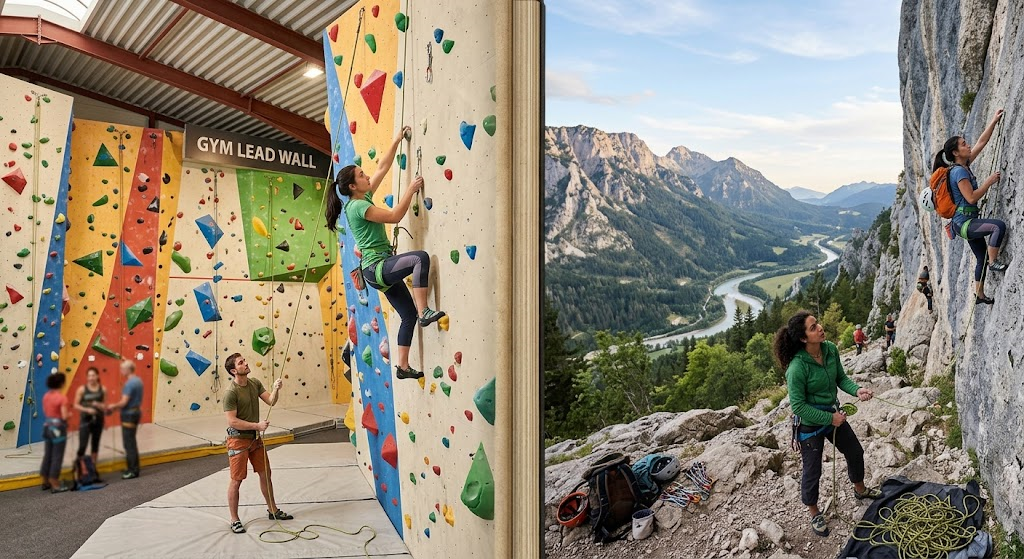
How to Transition From Indoor Climbing to Outdoor Rock Climbing: A Beginner’s Guide
Indoor climbing is one of the best ways to learn the fundamentals of rock climbing.
A climbing gym gives you controlled conditions, clearly marked routes, predictable surfaces, rental equipment, padded floors, and usually plenty of people who can answer questions. You can concentrate on movement without having to worry about finding a route through a mountain, evaluating rock quality, building anchors, dealing with changing weather, or figuring out how to get back to the ground.
Outdoor climbing is different.
It is still climbing, but the environment adds an entirely new layer of skills and responsibilities.
The holds aren’t color-coded. The wall wasn’t designed by a route setter. The weather can change. The approach may be difficult. The rock can be loose or fragile. Routes may be harder to identify than expected. Equipment requirements can change dramatically depending on the climbing discipline. Communication becomes even more important, and mistakes involving anchors, ropes, protection, or rappelling can have serious consequences.
That does not mean beginners should be intimidated by outdoor climbing.
It means the transition should be approached as a learning process rather than simply assuming that being able to climb a certain indoor grade automatically makes someone ready to climb outside.
The physical skills you have developed indoors are valuable. Your footwork, balance, grip, movement, route reading, and fitness all come with you.
But outdoor climbing requires you to add another category of knowledge: how to interact safely and responsibly with the natural climbing environment.
This guide explains how to make that transition, what changes outdoors, what equipment you may need, how to find appropriate beginner routes, how to work with experienced climbers, and how to prepare for your first outdoor climbing experience.
Indoor Climbing and Outdoor Climbing Are Not the Same Sport
It is tempting to think of outdoor climbing as simply indoor climbing with real rocks.
That comparison is incomplete.
Indoor climbing gives you a controlled environment.
Outdoor climbing gives you a natural environment that you have to understand.
At a gym:
- Holds are obvious.
- Routes are marked.
- The wall is inspected and maintained.
- The surface is relatively predictable.
- The climbing area is usually easy to access.
- Weather is rarely a concern.
- Anchors may already be installed.
- Staff are nearby.
- Equipment can often be rented.
Outside:
- Holds may be difficult to see.
- Routes may not be obvious.
- Natural rock varies dramatically.
- Rock can break or become loose.
- Weather can change quickly.
- Approaches can be strenuous.
- Anchors may require knowledge and equipment.
- You may be responsible for every piece of your climbing system.
- Emergency assistance may be far away.
That is why the transition should involve more than buying a pair of outdoor climbing shoes.
What Indoor Climbing Teaches You
Your time in the gym is still extremely valuable.
Indoor climbing can teach you many of the movement skills required outdoors.
You learn to:
- Use your feet
- Shift your weight
- Maintain balance
- Position your hips
- Grip holds efficiently
- Read sequences
- Recognize cruxes
- Rest
- Manage fatigue
- Move efficiently
- Deal with fear
- Fall appropriately in controlled environments
- Understand climbing grades
- Communicate with partners
- Develop climbing fitness
These skills provide the foundation for outdoor climbing.
The goal isn’t to abandon what you learned indoors.
The goal is to add outdoor knowledge to it.
When Are You Ready to Climb Outdoors?
There is no universal indoor grade that means you are automatically ready for outdoor climbing.
A climber who comfortably climbs difficult indoor routes may still lack the technical knowledge necessary for outdoor climbing.
Meanwhile, a relatively new climber who has received appropriate instruction and is accompanied by an experienced outdoor climber may have a perfectly enjoyable first outdoor experience.
Instead of asking:
“What grade do I need to climb before going outside?”
ask:
“What outdoor skills do I know how to perform safely?”
That is a much better question.
Physical Ability Is Only One Part of Readiness
Before transitioning outdoors, consider several areas.
Movement Skills
Can you climb efficiently rather than simply pulling yourself upward?
Route Reading
Can you look at a climb and identify a reasonable sequence?
Your ability to read a rock climbing route becomes particularly important outdoors because natural rock does not provide the obvious visual structure of a gym.
Equipment Knowledge
Do you understand the equipment you are using?
Rope Skills
Do you understand the relevant rope systems for the type of climbing you plan to do?
Communication
Can you clearly communicate with your climbing partner?
Risk Awareness
Do you understand that outdoor climbing involves hazards that may not exist indoors?
Judgment
Can you recognize when conditions or circumstances are beyond your experience?
That last skill may be the most important of all.
The Best First Outdoor Experience: Go With an Experienced Climber
For many beginners, the best way to make the transition is to climb outside with someone who has substantial outdoor experience.
That might be:
- An experienced friend
- A qualified instructor
- A reputable guide
- An established climbing organization
- An experienced climbing partner who understands the area and systems
The important distinction is between someone who is merely a strong climber and someone who actually understands outdoor climbing systems.
A person who climbs difficult gym routes is not automatically qualified to teach anchors, rappelling, outdoor protection, route finding, or rescue procedures.
Look for experience that matches what you are trying to learn.
Consider Taking an Outdoor Climbing Course
A climbing gym may offer outdoor transition courses.
These can cover subjects such as:
- Outdoor equipment
- Rock identification
- Route finding
- Anchors
- Rope systems
- Rappelling
- Cleaning routes
- Belaying outdoors
- Climbing commands
- Equipment organization
- Environmental responsibility
- Emergency planning
Professional instruction can be especially valuable if you eventually want to climb independently.
The objective isn’t merely to have someone show you where to put a rope.
You want to understand why a system is constructed or used a particular way.
Start With the Simplest Outdoor Discipline
Not all outdoor climbing disciplines have the same learning curve.
A beginner’s first experience is often simpler when the climbing system has fewer variables.
For example, an appropriately supervised top-rope experience at an established climbing area can allow you to concentrate primarily on climbing movement and becoming comfortable on natural rock.
Sport climbing introduces additional skills.
Trad climbing introduces substantially more.
Multi-pitch climbing introduces even more complexity.
You should build skills progressively.
For background on these disciplines, see the different types of rock climbing explained for beginners.
Outdoor Top-Rope Climbing
Top-rope climbing can be an excellent introduction to outdoor rock because the climbing movement itself can remain the primary focus.
However, that does not mean outdoor top-roping is automatically simple.
Someone must establish and inspect an appropriate anchor system.
The anchor, rope, hardware, attachment points, and overall setup all matter.
A beginner should learn these systems from someone competent rather than improvising based on what looks reasonable.
Outdoor Sport Climbing
Sport climbing can feel familiar to gym climbers because bolts may already be installed along the route.
But there are important differences.
You may need to understand:
- Quickdraws
- Clipping
- Rope management
- Route identification
- Anchor systems
- Cleaning
- Lowering
- Rappelling
- Bolt and anchor inspection
- Rope length requirements
The fact that a route contains bolts does not mean that every aspect of the climb is automatically safe or obvious.
You need to understand the entire system.
Trad Climbing Should Be a Later Step
Traditional climbing introduces another major layer of complexity.
The climber may need to place removable protection rather than simply clipping pre-installed bolts.
That requires knowledge of:
- Protection placement
- Rock features
- Gear selection
- Anchor construction
- Protection evaluation
- Rope management
- Route strategy
Trad climbing can be tremendously rewarding, but it is not something to learn casually from a few online videos.
It deserves hands-on instruction and supervised experience.
Outdoor Climbing Requires New Equipment
You may already own some climbing equipment from indoor climbing.
Some of it transfers directly.
Some does not.
You may already have:
- Climbing shoes
- Harness
- Chalk bag
- Helmet
- Belay device
Depending on the discipline, you may additionally need:
- Rope
- Quickdraws
- Locking carabiners
- Slings/runners
- Personal anchor equipment
- Trad protection
- Rope bag
- Guidebook or route information
- Navigation equipment
- Appropriate clothing
- First-aid supplies
- Emergency equipment
The exact equipment depends heavily on the type of climbing.
For a complete discussion of climbing equipment, see the rock climbing equipment guide covering shoes, harnesses, ropes, chalk, helmets, and essential gear.
Don’t Buy Everything at Once
A common beginner mistake is buying a huge pile of equipment before deciding what kind of outdoor climbing they actually enjoy.
You may discover that you love:
- Sport climbing
- Bouldering
- Top-roping
- Crack climbing
- Multi-pitch climbing
Each discipline has different equipment requirements.
Start with what you actually need.
Borrow or rent appropriate equipment when practical.
Then build your personal collection gradually.
Your Climbing Shoes Will Feel Different Outdoors
Indoor climbing walls are generally smooth and predictable.
Natural rock is different.
Your shoes may interact with:
- Rough textures
- Tiny edges
- Slabs
- Cracks
- Pockets
- Natural features
- Uneven surfaces
A shoe that feels fantastic in the gym may not necessarily feel ideal for every outdoor area.
This is another reason not to assume that outdoor climbing requires buying the most aggressive shoe available.
Fit and suitability matter more than marketing claims.
The Helmet Becomes Even More Important Outdoors
A helmet is an important part of many outdoor climbing systems because outdoor environments introduce hazards that are not present in the same way indoors.
Potential hazards include:
- Falling rock
- Loose equipment
- Impact with rock
- Objects dislodged by other climbers
- Falls in certain climbing situations
A helmet does not make climbing safe by itself.
It is one layer of a larger risk-management system.
For a broader discussion, see rock climbing safety, essential rules, hazards, and risk management.
The Rock Itself Is Part of the Problem
This may be one of the biggest adjustments for an indoor climber.
Indoor holds are intentionally designed to be used.
Outdoor rock is not.
A natural feature may look like a perfect handhold but be:
- Fragile
- Loose
- Sharp
- Poorly protected
- Difficult to use
- Unsafe to pull on
You have to learn to evaluate the rock.
That is one of the reasons beginners should climb with experienced outdoor climbers.
Loose Rock Is a Serious Outdoor Hazard
Rock can break.
This is particularly important when climbing beneath other people.
A climber may accidentally dislodge a rock above you.
That is one reason communication and helmets matter.
It is also important not to assume that every natural feature is solid simply because it looks substantial.
Experienced climbers learn to recognize warning signs.
Beginners should defer to experienced partners when uncertain.
Outdoor Route Finding Is a Skill
At a gym, the route is usually obvious.
Outside, finding the route may be part of the adventure.
You may have to:
- Locate the climbing area
- Find the correct cliff
- Identify a particular route
- Determine where it starts
- Follow a trail
- Read a guidebook
- Match route descriptions to the rock
- Find the descent
This means your outdoor preparation begins before you touch the rock.
Learn to Use a Climbing Guidebook or Route Database
Established climbing areas often have guidebooks or other reliable route information.
These resources may provide:
- Route names
- Grades
- Lengths
- Approach information
- Protection information
- Descriptions
- Maps
- Area rules
- Descent information
Treat route descriptions as useful information, not absolute guarantees.
Conditions can change.
New hazards can appear.
Routes may be altered or closed.
Local knowledge remains extremely valuable.
Understand the Approach
The approach is the journey from where you park or begin your hike to the climbing area.
Do not underestimate it.
An approach might involve:
- Hiking
- Scrambling
- Steep terrain
- Loose rock
- River crossings
- Exposure
- Navigation
A climber who is exhausted before beginning the climb may make poor decisions.
When planning your first outdoor trip, choose an area with a manageable approach.
The Descent Is Part of the Route
One of the most important lessons for beginners is that reaching the top does not necessarily mean you are finished.
You still need to get down.
Depending on the route, descent may involve:
- Walking
- Downclimbing
- Lowering
- Rappelling
- Following a trail
- Scrambling
You should understand the descent before beginning the climb.
This is particularly important in unfamiliar areas.
Weather Changes Everything
Indoor climbing largely eliminates weather as a concern.
Outside, weather can determine whether you should climb at all.
Pay attention to:
- Rain
- Lightning
- Wind
- Temperature
- Heat
- Cold
- Snow
- Humidity
- Wet rock
A forecast is helpful, but weather conditions can change rapidly in mountainous environments.
Do not let a desire to complete a route override changing conditions.
Wet Rock Can Be a Problem
Depending on the rock type, climbing after rain can damage the rock or significantly change climbing conditions.
Some rock types are particularly vulnerable when wet.
The responsible approach is to learn the specific rules and recommendations for the climbing area.
Sometimes the right decision is simply to wait.
There will always be another climbing day.
Outdoor Climbing Takes More Planning
An indoor climbing session might involve:
- Drive to gym.
- Check in.
- Climb.
- Go home.
Outdoor climbing can require:
- Select an area.
- Check conditions.
- Study access information.
- Plan the approach.
- Confirm the route.
- Gather equipment.
- Pack food and water.
- Plan communication.
- Understand the descent.
- Consider emergencies.
- Climb.
- Return safely.
The additional planning is part of the sport.
Bring More Than Climbing Gear
Beginners sometimes pack their climbing equipment and forget that they are spending time outside.
Depending on the environment, you may need:
- Plenty of water
- Food
- Extra layers
- Rain protection
- Sun protection
- First-aid supplies
- Headlamp
- Navigation tools
- Phone
- Emergency communication options
- Extra clothing
- Appropriate footwear
Your exact needs depend on the location, season, approach, and climbing objective.
Tell Someone Where You Are Going
Outdoor climbing can take you away from immediate assistance.
Someone who is not on the trip should know:
- Where you are going
- Who you are with
- What area you are visiting
- When you expect to return
If plans change significantly, update them when possible.
This is basic outdoor risk management.
Cell Service Is Not Guaranteed
Do not assume your phone will work because it worked at the parking lot.
Cliffs, valleys, forests, and remote locations can all affect connectivity.
Plan accordingly.
A phone can be useful.
It should not be your only emergency plan.
Communication Becomes More Important Outdoors
Indoor climbing gyms can be noisy, but outdoor environments can create entirely different communication challenges.
Wind, distance, multiple parties, and natural echoes can make commands difficult to hear.
Use clear, agreed-upon commands.
Make sure you and your partner understand what each command means.
Never assume that your partner heard you.
When in doubt, confirm.
Learn to Inspect Your Equipment
Outdoor equipment experiences different conditions than gym equipment.
Before climbing, inspect:
- Rope
- Harness
- Helmet
- Carabiners
- Quickdraws
- Slings
- Belay device
- Anchors
- Other relevant equipment
Look for:
- Cuts
- Fraying
- Damage
- Excessive wear
- Deformation
- Sharp edges
- Malfunctioning gates
- Questionable anchor components
If you are uncertain about an item’s condition, don’t gamble with it.
Learn Rope Management
Outdoor climbing often involves more rope handling than beginners experience indoors.
You may need to understand:
- Coiling
- Rope deployment
- Rope bags
- Rope ends
- Knots
- Rope routing
- Keeping the rope away from hazards
- Preventing tangles
Good rope management isn’t glamorous.
It is extremely important.
Anchors Deserve Special Attention
An anchor is not simply a place where you attach a rope.
A climbing anchor is a critical part of the protection system.
The person responsible for an anchor needs to understand:
- Anchor points
- Hardware
- Direction of loading
- Redundancy
- Connection methods
- Rope or sling systems
- Extension
- Equalization concepts
- Inspection
- Appropriate attachment
Beginners should learn anchor construction hands-on from a competent instructor or experienced mentor.
Do not attempt to build anchors independently because you watched a short online tutorial.
Rappelling Requires Training
Rappelling can look deceptively simple.
It involves descending a rope using a controlled system.
But mistakes can be catastrophic.
Before rappelling independently, you should receive appropriate instruction and supervised practice covering the complete system, including:
- Rope setup
- Anchor inspection
- Belay/rappel device
- Backup systems where appropriate
- Knots
- Rope ends
- Communication
- Personal attachment
- Retrieval
- Managing the rope
Rappelling should never be treated as an afterthought.
Don’t Confuse Confidence With Competence
This is one of the most important lessons for new outdoor climbers.
You may feel confident after several successful gym sessions.
That’s great.
But confidence in climbing movement does not automatically equal competence in outdoor systems.
You can be:
- A strong climber
- A good route reader
- Comfortable with heights
and still be inexperienced with:
- Anchors
- Rappelling
- Route finding
- Rock quality
- Outdoor protection
- Weather
- Emergency planning
Recognize the difference.
Your First Outdoor Day Shouldn’t Be a Personal Achievement Test
Avoid making your first outdoor trip about proving something.
You don’t need to:
- Climb your hardest grade
- Lead your hardest route
- Climb all day
- Conquer your fear immediately
- Impress experienced climbers
Your first goal should be learning.
Pay attention to how the environment differs from the gym.
Expect Outdoor Grades to Feel Different
A route with the same numerical grade as something you climb indoors may feel much harder outdoors.
That can happen because outdoor climbing may require:
- More route finding
- Different techniques
- Less obvious holds
- More sustained climbing
- Different rock textures
- Greater mental demands
- More commitment
- Different grading traditions
Do not become discouraged.
You are learning a different environment.
Natural Rock Can Make You Feel Like a Beginner Again
This is completely normal.
You might comfortably climb a certain grade indoors and struggle on what appears to be an easier outdoor route.
That does not mean you suddenly became a worse climber.
You are developing another skill set.
Outdoor climbing introduces unfamiliar movement patterns.
Your brain needs time to build a new library of experience.
Your Route-Reading Skills Will Change
Indoor route reading teaches you to follow marked holds.
Outdoor route reading requires you to identify natural features.
You may have to determine:
- Where the line goes
- Which crack is the route
- Which features are usable
- Where the crux is
- Where protection exists
- Where the route changes direction
This makes route reading even more valuable.
Learn to Read Natural Rock
Start paying attention to rock features.
Look for:
- Cracks
- Flakes
- Edges
- Pockets
- Ridges
- Corners
- Grooves
- Slabs
- Arêtes
- Ledges
Then ask how the feature might be used.
A crack may provide handholds.
A corner may provide stemming opportunities.
A slab may emphasize balance and friction.
A pocket may provide a very specific hand position.
The rock tells the story.
You have to learn how to read it.
Don’t Pull on Everything You See
Indoor climbers become accustomed to trusting the holds.
Outside, that instinct needs to be modified.
If you are unsure about a feature, ask an experienced climber.
Natural rock can be fragile.
A feature that looks secure may not be.
This is one of the biggest mindset changes when moving outdoors.
Outdoor Etiquette Matters
Climbing areas are shared spaces.
You may encounter:
- Other climbers
- Hikers
- Local residents
- Wildlife
- Land managers
- Other outdoor recreation users
Be respectful.
That includes:
- Keeping noise reasonable
- Waiting your turn
- Managing ropes
- Avoiding unnecessary congestion
- Following local rules
- Respecting closures
- Keeping dogs under control where permitted
- Packing out trash
Leave No Trace
Outdoor climbing depends on healthy natural environments.
Responsible climbers should minimize their impact.
That means:
- Pack out trash
- Stay on established trails where appropriate
- Respect vegetation
- Avoid damaging rock
- Follow local access rules
- Respect wildlife
- Don’t create unnecessary new trails
- Avoid climbing closed routes
- Follow area-specific restrictions
Access to climbing areas is a privilege that depends on responsible behavior.
Respect Local Climbing Rules
Different climbing areas may have different rules.
Restrictions can involve:
- Seasonal closures
- Wildlife
- Fire
- Camping
- Parking
- Chalk
- Fixed hardware
- Route access
- Dogs
- Drones
- Vegetation
- Specific climbing practices
Learn the rules before arriving.
Do not assume that because something is acceptable at your local gym, it is acceptable at every outdoor crag.
Build Outdoor Skills Gradually
You don’t have to learn everything at once.
A sensible progression might look something like this:
Stage 1: Indoor foundation
Learn basic movement, belaying, climbing communication, and equipment use.
Stage 2: Outdoor introduction
Climb outside with an experienced person.
Concentrate on natural rock and outdoor etiquette.
Stage 3: Learn outdoor systems
Learn appropriate skills such as route identification, anchors, rappelling, and outdoor rope management under qualified supervision.
Stage 4: Gain supervised experience
Repeat those skills in different environments.
Stage 5: Increase independence
Only after you have demonstrated competence should you begin taking greater responsibility for outdoor climbing systems.
Stage 6: Specialize
Eventually decide whether you want to pursue:
- Sport climbing
- Trad climbing
- Bouldering
- Multi-pitch
- Alpine climbing
- Other disciplines
There is no need to rush.
Don’t Rush Into Lead Climbing Outdoors
Indoor lead climbing experience is useful.
But outdoor lead climbing adds several variables.
You have to understand:
- Route identification
- Protection
- Clipping
- Rope management
- Anchors
- Route length
- Rock quality
- Descent
- Cleaning
An outdoor lead route should not be your first attempt at understanding outdoor systems.
Learn progressively.
Don’t Rush Into Trad Climbing
Trad climbing is particularly demanding because protection is part of the climbing problem.
Before leading trad routes, climbers need substantial knowledge and experience.
A typical progression might include:
- Learning gear
- Understanding placements
- Practicing placements
- Following experienced leaders
- Learning anchors
- Learning protection evaluation
- Practicing under supervision
- Building experience gradually
There is no prize for becoming an independent trad leader as quickly as possible.
Keep Training Indoors
Going outdoors does not mean you should stop going to the gym.
Indoor climbing remains an excellent training environment.
You can use the gym to work on:
- Strength
- Endurance
- Technique
- Route reading
- Movement drills
- New techniques
- Projecting
Then use outdoor climbing to develop your natural-rock skills.
The two environments complement each other.
Continue Developing Technique
Your indoor technique will become more valuable outdoors as you learn how to apply it to natural features.
Continue working on:
- Quiet feet
- Efficient movement
- Body positioning
- Balance
- Hip movement
- Grip efficiency
- Resting
- Route reading
For a deeper look at these skills, see rock climbing techniques for footwork, grip, body position, balance, and efficient movement.
Continue Training Intelligently
Outdoor climbing doesn’t eliminate the need for physical preparation.
If you want to climb harder or longer routes, continue developing:
- Finger strength
- Pulling strength
- Core strength
- Endurance
- Mobility
- Recovery
- Mental skills
But don’t let training become an excuse to ignore outdoor education.
Being stronger doesn’t compensate for not knowing how to build or evaluate a climbing system.
Our guide to getting better at rock climbing through training, strength, endurance, flexibility, and practice explores that side of progression.
Learn From Every Outdoor Day
After each trip, ask yourself:
What did I learn?
Maybe you learned:
- How difficult route finding can be
- How much water you need
- How different outdoor grades feel
- How natural footholds work
- How long an approach takes
- How quickly weather changes
- What equipment you actually use
- What skills you need to improve
Write those lessons down.
They will make your next trip better.
A Beginner’s Outdoor Climbing Checklist
Before leaving home, consider:
Climbing equipment
- Climbing shoes
- Harness
- Helmet
- Rope appropriate for the activity
- Belay device
- Carabiners
- Quickdraws or other appropriate equipment
- Slings/runners as needed
Personal items
- Water
- Food
- Clothing layers
- Rain protection
- Sun protection
- Appropriate footwear
- First-aid supplies
- Headlamp
Planning
- Route information
- Area access information
- Weather forecast
- Approach information
- Descent information
- Emergency plan
- Communication plan
Knowledge
- Do I understand the climbing system?
- Do I know the route?
- Do I understand the descent?
- Do I know what my partner is responsible for?
- Do we have clear communication commands?
If the answer to an important question is no, stop and figure it out before proceeding.
The Most Important Outdoor Skill: Knowing When Not to Climb
This deserves special emphasis.
Sometimes the smartest climbing decision is to walk away.
You might encounter:
- Bad weather
- Wet rock
- Damaged equipment
- Questionable anchors
- Loose rock
- A route beyond your experience
- A partner who is unprepared
- Dangerous conditions
- An approach that is beyond your ability
Walking away isn’t failure.
It is good judgment.
Experienced climbers understand that climbing is not about eliminating risk.
It is about managing risk intelligently.
Outdoor Climbing Should Expand Your Appreciation of the Sport
One of the greatest rewards of moving outside is that climbing becomes more than a gym workout.
You experience:
- Natural landscapes
- Different types of rock
- New movement challenges
- Adventure
- Exploration
- Problem-solving
- Community
- Patience
- Environmental responsibility
The climbing itself is only part of the experience.
You Don’t Have to Choose Between Indoor and Outdoor Climbing
Many climbers enjoy both.
Indoor climbing offers:
- Convenience
- Consistency
- Training
- Social opportunities
- Controlled conditions
- Year-round access
Outdoor climbing offers:
- Natural rock
- Adventure
- Exploration
- Different movement
- Scenic environments
- Route-finding challenges
There is room for both.
From Gym Climber to Outdoor Climber
The transition from indoor to outdoor climbing isn’t a single moment.
It is a progression.
You start with indoor movement.
Then you learn to read routes.
You develop strength and endurance.
You learn equipment.
You learn safety.
You climb outdoors with experienced people.
You learn natural rock.
You learn outdoor systems.
You gradually take on more responsibility.
Eventually, the things that initially seemed complicated begin to feel familiar.
That is how experience develops.
The Rock Climbing Learning Journey
At this point, the entire rock climbing series forms a natural progression.
You began with The Ultimate Beginner’s Guide to Rock Climbing, learning what the sport is and how its major disciplines differ.
Then you learned how to start rock climbing as a beginner and what to expect during your first climbing experience.
Next came rock climbing equipment, including shoes, harnesses, ropes, chalk, helmets, and other gear.
You then explored the different types of rock climbing, including bouldering, top-rope, sport, trad, lead, and multi-pitch climbing.
After that came rock climbing techniques, where you learned about footwork, grip, balance, body positioning, and efficient movement.
Then you learned how to improve at rock climbing through training, strength, endurance, flexibility, and practice.
The safety article addressed rock climbing safety, hazards, risk management, and responsible decision-making.
The previous article taught you how to read a rock climbing route, understand grades, identify cruxes, plan sequences, and develop climbing strategy.
Now you have reached the final major step: learning how to take those skills into the natural environment.
Outdoor Climbing FAQs
How good do I need to be at indoor climbing before climbing outside?
There is no universal grade requirement. Physical ability is only one part of readiness. You also need appropriate outdoor instruction, equipment knowledge, risk awareness, and a competent partner or instructor.
Is outdoor climbing harder than indoor climbing?
It can be, but not necessarily because the climbing grades are higher. Natural rock can be less obvious, more technical, and more mentally demanding. Route finding and outdoor systems also add complexity.
Can a beginner climb outdoors?
Yes. Beginners can absolutely enjoy outdoor climbing when they do so with appropriate instruction and experienced partners and choose an environment suited to their skill level.
Should I buy outdoor climbing equipment before my first trip?
Not necessarily. Some equipment can be rented or borrowed. It is usually better to understand what type of outdoor climbing you want to pursue before buying a large amount of specialized gear.
Can I use my indoor climbing shoes outdoors?
Yes. Climbing shoes can generally be used in both environments, although different outdoor rock types may favor different shoe characteristics.
Is outdoor sport climbing safe for beginners?
Sport climbing can be accessible to beginners when they have appropriate instruction and understand the complete system. The presence of bolts does not eliminate the need for knowledge about clipping, anchors, rope management, descent, and equipment inspection.
Should I start with trad climbing?
Generally, trad climbing is not an ideal first independent outdoor discipline because it adds substantial equipment and protection knowledge. Learn it progressively with qualified instruction and experienced mentorship.
Do I need a helmet outdoors?
A helmet is an important safety layer for many outdoor climbing situations because of hazards associated with falling rock and impacts. Follow appropriate practices for the type of climbing and environment.
What should I do if the weather changes?
Reassess the situation immediately. Depending on the conditions, the safest decision may be to stop climbing and leave the area. Lightning and other severe weather require particularly conservative decision-making.
Why do outdoor routes sometimes feel harder than indoor routes of the same grade?
Grades vary by location and style. Outdoor routes may also require unfamiliar movement, natural route reading, different rock techniques, and greater mental commitment.
How do I learn to build outdoor anchors?
Learn from a qualified instructor or highly experienced mentor through hands-on instruction and supervised practice. Anchor systems should not be learned solely by copying diagrams or watching short videos.
How do I find outdoor climbing routes?
Established climbing areas often have guidebooks, route databases, local climbing organizations, or other reliable information sources. Experienced local climbers can also provide valuable context.
What is the biggest mistake indoor climbers make when going outdoors?
One of the biggest mistakes is assuming that strong indoor climbing ability automatically equals outdoor competence. The physical skills transfer, but outdoor systems and environmental awareness must be learned separately.
Final Thoughts: Take Your Time Going Outside
The transition from indoor climbing to outdoor rock climbing should be exciting.
It should also be deliberate.
Don’t feel like you have to prove that you are a “real climber” by immediately tackling difficult outdoor routes. You don’t need to lead a route, place trad gear, build anchors, or rappel off a cliff simply because someone else is doing it.
Start with what you understand.
Go with people who know more than you.
Ask questions.
Take instruction.
Learn the environment.
Respect the rock.
Respect the weather.
Respect your equipment.
And most importantly, respect the limits of your experience.
Your indoor climbing skills provide an excellent foundation. Your technique, strength, endurance, route reading, and mental skills will all become useful outside.
But outdoor climbing adds another dimension to the sport.
You aren’t just climbing a wall anymore.
You’re navigating a natural environment, making decisions, managing systems, reading rock, respecting access, and accepting responsibility for your own preparation.
That is what makes outdoor climbing so rewarding.
The best climber isn’t necessarily the person who climbs the hardest route.
Sometimes it is the person who recognizes the conditions aren’t right, turns around, learns something new, and comes back another day.
Take your time.
Build your skills.
Learn from experienced climbers.
And eventually, the transition from the artificial walls of the gym to real rock will stop feeling like a giant leap.
It will simply become the next chapter of your climbing journey.