
Why Mid-Major College Basketball Programs Upset Power Schools
Why Mid-Major College Basketball Programs Upset Power Schools
Every college basketball season produces them.
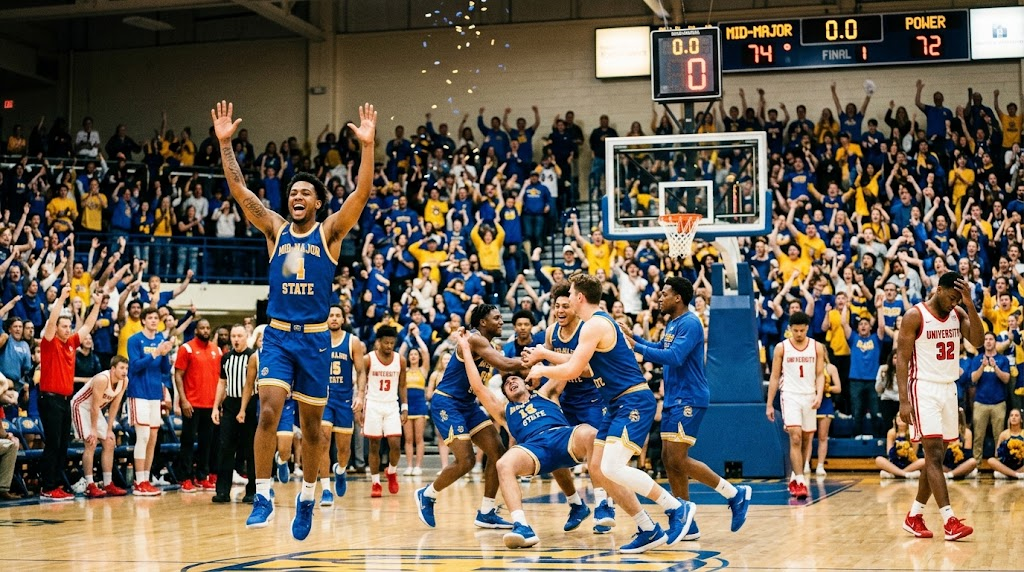
A relatively unknown mid-major program walks into a packed arena, faces a nationally ranked power-conference opponent and refuses to be intimidated.
The favorite has more resources.
The favorite may have higher-ranked recruits.
The favorite may have more athletic depth.
The favorite may have players with NBA aspirations.
The favorite may have a larger budget, bigger facilities and considerably more national attention.
And then the game starts.
Suddenly, none of those advantages seem quite as overwhelming.
The mid-major slows the pace.
It forces the favorite into uncomfortable shots.
Its guards attack relentlessly.
Its defense takes away the opponent’s first option.
Its shooters knock down open threes.
Its players make fewer mistakes.
The crowd becomes nervous.
The favorite begins pressing.
And eventually, the scoreboard tells a story that seemed almost impossible when the game began.
The upset is complete.
Mid-major college basketball programs don’t defeat power-conference opponents simply because the favorite had a bad night.
Sometimes that happens.
But many of the most memorable upsets are the result of specific basketball decisions that allow an underdog to neutralize advantages in talent, depth and resources.
The smaller program cannot always match the power school athlete for athlete.
It doesn’t have to.
Instead, it can make the game about the things it can control.
Execution.
Shot selection.
Turnovers.
Rebounding.
Spacing.
Tempo.
Defensive discipline.
Free throws.
And pressure.
That’s what makes college basketball different from many other sports.
A single-elimination tournament or one-game matchup gives a well-coached underdog an opportunity to turn a talent disadvantage into a tactical problem.
What Is a Mid-Major?
The term “mid-major” is not an official NCAA classification.
It is generally used to describe programs outside the highest-profile conferences that receive substantial national attention and resources.
The terminology can be complicated because college basketball’s conference structure continues to evolve.
Programs can change conferences.
Conferences can change membership.
Some schools that were historically considered mid-majors can eventually move into higher-profile leagues.
Others can build programs strong enough to receive significant national attention without changing conferences.
For purposes of understanding upsets, however, the basic distinction is useful.
A mid-major generally faces a different competitive and financial environment from the programs that dominate the largest conferences.
That difference makes an upset particularly interesting.
The Talent Gap Is Real
The first thing to acknowledge is that power-conference programs generally have access to enormous basketball resources.
They can recruit nationally.
They can offer major facilities.
They can attract large crowds.
They can provide extensive support systems.
They can often offer players opportunities to compete on the biggest stages.
And the modern transfer environment has given high-resource programs another method of acquiring established talent.
Recent analysis of college basketball’s transfer landscape has shown how important movement between programs has become, with many major-conference stars having started their careers at mid-major schools.
That makes the upset question even more fascinating.
If the power school has more talent, how does the smaller program win?
The answer begins with this:
Basketball games are decided by possessions, not recruiting rankings.
One Game Can Neutralize a Talent Advantage
Over a long season, superior talent generally has more opportunities to demonstrate itself.
Depth matters.
Consistency matters.
Athleticism matters.
Shooting matters.
Size matters.
A team with significantly more talent has more ways to survive a bad stretch.
But one basketball game is different.
The underdog doesn’t have to prove that it is better over 30 games.
It has to be better for approximately 40 minutes.
That creates opportunity.
If the mid-major can make the game ugly, slow, physical and unpredictable, the favorite’s talent advantage becomes less decisive.
The fewer possessions a game contains, the fewer opportunities the more talented team has to separate itself.
That is why tempo can be one of an underdog’s most important weapons.
Tempo Can Change the Entire Game
Imagine a power-conference team that wants to run.
It has athletic guards.
It has multiple scoring options.
It wants transition opportunities.
It wants to attack before the defense gets organized.
The mid-major coach may have a different plan.
Walk the ball up.
Run the offense.
Use the shot clock.
Avoid unnecessary turnovers.
Make the favorite defend for 25 seconds.
Take good shots.
Repeat.
That can frustrate an opponent.
A team accustomed to scoring 75 or 80 points may suddenly find itself playing a 60-possession game.
The margin for error changes.
Controlling tempo allows an underdog to control how many opportunities the favorite has to use its athletic advantages.
Slow Doesn’t Mean Passive
There is an important distinction here.
Playing slowly does not mean refusing to attack.
A well-designed half-court offense can be extremely aggressive.
The objective is to force the defense to work.
Move the ball.
Set screens.
Create switches.
Attack mismatches.
Force help.
Kick the ball out.
Reverse the ball.
Attack again.
The underdog isn’t simply trying to survive.
It is trying to create efficient opportunities while preventing the favorite from getting easy ones.
Three-Point Shooting Can Change Everything
Few things equalize college basketball faster than the three-point shot.
A team with less size or athleticism can still threaten a superior opponent if it consistently makes perimeter shots.
One three-pointer is worth the same three points regardless of the recruit’s ranking.
That sounds obvious.
But strategically, it is enormous.
A power school may have a six-foot-eight wing who can dominate the paint.
A mid-major may counter by putting four shooters around a ball handler.
Now the bigger defender has to leave the paint.
Closeouts become longer.
Help defense becomes more difficult.
Driving lanes open.
The underdog’s offense suddenly has options.
Elite perimeter shooting can turn a talent disadvantage into a spacing problem for the favorite.
Shot Selection Matters
Shooting a lot of threes isn’t automatically a good strategy.
The quality of the attempts matters.
A mid-major looking for an upset generally needs to maximize efficient possessions.
That means avoiding difficult shots early in the shot clock.
Avoiding contested jumpers.
Avoiding unnecessary isolation.
Avoiding rushed attempts.
The best underdog offenses often understand that every possession has value.
A 25-foot contested shot with 18 seconds remaining may be a bad shot.
A wide-open three after ball movement may be an excellent one.
The difference is not simply whether the shot goes in.
It is whether the process consistently produces good opportunities.
Turnovers Are the Underdog’s Enemy
Nothing can destroy an upset attempt faster than careless turnovers.
Every turnover gives the favorite a possession it didn’t have to earn through defense.
And live-ball turnovers can be even more damaging.
A power-conference team with superior athletes can turn a steal into an immediate dunk.
That creates points and momentum.
A mid-major therefore needs disciplined ball handling.
Guards have to value possessions.
Passes need to be sharp.
Players must understand spacing.
The team cannot panic when pressure arrives.
For an underdog, protecting the basketball can be just as important as making shots.
The Favorite’s Pressure Can Become a Weapon for the Underdog
This is one of the psychological dynamics of an upset.
The favorite is supposed to win.
Everyone expects it.
The underdog is playing with less pressure.
If the mid-major leads by eight points with ten minutes remaining, suddenly the pressure shifts.
The favorite begins thinking:
“We’re supposed to win this game.”
The underdog begins thinking:
“We actually have a chance.”
That psychological shift can be enormous.
Players who were relaxed may become tentative.
Shots that normally look easy suddenly feel important.
The favorite may rush.
The underdog may become more confident.
An upset can become increasingly difficult for the favorite once the underdog stops believing it is supposed to lose.
Confidence Is Contagious
One made three-pointer can change the energy of a team.
Then another.
Then a defensive stop.
Then a transition basket.
Suddenly the bench is celebrating.
The crowd is louder.
The players are talking.
The favorite starts looking uncomfortable.
Confidence can spread quickly in basketball because the game is so momentum-driven.
That doesn’t mean “momentum” magically determines the winner.
It means successful plays affect behavior.
Players communicate more.
They run harder.
They make decisive moves.
They take open shots without hesitation.
The psychological effect is real even when the underlying causes are basketball-related.
Defensive Scheme Is Often the Difference
A mid-major doesn’t necessarily need to shut down the power school’s offense.
It needs to make the offense uncomfortable.
That can happen in several ways.
Man-to-man defense can force difficult individual decisions.
Zone defense can disrupt rhythm.
A matchup zone can create confusion.
Full-court pressure can accelerate the game.
A switching defense can take away driving lanes.
A packed-in defense can dare the opponent to shoot.
The correct choice depends on the opponent.
The best mid-major defenses aren’t necessarily the most aggressive; they are the defenses that force the favorite to play outside its comfort zone.
Scouting Matters
Mid-major coaches often understand that preparation can compensate for talent.
If the favorite has an elite scorer, the underdog needs to know where that player wants to receive the ball.
What hand does the player prefer?
Where does the player shoot best?
What happens when the player gets doubled?
Which teammates receive the ball when help arrives?
Does the player struggle against physical defenders?
Does the offense rely heavily on one action?
These details matter.
The more accurately a team can predict what the opponent wants to do, the less reactive it has to be.
Take Away the First Option
Elite offenses usually have a preferred starting point.
Maybe it is a post entry.
Maybe it is a ball screen.
Maybe it is a dribble handoff.
Maybe it is a transition attack.
Maybe it is an isolation.
A mid-major doesn’t necessarily need to eliminate the entire offense.
It can try to eliminate the first option.
Force the ball to the second option.
Then the third.
Then the fourth.
Eventually, the possession becomes more difficult.
Great upset defenses often make talented offenses beat them with Plan B instead of allowing them to run Plan A.
Making Stars Work for Every Point
A power-school star may still score 25 points.
The question is how much work it takes.
If that player scores 25 points on 9-of-14 shooting with five assists, the favorite may be in excellent shape.
If the same player scores 25 points on 8-of-24 shooting with six turnovers, the story is completely different.
The underdog doesn’t always need to stop the star.
It needs to make the star inefficient.
That can involve double teams, physical defense, changing defenders, forcing contested shots and denying easy opportunities.
Depth Can Be Less Important Than People Think
One major advantage power programs have is depth.
They can bring talented players off the bench.
But depth doesn’t automatically win one game.
If a mid-major’s best players stay out of foul trouble and remain fresh enough to play heavy minutes, the talent gap can shrink.
This is particularly true late in games.
The underdog may have five or six players who know exactly what they are supposed to do.
The favorite may have ten talented players but less chemistry.
That difference can matter.
Chemistry Is an Underrated Advantage
Mid-major teams sometimes have rosters built around continuity.
Players may spend multiple seasons together.
They know one another’s tendencies.
They understand defensive rotations.
They know where teammates want the ball.
They communicate.
That can produce an advantage against a more talented team that has undergone significant roster turnover.
The modern transfer environment has made continuity harder to maintain for many programs, particularly those outside the largest conferences. Recent reporting has highlighted how mid-major programs increasingly lose productive players to higher-profile programs and then have to rebuild.
But when a mid-major does maintain continuity, it can become a major competitive asset.
Experience Matters in Close Games
Late-game execution is one of the biggest differences between good teams and upset teams.
Imagine the score is tied with two minutes remaining.
The underdog needs players who know what to do.
Who initiates the offense?
Who takes the shot?
When should the team attack?
When should it use clock?
Who takes the defensive assignment?
Who handles the ball against pressure?
Experience can help answer those questions.
Close games reward teams that remain organized when the pressure becomes highest.
Free Throws Become Critical
An underdog cannot afford to waste opportunities.
Free throws are especially important late.
A team that attacks the basket can force the favorite into foul trouble.
Once the bonus becomes a factor, aggressive drives become even more valuable.
But the underdog also needs to make the free throws it earns.
A team can play brilliantly for 39 minutes and still give away an upset through missed foul shots.
Rebounding Can Neutralize Athleticism
Rebounding is another area where the underdog has to compete.
A power school may have greater size.
That makes offensive rebounding dangerous.
If the favorite misses a shot but gets the rebound, it receives another possession.
That can eventually overwhelm a smaller team.
The mid-major therefore needs disciplined box-outs.
Five players have to participate.
Guards need to rebound.
Big men need to establish position.
The team cannot simply rely on height.
Rebounding is often less about jumping ability than positioning, anticipation and physical commitment.
The Underdog Can Attack the Favorite’s Weaknesses
No team is perfect.
Even a nationally ranked power program has weaknesses.
Maybe its backup point guard struggles against pressure.
Maybe its big men have difficulty defending in space.
Maybe its shooters are streaky.
Maybe it struggles against zone defense.
Maybe its transition defense is poor.
Maybe it commits too many turnovers.
The mid-major’s job is to find those weaknesses and repeatedly attack them.
That is where coaching becomes critical.
Coaching Can Shrink the Talent Gap
A great coach can’t manufacture athleticism.
But a coach can determine how often athleticism becomes relevant.
If the power school wants to run, slow the game.
If it wants to attack the paint, clog the lane.
If it wants to pressure the ball, use back cuts.
If it wants to switch everything, attack mismatches.
If it wants to play small, punish it inside.
Coaching is about deciding which strengths and weaknesses will determine the game.
That is why the best mid-major coaches are so valuable.
Preparation Creates Confidence
Players are more confident when they know what is coming.
If a team has spent all week preparing for a press and successfully breaks it several times early, the players become more comfortable.
If they have practiced defending a star’s favorite move and stop it during the game, confidence grows.
Preparation turns uncertainty into familiarity.
That matters enormously against a favored opponent.
The Home-Court Factor
Many famous upsets occur in hostile environments.
But home-court advantage can be a major equalizer when the mid-major hosts a power program.
The building may be smaller.
The crowd may be closer to the floor.
The atmosphere may be intense.
Students may be directly behind the basket.
The opponent may not be accustomed to the environment.
That can affect communication.
It can affect free throws.
It can affect concentration.
And it can give the underdog emotional energy.
Why Power Schools Sometimes Struggle Against Smaller Programs
The favorite can have a different psychological problem.
The game may not appear important.
Players may be thinking about a conference matchup later in the week.
They may be looking ahead.
They may underestimate the opponent.
Meanwhile, the mid-major may view the game as one of the biggest opportunities of the season.
That difference in urgency can matter.
The favorite doesn’t necessarily lack motivation.
But the underdog often has an enormous incentive.
Scheduling Creates Opportunity
Power-conference programs schedule mid-major opponents for several reasons.
They can prepare for different styles.
They can give younger players experience.
They can play games near home.
They can fill the schedule.
And sometimes they can help smaller programs financially through guaranteed-game arrangements.
For the mid-major, however, the matchup can be much more important.
A win can provide national exposure.
It can improve tournament credentials.
It can give the program recruiting momentum.
It can become a defining moment for the season.
The same game can have very different stakes for the two programs.
The Modern Transfer Portal Has Changed the Equation
The transfer portal has complicated the traditional Cinderella story.
In previous eras, a mid-major that developed several talented players might keep those players for multiple seasons.
Now, successful players can attract attention from higher-resource programs.
That can make sustained dominance harder.
Recent reporting found that many of the nation’s top players at high-major programs began their careers at mid-major schools, illustrating how smaller programs can function as talent-development pathways.
This creates an unusual paradox.
Mid-major programs can develop elite talent.
But their success can make those players more attractive to larger programs.
NIL Has Added Another Layer
Name, image and likeness opportunities have also changed roster construction.
The financial resources available to major programs can create additional recruiting advantages.
Recent reporting has pointed to NIL and the transfer portal as factors contributing to a widening gap between the highest-resource programs and smaller conferences.
That does not mean mid-majors cannot compete.
It means they may need to find different advantages.
Role.
Development.
Playing time.
Leadership opportunities.
Coaching.
Community.
Culture.
Those factors can still matter to recruits and transfers.
The Mid-Major Can Sell Opportunity
A talented player at a power school might be one of several talented players.
At a mid-major, that same player might become the centerpiece.
Instead of playing 15 minutes, the player might play 30.
Instead of being the fourth scoring option, the player might become the first.
Instead of waiting for an opportunity, the player can create an entire identity.
That can be a powerful recruiting message.
Sometimes the most valuable resource a mid-major can offer is opportunity.
Upsets Are Becoming More Difficult
This is an important part of the modern story.
Recent data has shown a sharp decline in wins by small-conference teams over power-conference opponents. ESPN Research reported 69 such wins in 2021-22, 75 in 2022-23, 69 in 2023-24, 48 in 2024-25 and just 29 in 2025-26.
The reasons discussed by coaches and analysts include roster movement, financial advantages, scheduling changes and greater talent concentration at the top.
That means the classic Cinderella formula is facing new challenges.
But it doesn’t eliminate the possibility.
It makes the successful upset more dependent on execution.
Why March Madness Remains Different
The NCAA Tournament creates a unique environment.
The game is single elimination.
There is no tomorrow for the losing team.
That creates pressure.
The underdog only needs one exceptional performance.
The favorite has to avoid disaster.
And March Madness has repeatedly demonstrated how quickly a tournament can change.
A mid-major doesn’t need to prove that it belongs among the nation’s best programs over an entire season.
It needs to win the next game.
Then the next one.
The Three-Point Variance Factor
Tournament basketball can also magnify shooting variance.
A team that normally shoots 35 percent from three might shoot 45 percent for one game.
A favorite that normally shoots 37 percent might shoot 25 percent.
That difference can dramatically alter the outcome.
The underdog’s challenge is to maximize the probability of a high-efficiency shooting night by creating open attempts.
It cannot control every shot.
But it can control shot quality.
The Underdog Needs Some Luck — But Not Only Luck
This is where the “anything can happen” explanation becomes incomplete.
Yes, an upset usually involves some randomness.
Shots bounce differently.
Calls go differently.
A favorite may miss open shots.
A late possession may take an unexpected turn.
But preparation determines whether a team is positioned to take advantage of those breaks.
Luck may open the door, but execution determines whether the underdog walks through it.
What the Best Upset Plans Have in Common
Although every opponent is different, successful mid-major game plans often share several characteristics.
They protect the basketball.
They control tempo.
They defend without unnecessary fouling.
They force difficult shots.
They rebound.
They move the ball.
They make open threes.
They attack weaknesses.
They stay composed.
They execute late.
And perhaps most importantly, they don’t spend the game trying to prove that they belong.
They simply play their style.
The Favorite Has to Play the Underdog’s Game
This may be the central principle.
If the mid-major can force the power school into its preferred style, the talent gap becomes less important.
The favorite may want to play fast.
Don’t let it.
The favorite may want to attack the paint.
Don’t let it.
The favorite may want to create transition opportunities.
Don’t turn the ball over.
The favorite may want to dominate the offensive glass.
Box out.
The favorite may want its star to control the game.
Make someone else beat you.
An upset often happens when the favorite is forced to solve a game it did not expect to play.
Why These Upsets Matter
A mid-major upset is more than one result.
It can change the perception of a program.
It can help recruiting.
It can attract fans.
It can generate national media coverage.
It can increase the profile of the coach.
It can create opportunities for future scheduling.
It can become a defining moment in program history.
And for the players, it can become one of the greatest memories of their careers.
That is why these games matter so much.
The Blueprint for Beating a Power School
There isn’t a guaranteed formula, but the basic blueprint is understandable.
Control the tempo
Don’t allow the favorite to play exactly how it wants.
Protect the basketball
Don’t give superior athletes easy transition opportunities.
Make the favorite defend
Force the opponent to execute for an entire possession.
Shoot intelligently
Create open perimeter opportunities rather than settling for contested attempts.
Defend the stars
Make the favorite’s best players work for everything.
Rebound
End possessions.
Stay out of foul trouble
Keep the best players on the floor.
Stay composed
Don’t panic when the favorite makes a run.
Execute late
Close the game with discipline.
Believe
Once the opportunity appears, the team has to take it.
Final Thoughts
Mid-major college basketball programs upset power schools because basketball provides something that recruiting rankings cannot completely eliminate:
the ability to turn a game into a tactical contest.
The power program may have more talent.
It may have more money.
It may have more depth.
It may have more exposure.
It may have more future professional players.
But none of those advantages automatically guarantees victory.
A well-coached mid-major can slow the game down.
It can attack mismatches.
It can spread the floor.
It can make threes.
It can force turnovers.
It can deny transition opportunities.
It can make a star uncomfortable.
It can rebound above its size.
And it can make the favorite play a game it never wanted to play.
That is the beauty of college basketball.
At a time when financial resources, NIL opportunities and transfer movement are making the competitive landscape increasingly uneven, the traditional upset has actually become harder to produce. Recent data shows a substantial decline in small-conference wins over power-conference teams.
But harder does not mean impossible.
When a mid-major finds the right combination of coaching, chemistry, shooting, defense, preparation and confidence, it can still turn a massive talent disadvantage into a one-game basketball problem.
And once that happens, rankings stop mattering.
Recruiting stars stop mattering.
Budgets stop mattering.
The only thing that matters is the next possession.
That is why mid-major upsets remain one of the most compelling parts of college basketball — and why, when one happens, it can feel like the entire sport has been reminded that 40 minutes on the court can still rewrite the hierarchy.