
The Rise of Small-Ball Lineups in Basketball Explained
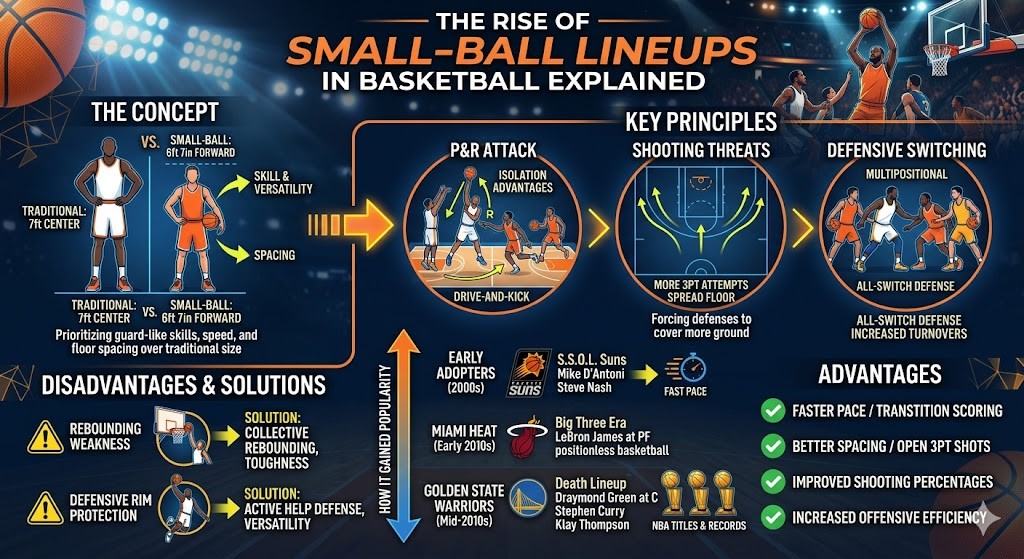
The Rise of Small-Ball Lineups in Basketball Explained
Basketball has evolved dramatically over the past two decades. The traditional model—featuring dominant centers and power forwards controlling the paint—has gradually given way to a faster, more versatile style of play.
At the center of this evolution is one key concept:
Small-ball lineups.
Teams across the NBA and around the world are embracing smaller, quicker, and more flexible lineups to gain a competitive edge.
But what exactly is small-ball—and why has it become so important?
Let’s break it down.
What Is a Small-Ball Lineup?
A small-ball lineup typically replaces traditional big men with smaller, more agile players.
Instead of using a true center, teams might:
- Play a forward at center
- Use multiple guards or wings
- Focus on speed and spacing
The goal is simple: increase versatility and offensive efficiency.
The Shift Away From Traditional Centers
Historically, teams relied heavily on size.
Centers were expected to:
- Protect the rim
- Rebound
- Score in the post
However, as the game evolved, slower big men became easier to exploit.
Smaller lineups began to:
- Stretch the floor
- Force mismatches
- Increase pace
This made traditional lineups less effective in certain situations.
Spacing and the Three-Point Revolution
One of the biggest drivers of small-ball is floor spacing.
With more shooters on the court:
- Defenses are forced to spread out
- Driving lanes open up
- Ball movement improves
The rise of the three-point shot has made spacing more valuable than ever.
Teams now prioritize players who can:
- Shoot from distance
- Move without the ball
- Create space for teammates
Speed and Pace Advantage
Small-ball lineups are faster.
They allow teams to:
- Push the ball in transition
- Increase the tempo
- Tire out opponents
Faster play creates more scoring opportunities and puts pressure on defenses.
Teams that control pace often control the game.
Versatility Is the Key
Modern basketball values players who can do multiple things.
Small-ball lineups emphasize:
- Positionless basketball
- Switching on defense
- Multi-skilled players
Instead of rigid roles, players are expected to:
- Handle the ball
- Shoot
- Defend multiple positions
This flexibility makes teams harder to defend and predict.
Defensive Switching Becomes Easier
Defense is a major advantage of small-ball.
With similar-sized players on the court, teams can:
- Switch screens بسهولة
- Reduce mismatches
- Maintain defensive pressure
Switching defenses disrupt offensive flow and limit easy scoring chances.
Creating Mismatches on Offense
Small-ball forces opponents into difficult decisions.
For example:
- A slower center may struggle to guard a perimeter player
- A smaller defender may be overpowered inside
Teams exploit these mismatches through:
- Isolation plays
- Pick-and-roll actions
- Ball movement
This creates high-percentage scoring opportunities.
Rebounding Trade-Offs
One downside of small-ball is rebounding.
Smaller lineups may:
- Struggle against bigger teams
- Give up second-chance points
However, teams often offset this by:
- Gang rebounding (everyone contributes)
- Increasing pace to limit half-court play
The trade-off is calculated.
The Influence of Championship Teams
Small-ball gained major attention through successful teams.
For example, the Golden State Warriors popularized the concept with their “Death Lineup.”
With players like Draymond Green playing center, they combined:
- Shooting
- Defense
- Versatility
Their success showed that small-ball could win championships.
The Role of Stretch Bigs
Not all big men disappeared—they evolved.
“Stretch bigs” can:
- Shoot from the perimeter
- Space the floor
- Still provide size
These players bridge the gap between traditional and modern styles.
They fit perfectly into small-ball systems.
Conditioning and Endurance
Small-ball demands high levels of fitness.
Players must:
- Run the floor constantly
- Defend multiple positions
- Maintain energy at a fast pace
Conditioning becomes a competitive advantage.
Impact on Player Development
The rise of small-ball has changed how players develop.
Young athletes now focus on:
- Ball handling
- Shooting
- Versatility
Even taller players are expected to develop guard-like skills.
This shift is reshaping the future of the game.
Coaching Adjustments
Coaches have adapted to maximize small-ball effectiveness.
Strategies include:
- Positionless rotations
- Emphasis on spacing and movement
- Defensive switching schemes
Lineups are more flexible than ever.
Coaches adjust based on matchups rather than sticking to traditional roles.
Small-Ball in International Basketball
The influence of small-ball extends beyond the NBA.
International teams have adopted similar approaches, emphasizing:
- Skill over size
- Ball movement
- Perimeter shooting
This global shift reinforces the effectiveness of the strategy.
When Small-Ball Doesn’t Work
Small-ball isn’t perfect.
It can struggle against:
- Dominant interior players
- Strong rebounding teams
- Physical matchups
In these cases, teams may adjust by adding size back into the lineup.
Balance is still important.
Hybrid Lineups Are the Future
Many teams now use hybrid approaches.
They combine:
- Small-ball lineups for speed
- Traditional lineups for size
This flexibility allows teams to adapt during games.
Analytics Support the Shift
Advanced analytics have played a major role in the rise of small-ball.
Data shows:
- Three-point shots are highly efficient
- Spacing improves offensive output
- Versatility increases lineup effectiveness
Teams use this data to guide decisions.
Why Fans Love Small-Ball
Small-ball is exciting to watch.
It creates:
- Faster games
- More scoring
- Dynamic plays
The pace and style appeal to modern audiences.
The Evolution Continues
Basketball is constantly evolving.
Small-ball is not the final stage—it’s part of an ongoing transformation.
Future trends may include:
- Even more versatile players
- Increased emphasis on skill
- Continued blending of positions
Final Thoughts
The rise of small-ball lineups has changed basketball at every level.
By prioritizing speed, spacing, and versatility, teams have found new ways to gain an advantage.
While size still matters, it is no longer the defining factor it once was.
In today’s game, adaptability is everything.
And small-ball is one of the clearest examples of how innovation continues to shape the sport.