
Why Street Circuits Are Growing in Popularity in Motorsports
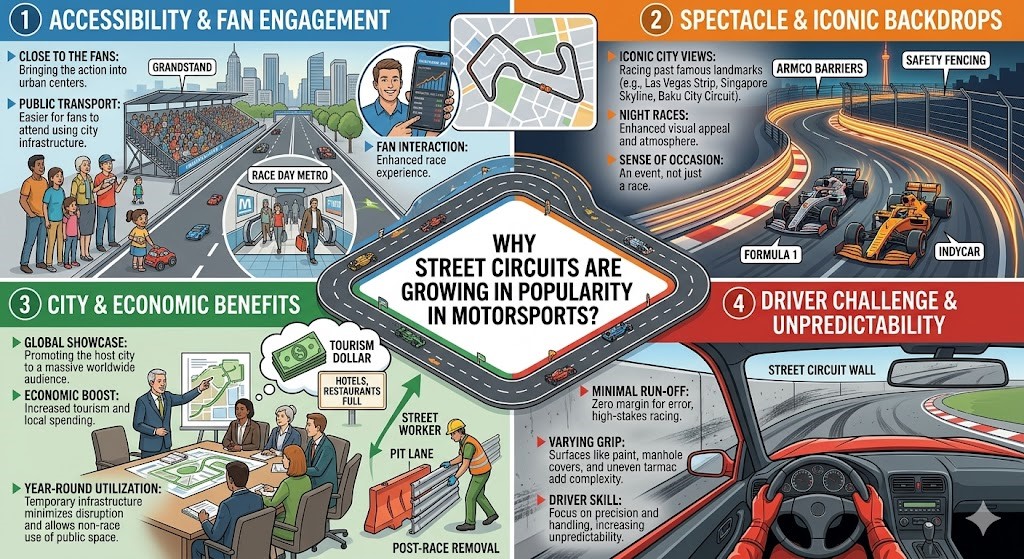
Why Street Circuits Are Growing in Popularity in Motorsports
Street circuits are growing in popularity in motorsports at a remarkable pace. In today’s fast-moving sports landscape, fans demand more than just competition. They want energy, atmosphere, and connection. Street racing delivers all three. It transforms everyday city roads into high-speed battlegrounds, blending elite competition with urban spectacle.
At the same time, racing organizations are adapting. They are no longer focused solely on tradition. Instead, they are chasing global audiences, media exposure, and new revenue streams. Because of this shift, street circuits have become a central part of modern motorsports strategy.
From historic races like the Monaco Grand Prix to newer additions like the Las Vegas Grand Prix, street circuits are redefining how the sport is presented and consumed. And as the sport evolves, their influence continues to grow.
The Evolution of Street Circuits in Motorsports
Street racing is not a new concept. In fact, it has deep roots in motorsports history. Early races often took place on public roads before permanent tracks became common.
However, for many years, purpose-built circuits dominated the sport. They offered more control, better safety, and consistent conditions. Street circuits, on the other hand, were seen as risky and logistically complex.
That perception has changed.
Modern engineering, safety technology, and event management have made street racing more viable. As a result, racing organizations have revisited the concept with a fresh perspective.
Today, street circuits are not just alternatives. They are marquee events. They attract global audiences, major sponsors, and significant media attention.
This evolution reflects a broader shift in how sports operate. Experience now matters as much as competition.
Bringing the Race to the Heart of the City
One of the biggest reasons street circuits are growing is simple: location.
Traditional race tracks are often built far from city centers. Fans must travel long distances, which limits accessibility. Street circuits eliminate that barrier.
By placing races directly in urban environments, motorsports become part of everyday life. Fans can walk to events, experience the atmosphere, and engage with the sport more easily.
This accessibility changes the audience dynamic.
Casual fans who might never attend a traditional race suddenly become part of the experience. They hear the engines, see the cars, and feel the energy firsthand.
Events like the Singapore Grand Prix demonstrate this perfectly. The race takes place in a bustling city environment, surrounded by lights, entertainment, and culture.
As a result, street circuits expand the reach of motorsports beyond its traditional fan base.
A Visual Spectacle for the Modern Era
In the age of social media and global broadcasting, visuals matter more than ever.
Street circuits offer something permanent tracks often cannot: iconic backdrops.
City skylines, historic landmarks, and waterfront views create stunning visuals that capture attention instantly. These images travel across social media, television, and digital platforms, amplifying the sport’s visibility.
The Monaco Grand Prix remains the gold standard for this. The combination of luxury yachts, tight corners, and scenic views creates a unique identity that fans recognize worldwide.
Similarly, the Las Vegas Grand Prix leverages neon lights and the famous Strip to create a modern, high-energy visual experience.
These races are not just competitions. They are global showcases.
And in today’s media-driven environment, that matters immensely.
Economic Benefits for Host Cities
Street circuits are powerful economic engines.
When a city hosts a major race, it attracts tourists, media coverage, and international attention. Hotels fill up. Restaurants become busy. Local businesses see increased activity.
Beyond immediate revenue, these events provide long-term value. They enhance the city’s global profile and attract future visitors.
Governments and tourism boards recognize this impact. As a result, many cities actively pursue street racing events.
The financial incentives are clear. Hosting a race can generate millions in economic activity while promoting the city on a global stage.
Because of this, competition among cities has intensified.
This demand further fuels the growth of street circuits in motorsports.
A New Model for Fan Engagement
Modern sports are no longer just about watching. They are about experiencing.
Street circuits excel in this area.
Race weekends often include concerts, festivals, fan zones, and interactive experiences. These additions transform races into multi-day entertainment events.
Fans are not just spectators. They become participants.
This approach attracts a broader audience. Families, tourists, and casual fans all find value in the experience.
For racing organizations, this is a major advantage. It increases ticket sales, boosts engagement, and builds long-term fan loyalty.
As expectations continue to rise, this experience-driven model becomes even more important.
Unique Challenges That Create Excitement
Street circuits are inherently unpredictable. And that unpredictability drives excitement.
Unlike permanent tracks, street circuits are narrow and unforgiving. Barriers line the course, leaving little room for error.
Drivers must operate with extreme precision. One mistake can end a race instantly.
Surface conditions also vary. City streets may have bumps, uneven pavement, and changing grip levels.
These factors create a unique challenge.
Drivers must adapt quickly. Teams must adjust strategies. And fans witness a different kind of racing.
This unpredictability often leads to surprising outcomes.
Underdogs can compete. Favorites can struggle. And every race feels different.
That level of uncertainty keeps fans engaged from start to finish.
Strategy Becomes More Important Than Ever
Street circuits change the strategic landscape of racing.
Overtaking is more difficult due to tight layouts. As a result, qualifying becomes critical.
Track position often determines success. Teams must execute flawless strategies to gain an advantage.
Pit stops, tire management, and timing all play crucial roles.
Additionally, safety cars are more common. Accidents and incidents can quickly alter the race.
Teams must be prepared to adapt at any moment.
This strategic complexity adds another layer of intrigue.
Fans are not just watching speed. They are watching decisions, adjustments, and execution.
Expanding Global Reach
Street circuits play a major role in expanding motorsports globally.
By hosting races in major cities, racing organizations reach new audiences.
This strategy is especially important for series like Formula One. In recent years, it has aggressively expanded its street race calendar.
This expansion has helped grow its fan base significantly, particularly among younger audiences.
Other series, such as IndyCar Series, have also embraced street circuits to connect with fans in key markets.
This global approach ensures long-term growth and relevance.
It also introduces motorsports to regions where traditional tracks may not exist.
The Influence of Entertainment Culture
Sports today compete with countless entertainment options.
To stand out, they must offer more than just competition.
Street circuits embrace this reality.
They combine racing with music, nightlife, and cultural experiences. Events often feature major artists, celebrity appearances, and immersive attractions.
This blend of sports and entertainment creates a unique atmosphere.
It appeals to a wider audience and keeps fans engaged beyond the race itself.
In many ways, street circuits represent the future of sports entertainment.
They deliver a complete experience rather than a single event.
Technological Advancements in Safety
Safety has always been a concern in street racing. However, modern technology has changed the equation.
Advanced barriers, improved fencing, and better track design reduce risk.
Cars are also safer than ever. Stronger chassis, improved crash structures, and advanced protective systems protect drivers.
These advancements make street circuits more viable.
While risks remain, they are managed more effectively than in the past.
This progress has played a key role in the growth of street racing.
Logistical Challenges and Solutions
Street circuits are complex to organize.
Road closures, infrastructure setup, and coordination with local authorities require detailed planning.
Cities must manage traffic, minimize disruption, and ensure safety.
Despite these challenges, advancements in event management have made the process more efficient.
Organizers now have experience and systems in place to handle these complexities.
As a result, more cities are willing to host events.
The benefits often outweigh the logistical hurdles.
Environmental Considerations
Modern sports must also consider environmental impact.
Street circuits face scrutiny in this area.
Closing roads and hosting large events can affect local communities.
However, many organizations are taking steps to address these concerns.
Sustainability initiatives, improved transportation planning, and eco-friendly practices are becoming more common.
These efforts help balance the benefits of hosting events with environmental responsibility.
As sustainability becomes more important, this will remain a key focus.
The Role of Tradition vs. Innovation
Motorsports has a rich history. Traditional tracks hold a special place in the sport.
However, innovation drives growth.
Street circuits represent a modern approach. They challenge tradition while creating new opportunities.
Rather than replacing permanent tracks, they complement them.
This balance allows motorsports to honor its history while embracing the future.
It also ensures a diverse and dynamic racing calendar.
Why Street Circuits Continue to Grow
When you look at the full picture, the rise of street circuits makes perfect sense.
They increase accessibility, enhance visuals, drive economic growth, and expand global reach.
They also create exciting, unpredictable racing.
Few formats offer such a complete package.
As a result, racing organizations continue to invest in street events.
Cities continue to compete for hosting rights.
And fans continue to embrace the experience.
Final Thoughts
Street circuits are not just a trend. They are a reflection of where motorsports is heading.
They bring the sport closer to fans by creating unforgettable moments that redefine what a race can be.
From the elegance of the Monaco Grand Prix to the modern spectacle of the Las Vegas Grand Prix, street racing continues to evolve.
As motorsports adapts to a changing world, street circuits will play an even larger role.
In the end, they combine competition, culture, and entertainment in a way that few other formats can match.
And that is exactly why their popularity continues to rise.