
How the Minor Leagues Build Major League Stars in Baseball
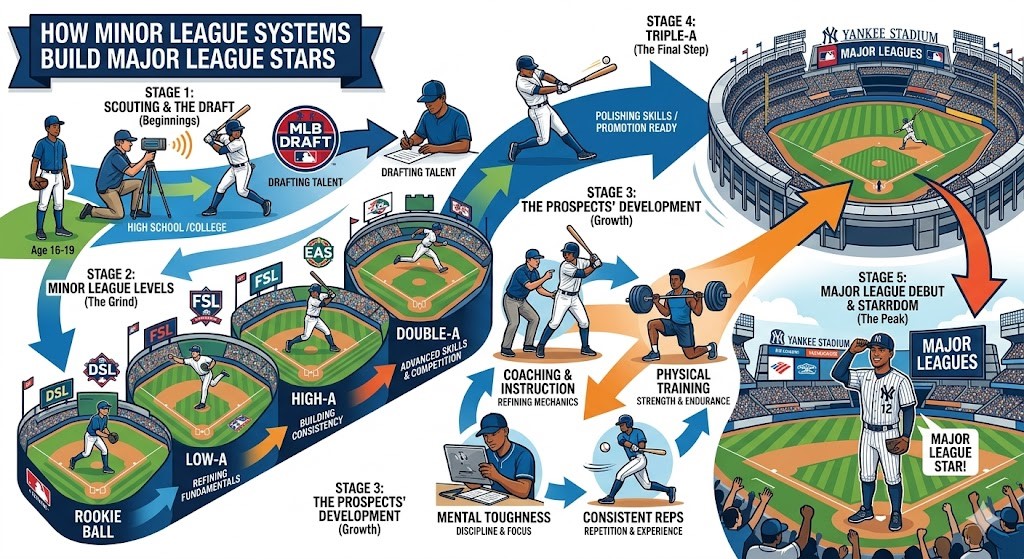
How Minor League Systems Build Major League Stars in Baseball
Minor league systems build Major League stars in baseball by developing raw talent into complete, polished players. While fans often focus on the bright lights of the big leagues, the real transformation happens behind the scenes. From small towns to packed development complexes, the journey through the minors shapes everything from mechanics to mindset.
In today’s game, success at the highest level depends heavily on the strength of a team’s farm system. Simply put, organizations that develop talent well win more games over time.
The Foundation of Player Development
Every Major League player starts somewhere. For most, that journey begins in the minor leagues.
After the draft or international signing, players enter a structured system designed to refine their skills. At this stage, raw ability matters. However, development quickly becomes the priority.
Coaches focus on fundamentals first. Hitters work on swing mechanics and pitch recognition. Pitchers refine control, velocity, and movement. Fielders improve footwork, positioning, and reaction time.
This foundation sets the tone for everything that follows. Without it, even the most talented players struggle to advance.
The Multi-Level Progression System
Minor league baseball is not a single step. Instead, it is a ladder.
Players move through multiple levels, each one more challenging than the last. Typically, the progression includes Rookie ball, Single-A, High-A, Double-A, and Triple-A.
At each level, competition improves. Pitchers throw harder and locate better. Hitters become more disciplined. Defensive play sharpens.
Because of this structure, players must continually adapt. What works at one level may fail at the next.
This constant adjustment forces growth. It also prepares players for the complexity of Major League Baseball.
Skill Refinement Over Time
Development is not about quick fixes. It is a long-term process.
Players spend years refining their skills in the minors. They make adjustments, face adversity, and learn from failure.
For example, a hitter might struggle with breaking balls early in their career. Through repetition and coaching, they gradually improve recognition and timing.
Similarly, a pitcher may need to develop a secondary pitch. Over time, that pitch can become a key weapon.
This steady improvement transforms raw prospects into reliable performers.
Mental Toughness and Resilience
Talent alone does not create Major League stars. Mental strength plays a huge role.
The minor leagues test players in ways the majors often do not. Long bus rides, small crowds, and modest pay create a challenging environment.
Additionally, failure is constant. Even top prospects struggle at times.
Because of this, players must develop resilience. They learn to handle pressure, stay focused, and maintain confidence.
These mental skills become critical at the Major League level, where expectations and scrutiny increase dramatically.
Coaching and Instruction
Minor league systems provide access to specialized coaching that shapes player development.
Hitting coaches, pitching coaches, strength trainers, and analysts all contribute to improvement.
Instruction is detailed and personalized. Coaches break down mechanics, analyze performance, and create development plans tailored to each player.
This level of attention helps players maximize their potential.
Moreover, organizations now use advanced technology. Video analysis, data tracking, and biomechanics play a major role in modern development.
As a result, players receive more precise feedback than ever before.
Learning the Professional Game
The minors are not just about physical skills. They also teach players how to play the game the right way.
Situational awareness becomes a major focus. Players learn when to take extra bases, how to position defensively, and how to execute strategies.
Baseball IQ improves through repetition and experience.
For instance, a young infielder learns where to throw the ball in different game situations. A hitter learns how to approach different pitchers.
These lessons prepare players for the speed and complexity of the Major Leagues.
Building Physical Strength and Endurance
The grind of a baseball season is demanding. Minor league systems prepare players physically for that challenge.
Strength and conditioning programs focus on building endurance, flexibility, and durability.
Players learn how to maintain their bodies over a long season. They also develop routines that support performance and recovery.
This preparation is essential. Without it, players cannot handle the rigors of a 162-game Major League season.
Evaluating and Identifying Talent
Minor league systems also serve as evaluation tools.
Organizations track performance closely. They analyze statistics, monitor progress, and assess potential.
Not every player reaches the majors. In fact, most do not.
However, this evaluation process helps teams identify who is ready to advance and who needs more development.
It also allows organizations to make informed decisions about trades, promotions, and roster construction.
The Role of Patience in Development
Patience is a key ingredient in building Major League stars.
Some players develop quickly. Others take years to reach their potential.
Rushing development often leads to failure. Players who are not ready struggle against advanced competition.
Successful organizations understand this. They allow players to progress at their own pace.
This patience leads to more consistent long-term success.
Creating Organizational Depth
Strong minor league systems provide depth at every position.
Injuries and performance fluctuations are part of baseball. When they occur, teams rely on minor league players to step in.
Because of this, development systems must produce not just stars, but also reliable contributors.
This depth separates successful organizations from struggling ones.
Teams with strong farm systems remain competitive year after year.
Real-World Examples of Development Success
Many Major League stars spent years developing in the minors.
Players like Mike Trout, Mookie Betts, and Clayton Kershaw all progressed through minor league systems before becoming elite players.
Their success did not happen instantly. It came from years of development, adjustment, and growth.
These examples highlight the importance of the minor leagues in shaping elite talent.
The Impact of Modern Analytics
Analytics have transformed player development.
Teams now use data to identify strengths and weaknesses with incredible precision.
For hitters, metrics like exit velocity and launch angle provide insight into performance. For pitchers, spin rate and pitch movement are key factors.
This information allows for targeted improvement.
Instead of guessing, coaches can focus on specific areas that need development.
As a result, players improve more efficiently.
Transitioning to the Major Leagues
The final step in development is the transition to the majors.
This jump is significant. The speed of the game increases, and the level of competition rises dramatically.
However, players who have developed properly are prepared for this challenge.
They have the skills, experience, and mental toughness needed to succeed.
Even then, adjustments continue. Development does not stop at the Major League level.
Why Minor League Systems Matter More Than Ever
In modern baseball, building through the minor leagues is more important than ever.
Free agency is expensive and unpredictable. Developing talent internally provides a more sustainable path to success.
Organizations that invest in their farm systems gain a competitive advantage.
They produce stars, maintain depth, and adapt to changes more effectively.
This approach leads to long-term success rather than short-term fixes.
Final Thoughts
If you want to understand how Major League stars are made, look beyond the spotlight.
The real work happens in the minor leagues. It is where players grow, adapt, and transform into professionals.
From skill development to mental toughness, every aspect of a player’s game is shaped during this journey.
In the end, minor league systems do more than develop players. They build the foundation for success at the highest level of baseball.
And in today’s game, that foundation makes all the difference.