
The Evolution of Baseball Training Methods
The Evolution of Baseball Training Methods
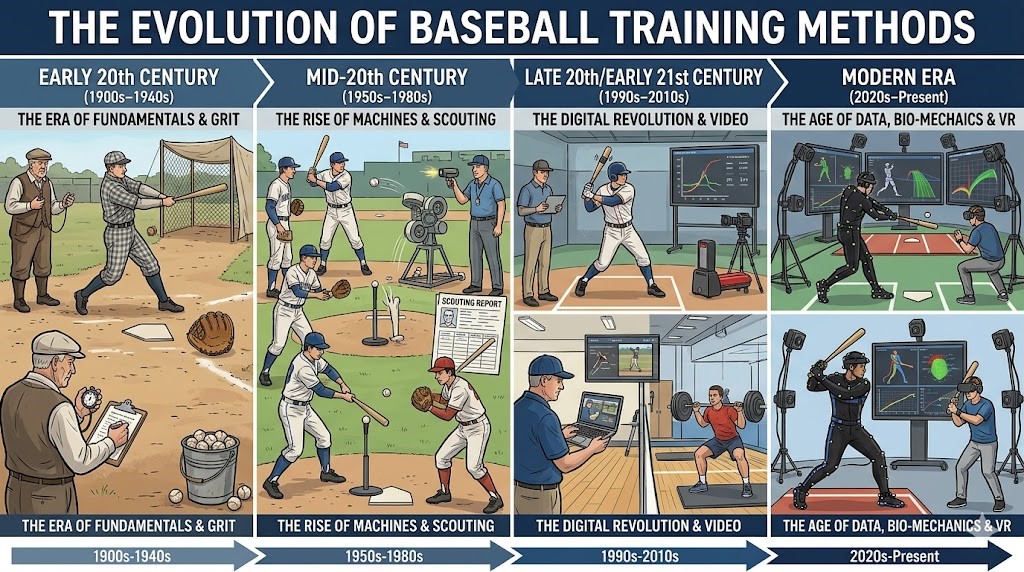
Baseball has always been a sport built on skill, discipline, and preparation. However, the way players train today bears little resemblance to the methods used a century ago. From basic drills and instinct-based coaching to advanced analytics, biomechanics, and sports science, baseball training has undergone a remarkable transformation.
Modern players are faster, stronger, and more specialized than ever before. Organizations invest millions of dollars into player development systems designed to maximize performance while reducing injury risk. Technology now influences nearly every aspect of training, from swing mechanics and pitching delivery to nutrition and recovery.
The evolution of baseball training reflects broader changes in sports science and athletic performance. As teams search for every possible competitive advantage, training methods continue to become more sophisticated and data-driven.
From youth leagues to Major League Baseball, the development of training techniques has helped reshape the sport itself.
Early Baseball Training: Simplicity and Repetition
In baseball’s early years, training methods were relatively simple.
Players relied heavily on repetition and experience. Coaches emphasized fundamentals such as throwing, catching, fielding, and hitting through countless practice sessions.
There were few specialized instructors.
Most players learned from teammates, managers, and personal experience.
Conditioning programs were limited compared to modern standards. Many athletes maintained fitness through physical labor rather than structured strength training.
During the late nineteenth and early twentieth centuries, baseball was viewed primarily as a skill-based game rather than an athletic one.
As a result, scientific approaches to training were virtually nonexistent.
The Rise of Organized Spring Training
One of the first major developments in baseball preparation was the growth of organized spring training.
Teams began gathering players before the season to improve conditioning and sharpen skills.
These training camps provided opportunities for coaches to evaluate talent and implement team strategies.
Spring training gradually evolved into a critical part of player development.
Players arrived better prepared, and organizations gained greater control over preparation processes.
The concept established an important principle that remains relevant today: successful performance begins long before Opening Day.
Spring training became the foundation for more structured and professional preparation methods.
Strength Training Was Once Controversial
It may seem surprising today, but strength training was once viewed with skepticism in baseball.
Many coaches believed weightlifting would reduce flexibility and negatively impact performance.
For decades, players avoided serious strength programs.
Instead, conditioning focused on running, calisthenics, and sport-specific drills.
This mindset began changing during the second half of the twentieth century.
Athletes across multiple sports demonstrated that properly designed strength programs could improve performance without sacrificing athleticism.
Baseball gradually embraced resistance training.
As understanding improved, strength and conditioning became essential components of player development.
The Influence of Sports Science
The emergence of sports science revolutionized baseball training.
Researchers began studying human movement, muscle development, recovery, and performance optimization.
Teams increasingly incorporated scientific principles into training programs.
Rather than relying solely on tradition, coaches used evidence-based methods.
Sports science helped players improve strength, speed, endurance, and injury prevention.
Organizations also began employing specialists in physiology, nutrition, and athletic training.
This interdisciplinary approach significantly enhanced player development.
The influence of sports science continues growing throughout every level of baseball.
Specialized Position Training
As baseball evolved, training became increasingly specialized.
Different positions require unique physical and technical skills.
Pitchers, catchers, infielders, and outfielders now follow customized development programs.
Pitchers focus heavily on arm care, mechanics, and velocity development.
Catchers emphasize mobility, game management, and defensive skills.
Infielders train reaction time and footwork, while outfielders prioritize speed and route efficiency.
This specialization allows players to maximize performance within their specific roles.
Customized training has become a cornerstone of modern baseball development.
The Analytics Revolution
Few developments have influenced baseball training more than analytics.
Organizations now collect and analyze enormous amounts of performance data.
Metrics provide insight into nearly every aspect of the game.
Hitters study launch angles, exit velocities, and swing paths.
Pitchers analyze spin rates, release points, and movement profiles.
Coaches use this information to identify strengths and weaknesses with unprecedented precision.
Analytics allow training programs to become highly individualized.
Instead of relying on generic approaches, players focus on areas with the greatest potential impact.
This targeted development improves efficiency and effectiveness.
Technology Changes Hitting Development
Hitting instruction has transformed dramatically because of technology.
Modern hitters have access to tools that previous generations could never imagine.
High-speed cameras capture swings in extraordinary detail.
Motion analysis systems identify mechanical inefficiencies.
Bat sensors measure swing speed, attack angle, and contact quality.
Hitters can review immediate feedback after every session.
This information accelerates learning and refinement.
Players no longer rely solely on feel and observation.
Technology provides objective measurements that guide improvement.
As a result, hitting development has become increasingly precise.
Pitching Development Enters a New Era
Pitching training has experienced perhaps the most dramatic transformation.
Modern pitchers use advanced technologies to improve velocity, movement, and command.
Tools such as radar systems, motion capture technology, and pitch-tracking devices provide detailed performance data.
Pitchers now understand how factors such as spin rate and release angle influence effectiveness.
Training programs emphasize biomechanics and efficiency.
Athletes work to maximize performance while minimizing stress on the arm.
Velocity development programs have become increasingly sophisticated.
The result is a generation of pitchers throwing harder and more effectively than ever before.
Biomechanics and Movement Analysis
Biomechanics has become a critical component of baseball training.
This field studies how the body moves during athletic activity.
Coaches and specialists analyze throwing mechanics, batting swings, and fielding movements.
The goal is to improve efficiency while reducing injury risk.
Small adjustments can have significant effects on performance.
For example, improving hip rotation during a swing may increase power production.
Similarly, optimizing pitching mechanics can enhance velocity while protecting the shoulder and elbow.
Biomechanical analysis provides valuable insights that traditional observation often misses.
Nutrition Becomes a Competitive Advantage
Nutrition was once an overlooked aspect of baseball preparation.
Today, it is a major component of player development.
Teams employ nutritionists who design meal plans tailored to individual needs.
Athletes focus on fueling performance and recovery.
Proper nutrition supports muscle growth, energy production, and injury prevention.
Hydration strategies are carefully monitored as well.
Players now understand that what they eat directly impacts performance.
This awareness has elevated nutrition from an afterthought to a critical competitive advantage.
Recovery and Regeneration Gain Importance
Modern baseball organizations place enormous emphasis on recovery.
The long season creates significant physical demands.
Without proper recovery, performance declines and injury risk increases.
Teams use a variety of methods to promote regeneration.
These include massage therapy, mobility training, sleep optimization, and recovery technology.
Athletes track workload and fatigue levels more carefully than ever before.
Recovery is no longer viewed as passive rest.
Instead, it is considered an active and essential component of performance development.
This shift has improved both longevity and consistency.
Mental Performance Training
The mental side of baseball has received increasing attention in recent decades.
Baseball is a game filled with pressure, failure, and emotional challenges.
Even elite hitters fail frequently.
Mental performance coaches help athletes develop focus, confidence, and resilience.
Visualization, mindfulness, and concentration exercises have become common.
Players learn strategies for handling adversity and maintaining consistency.
Mental skills training improves decision-making and emotional control.
Organizations increasingly recognize that mental preparation is just as important as physical development.
Injury Prevention Becomes a Priority
Injury prevention is now a major focus throughout baseball.
Teams invest heavily in keeping players healthy.
Training programs incorporate mobility work, flexibility exercises, and workload monitoring.
Athletic trainers and medical staffs collaborate closely with coaches.
The goal is to identify potential issues before injuries occur.
Advanced screening techniques help detect movement limitations and physical imbalances.
Preventing injuries protects both athletes and organizational investments.
Healthy players perform better and contribute more consistently over time.
Data-Driven Player Development
Modern player development relies heavily on data.
Every training session generates valuable information.
Organizations track performance metrics, workload, recovery indicators, and skill progression.
This data helps coaches make informed decisions.
Training programs can be adjusted quickly based on objective feedback.
Players also gain greater understanding of their own development.
Data-driven approaches create accountability and clarity.
The ability to measure improvement accurately has transformed how organizations evaluate progress.
Youth Baseball Training Evolves
The evolution of training extends beyond professional baseball.
Youth programs now incorporate many principles once reserved for elite athletes.
Young players have access to specialized coaching, technology, and development resources.
Travel baseball and private instruction have expanded dramatically.
While these opportunities can accelerate development, they also create challenges.
Overtraining and early specialization have become concerns.
Experts increasingly emphasize balanced development and long-term athletic growth.
The goal is to help young athletes improve while maintaining enjoyment of the sport.
The Role of Artificial Intelligence
Artificial intelligence is beginning to influence baseball training.
AI systems analyze enormous amounts of performance data quickly and efficiently.
These technologies identify patterns that may be difficult for humans to detect.
Teams use AI to evaluate mechanics, predict injury risk, and optimize training plans.
As technology advances, its role will likely expand further.
Artificial intelligence offers exciting possibilities for future player development.
However, human coaching and judgment remain essential.
The best results typically come from combining technology with experience and expertise.
Virtual Reality and Simulation Training
Virtual reality has emerged as another innovative training tool.
Hitters can face simulated pitchers without stepping onto a field.
These systems improve pitch recognition and decision-making.
Players gain valuable repetitions in controlled environments.
Simulation training also allows athletes to prepare for specific opponents.
As technology improves, virtual reality may become an increasingly important component of player development.
The ability to practice mentally and visually adds another dimension to training.
The Balance Between Technology and Fundamentals
Despite technological advancements, fundamentals remain essential.
Throwing, catching, hitting, and fielding still form the foundation of baseball success.
Technology enhances training but does not replace basic skills.
Great coaches understand the importance of balancing innovation with traditional instruction.
Players must develop sound fundamentals before advanced tools can provide maximum benefit.
The most successful programs combine proven techniques with modern technology.
This balanced approach creates well-rounded athletes.
The Future of Baseball Training
The future of baseball training will likely involve even greater integration of technology and science.
Wearable devices, artificial intelligence, advanced analytics, and biometric monitoring will continue evolving.
Training programs will become increasingly personalized.
Organizations will gain deeper understanding of performance and recovery.
At the same time, the human elements of coaching, leadership, and mentorship will remain vital.
Technology provides information, but people still interpret and apply it.
The future belongs to organizations that effectively combine innovation with strong coaching principles.
Why Baseball Training Continues to Evolve
Baseball is constantly changing.
Competition grows more intense every year.
Teams search relentlessly for advantages that improve performance.
This pursuit drives innovation in training methods.
Every generation builds upon previous knowledge while introducing new ideas.
As science and technology advance, baseball training evolves alongside them.
The goal remains the same: helping athletes perform at their highest potential.
The methods simply become more effective and sophisticated.
Final Thoughts
The evolution of baseball training methods reflects the sport’s ongoing pursuit of excellence.
From simple repetition and instinct-based coaching to advanced analytics, biomechanics, and artificial intelligence, training has transformed dramatically over time.
Organizations throughout Major League Baseball now rely on science, technology, and specialized expertise to develop players more effectively than ever before.
Modern athletes benefit from customized programs that address physical, technical, mental, and nutritional development.
Yet despite all the innovation, the core objective remains unchanged.
Baseball training is ultimately about helping players improve their skills, maximize their potential, and compete at the highest level possible.
As technology continues advancing, the future of baseball training promises to be even more exciting, precise, and impactful than ever before.