
How NBA Teams Identify Draft Busts Early
How NBA Teams Identify Draft Busts Early
Every year, NBA franchises invest enormous amounts of time, money, and resources into evaluating draft prospects. Scouts travel across the world, executives analyze countless hours of film, and analytics departments study every measurable statistic available. Despite these efforts, not every highly drafted player becomes a star.
Some prospects fail to meet expectations due to injuries, poor work habits, lack of development, or an inability to adapt to the professional game. These players are often labeled “draft busts,” a term used when a highly selected player significantly underperforms compared to expectations.
While fans may take years to recognize a disappointing draft pick, NBA organizations often identify warning signs much earlier. Teams continuously monitor player development and can frequently detect potential problems within a player’s first season or two.
Understanding how NBA teams identify draft busts early reveals the complex evaluation process that extends far beyond draft night.
What Defines a Draft Bust?
Before discussing how teams identify draft busts, it is important to understand what the term actually means.
A draft bust is not simply a player who fails to become a superstar.
Expectations matter.
A player selected first overall faces different expectations than someone drafted late in the second round.
Teams evaluate players based on:
- Draft position
- Projected role
- Development potential
- Organizational expectations
- Long-term value
A player drafted in the top five who becomes only a marginal contributor may be considered a bust, while a second-round player with the same production might exceed expectations.
Because expectations vary, teams focus on development trajectories rather than labels.
NBA Teams Begin Evaluating Immediately
The evaluation process does not end when a player is drafted.
In many ways, it is just beginning.
Organizations immediately begin tracking:
- Practice performance
- Conditioning habits
- Learning ability
- Professionalism
- Coachability
- Work ethic
Teams often discover important information during a player’s first few months in the organization.
These observations can either reinforce confidence or raise concerns.
The earliest warning signs frequently emerge away from game action.
Work Ethic Is One of the Biggest Indicators
Talent can get a player drafted.
Work ethic often determines whether that player succeeds.
NBA organizations place tremendous value on effort and commitment.
Players who consistently arrive early, seek extra instruction, and embrace development programs tend to improve.
Conversely, teams become concerned when players:
- Avoid extra work
- Resist coaching
- Show inconsistent effort
- Lack professionalism
- Fail to improve habits
Many front offices believe poor work habits are among the strongest predictors of long-term disappointment.
Physical talent alone rarely guarantees NBA success.
Learning Speed Matters More Than Fans Realize
The NBA is significantly more complex than college or international basketball.
Players must learn:
- Offensive systems
- Defensive schemes
- Terminology
- Rotations
- Scouting reports
- Game plans
Some rookies adapt quickly.
Others struggle to process information at NBA speed.
Teams carefully monitor how rapidly players absorb new concepts.
A prospect who consistently repeats mistakes may trigger concerns.
Mental development often becomes as important as physical development.
Players who cannot handle the intellectual demands of the league frequently struggle to earn meaningful playing time.
Defensive Awareness Reveals Future Potential
Defense is one area where organizations often identify problems early.
Many college stars dominate offensively while hiding defensive weaknesses.
The NBA exposes those weaknesses.
Teams evaluate:
- Defensive positioning
- Rotations
- Communication
- Awareness
- Effort
- Adaptability
A player who repeatedly misses assignments can become a liability.
Even talented scorers may struggle to stay on the court if coaches cannot trust them defensively.
Poor defensive development often serves as an early warning sign.
Physical Development Is Closely Monitored
NBA teams invest heavily in strength and conditioning programs.
Young players are expected to improve physically after entering the league.
Organizations track:
- Strength gains
- Conditioning levels
- Mobility
- Durability
- Body composition
A player who fails to make expected physical progress may raise concerns.
Modern basketball demands elite athletic preparation.
Teams want to see continuous improvement.
Lack of physical development can limit a player’s ability to compete against elite athletes.
Basketball IQ Becomes More Important
Basketball intelligence is difficult to measure before the draft.
Once players enter the league, teams gain a clearer picture.
Organizations evaluate:
- Decision-making
- Court awareness
- Passing instincts
- Situational understanding
- Game management
Players with high basketball IQ often outperform expectations.
Those who struggle to make sound decisions frequently face developmental challenges.
The speed of NBA games magnifies poor decision-making.
Teams quickly recognize whether a player can process information effectively.
Shooting Development Provides Critical Clues
In today’s NBA, shooting ability is more valuable than ever.
Organizations pay close attention to a player’s shooting progression.
Key indicators include:
- Shooting mechanics
- Practice performance
- Confidence
- Shot selection
- Consistency
Teams are often patient with shooting development.
However, a complete lack of progress can become concerning.
Players who fail to improve shooting skills may find it difficult to fit into modern offensive systems.
Early shooting trends often provide valuable insight into future success.
Injuries Can Change Everything
Injuries remain one of the most significant factors in player development.
A prospect may possess tremendous talent but struggle to stay healthy.
Teams monitor:
- Injury frequency
- Recovery timelines
- Physical durability
- Long-term medical outlook
Repeated injuries can slow development dramatically.
Even highly promising prospects may fail to reach their potential due to health issues.
Organizations understand that availability is a critical component of success.
Durability concerns often emerge earlier than fans realize.
Response to Adversity Reveals Character
Every NBA player experiences setbacks.
The key question is how they respond.
Teams carefully observe players during difficult periods.
Examples include:
- Reduced playing time
- Poor performances
- Injuries
- Criticism
- Developmental struggles
Players who remain focused and committed often continue improving.
Those who become frustrated or disengaged may struggle long term.
Character evaluation becomes especially important during adversity.
Mental toughness frequently separates successful players from disappointing ones.
Analytics Help Identify Warning Signs
Modern NBA teams rely heavily on analytics.
Data can reveal problems before they become obvious to casual observers.
Organizations analyze:
- Efficiency metrics
- Defensive impact
- Shooting trends
- Lineup performance
- Advanced statistical indicators
These metrics help teams evaluate whether a player is contributing to winning basketball.
Analytics provide objective evidence that complements traditional scouting observations.
When negative trends persist, organizations take notice.
Practice Habits Matter
Fans only see games.
Teams see practices every day.
Practice performance often reveals more about a player’s future than game statistics.
Coaches monitor:
- Focus
- Energy
- Consistency
- Competitiveness
- Preparation
Players who dominate practice environments frequently earn additional opportunities.
Those who struggle consistently may fall behind in development.
Practice habits often predict future growth.
The Importance of Coachability
NBA coaches want players who are willing to learn.
Coachability plays a major role in development.
Teams evaluate how players respond to:
- Feedback
- Film sessions
- Corrections
- Tactical adjustments
Players who embrace coaching generally improve faster.
Those who resist instruction create concerns.
Organizations recognize that long-term success requires continuous learning.
A lack of coachability can severely limit a player’s potential.
G League Performance Provides Valuable Insight
The NBA G League has become a crucial developmental tool.
Many young players spend significant time there refining their skills.
Teams closely analyze G League performance.
They look beyond statistics and focus on:
- Decision-making
- Effort
- Leadership
- Consistency
- Skill development
Strong performances often indicate positive growth.
Struggles against G League competition may signal larger concerns.
The developmental league provides valuable evaluation opportunities.
Confidence Can Influence Development
Confidence affects performance at every level of basketball.
Young players often experience challenges adjusting to the NBA.
Organizations monitor confidence carefully.
Players who maintain belief in themselves while remaining coachable tend to progress more effectively.
Conversely, declining confidence can create additional obstacles.
Teams work with sports psychologists and development staff to support players mentally.
Mental development has become an increasingly important aspect of player evaluation.
Role Acceptance Matters
Not every prospect becomes a superstar.
Successful NBA careers often require adaptation.
Teams observe whether players can accept appropriate roles.
Some prospects struggle when asked to:
- Focus on defense
- Come off the bench
- Reduce shot volume
- Specialize in specific skills
Role acceptance frequently determines career longevity.
Players who embrace team needs often outperform expectations.
Those who resist adaptation may struggle to find consistent opportunities.
Comparing Progress to Development Benchmarks
Organizations establish development goals for every player.
These benchmarks may include:
- Skill improvement
- Physical growth
- Statistical targets
- Tactical understanding
Teams regularly compare progress against expectations.
Falling significantly behind developmental benchmarks can create concern.
This process helps organizations identify issues early and adjust development plans accordingly.
Why Teams Rarely Give Up Quickly
Although teams may identify warning signs early, they rarely abandon prospects immediately.
Player development is not always linear.
Some athletes require additional time to mature physically and mentally.
Organizations understand that patience can be rewarded.
Many successful players developed slowly before eventually becoming major contributors.
As a result, teams balance concern with long-term optimism.
The goal is to maximize every player’s opportunity to succeed.
The Difference Between Slow Development and a True Bust
One of the biggest mistakes fans make is labeling players too quickly.
Not every slow start indicates failure.
NBA organizations distinguish between:
- Temporary struggles
- Developmental delays
- Long-term limitations
A player may require several years to reach full potential.
Teams focus on growth trends rather than short-term results.
The distinction between slow development and a true bust often becomes clearer over time.
Patience remains an important part of player evaluation.
Why Some Busts Surprise Everyone
Despite extensive scouting and evaluation, some busts remain impossible to predict.
Players may encounter unexpected injuries, personal challenges, or developmental setbacks.
Even the most sophisticated organizations cannot forecast every outcome.
Basketball remains a human endeavor filled with uncertainty.
This unpredictability is one reason the draft remains both exciting and risky.
Every selection carries potential rewards and potential disappointments.
Final Thoughts
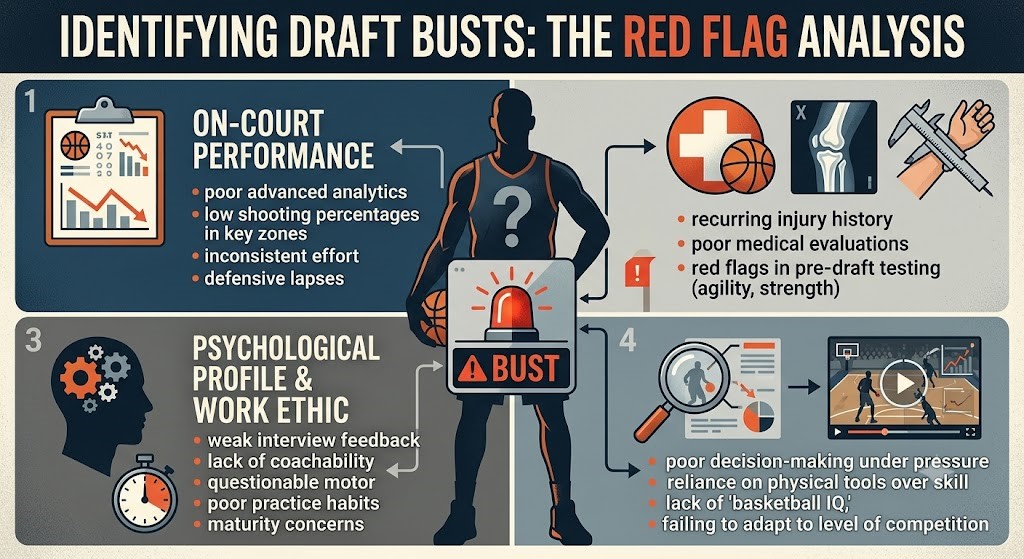
NBA teams identify potential draft busts far earlier than most fans realize. By monitoring work ethic, coachability, basketball IQ, defensive awareness, physical development, practice habits, and response to adversity, organizations can detect warning signs long before they become obvious in game statistics.
Teams also use analytics, player development benchmarks, G League performance, and psychological evaluations to build a complete picture of a player’s progress.
Ultimately, identifying draft busts early is not about predicting failure. It is about recognizing developmental challenges quickly enough to help players overcome them. The teams that excel at this process often gain a significant advantage in building successful NBA franchises.