
Why Soccer Tactics Change Every Decade
Why Soccer Tactics Change Every Decade
Soccer is often called the world’s game because of its simplicity. Two teams compete to score goals while preventing their opponents from doing the same. Yet beneath this simple objective lies a sport that is constantly evolving. Over the decades, coaches, players, and analysts have continually developed new strategies designed to gain an advantage over the competition.
One of the most fascinating aspects of soccer is how tactical philosophies change from generation to generation. What was considered revolutionary in one era often becomes standard practice in the next. Eventually, opponents discover ways to counter successful tactics, forcing coaches to innovate once again.
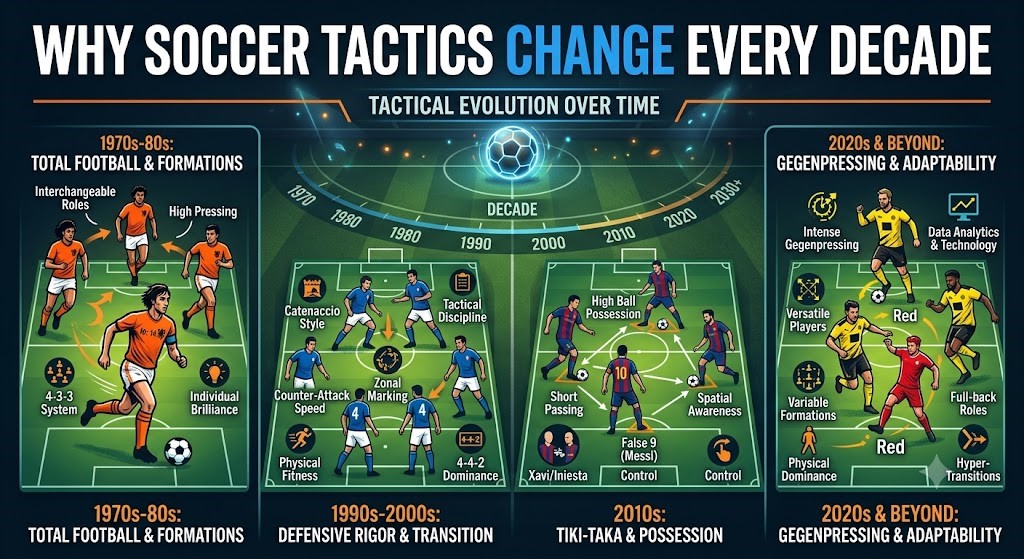
The evolution of soccer tactics can be viewed through four major eras: the rise of Total Football and modern formations in the 1970s and 1980s, the emphasis on defensive rigor and transition play in the 1990s and 2000s, the dominance of Tiki-Taka and possession-based soccer in the 2010s, and the emergence of Gegenpressing and tactical adaptability in the 2020s and beyond.
Understanding these eras helps explain why soccer tactics continue to change every decade and why the sport remains one of the most dynamic games in the world.
The Constant Search for a Competitive Advantage
At its core, tactical evolution is driven by competition.
Every coach wants to create advantages that help their team win matches. When a particular strategy proves successful, other teams quickly study and imitate it. As more clubs adopt the same ideas, opponents begin searching for weaknesses and developing countermeasures.
This cycle of innovation and adaptation has existed throughout soccer history.
No tactical system remains dominant forever. Every successful approach eventually creates new challenges that inspire the next generation of ideas.
Because of this, soccer is constantly evolving. Tactical trends rise and fall, but the desire to gain a competitive edge never changes.
1970s–1980s: Total Football and Formations
The first major era highlighted in modern tactical history is the rise of Total Football during the 1970s and its continued influence throughout the 1980s.
Prior to this period, soccer positions were generally rigid. Defenders defended, midfielders distributed the ball, and forwards focused primarily on scoring goals. Players were expected to stay within clearly defined roles.
That philosophy began to change dramatically.
The Dutch revolutionized the sport with a concept known as Total Football. Under this approach, players could interchange positions while maintaining team shape and balance.
Teams such as AFC Ajax and the Netherlands national football team helped popularize this style of play.
A defender might move into midfield. A midfielder could advance into attack. Teammates would seamlessly adjust to maintain structure.
This tactical flexibility created significant problems for opponents.
Instead of defending predictable movements, teams were forced to react to constant positional changes.
The era also saw the development of more sophisticated formations. Coaches began viewing formations as fluid frameworks rather than static structures.
The focus shifted toward:
- Positional interchange
- Intelligent movement
- Technical skill
- Collective teamwork
- Tactical flexibility
These ideas laid the foundation for many modern tactical concepts.
Why Total Football Changed Soccer Forever
The significance of Total Football extended far beyond the Netherlands.
For the first time, coaches began emphasizing the importance of collective movement rather than individual positions.
Players needed to understand multiple roles.
Technical ability became increasingly important because every player was expected to contribute in possession.
Defensive responsibilities were shared throughout the team rather than assigned solely to defenders.
The concept transformed coaching philosophy across the globe.
Many of the tactical principles used today can trace their origins back to this revolutionary period.
The 1970s and 1980s proved that soccer could be played as a fluid, interconnected system rather than a collection of individual roles.
1990s–2000s: Defensive Rigor and Transition
As teams became more tactically sophisticated, opponents began searching for ways to neutralize the fluid attacking styles that had become popular.
This led to the next major tactical era.
The 1990s and early 2000s were characterized by defensive organization, compactness, and transition play.
Coaches recognized that controlling space could be just as valuable as controlling possession.
Teams became more disciplined defensively.
Defensive lines operated with greater coordination.
Midfielders contributed heavily to defensive structure.
Entire teams worked together to limit opponents’ space and opportunities.
During this period, coaches focused heavily on:
- Defensive shape
- Compact formations
- Tactical discipline
- Counterattacking opportunities
- Fast transitions
Rather than maintaining possession at all costs, many teams sought to absorb pressure before launching quick attacks.
This strategy proved highly effective against opponents that committed large numbers of players forward.
The Rise of Counterattacking Soccer
Counterattacking became one of the defining characteristics of this era.
Teams learned that they did not always need to dominate possession to win matches.
Instead, they could remain organized defensively and strike quickly when opportunities appeared.
Fast forwards and creative midfielders became especially valuable.
Winning possession often triggered immediate attacks designed to exploit open space before opponents could recover defensively.
Many successful teams built championship campaigns around defensive stability and efficient transitions.
The emphasis on organization and discipline reshaped soccer at every level.
Coaches increasingly understood that tactical structure could overcome talent disadvantages.
How Defensive Rigor Changed Player Roles
The defensive emphasis of the 1990s and 2000s altered expectations for nearly every position.
Forwards became the first line of defense.
Midfielders were expected to contribute in both attacking and defensive phases.
Defenders developed greater technical abilities to initiate attacks from the back.
The game became more demanding physically and tactically.
Players needed to understand complex defensive systems and execute them consistently.
This era demonstrated that successful soccer required balance between attack and defense.
Teams could no longer rely solely on creativity and skill.
Organization became equally important.
2010s: Tiki-Taka and Possession
The next tactical revolution emerged during the 2010s with the rise of Tiki-Taka and possession-based soccer.
This philosophy emphasized controlling matches through ball possession.
Instead of focusing primarily on defensive organization or rapid transitions, teams sought to dominate the game by keeping the ball away from opponents.
Short, quick passes became central to attacking strategy.
Players constantly moved to create passing angles.
Patience replaced urgency.
The objective was not simply to advance the ball quickly but to control every aspect of the match through possession.
Teams such as FC Barcelona and the Spain national football team became the most recognizable examples of this style.
Key characteristics included:
- Short passing combinations
- Positional play
- Ball retention
- Technical precision
- Patience in attack
This approach demonstrated that possession could function as both an attacking and defensive weapon.
Why Possession Became So Influential
Possession-based soccer offered several advantages.
Teams with the ball controlled the tempo of the match.
Opponents were forced to chase and defend.
Extended periods of possession reduced defensive pressure while creating attacking opportunities.
The success of possession-oriented teams inspired coaches around the world.
Youth academies emphasized technical development.
Players became more comfortable operating in tight spaces.
Passing accuracy and decision-making gained increased importance.
The influence of Tiki-Taka extended far beyond professional soccer.
It reshaped player development and coaching education across multiple continents.
The Challenges of Possession Soccer
Although highly successful, possession-based systems were not without weaknesses.
Maintaining possession required exceptional technical ability.
Teams that dominated the ball sometimes struggled against organized defenses.
Opponents began developing strategies designed specifically to disrupt possession.
Aggressive pressing emerged as a particularly effective response.
As soccer history repeatedly demonstrates, every successful tactical trend eventually inspires a countertrend.
The dominance of possession-based soccer created the conditions for the next tactical evolution.
2020s and Beyond: Gegenpressing and Adaptability
The current tactical era is defined by Gegenpressing and adaptability.
Gegenpressing refers to the practice of immediately attempting to win the ball back after losing possession.
Rather than retreating into defensive positions, players apply intense pressure to the opponent.
The goal is to recover possession before the opposition can organize an attack.
This strategy creates opportunities to regain control quickly while exploiting opponents during moments of transition.
Modern teams increasingly focus on:
- High-intensity pressing
- Immediate ball recovery
- Rapid transitions
- Tactical flexibility
- Formation adjustments
- Positional versatility
These concepts have become defining characteristics of contemporary soccer.
Adaptability Is the New Tactical Advantage
Perhaps the most important characteristic of modern soccer is adaptability.
Unlike previous eras that were often dominated by a single philosophy, today’s teams frequently switch approaches during matches.
A team may begin in one formation and finish in another.
Players often perform multiple roles throughout a game.
Coaches make tactical adjustments based on opponents, game situations, and available personnel.
This flexibility makes teams more difficult to predict and defend.
Adaptability has become one of the most valuable assets in modern soccer.
The ability to adjust quickly often determines success at the highest levels.
Technology and Analytics Accelerate Change
Technology has significantly accelerated tactical evolution.
Modern coaches have access to detailed video analysis, performance data, and advanced statistical tools.
Teams can study opponents in extraordinary detail.
Analysts identify strengths, weaknesses, and patterns that were previously difficult to detect.
As a result, tactical innovations spread faster than ever before.
Successful strategies are quickly copied.
Counterstrategies emerge almost immediately.
This rapid exchange of information contributes to the faster pace of tactical change in modern soccer.
Globalization Spreads Ideas Worldwide
Soccer has become increasingly global.
Players, coaches, and analysts move between countries and leagues regularly.
Tactical concepts that originate in one region often spread worldwide within a matter of months.
International competitions provide opportunities for teams to observe different playing styles and strategic approaches.
This exchange of ideas promotes innovation.
Globalization has created a more interconnected soccer community where knowledge spreads rapidly.
As a result, tactical development continues to accelerate.
Why No Tactical System Lasts Forever
The most important reason tactics change every decade is that no system remains dominant indefinitely.
Every strategy has strengths.
Every strategy also has weaknesses.
Once opponents identify those weaknesses, they begin developing solutions.
The cycle repeats continuously.
Total Football inspired defensive organization.
Defensive organization led to possession-based soccer.
Possession-based soccer helped fuel the rise of Gegenpressing and tactical adaptability.
Each era creates the foundation for the next.
This constant evolution keeps soccer fresh, competitive, and unpredictable.
The Future of Soccer Tactics
Predicting the future of soccer tactics is difficult because innovation never stops.
However, several trends appear likely to continue.
Data analysis will become increasingly sophisticated.
Player versatility will remain highly valued.
Tactical flexibility will become even more important.
Coaches will continue searching for new ways to control space, possession, and transitions.
Future tactical revolutions may look very different from today’s systems, but the process of innovation and adaptation will remain unchanged.
Soccer’s future will be shaped by the same competitive forces that have driven tactical evolution for generations.
Final Thoughts
Soccer tactics change every decade because success creates imitation, imitation creates countermeasures, and countermeasures inspire innovation.
The tactical timeline of modern soccer clearly illustrates this process.
The 1970s and 1980s introduced Total Football and fluid formations. The 1990s and 2000s emphasized defensive rigor and transition play. The 2010s showcased the power of Tiki-Taka and possession-based soccer. The 2020s and beyond have brought the rise of Gegenpressing and tactical adaptability.
Each era built upon the lessons of the previous one while introducing new ideas that transformed the sport.
Ultimately, soccer tactics continue to evolve because coaches never stop searching for better ways to win. As long as innovation remains a driving force in the sport, new tactical eras will continue to emerge and shape the future of the world’s most popular game.