
Essential Padel Shots Every Beginner Should Learn
Essential Padel Shots Every Beginner Should Learn
Padel has quickly become one of the fastest-growing racket sports in the world. The sport combines the strategy of tennis with the fast-paced wall play of squash. Because the court is enclosed and rallies often continue longer than expected, players must develop a wide variety of shots to succeed.
Fortunately, beginners do not need to master dozens of techniques to start enjoying the game. In fact, a small group of core padel shots forms the foundation for nearly every rally.
Learning these fundamental shots allows players to control the pace of the game, defend difficult positions, and attack when opportunities appear.
If you are completely new to the sport, begin with The Ultimate Beginner’s Guide to Padel: Rules, Equipment, Strategy, and How to Start Playing. That guide explains how the game works and how beginners can quickly get started.
In this article, we will focus specifically on the most important padel shots beginners should learn. These shots appear in almost every match, from casual games to professional tournaments.
Mastering them will dramatically improve your confidence and performance on the court.
Why Shot Selection Matters in Padel
Unlike many racket sports, padel relies heavily on control and placement rather than pure power.
Because the court is smaller and surrounded by walls, players must think strategically about where the ball travels.
A well-placed shot can create difficult rebounds or force opponents into uncomfortable positions.
Meanwhile, poorly chosen shots often bounce off the walls and give opponents easy opportunities to attack.
Understanding which shot to use in each situation is therefore one of the most important skills in padel.
Many of these decisions also depend on court positioning and movement, which you can explore further in Winning Padel Strategies: Positioning, Teamwork, and Shot Selection.
The Forehand Drive
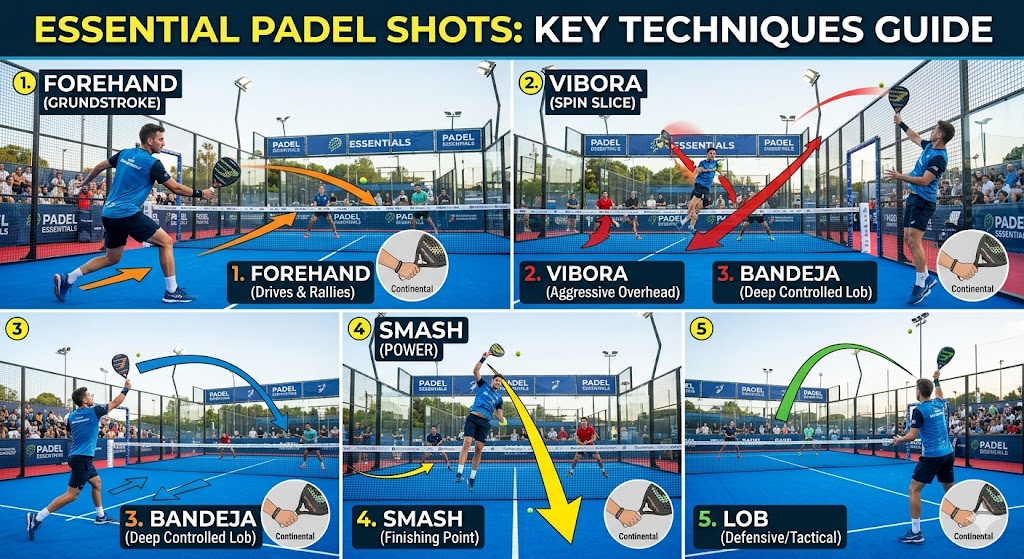
The forehand drive is one of the most basic and important shots in padel.
Players hit this shot on their dominant side using a forward swinging motion.
Most rallies include several forehand drives as players exchange controlled groundstrokes from the baseline.
Beginners should focus on keeping the ball low and consistent.
Rather than hitting with maximum power, aim for controlled placement.
A steady forehand drive allows players to maintain rallies and build confidence.
Practicing this shot regularly helps players develop timing and accuracy.
The Backhand Drive
The backhand drive complements the forehand and is equally important.
Players hit this shot on the non-dominant side of their body.
Many beginners initially struggle with backhand technique. However, consistent practice quickly improves this skill.
The backhand drive should mirror the forehand in terms of control and placement.
Keep the swing smooth and balanced.
Focus on directing the ball toward open areas of the court.
Mastering both forehand and backhand drives helps players handle rallies from any position.
These basic strokes also become more effective when paired with the proper gear described in Padel Equipment Guide: Choosing the Right Racket, Balls, and Shoes.
The Volley
Volleys play a major role in padel strategy.
A volley occurs when a player strikes the ball before it bounces.
Players usually perform volleys while standing near the net.
This position allows them to apply pressure and control the pace of the rally.
Successful volleys require quick reflexes and precise racket control.
Instead of swinging aggressively, players should use short, controlled movements.
The goal is to redirect the ball into difficult areas of the court.
Teams that control the net often gain a significant advantage during matches.
The Lob
The lob is one of the most important strategic shots in padel.
Players hit a lob by sending the ball high over their opponents’ heads.
This shot forces opponents near the net to move backward toward the baseline.
The lob often helps defensive players regain control of the rally.
Once the opponents retreat, the defensive team can advance toward the net.
This shift in positioning frequently changes the momentum of the point.
Because net control is so valuable in padel, mastering the lob becomes essential for long-term success.
Many strategic concepts involving lobs are explained in Winning Padel Strategies: Positioning, Teamwork, and Shot Selection.
The Smash
The smash is one of the most exciting offensive shots in padel.
Players perform a smash when the ball arrives high enough to strike downward with power.
A well-executed smash can end the point immediately.
However, smashes require careful timing and positioning.
If a player hits the ball too hard or at the wrong angle, it may rebound off the back wall and return to the opponent.
For this reason, experienced players focus on controlled smashes rather than pure power.
Smashes become particularly effective when used after a well-placed lob forces opponents into defensive positions.
The Bandeja
The bandeja is one of the most distinctive shots in padel.
The name comes from the Spanish word for “tray.”
Players typically use this shot when returning a high lob while maintaining their position near the net.
Instead of smashing aggressively, the player hits the ball with controlled spin and moderate speed.
This technique keeps the opponents on defense while allowing the attacking team to remain near the net.
The bandeja is especially useful because it reduces the risk of giving opponents an easy rebound off the back wall.
Although beginners may take time to master this shot, it becomes a powerful weapon with practice.
The Vibora
The vibora is another advanced overhead shot used in padel.
This shot resembles the bandeja but adds more sidespin and speed.
Players use the vibora to create difficult angles that push opponents toward the corners of the court.
Because the ball curves sharply after bouncing, returning a vibora can be challenging.
While beginners do not need to rely on this shot immediately, understanding its purpose helps players recognize it during matches.
Over time, players may add the vibora to their offensive toolkit.
The Wall Rebound Shot
One feature that makes padel unique is the ability to play the ball after it rebounds from the wall.
Players often use this technique when defending deep shots.
Instead of rushing to return the ball immediately, they allow it to bounce off the back wall first.
This extra moment provides more time to position the racket properly.
After the rebound, the player can send the ball back across the net.
Understanding how the ball reacts to walls requires familiarity with the court structure described in Padel Court Layout and Dimensions: Understanding the Walls, Net, and Service Boxes.
Practicing wall rebounds greatly improves defensive play.
The Drop Shot
The drop shot is a finesse shot designed to surprise opponents.
Players hit this shot softly so the ball lands just over the net.
Because the ball travels slowly, opponents must rush forward to reach it.
Drop shots work best when opponents stand deep near the baseline.
The sudden change in pace often catches them off guard.
However, drop shots require careful control.
If the ball travels too high or too far, opponents can easily return it.
For this reason, players should use drop shots selectively.
The Chiquita
The chiquita is a clever control shot used frequently in padel.
Players hit this shot softly toward the opponents’ feet near the net.
The goal is to force a difficult volley.
Because the ball stays low, opponents often struggle to return it effectively.
This shot helps players regain control of the rally and create offensive opportunities.
Although it looks simple, the chiquita requires precise placement.
Players must focus on accuracy rather than power.
Combining Shots During Rallies
Padel rallies rarely involve a single shot repeated over and over.
Instead, players combine several shots to control the pace of the point.
For example, a rally might include:
- a defensive wall rebound
- a lob to regain net position
- a controlled volley
- a smash to finish the point
Each shot serves a purpose within the larger strategy.
Understanding how these shots work together helps players build more effective game plans.
Practicing Shot Technique
Improving shot technique requires consistent practice.
Beginners should start by practicing basic drives and volleys.
Once those skills feel comfortable, players can add lobs and overhead shots.
Practicing with a partner helps simulate real match conditions.
Players should also focus on maintaining proper positioning during practice sessions.
These habits build muscle memory and confidence.
Common Shot Mistakes Beginners Make
Many beginners make predictable mistakes while learning padel shots.
For example, players sometimes swing too hard during groundstrokes.
Others attempt smashes when a controlled bandeja would be safer.
Beginners may also forget to use the walls when defending difficult shots.
Recognizing these mistakes helps players improve faster.
For a deeper look at common errors, review Common Padel Mistakes Beginners Make and How to Fix Them.
Learning from these mistakes accelerates skill development.
How Equipment Affects Shot Performance
The equipment players use can influence their ability to perform certain shots.
For example, rackets with larger sweet spots help beginners control volleys and drives.
Meanwhile, balanced rackets improve consistency during overhead shots.
Players who choose equipment carefully often develop their skills more quickly.
You can learn how to select the best gear in Padel Equipment Guide: Choosing the Right Racket, Balls, and Shoes.
Proper equipment supports proper technique.
Playing with Purpose
As players gain experience, they begin to hit each shot with a specific goal.
Instead of simply returning the ball, they try to move opponents around the court.
Strategic shot placement creates openings for attacking opportunities.
These tactical decisions often determine the outcome of matches.
Many players develop these skills further when participating in organized competitions described in Padel Tournaments and Leagues: How Competitive Padel Works.
Competition provides valuable experience and motivation to improve.
Final Thoughts on Essential Padel Shots
Padel rewards players who combine technique with strategy.
Fortunately, beginners only need to master a handful of fundamental shots to start enjoying the game.
Forehand and backhand drives create consistent rallies.
Volleys and smashes apply pressure near the net.
Lobs and wall rebounds provide defensive stability.
Meanwhile, specialty shots like the bandeja and vibora add advanced options for experienced players.
As players practice these techniques, their confidence and skill levels grow quickly.
Understanding when and how to use each shot transforms padel from a simple game into a dynamic and strategic sport.
Continue Learning About Padel
Explore the rest of the padel learning series:
The Ultimate Beginner’s Guide to Padel: Rules, Equipment, Strategy, and How to Start Playing
Official Padel Rules Explained: Court Dimensions, Serving, and Gameplay
Padel Court Layout and Dimensions: Understanding the Walls, Net, and Service Boxes
Padel Equipment Guide: Choosing the Right Racket, Balls, and Shoes
Winning Padel Strategies: Positioning, Teamwork, and Shot Selection
Common Padel Mistakes Beginners Make and How to Fix Them
How to Build or Find a Padel Court Near You
Padel Tournaments and Leagues: How Competitive Padel Works



2 Responses
[…] Many of the fundamental techniques used for controlled play appear in Essential Padel Shots Every Beginner Should Learn. […]
[…] Many of these offensive techniques appear in Essential Padel Shots Every Beginner Should Learn. […]