
The Ultimate Beginner’s Guide to Padel
The Ultimate Beginner’s Guide to Padel
Padel is one of the fastest-growing sports in the world. What started as a niche racket sport has quickly become a global phenomenon played in more than 90 countries.
At first glance, padel looks similar to tennis. Players use rackets, hit a ball over a net, and compete on a rectangular court. However, padel introduces several unique features that make the game both exciting and accessible.
For example, the court is surrounded by walls that players can use during rallies. The rackets are solid rather than strung. Matches are usually played in doubles, which adds teamwork and strategy.
Because of these features, padel combines elements of tennis, squash, and racquetball. Yet it still maintains its own unique style and rhythm.
Beginners often find the sport easy to learn but challenging to master. Rallies tend to last longer than tennis points, and clever shot placement can be more important than raw power.
This guide explains everything new players need to know about the sport. You will learn about the rules, the equipment, the court layout, and the basic strategies that help beginners improve quickly.
By the end of this article, you will have a solid understanding of how padel works and how to start playing confidently.
What Is Padel?
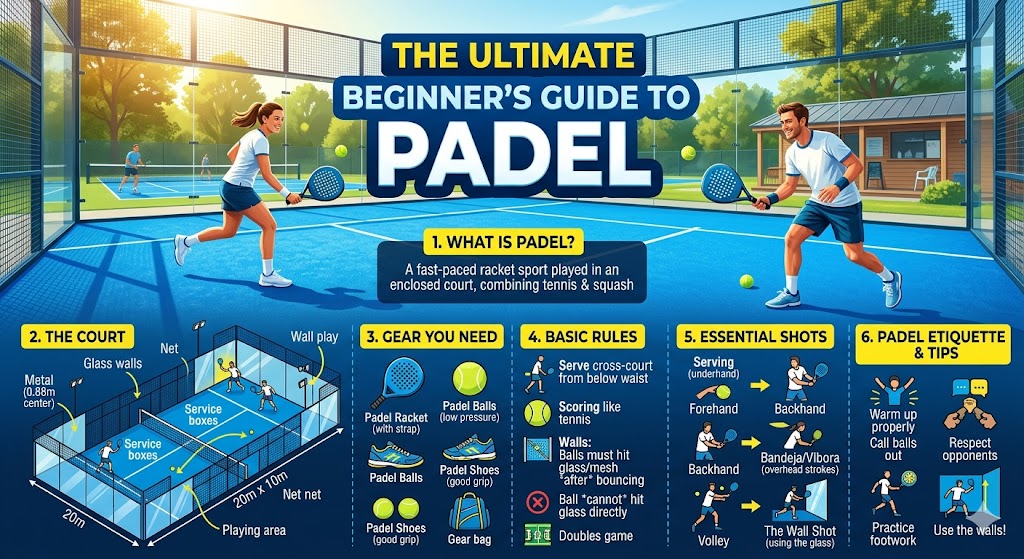
Padel is a racket sport typically played in doubles on an enclosed court that is smaller than a tennis court.
The court measures 20 meters long and 10 meters wide. Glass walls and metal fencing surround the playing area.
Players can hit the ball off the walls during rallies, similar to squash. However, the ball must bounce on the ground before contacting the wall on the receiving side.
This unique feature creates long, strategic rallies. Players often use angles, spins, and rebounds to outmaneuver their opponents.
Padel uses a scoring system similar to tennis. Games follow the familiar sequence of 15, 30, 40, and game.
The combination of accessible rules and strategic depth makes padel appealing to beginners and experienced athletes alike.
If you want to understand the official regulations in detail, read Official Padel Rules Explained: Court Dimensions, Serving, and Gameplay.
The History of Padel
Padel originated in Mexico in the late 1960s.
The sport’s founder, Enrique Corcuera, wanted to create a racket game that could be played in a smaller space. He built a compact court surrounded by walls at his home.
The walls prevented the ball from leaving the court and introduced new gameplay possibilities.
Soon afterward, the sport spread to Spain and Argentina. These countries embraced padel enthusiastically, and it eventually became one of their most popular recreational sports.
Today, Spain has thousands of padel courts and millions of regular players.
Professional tournaments attract large crowds and international media attention.
In recent years, the sport has expanded rapidly into Europe, the Middle East, and North America.
Because of this growth, many sports analysts believe padel may become one of the most widely played racket sports in the world.
Why Padel Is So Popular
Several factors explain the rapid growth of padel.
First, the game is easy to learn.
Beginners can enjoy rallies within minutes of stepping onto the court.
Second, the sport emphasizes teamwork and strategy rather than physical power.
Players of different ages and athletic abilities can compete together.
Third, rallies tend to last longer than tennis points. The walls keep the ball in play and create more opportunities for creative shots.
Finally, padel courts require less space than tennis courts, making them easier to build in urban areas.
Because of these advantages, many clubs and recreation centers have begun installing padel courts.
Understanding the Padel Court
The padel court has a distinctive design that sets it apart from other racket sports.
The playing surface measures 20 meters by 10 meters and is divided by a net.
Glass walls form the back and parts of the side boundaries. Metal fencing completes the enclosure.
Players can hit the ball off the glass walls during rallies, which adds a strategic element to the game.
The court also contains service boxes similar to those used in tennis.
These boxes determine where serves must land.
Understanding court layout helps players anticipate rebounds and position themselves effectively.
You can learn more about court design in Padel Court Layout and Dimensions: Understanding the Walls, Net, and Service Boxes.
Padel Equipment Basics
Padel requires only a few essential pieces of equipment.
However, choosing the right gear can significantly improve your playing experience.
The main pieces of equipment include:
- Padel racket
- Padel balls
- Athletic shoes designed for court surfaces
Unlike tennis rackets, padel rackets have solid faces with small holes drilled through them.
They also lack strings.
The racket shape, weight, and balance influence control and power.
Players often experiment with different rackets before finding one that suits their playing style.
You can learn how to choose the right gear in Padel Equipment Guide: Choosing the Right Racket, Balls, and Shoes.
Basic Padel Rules
Padel rules resemble tennis rules in many ways, but several differences exist.
The serve must be hit underhand and below waist height.
Additionally, the ball must bounce in the service box before contacting the wall.
During rallies, players can use the walls strategically. However, the ball must first bounce on the ground before hitting the wall on the receiving side.
Players score points using the same sequence as tennis.
Matches usually consist of best-of-three sets.
Understanding these rules helps beginners feel comfortable when stepping onto the court.
For a detailed breakdown of gameplay, read Official Padel Rules Explained: Court Dimensions, Serving, and Gameplay.
Basic Padel Strategy for Beginners
Padel strategy differs from tennis strategy in several important ways.
Because the court is enclosed, positioning becomes extremely important.
Experienced players often move toward the net quickly because the net position provides a strong offensive advantage.
Meanwhile, players near the baseline focus on defensive shots and controlled returns.
Beginners should focus on keeping the ball in play rather than attempting powerful winners.
Patience often wins points in padel.
Strategic thinking becomes even more important as players improve their skills.
For a deeper look at tactics, explore Winning Padel Strategies: Positioning, Teamwork, and Shot Selection.
Learning the Basic Padel Shots
Padel features several essential shots that beginners should practice regularly.
The forehand and backhand form the foundation of most rallies.
Players also use volleys when standing near the net.
Another important shot is the lob, which sends the ball high over opponents and pushes them toward the back of the court.
Lobs play a crucial role in padel strategy because they allow players to regain the net position.
As players gain experience, they also learn advanced shots such as smashes and drop shots.
Developing consistent technique is the key to improvement.
You can learn the mechanics of these shots in Essential Padel Shots Every Beginner Should Learn.
Common Beginner Challenges
Most new padel players face several early challenges.
For example, beginners often struggle to judge rebounds off the walls.
They may also stand too far from the net or attempt overly aggressive shots.
These mistakes are normal during the learning process.
Fortunately, they are easy to correct with practice.
Understanding these errors helps beginners improve much faster.
To avoid common pitfalls, read Common Padel Mistakes Beginners Make and How to Fix Them.
Practicing Padel Effectively
Improvement in padel comes from regular practice and thoughtful play.
Beginners should focus on consistency rather than power.
Practicing rallies with a partner can help develop control and timing.
Drills that emphasize volleys, lobs, and defensive positioning are especially valuable.
Watching experienced players also provides insight into strategy and court positioning.
As players gain confidence, they can gradually introduce more advanced shots into their game.
Playing Socially vs Competitively
Many people play padel simply for fun and exercise.
Clubs frequently organize social matches where players rotate partners and enjoy casual competition.
However, competitive padel is also growing rapidly.
Local leagues and tournaments allow players to test their skills against others in organized matches.
These events often divide players into skill levels to keep competition balanced.
If you want to explore competitive opportunities, read Padel Tournaments and Leagues: How Competitive Padel Works.
Why Padel Is a Great Sport for Beginners
Padel stands out among racket sports because it offers a rare combination of accessibility and depth.
Beginners can start playing quickly without years of training.
At the same time, experienced players continue discovering new strategies and techniques.
The social nature of doubles play also creates a welcoming environment for new players.
Many clubs host beginner clinics and group lessons to help newcomers learn the basics.
Because of these factors, padel appeals to people of all ages and athletic backgrounds.
Final Thoughts on Learning Padel
Padel continues to grow in popularity because it is fun, social, and strategically engaging.
The sport blends elements of tennis and squash while introducing its own unique style of play.
Beginners who understand the rules, equipment, and basic strategies can begin enjoying the game almost immediately.
With regular practice, players quickly develop better court awareness and shot control.
Whether you play casually with friends or pursue competitive tournaments, padel offers an exciting and rewarding experience.
As the sport expands around the world, more people are discovering why it has become one of the fastest-growing racket sports today.
Continue Learning About Padel
Explore the rest of the padel learning series:
Official Padel Rules Explained: Court Dimensions, Serving, and Gameplay
Padel Court Layout and Dimensions: Understanding the Walls, Net, and Service Boxes
Padel Equipment Guide: Choosing the Right Racket, Balls, and Shoes
Essential Padel Shots Every Beginner Should Learn
Winning Padel Strategies: Positioning, Teamwork, and Shot Selection
Common Padel Mistakes Beginners Make and How to Fix Them
How to Build or Find a Padel Court Near You
Padel Tournaments and Leagues: How Competitive Padel Works



8 Responses
[…] you are new to the sport, start with The Ultimate Beginner’s Guide to Padel: Rules, Equipment, Strategy, and How to Start Playing. That article explains the sport’s history, basic gameplay, and why it has become so […]
[…] you are new to the sport, start with The Ultimate Beginner’s Guide to Padel: Rules, Equipment, Strategy, and How to Start Playing. That guide explains the basics of the sport and how beginners can begin […]
[…] you are completely new to the sport, begin with The Ultimate Beginner’s Guide to Padel: Rules, Equipment, Strategy, and How to Start Playing. That article explains how the game works and how beginners can get started […]
[…] you are completely new to the sport, begin with The Ultimate Beginner’s Guide to Padel: Rules, Equipment, Strategy, and How to Start Playing. That guide explains how the game works and how beginners can quickly get […]
[…] you are new to the sport, begin with The Ultimate Beginner’s Guide to Padel: Rules, Equipment, Strategy, and How to Start Playing. That article explains how the game works and how players can get […]
[…] you are completely new to the sport, begin with The Ultimate Beginner’s Guide to Padel: Rules, Equipment, Strategy, and How to Start Playing. That guide explains the basics of the sport and how players can start developing their […]
[…] you are new to the sport, start with The Ultimate Beginner’s Guide to Padel: Rules, Equipment, Strategy, and How to Start Playing. That guide explains how padel works and why the sport has grown so […]
[…] you are new to the game, start by reading The Ultimate Beginner’s Guide to Padel: Rules, Equipment, Strategy, and How to Start Playing. That guide introduces the fundamentals and explains how players begin their padel […]