
How Racing Safety Innovations Save Lives in Motorsports
How Racing Safety Innovations Save Lives in Motorsports
Motorsports has always involved speed, competition, engineering and risk.
That combination is part of what makes racing so compelling. Drivers and riders push machines to extraordinary limits, often traveling at speeds where a mistake can produce catastrophic consequences in fractions of a second.
But modern motorsports is dramatically safer than it once was.
That did not happen because racing became less dangerous.
In many ways, the machines became faster and more technologically advanced. Instead, motorsports became safer because engineers, sanctioning bodies, medical professionals, track designers and competitors learned how to manage the consequences of crashes.
The most important safety innovations are often the ones spectators barely notice.
A carbon-fiber survival cell.
A HANS device.
A helmet.
A wheel tether.
A deformable barrier.
A SAFER barrier.
A halo.
A fire-resistant racing suit.
A better-designed runoff area.
A faster medical response.
Each one represents years of research, testing and lessons learned from accidents.
And collectively, these innovations have transformed racing.
The story of motorsports safety is therefore not simply a story about equipment.
It is a story about the racing community learning from tragedy and refusing to accept that death has to be an inevitable part of competition.
Racing Was Once an Extremely Dangerous Sport
Early motorsport was brutally unforgiving.
Race cars offered little protection.
Drivers often competed without the sophisticated helmets, restraints, fire-resistant clothing and protective structures that are considered standard today.
Tracks frequently provided minimal protection from trees, buildings, telephone poles, concrete walls and other hazards.
A crash could easily become fatal.
Even relatively minor incidents could produce devastating injuries because there were so few systems designed to protect the driver.
As racing speeds increased, the consequences became even more severe.
Motorsports eventually reached a point where technological advancement was producing faster vehicles much more quickly than safety technology was evolving.
The result was an unacceptable number of serious injuries and fatalities.
The industry eventually began changing its philosophy.
Instead of asking how drivers could avoid every crash, engineers increasingly asked another question:
What can we do to make the driver survive when the crash happens?
That change in thinking became one of the most important developments in racing history.
Safety Became an Engineering Discipline
Modern motorsport safety is not based on one device.
It is a system.
The car protects the driver.
The driver’s equipment protects the driver.
The track is designed to manage the car’s energy.
Barriers are designed to absorb impacts.
Race officials monitor incidents.
Medical crews respond rapidly.
Data from crashes is collected and analyzed.
Rules are changed when evidence demonstrates that an existing system is insufficient.
The FIA Foundation describes this approach as part of the broader effort toward eliminating death and serious injury in motorsport, supporting research into technologies including the halo, HANS, high-speed barriers, helmets, wheel tethers and crash testing.
That philosophy is important because no single piece of equipment can make racing completely safe.
Instead, modern motorsport uses layers of protection.
If one layer fails, another may still protect the competitor.
The Carbon-Fiber Survival Cell
One of the greatest advances in modern race-car construction is the carbon-fiber survival cell.
In Formula 1, the driver sits inside an extremely strong carbon-fiber monocoque.
The idea is relatively simple.
The vehicle can be damaged.
Parts of the car can break apart.
The car can absorb tremendous energy.
But the driver’s central survival space must remain intact.
Formula 1 has used carbon-fiber monocoque construction since the early 1980s, when McLaren demonstrated the potential of carbon-fiber technology with its MP4/1.
The result was a fundamental change in race-car safety.
Instead of attempting to make the entire car indestructible, engineers could design specific sections to deform or break while protecting the driver inside the survival cell.
That concept is now central to modern open-wheel racing.
Controlled Destruction Saves Lives
This sounds strange at first.
Why would engineers intentionally build parts of a race car to break?
Because absorbing energy is critical.
When a car traveling at high speed crashes, the vehicle has enormous kinetic energy.
That energy has to go somewhere.
If the car simply transfers all of that energy directly into the driver, the consequences can be catastrophic.
Modern race cars are therefore designed with structures that deform and absorb energy.
The vehicle can sacrifice itself to protect the person inside.
That is one of the most important concepts in modern motorsport safety.
Crash Testing Changed Racing
Modern racing cars are not simply built and sent onto a track.
They undergo extensive testing.
Crash structures are tested to determine how they respond to different types of impacts.
Front impacts.
Side impacts.
Rear impacts.
Rollovers.
Intrusions.
The objective is to understand what happens when things go wrong before a real driver experiences the consequences.
Formula 1’s safety requirements have become increasingly demanding, with crash-testing standards evolving substantially over the decades.
The philosophy is straightforward:
Test the car harder than you expect the driver to experience it.
The HANS Device Changed Driver Protection
Few safety innovations have had a greater impact on racing than the Head and Neck Support device, commonly called HANS.
The device was developed after researchers recognized the devastating consequences of severe head and neck movement during crashes.
The HANS device connects the driver’s helmet to a support structure resting around the shoulders.
During a violent impact, it helps restrict the movement of the head relative to the torso.
That reduces the forces placed on the neck and helps protect against catastrophic injuries.
The FIA made HANS compulsory in Formula 1 beginning in 2003.
The device has since become one of the most recognizable pieces of safety equipment in motorsports.
Dale Earnhardt’s Death Changed NASCAR Safety
Few moments illustrate the importance of racing safety better than the death of Dale Earnhardt Sr. during the 2001 Daytona 500.
Earnhardt’s death shocked NASCAR.
It also intensified the push toward better head-and-neck protection.
The HANS device became an increasingly important part of NASCAR’s safety program following the crash.
This illustrates a difficult truth about motorsport safety:
Sometimes the most important advances occur because something terrible happened first.
The goal is to make sure that tragedy produces knowledge rather than simply sorrow.
Safety Improvements Often Begin With Tragedy
The history of motorsports contains numerous examples.
A driver dies.
Engineers investigate.
Officials examine the wreck.
Medical experts analyze injuries.
Designers identify weaknesses.
Regulators change requirements.
The next generation of cars becomes safer.
The process is painful, but it has saved lives.
The deaths of Ayrton Senna and Roland Ratzenberger during the 1994 San Marino Grand Prix, for example, triggered major safety changes throughout Formula 1.
The important lesson is not that racing is inherently unsafe.
It is that racing safety improves when the sport refuses to ignore evidence.
The Halo May Be the Most Visible Safety Innovation
Few racing safety technologies have generated as much debate as the halo.
When the device was introduced into Formula 1 in 2018, many fans disliked it.
They believed it disrupted the traditional appearance of an open-wheel race car.
Some questioned whether it was necessary.
Others argued that open cockpits were part of the identity of Formula 1.
Today, those objections seem much less significant.
The halo is now widely regarded as one of the most important safety developments in modern single-seater racing.
What Does the Halo Do?
The halo is a strong structural device positioned around and above the driver’s head.
Its primary purpose is to protect the cockpit area from large objects and from another vehicle potentially entering the driver’s space.
The FIA subjected the halo to extremely demanding testing.
The device must withstand forces of approximately 125 kilonewtons from above and from the side.
That is an extraordinary amount of force.
The halo therefore isn’t decorative.
It is structural protection.
The Halo Has Already Demonstrated Its Value
Several major incidents have demonstrated why the halo matters.
In the 2018 Belgian Grand Prix, Charles Leclerc was involved in a first-lap incident in which another car became airborne.
In 2021, Lewis Hamilton’s car was struck by Max Verstappen’s Red Bull at Monza, with the Red Bull passing over Hamilton’s cockpit area.
In 2022, Zhou Guanyu suffered a dramatic rollover at Silverstone.
The halo played an important protective role in these and other incidents.
The FIA Foundation has specifically highlighted incidents in which the halo likely prevented serious head or neck injuries.
Perhaps the greatest compliment to the halo is that the criticism surrounding its appearance has largely disappeared.
Once fans saw what it could do, aesthetics became secondary.
Wheel Tethers Prevent Another Kind of Disaster
A detached wheel traveling at racing speed is essentially a projectile.
That creates danger not only for the driver but also for other competitors, marshals and spectators.
Wheel tethers are designed to keep wheels connected to the vehicle during crashes.
They don’t necessarily prevent the wheel from moving.
They prevent it from becoming completely detached and traveling uncontrolled.
That distinction can save lives.
Formula 1 introduced wheel-tether requirements beginning in the late 1990s and strengthened the system after additional accidents demonstrated the need for redundancy.
This is another example of motorsport safety evolving through experience.
Helmets Have Become Engineering Marvels
A racing helmet might look simple from the outside.
It isn’t.
Modern racing helmets are engineered to protect against:
- Massive impacts
- Penetration
- Fire
- Heat
- Debris
- Multiple impact scenarios
The helmet must be strong enough to protect the driver while remaining light enough to avoid placing excessive strain on the neck.
That is an extremely difficult engineering problem.
The modern helmet is therefore much more than protective headgear.
It is a carefully engineered life-support system for the driver’s head.
Fire Protection Is Another Critical Layer
Fire has always been one of motorsport’s greatest dangers.
Race cars contain fuel, oil, electrical systems and extremely hot components.
A crash can turn those ingredients into a serious fire within seconds.
Modern racing drivers therefore use fire-resistant suits, gloves, shoes, underwear and other protective equipment.
The objective is not necessarily to prevent every fire.
It is to give the driver enough protection and time to escape.
That distinction matters.
Safety equipment often buys seconds.
In an emergency, seconds can mean everything.
The Car Must Help the Driver Escape
Modern race cars are also designed around driver extraction.
Drivers need to be able to get out of the vehicle quickly after an accident.
That creates a difficult engineering balance.
The cockpit needs to be strong enough to protect the driver.
But it also needs to provide a viable escape route.
This is particularly important after fires, rollovers or crashes in which the car comes to rest in a dangerous position.
SAFER Barriers Changed Oval Racing
Track safety is just as important as car safety.
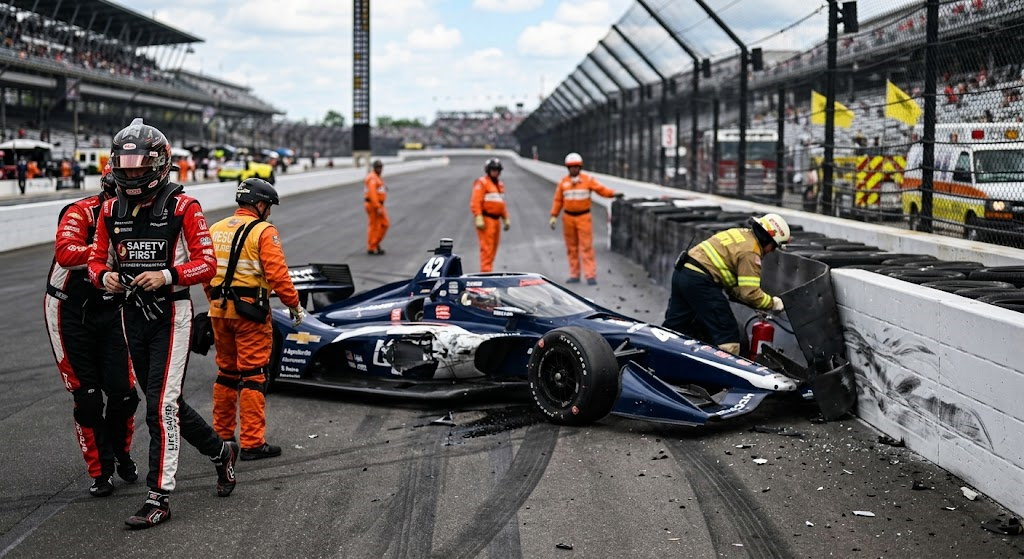
One of the most important innovations in American motorsports has been the SAFER barrier.
SAFER stands for Steel and Foam Energy Reduction.
The system was designed to reduce the forces transmitted to a vehicle and driver during a wall impact.
The University of Nebraska-Lincoln’s Midwest Roadside Safety Facility was involved in developing the system, which was first installed at Indianapolis Motor Speedway in 2002.
The concept was revolutionary.
Instead of allowing a race car to strike a rigid concrete wall and absorb the majority of the impact through the car and driver, the barrier system can deform and absorb energy.
Again, the objective is controlled energy management.
Why Barrier Design Matters
A barrier has two jobs.
First, it must prevent the car from entering an even more dangerous area.
Second, it must reduce the severity of the impact.
Those objectives aren’t always easy to combine.
A barrier that is too rigid may protect the track but create enormous forces.
A barrier that is poorly designed may cause the car to rebound unpredictably.
Modern barrier systems attempt to manage both problems.
TecPro and Other Energy-Absorbing Barriers
Modern road courses increasingly use sophisticated energy-absorbing barriers.
Systems such as TecPro are designed to deform and absorb energy during crashes.
The broader philosophy is similar to SAFER barriers.
Instead of treating the wall as an immovable object, engineers attempt to make the barrier part of the crash-management system.
This has become particularly important on temporary street circuits, where concrete walls and limited runoff can create unique safety challenges.
Runoff Areas Save Lives
Sometimes the best safety barrier is distance.
Modern race tracks increasingly use runoff areas to give a car space to slow down after leaving the racing surface.
Runoff can include:
- Asphalt
- Gravel
- Grass
- Specialized surfaces
- Energy-absorbing systems
The ideal solution depends on the type of circuit and the nature of the corner.
A high-speed corner may require substantial runoff.
A street circuit may have almost none.
Track design therefore becomes an exercise in risk management.
Street Circuits Present Unique Safety Challenges
Street circuits are particularly difficult because they are built around existing roads.
There may be:
- Buildings
- Curbs
- Concrete walls
- Narrow passages
- Limited runoff
- Pedestrian infrastructure
This makes modern barrier technology and incident management especially important.
A street circuit cannot simply be redesigned from scratch like a purpose-built facility.
Engineers have to work with what is available.
Racing Safety Extends Beyond the Car
It is easy to think of motorsport safety as something that protects the driver.
But modern safety systems also protect:
- Track workers
- Marshals
- Medical personnel
- Officials
- Spectators
- Other competitors
Wheel tethers are an excellent example.
A loose wheel doesn’t care who is standing in its path.
Neither does debris.
Neither does an uncontrolled car.
Modern motorsport safety therefore treats the entire circuit as a safety environment.
Catch Fences Protect Spectators
At many oval and high-speed circuits, catch fencing is a critical safety system.
The goal is to prevent cars and large pieces of debris from reaching spectators.
A fence cannot necessarily stop every object.
But it can dramatically reduce the likelihood that a crash becomes a catastrophe for people outside the racing surface.
Spectator safety is an essential part of modern track design.
Medical Response Has Become Faster
Preventing injuries is only part of the equation.
When an injury occurs, medical response matters enormously.
Modern motorsport events typically have highly trained medical personnel positioned strategically around the circuit.
Medical cars and rapid-response vehicles can reach incidents quickly.
The FIA has emphasized medical specialists, marshals and grassroots safety training as important parts of the broader motorsport safety system.
This creates another layer of protection.
If something goes wrong, help needs to arrive quickly.
The First Few Minutes Matter
Traumatic injuries can deteriorate rapidly.
A driver who initially appears stable may have internal injuries.
A fire can spread.
A damaged vehicle can become unstable.
A track worker may be exposed to additional danger.
That is why motorsport medical teams train specifically for high-speed trauma.
The goal is not simply to treat the injury.
It is to stabilize the person and get them to appropriate medical care as quickly as possible.
Data Has Become a Safety Tool
Modern race cars produce enormous amounts of data.
That data can help engineers understand what happened during a crash.
Sensors can measure:
- Acceleration
- Deceleration
- Impact forces
- Vehicle orientation
- Structural loads
- Driver inputs
This information can be used to reconstruct crashes.
Engineers can then determine whether the car, safety equipment or circuit performed as expected.
That information becomes useful for future designs.
One crash can therefore contribute to preventing another.
Crash Investigation Is a Form of Learning
A serious accident doesn’t simply end when the driver is transported away.
Engineers want to know:
What happened?
Why did it happen?
Where did the energy go?
Which component failed?
Which component worked?
Could the driver have been better protected?
Could the barrier have absorbed more energy?
Could the track have been designed differently?
Those questions turn an accident into engineering information.
Racing Safety Is a Constant Process
The biggest misconception about motorsport safety is that the sport has somehow “solved” the problem.
It hasn’t.
Every new generation of cars creates new challenges.
Every increase in speed creates new risks.
New circuits create different hazards.
Electric racing creates high-voltage concerns.
New materials create different engineering challenges.
Safety therefore cannot remain static.
The sport must continually evolve.
Electric Racing Creates New Safety Questions
The rise of electric motorsport has created another category of safety concerns.
High-voltage battery systems require different procedures from traditional gasoline-powered vehicles.
A damaged battery can create electrical hazards.
Emergency crews need to understand how to identify and isolate high-voltage systems.
Fire response can also differ from traditional fuel fires.
As electric racing continues to develop, safety regulations must evolve alongside the technology.
Motorcycle Racing Requires Different Solutions
Motorcycle racing presents a completely different safety problem.
A rider is not enclosed inside a survival cell.
The rider becomes physically separated from the motorcycle during many crashes.
That makes personal protective equipment particularly important.
Modern motorcycle racing uses:
- Advanced helmets
- Airbag suits
- Protective leathers
- Specialized gloves
- Reinforced boots
- Impact-absorbing materials
Airbag technology has become particularly significant.
Instead of relying entirely on passive padding, modern systems can detect a crash and rapidly inflate protective airbags around the rider’s body.
Safety Innovation Often Spreads Across Racing
One of the most fascinating aspects of motorsport is how innovations migrate between disciplines.
A technology developed in Formula 1 may influence another form of racing.
A NASCAR safety innovation may benefit other categories.
A motorcycle-racing technology may eventually appear in consumer protective equipment.
A barrier system developed for one type of circuit may be adapted elsewhere.
Competition may separate racing series, but safety research can benefit everyone.
Motorsport Can Influence Road-Car Safety
Racing also serves as an engineering laboratory.
Technologies developed or refined through motorsports have influenced passenger vehicles.
Carbon-fiber structures.
Energy-absorbing materials.
Data analysis.
Advanced restraints.
Brake technology.
Aerodynamic research.
Tire technology.
The relationship is not always direct, but racing provides manufacturers with a high-pressure environment in which technology can be tested under extreme conditions.
The Culture of Safety Has Changed
Perhaps the biggest innovation isn’t a piece of equipment.
It is the culture surrounding safety.
There was once an attitude in motorsport that danger was simply part of racing.
Today, that philosophy is increasingly unacceptable.
Drivers expect protection.
Teams demand it.
Officials regulate it.
Engineers constantly improve it.
Fans increasingly understand its importance.
That cultural change may be just as significant as any individual technology.
Drivers Still Take Enormous Risks
None of these innovations makes motorsports safe in the conventional sense.
Drivers still experience massive impacts.
Cars still catch fire.
Vehicles still flip.
Motorcycles still crash.
Racing remains inherently dangerous.
The difference is that the odds of surviving a serious accident have improved enormously.
That is the real achievement.
Safety Doesn’t Make Racing Less Authentic
Some fans occasionally argue that modern safety has made motorsports too sanitized.
But safety does not remove the challenge.
Drivers still have to manage:
- Speed
- Braking
- Tires
- Weather
- Traffic
- Strategy
- Physical endurance
- Mental pressure
- Mechanical failures
The difference is that the sport no longer has to accept unnecessary deaths as part of the entertainment.
A driver surviving a crash isn’t a sign that racing has become less exciting.
It is a sign that racing has become smarter.
The Most Important Safety Innovation May Be Prevention
Most attention goes to spectacular technologies like the halo.
But some of the most important safety improvements are less dramatic.
Better race control.
Improved warning systems.
Better weather monitoring.
Safer pit-lane procedures.
Improved marshal training.
More accurate incident detection.
Virtual safety cars.
Better communication.
These technologies can prevent secondary crashes.
And preventing a crash is always preferable to surviving one.
The Virtual Safety Car Changed Incident Management
Modern race control can neutralize a race without requiring the field to run at full racing speed.
The Virtual Safety Car is one example.
When an incident occurs, drivers are required to reduce speed and maintain prescribed timing.
This allows marshals and emergency personnel to work while reducing the risk of approaching cars arriving at full racing speed.
The technology demonstrates how safety can involve managing driver behavior, not just protecting drivers after an impact.
The Halo Provides a Perfect Safety Lesson
The halo is particularly valuable as a case study because it demonstrates how safety innovation can be unpopular before it becomes accepted.
Fans disliked its appearance.
Some drivers questioned it.
Critics argued that it didn’t belong on traditional Formula 1 cars.
Then serious accidents demonstrated its value.
The lesson is important:
Safety equipment should be judged by what happens when it is needed, not by how it looks when nothing is wrong.
Safety Innovation Requires Money
Advanced safety isn’t cheap.
Carbon-fiber structures require sophisticated manufacturing.
Crash testing requires expensive facilities.
Barrier systems cost money.
Medical teams cost money.
Track modifications cost money.
Research requires funding.
This creates a particular challenge for grassroots motorsports.
The biggest professional series can invest enormous sums in safety.
Smaller racing organizations cannot always do the same.
That is why making proven safety technology affordable and accessible is so important.
Grassroots Racers Benefit Too
Safety innovations eventually reach local racing.
A weekend racer may use a HANS device.
A local track may use energy-absorbing barriers.
Drivers may wear advanced fire-resistant equipment.
Helmets benefit from decades of research.
The technology may have originated in the highest levels of motorsport, but the benefits can eventually reach competitors throughout the racing community.
The Goal Is Not Zero Risk
Zero risk is impossible in motorsports.
The objective is something more realistic:
Reduce preventable risk as much as possible.
That means identifying dangerous situations.
Studying accidents.
Developing solutions.
Testing those solutions.
Making them mandatory when appropriate.
Then studying the next problem.
Safety is therefore a continuous cycle.
What the Future May Bring
The next generation of racing safety will likely become increasingly intelligent.
Sensors may detect impacts faster.
Protective systems may activate automatically.
Crash data may be transmitted immediately.
Artificial intelligence may help reconstruct accidents.
Materials may become stronger and lighter.
Medical response may become even faster.
Driver-monitoring systems may provide better information about injuries.
Circuit designs will continue evolving.
The objective will remain the same:
Give drivers the best possible chance of walking away.
Racing Will Never Be Completely Safe
That needs to be acknowledged honestly.
Motorsports involves extreme forces.
The machines are fast.
The competition is aggressive.
Mistakes happen.
Mechanical failures happen.
Weather changes.
Drivers sometimes make errors.
No safety system can eliminate every possible outcome.
But the existence of risk does not justify ignoring preventable dangers.
That is the distinction between old-school danger and modern motorsport safety.
Every Innovation Represents Someone’s Lesson
A HANS device exists because engineers studied catastrophic head and neck injuries.
A halo exists because researchers recognized the danger of cockpit intrusion.
A SAFER barrier exists because rigid walls could transmit devastating forces.
Wheel tethers exist because detached wheels can become deadly projectiles.
Survival cells exist because drivers need a protected space during massive crashes.
Improved medical response exists because survival depends on what happens after impact as well as during it.
Every innovation has a story.
And behind many of those stories is a crash that somebody never forgot.
Final Thoughts
The history of motorsports safety is one of the most remarkable stories in sports.
Racing has become faster.
Cars have become more powerful.
Tracks have become more sophisticated.
Yet the survival rate from many serious crashes has improved dramatically because engineers, medical professionals, governing bodies, teams and drivers have continually pushed safety technology forward.
The carbon-fiber survival cell protects the driver’s central space.
Energy-absorbing structures manage crash forces.
The HANS device protects the head and neck.
Helmets protect against impact and penetration.
Fire-resistant equipment buys precious time.
Wheel tethers keep tires from becoming dangerous projectiles.
SAFER and other energy-absorbing barriers reduce impact forces.
Runoff areas give cars space to slow down.
Catch fencing protects spectators.
Medical teams provide rapid treatment.
Data helps engineers understand what happened.
And the halo provides perhaps the clearest modern example of how one controversial technology can become an essential part of racing safety. The FIA and Formula 1 have documented multiple incidents in which the device provided critical protection to drivers.
But perhaps the most important lesson is bigger than any individual technology.
Motorsports safety is an ongoing process.
Every generation of racing creates new risks.
Every major crash provides new information.
Every piece of research creates another opportunity to improve.
That means the sport can never declare itself finished with safety.
There will always be another problem to solve.
Another barrier to improve.
Another material to test.
Another crash to study.
Another piece of protective equipment to redesign.
And that is exactly how it should be.
The goal of motorsports safety isn’t to eliminate the danger that makes racing exciting.
The goal is to make sure that when the unimaginable happens, the person inside the race car has every possible advantage in surviving it.
That is why the greatest racing safety innovations aren’t really about machines.
They are about people.
Every stronger survival cell, every better helmet, every improved barrier, every HANS device and every halo represents the same fundamental belief:
Winning a race should never be more important than coming home.
That is the true legacy of motorsports safety innovation.