
Professional Athletes and Their College Eligibility
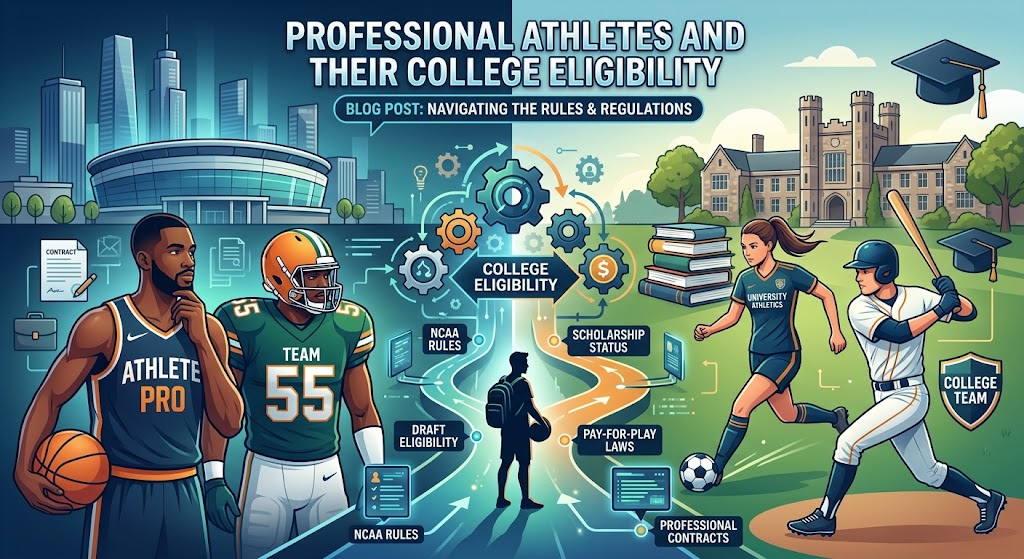
Professional Athletes and Their College Eligibility: Should Former Pros Be Allowed to Return to College Sports?
College athletics has always existed in a complicated space between education and elite competition.
Today’s college athletes train like professionals, travel across the country, compete in enormous stadiums and arenas, appear on national television, and can now benefit financially from their name, image, and likeness. The old definition of the “amateur athlete” has been dramatically transformed.
But there is still a line that many people believe should remain.
That line is professional experience.
The question now confronting college athletics is no longer simply whether college athletes should be allowed to make money. That debate has largely been settled by the realities of modern college sports.
The much more difficult question is this:
Should an athlete who has already entered professional sports be allowed to return to college and compete against athletes who have never played professionally?
That question has suddenly become much more than a hypothetical.
As the 2026 college football season begins, LSU is at the center of an extraordinary legal and philosophical battle involving former NFL players, the NCAA, the Southeastern Conference, and the future definition of college athletics.
A Louisiana judge has now issued a preliminary injunction that clears the way for former NFL players Dae’Quan Wright and Zxavian Harris to join LSU’s roster, while the SEC has filed a federal lawsuit seeking to prevent LSU from doing so. The case is part of a larger fight involving athletes seeking additional eligibility under the NCAA’s newly adopted age-based eligibility system.
The legal questions will ultimately be decided by courts and governing bodies.
But there is another question that deserves serious consideration:
Just because something can be allowed under a changing eligibility rule does not necessarily mean it is good for college athletics.
And that is where the argument against professional athletes returning to college sports becomes particularly compelling.
The LSU Situation Has Changed the Conversation
The current controversy centers around athletes who played college football, moved into the professional ranks, and then sought another opportunity to play college football.
Two of the most prominent names are former Ole Miss players Dae’Quan Wright and Zxavian Harris.
Both had brief NFL experiences before seeking to return to college football.
Wright previously played tight end at Ole Miss and later spent time with the Cleveland Browns. Harris played defensive line at Ole Miss and later spent time with the New Orleans Saints. Both had been coached at Ole Miss by current LSU head coach Lane Kiffin.
Their situations became possible because of a major change in NCAA eligibility rules.
In June 2026, the NCAA adopted an age-based Division I eligibility model that generally provides up to five years of eligibility to athletes who enter college within the prescribed age and enrollment window. The new system replaced many of the previous sport-specific and seasons-of-competition rules.
The change created a complicated transition period.
Some athletes argued that they were unfairly excluded from the new eligibility structure.
Legal challenges followed.
Now former professional athletes are arguing that they should receive the same additional college eligibility as other athletes.
That argument has found some success in court.
But legality and fairness are not necessarily the same thing.
What Makes a Professional Athlete Different?
This is the central issue.
A college athlete who has spent four years developing within college athletics is not necessarily equivalent to an athlete who has already entered professional sports.
The professional athlete has crossed a significant competitive threshold.
They have been evaluated by professional scouts.
They have competed for professional roster spots.
They have experienced professional training environments.
They have signed professional contracts.
They have entered an entirely different level of the sporting world.
Even if that professional career lasts only a few weeks or months, the experience matters.
A player who participates in an NFL training camp is not suddenly identical to a college player who has never experienced professional football simply because the professional opportunity ended.
That distinction should matter when determining eligibility.
The Argument for Allowing Former Pros Back
To understand the controversy fairly, it is important to examine the strongest argument on the other side.
Former professional athletes can argue that they were caught in an eligibility transition they did not create.
Imagine a college athlete who believes he has exhausted his eligibility under the rules that existed when he made his career decisions.
He graduates.
He signs with an NFL team.
He pursues his professional dream.
He is eventually released.
Then the governing organization changes its eligibility structure and creates additional opportunities for athletes who meet certain requirements.
The athlete may reasonably argue:
Why should I be punished because I attempted to become a professional?
That is not an unreasonable argument.
The athletes involved in the LSU case have argued that they made professional decisions without knowing the NCAA would later create a fifth-year opportunity that might have applied to them.
Some of the athletes have even indicated a willingness to repay professional earnings in order to return to college competition.
That demonstrates how seriously they view the opportunity.
There is also an argument involving fairness and equal treatment.
If the NCAA’s new eligibility rules create five-year opportunities for athletes who meet the criteria, supporters argue that the organization should not selectively exclude someone simply because that athlete briefly attempted to play professionally.
That is a legitimate argument.
But it still does not answer the larger question of what college athletics is supposed to represent.
The Problem With Treating Professional Experience as Irrelevant
The biggest concern is that professional experience becomes meaningless under this interpretation.
Imagine two athletes competing for the same starting position.
One has spent his entire athletic career in high school and college.
The other has already signed an NFL contract, entered an NFL training camp, practiced against professional athletes, received professional coaching, and competed for a professional roster position.
Are those really equivalent competitive experiences?
They are not.
The professional athlete may have been released.
He may not have played in a regular-season game.
He may not have established himself professionally.
But he has nevertheless crossed the boundary between college and professional sports.
That boundary used to mean something.
It should still mean something.
“Professional” Does Not Have to Mean Superstar
One argument sometimes made in this debate is that a player who was cut from an NFL roster isn’t really a professional in the meaningful sense.
That argument misses the point.
Professional sports are not defined by whether someone becomes a superstar.
A player doesn’t become a professional only after starting ten NFL games.
He doesn’t become professional only after signing a multimillion-dollar contract.
Professional status begins when the athlete enters the professional system.
The distinction should therefore not be based solely on how successful the professional career was.
Otherwise, college eligibility could become a strange evaluation of how “professional” someone was.
Did he play?
Did he make the active roster?
How many games?
How much money?
How long was the contract?
Where would the line be drawn?
That creates an enormous administrative problem.
A much cleaner standard is:
Once an athlete enters professional competition in the same sport, the college eligibility clock should end.
The Line Between College and Professional Sports Matters
College athletics has already lost many of the characteristics that once separated it from professional sports.
College athletes can receive significant NIL compensation.
Transfer opportunities have transformed roster movement.
Coaches and athletic departments operate enormous businesses.
Major college football programs generate massive revenues.
Players are increasingly treated as valuable athletic assets.
All of that may be the unavoidable reality of modern college sports.
But if college athletics completely eliminates the remaining boundaries between college and professional sports, there may eventually be no meaningful distinction at all.
That should concern anyone who believes college athletics should continue to exist as a separate level of competition.
College sports can evolve without becoming professional sports in every respect.
What Happens to the Meaning of College Football?
College football has historically been a developmental level.
Players arrive from high school.
They develop physically and mentally.
They learn advanced systems.
They compete against increasingly talented opponents.
Then, for those talented enough, they move into professional football.
That progression is one of the things that makes the sport compelling.
The college game is supposed to be a place where future professionals are developed.
It should not become a place where former professionals return after the professional experience doesn’t work out.
That reverses the traditional pipeline.
Instead of:
High School → College → Professional
we could eventually have:
High School → College → Professional → College → Professional
And that creates a fundamentally different sporting system.
The Transfer Portal Already Changed College Athletics
This issue cannot be separated from the transfer portal.
The transfer portal has already created tremendous roster movement.
Players can leave one school and join another.
Coaches can rebuild rosters rapidly.
Programs can address weaknesses with experienced college players.
That system has advantages and disadvantages, but at least the athletes moving through it are still college athletes.
Allowing former professionals to enter the same system introduces another level of roster mobility.
Now a program can potentially recruit:
- High school prospects
- Traditional college transfers
- Junior college players
- International players
- Former professional athletes
That is an entirely different recruiting ecosystem.
Competitive Balance Is a Major Concern
This is where the LSU controversy becomes especially important.
What happens if wealthy and powerful programs begin aggressively recruiting former professionals?
A program with tremendous resources could potentially build a roster containing players with actual professional experience alongside traditional college athletes.
That could create enormous competitive advantages.
Imagine a college defense featuring multiple players who have already spent time in professional training environments.
Even if those players were unable to establish themselves in the NFL, their experience could be invaluable.
They understand professional terminology.
They have experienced professional preparation.
They know what elite professional athletes look like.
They have already been tested at a level most college players have never reached.
That experience has value.
The Existing Players Matter Too
There is another perspective that deserves more attention.
What about the college athletes already on the roster?
A player may spend years developing within a program.
He works through scout-team repetitions.
He learns the system.
He earns the respect of teammates.
He waits for his opportunity.
Then the coaching staff brings in a former professional who immediately competes for his position.
That can be extraordinarily frustrating.
Texas coach Steve Sarkisian has criticized the practice on moral grounds, expressing concern about college athletes who could lose opportunities after spending years developing within their programs.
That concern should not be dismissed.
College football already has fierce competition for playing time.
Introducing former professional athletes makes that competition even more difficult for traditional college players.
Development Could Become Less Valuable
This may be one of the most damaging long-term consequences.
College coaches have historically had an incentive to develop players.
Find a talented freshman.
Teach him.
Strengthen him.
Improve his technique.
Turn him into a starter.
Eventually, he may become an NFL player.
But if coaches can simply recruit former professionals whenever roster problems arise, the incentive to develop young players could weaken.
Why spend years developing a prospect if an experienced former professional can be brought in immediately?
That could disproportionately hurt younger athletes.
The Fifth-Year Question Is Complicated
The NCAA’s new eligibility model is at the center of much of this controversy.
Under the age-based model, athletes who satisfy the requirements can generally receive up to five years of eligibility. The system is designed to simplify eligibility by replacing many previous rules with a consistent age- and enrollment-based framework.
That change was intended to provide greater clarity.
Instead, the transition has produced significant litigation.
The problem is not necessarily the idea of five years.
A fifth year can be extremely beneficial.
It can help athletes complete degrees.
It can provide additional development.
It can give injured players another opportunity.
It can reward athletes who need more time.
The problem arises when a fifth college season becomes a pathway back into college after an athlete has already entered professional sports.
Those are two very different situations.
A Fifth College Year Is Not the Same as a Return From the NFL
This distinction should be emphasized.
A player who spends five years in college is still a college athlete.
A player who spends four years in college, signs with an NFL team, participates in professional activities, and then returns to college has crossed a different threshold.
The fifth-year concept should not automatically erase that distinction.
The NCAA can create additional college eligibility without necessarily allowing former professionals back into college competition.
Those policies can coexist.
The NCAA’s Old Rules Recognized This Boundary
The concept is not historically foreign to college athletics.
NCAA rules have long included restrictions concerning participation with professional teams.
The NCAA’s rules specifically addressed competition with professional teams and, under previous regulations, stated that following initial full-time collegiate enrollment, an individual who competed on a professional athletics team in the same sport could become ineligible for intercollegiate athletics.
The broader principle was clear:
Professional competition could affect college eligibility.
The modern controversy is partly about how those old concepts interact with new eligibility rules.
That is exactly why the current litigation matters so much.
NIL Changed the Amateurism Argument
There is an important complication.
Someone could reasonably ask:
“If college athletes can now make money from NIL, why should anyone care whether they are called professionals?”
That is a fair question.
The answer is that compensation and professional competition are not necessarily the same thing.
A college athlete can earn money from NIL without becoming a professional athlete in the competitive sense.
An athlete can sign endorsement agreements.
An athlete can build a personal brand.
An athlete can monetize social media.
An athlete can receive benefits associated with modern college athletics.
None of those activities necessarily mean the athlete has competed professionally in the sport.
That distinction remains useful.
College Athletics Does Not Need to Be Purely Amateur to Have Boundaries
The argument against former professionals returning to college should not depend on pretending college sports are still the same as they were decades ago.
They aren’t.
College athletics has changed dramatically.
Athletes deserve financial opportunities.
Athletes deserve greater control over their careers.
Athletes deserve reasonable transfer rights.
Athletes deserve protection from outdated systems.
But reform does not require eliminating every boundary.
A college athlete can be compensated without becoming a professional athlete.
A college team can operate like a sophisticated business without becoming an NFL franchise.
And a player can receive NIL benefits without having already competed professionally.
There can still be a line.
What About Players Who Never Actually Played in the NFL?
This is one of the hardest questions.
Suppose a college player signs an NFL contract but never appears in an NFL regular-season game.
Does that make him a professional?
The answer should still be yes if the player actually entered the professional system.
Otherwise, eligibility becomes dependent on arbitrary circumstances.
Consider two athletes.
Player A signs an NFL contract and participates in training camp but is released before playing a regular-season game.
Player B signs an NFL contract and appears in one regular-season game.
Should Player A be allowed to return to college while Player B cannot?
That creates an arbitrary distinction.
A clear rule would be easier to administer:
Participation in the professional system ends college eligibility in that sport, regardless of how long the professional career lasts.
The “One Game” Problem
If the rule is based solely on appearing in an NFL game, another problem appears.
What about preseason?
What about training camp?
What about practice squads?
What about reserve lists?
What about contracts?
What about professional developmental leagues?
The more exceptions are created, the more complicated eligibility becomes.
College athletics already has enough complicated rules.
A straightforward professional-participation standard would provide greater clarity.
The Educational Argument
There is also an academic component.
College athletics is supposed to be connected to education.
That doesn’t mean athletes cannot pursue professional careers.
In fact, college sports can be one of the best pathways into professional sports.
But once an athlete has left college for professional competition, the educational relationship has changed.
Returning to complete a degree is one thing.
Returning specifically to compete against college athletes is another.
The distinction should be respected.
A former professional athlete should always be able to return to a university as a student if admitted.
But athletic eligibility is a separate question.
What Happens If Professional Athletes Become Common?
This is the question that should concern college sports leaders most.
One or two unusual cases might seem harmless.
But rules should not be designed around one unusual case.
They should be designed around what happens if everyone takes advantage of them.
Imagine a future where former NFL players routinely return to college.
Some could leave the NFL voluntarily.
Some could be released.
Some could play overseas.
Some could spend years in professional leagues before returning.
College programs could begin recruiting these athletes.
Coaches could advertise professional experience as a recruiting advantage.
Former professionals could become valuable transfer targets.
At that point, the college game would look dramatically different.
Could College Become a Second Chance Professional League?
This is perhaps the most troubling possibility.
A player doesn’t make an NFL roster.
He returns to college.
He dominates.
Another player has a brief NFL career.
He returns.
Another spends several years overseas.
He returns.
Eventually, college athletics could become a destination for former professionals who need another opportunity.
That would fundamentally change the purpose of college competition.
College would no longer simply be the level before professional sports.
It would become an alternate professional development league.
That is not what college athletics should become.
The LSU Case Could Set a Precedent
The significance of LSU goes far beyond two players.
If former professionals are allowed to compete successfully, other programs will notice.
Coaches will evaluate the competitive advantage.
Athletic departments will examine the legal environment.
Former professional players will see new opportunities.
Recruiting strategies could change.
The precedent could spread quickly.
That is why the SEC has taken such a strong position.
The conference has argued that allowing former professional athletes back into college competition threatens its governance structure and the competitive boundaries of college athletics. The SEC has also adopted a rule prohibiting member schools from adding former professional athletes, while LSU has challenged the restrictions.
The SEC Versus LSU
The conflict has now expanded beyond eligibility.
The SEC filed a federal lawsuit against LSU, seeking to prevent the school from adding former professional athletes despite the Louisiana court’s preliminary injunction.
This means the controversy is no longer simply about whether two players deserve another season.
It is about who has authority to define the boundaries of college sports.
That makes the case historically significant.
The Courts May Decide the Immediate Future
The Louisiana ruling does not necessarily mean the issue is permanently settled.
The preliminary injunction provides immediate relief while the larger legal dispute continues.
The SEC’s federal lawsuit creates another legal front.
The NCAA’s eligibility rules are also undergoing significant changes.
Therefore, the final legal outcome remains uncertain.
That uncertainty makes it especially important for college sports leaders to think beyond the immediate case.
The question is not simply:
Can these two players play?
The bigger question is:
What kind of college athletics system do we want to create?
A Reasonable Compromise Is Possible
There is a way to protect athletes without allowing former professionals to return indefinitely.
The NCAA could maintain a clear rule:
An athlete may receive additional college eligibility under the applicable eligibility rules, but professional participation in the same sport permanently ends intercollegiate playing eligibility.
That would preserve the benefits of expanded eligibility while maintaining the college-professional boundary.
It would also provide clarity.
Athletes would know the consequences of signing professional contracts.
Coaches would know the rules.
Universities would know the rules.
Professional leagues would know the rules.
Most importantly, college athletes would know they are competing within a defined collegiate environment.
What About Exceptional Circumstances?
Rules sometimes need narrowly defined exceptions.
An athlete could potentially be allowed to return if a professional relationship was administrative rather than competitive, depending on the circumstances.
But those exceptions should be extremely limited.
Otherwise, exceptions quickly become loopholes.
The governing principle should remain simple.
College eligibility is for college athletes.
The “They Deserve a Second Chance” Argument
Former professionals deserve second chances.
Absolutely.
But there are many ways to provide them.
Professional leagues can provide developmental opportunities.
Players can pursue other professional leagues.
Players can coach.
Players can train.
Players can return to school academically.
Players can pursue careers outside athletics.
College sports should not necessarily become the universal second-chance system for professional athletes.
A second chance can exist without giving someone another season of college competition.
The “They Are Still Young” Argument
Age is another factor.
Many athletes entering professional sports are still very young.
Some may be only 21 or 22 years old.
It can therefore seem harsh to permanently close the college door.
But age alone should not determine competitive eligibility.
A 22-year-old professional athlete is still a professional athlete.
A 28-year-old college athlete may still be eligible under certain circumstances.
The issue is not simply age.
It is the level of competition the athlete has already entered.
The Importance of a Clear Starting and Ending Point
Every sports system needs boundaries.
Youth sports has boundaries.
High school sports has boundaries.
College sports has boundaries.
Professional sports has boundaries.
The transitions between them matter.
When a player moves from high school to college, he enters a new competitive environment.
When he moves from college to the NFL, he enters another.
If he can freely move backward and forward, the distinction between those levels becomes increasingly meaningless.
College athletics needs a clear endpoint.
For athletes who enter professional competition, that endpoint should be the professional boundary.
College Athletes Deserve a Fair Playing Field
The strongest argument for excluding former professionals is ultimately about fairness to traditional college athletes.
Imagine being a 20-year-old college player.
You have never been paid to play professionally.
You have never participated in an NFL training camp.
You have never practiced against NFL veterans.
You have never had professional coaches evaluating your every movement.
Then a former NFL player arrives at your school and competes for your position.
That doesn’t necessarily mean the former professional will win.
But the competitive circumstances are fundamentally different.
College athletes deserve to know that they are competing against other college athletes.
What College Athletics Should Be
College athletics can be financially sophisticated.
It can feature enormous television contracts.
It can include NIL compensation.
It can involve professional-level facilities and training.
It can generate enormous revenue.
None of that requires abandoning the concept of collegiate competition.
The college game should remain a distinct level of sports.
Its athletes should be developing toward professional careers rather than cycling back into college after professional careers begin.
The Future Could Depend on This Debate
The LSU controversy may ultimately be remembered as one of the moments when college athletics decided what its remaining boundaries would be.
The sport has already crossed many traditional lines.
The transfer portal changed roster movement.
NIL changed compensation.
Conference realignment changed the structure of college sports.
Revenue sharing and athlete compensation have further blurred the line between college and professional athletics.
Allowing former professionals to return could be another major step.
It may be a step that college sports cannot easily reverse.
My Position: No Pros in College Athletics
There is a legitimate argument on both sides of the LSU situation.
The athletes involved are not villains.
They are pursuing opportunities that they believe the changing rules now provide.
They were caught in a confusing transition.
Their desire to continue playing football is understandable.
The legal arguments deserve to be heard.
But from the standpoint of what college athletics should be, the answer should ultimately be clear:
No professional athletes should compete in college athletics after entering professional competition in the same sport.
That position does not require hostility toward the athletes.
It does not require defending every old NCAA rule.
It does not require pretending college sports are still amateur in the traditional sense.
It simply recognizes that there should be a meaningful distinction between college and professional sports.
The Line Should Be Drawn at Professional Competition
College athletes should have opportunities.
They should have financial rights.
They should have transfer rights.
They should have additional eligibility when legitimate circumstances justify it.
They should have access to education and athletic development.
But once an athlete crosses into professional competition, the college playing field should be behind him.
He can return to the university.
He can earn another degree.
He can coach.
He can train.
He can become a mentor.
He can remain part of the school’s community.
But he should not return to the field as a professional athlete competing against college players.
Final Thoughts
The debate over professional athletes and college eligibility is much bigger than LSU.
It is about what college athletics is supposed to be.
The NCAA’s changing eligibility rules, the transfer portal, NIL, athlete compensation, and the increasing professionalization of college sports have already transformed the landscape. The current fight involving LSU, former NFL players, the SEC, and the NCAA is another consequence of that transformation.
The Louisiana court’s preliminary injunction has given former NFL players a path back to LSU, while the SEC’s federal lawsuit demonstrates that the fight is far from over.
The athletes involved have understandable arguments.
If the rules changed after they made important career decisions, it is reasonable for them to ask whether they were treated fairly.
But fairness to individual athletes must be balanced against fairness to every other athlete competing in college.
That is where the argument for a firm professional boundary becomes strongest.
College athletics should evolve.
It should modernize.
It should give athletes more rights and financial opportunities.
But it should not become a revolving door between college and professional sports.
A former professional football player is not the same thing as a traditional college football player, even if his professional career lasted only a short time. The experience, training, competition, exposure, and evaluation that come with entering professional sports create a distinction that should matter.
If college football eventually becomes a place where former NFL players can routinely return, the sport will have crossed another important boundary.
And once that boundary disappears, it may be impossible to put it back.
For The Sports Utopia, the larger lesson is simple:
College athletics can become more modern without becoming professional sports.
The transfer portal can exist.
NIL can exist.
Athletes can receive financial benefits.
Fifth-year eligibility can exist.
Players can have greater control over their careers.
But there should still be one line that remains firm:
Once you become a professional athlete in your sport, your college playing career should be over.
That is not punishment.
It is a definition.
And if college athletics is going to remain meaningfully different from professional sports, some definitions still have to matter.