
Common Wiffle Ball Mistakes Beginners Make and How to Fix Them
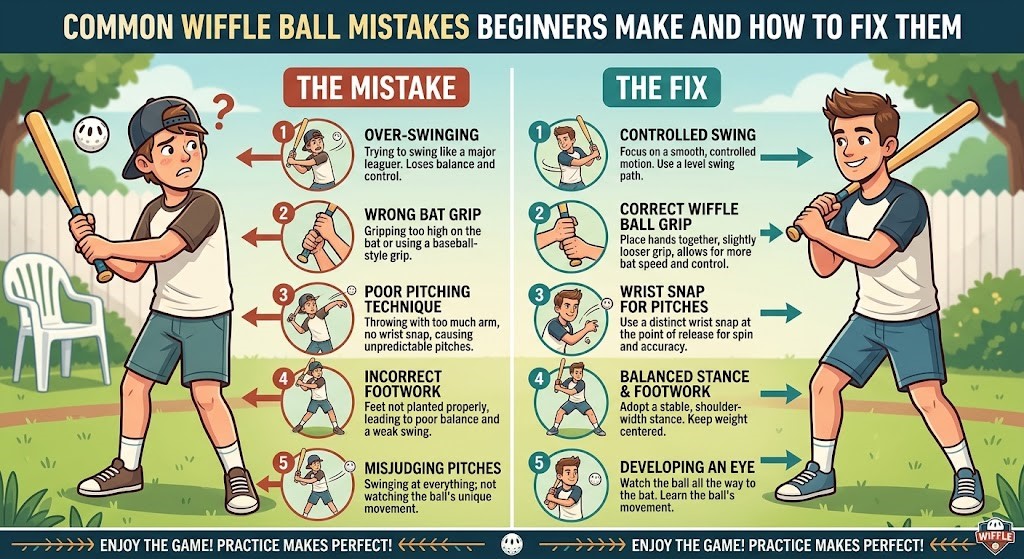
Common Wiffle Ball Mistakes Beginners Make and How to Fix Them
Wiffle Ball looks simple at first glance.
After all, it is often played in backyards with minimal equipment.
However, once you start playing regularly, you quickly realize that the game has depth.
Pitching requires control and creativity.
Hitting demands timing and precision.
Defense calls for awareness and positioning.
Because of this, beginners often make mistakes.
These mistakes are completely normal.
In fact, every experienced player made them at some point.
The key is recognizing those mistakes early and fixing them.
If you are new to the game, begin with The Ultimate Beginner’s Guide to Wiffle Ball: Rules, Equipment, Backyard Setup, and Winning Strategies. That guide covers the fundamentals you need before focusing on improvement.
In this article, we will break down the most common Wiffle Ball mistakes beginners make and how to fix them quickly.
Why Beginners Struggle in Wiffle Ball
Wiffle Ball is different from other sports.
The ball moves unpredictably.
The field varies from game to game.
Rules can change depending on the group.
Because of this, beginners often feel overwhelmed.
However, most struggles come down to a few common issues.
Once you fix these, your performance improves quickly.
Mistake #1: Trying to Throw Too Hard
Many beginners believe that speed equals success.
They try to throw every pitch as hard as possible.
This leads to poor control.
It also reduces movement.
How to Fix It
Focus on control instead of power.
Use a smooth, consistent motion.
Let the ball’s design create movement.
You will become a better pitcher by mastering technique.
Learn proper mechanics in How to Throw Wiffle Ball Pitches: Curveballs, Sliders, and More.
Mistake #2: Ignoring Pitch Variety
Some beginners rely on a single pitch.
They throw the same curveball over and over.
Hitters quickly adjust.
This makes it easier to hit.
How to Fix It
Mix your pitches.
Use different movements and speeds.
Keep hitters guessing.
Pitch variety is a key part of Winning Wiffle Ball Strategies: Pitching, Hitting, and Game Tactics.
Mistake #3: Swinging at Every Pitch
New players often swing too much.
They try to hit everything.
This leads to missed swings and weak contact.
How to Fix It
Be patient.
Wait for a good pitch.
Focus on quality swings instead of quantity.
Understanding the strike zone helps.
You can learn more in Official Wiffle Ball Rules Explained: Gameplay, Scoring, and Outs.
Mistake #4: Poor Timing at the Plate
Timing is one of the hardest skills to develop.
Beginners often swing too early or too late.
How to Fix It
Watch the ball carefully.
Start your swing at the right moment.
Practice consistently.
Improve your approach with Wiffle Ball Hitting Tips: How to Improve Contact and Power.
Mistake #5: Overpowering the Swing
Many players try to hit home runs every time.
They swing too hard.
This reduces accuracy.
How to Fix It
Focus on contact first.
Use controlled swings.
Power will come naturally over time.
Mistake #6: Poor Field Positioning
Beginners often stand in the wrong place.
This makes it harder to field the ball.
How to Fix It
Position yourself based on the hitter.
Cover the most likely areas.
Adjust as needed.
Learn proper positioning in Wiffle Ball Fielding and Defense: Positioning and Strategy.
Mistake #7: Lack of Communication
In team games, communication is essential.
Beginners often stay silent.
This leads to confusion.
How to Fix It
Talk to your teammates.
Call out plays.
Work together.
Communication improves defense.
Mistake #8: Not Understanding the Field
Every Wiffle Ball field is different.
Beginners often ignore this.
They do not adjust their play style.
How to Fix It
Study the field before playing.
Know the boundaries.
Understand how the layout affects gameplay.
You can learn more in How to Set Up a Wiffle Ball Field in Your Backyard (Dimensions and Layout Tips).
Mistake #9: Poor Pitch Control
Wild pitches can ruin a game.
Beginners often struggle with accuracy.
How to Fix It
Practice regularly.
Focus on hitting the strike zone.
Use consistent mechanics.
Control improves with repetition.
Mistake #10: Not Practicing Enough
Improvement requires practice.
Some beginners expect instant results.
How to Fix It
Practice regularly.
Work on specific skills.
Stay consistent.
Mistake #11: Ignoring Strategy
Some players rely only on physical skill.
They do not think about strategy.
How to Fix It
Study the game.
Think ahead.
Make smart decisions.
Strategy plays a major role in success.
Mistake #12: Being Too Predictable
Repeating the same actions makes you easy to read.
Opponents will adjust.
How to Fix It
Change your approach.
Mix pitches.
Vary your swings.
Stay unpredictable.
Mistake #13: Poor Reaction Time
Slow reactions lead to missed opportunities.
How to Fix It
Stay alert.
Practice quick movements.
Improve your focus.
Mistake #14: Lack of Confidence
Confidence affects performance.
Beginners often doubt themselves.
How to Fix It
Stay positive.
Focus on improvement.
Build confidence through practice.
Mistake #15: Not Adapting to Opponents
Every opponent is different.
Beginners often use the same approach for everyone.
How to Fix It
Observe your opponents.
Adjust your strategy.
Exploit weaknesses.
Mistake #16: Overcomplicating the Game
Some players try to do too much.
They overthink every play.
How to Fix It
Keep it simple.
Focus on fundamentals.
Build skills step by step.
Mistake #17: Poor Equipment Choices
Using the wrong equipment can affect performance.
How to Fix It
Choose quality bats and balls.
Use equipment suited to your playing style.
Learn more in Wiffle Ball Equipment Guide: Bats, Balls, and Backyard Essentials.
Mistake #18: Ignoring Competitive Opportunities
Some players never move beyond casual play.
They miss opportunities to improve.
How to Fix It
Consider joining leagues or tournaments.
Competitive play challenges your skills.
Learn more in Wiffle Ball Leagues and Tournaments: How Competitive Play Works.
How to Improve Faster
Fixing mistakes is only part of the process.
You also need a plan for improvement.
Focus on One Skill at a Time
Do not try to fix everything at once.
Work on one area.
Then move to the next.
Practice with Purpose
Set goals for each session.
Track your progress.
Learn from Experience
Every game teaches you something.
Pay attention to what works.
Stay Consistent
Consistency leads to improvement.
Keep practicing.
Building Good Habits Early
Good habits create long-term success.
Develop Strong Fundamentals
Master the basics.
Build a solid foundation.
Stay Disciplined
Stick to good techniques.
Avoid shortcuts.
Keep Learning
Continue studying the game.
Always look for ways to improve.
Final Thoughts on Wiffle Ball Mistakes
Mistakes are part of the learning process.
Every player makes them.
The difference between average and great players is how they respond.
Focus on:
- improving fundamentals
- practicing regularly
- learning from mistakes
- staying positive
With time and effort, you will become a better player.
Continue Learning About Wiffle Ball
Explore the full Wiffle Ball series:
Official Wiffle Ball Rules Explained: Gameplay, Scoring, and Outs
Wiffle Ball Equipment Guide: Bats, Balls, and Backyard Essentials
How to Set Up a Wiffle Ball Field in Your Backyard (Dimensions and Layout Tips)
How to Throw Wiffle Ball Pitches: Curveballs, Sliders, and More
Wiffle Ball Hitting Tips: How to Improve Contact and Power
Wiffle Ball Fielding and Defense: Positioning and Strategy
Winning Wiffle Ball Strategies: Pitching, Hitting, and Game Tactics
Wiffle Ball Leagues and Tournaments: How Competitive Play Works