
Evolution of Offensive Line Play in the NFL
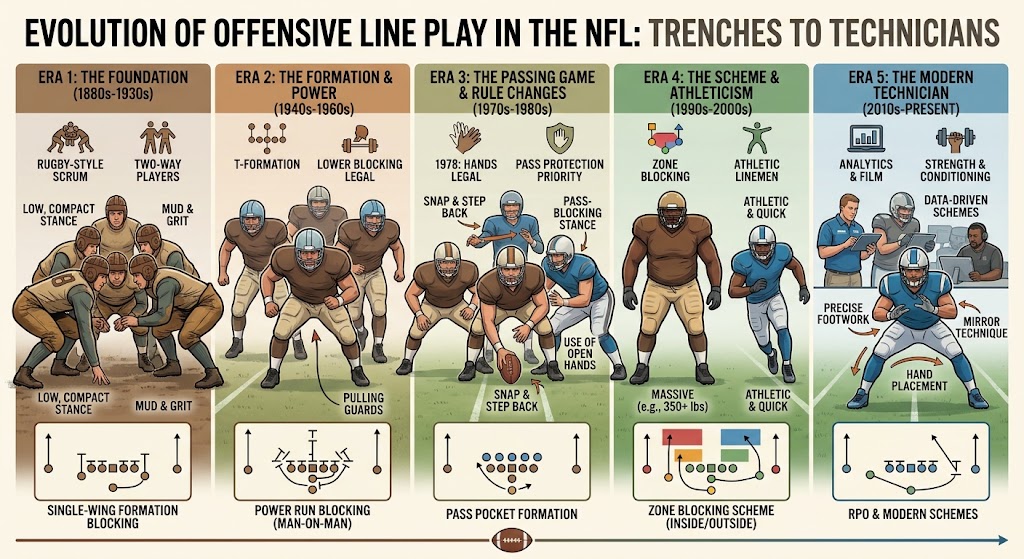
The Evolution of Offensive Line Play in the NFL
The offensive line is one of the most important and misunderstood units in football. Quarterbacks receive the headlines, running backs collect statistics, and wide receivers make spectacular catches, but none of those players can consistently succeed without an offensive line capable of creating time and space.
The way offensive linemen perform their jobs has changed dramatically throughout the history of the National Football League. Early football emphasized physical strength and straightforward blocking schemes. As the passing game expanded, offensive linemen became increasingly responsible for protecting quarterbacks against sophisticated pass rushers. Modern offenses have added spread formations, zone blocking, pre-snap movement, mobile quarterbacks, complex protections, and rapid decision-making.
Today’s offensive lineman must be more than a powerful blocker. He must be athletic enough to move in space, intelligent enough to recognize defensive alignments, technically disciplined enough to handle elite pass rushers, and versatile enough to execute multiple blocking concepts.
The evolution of offensive line play reflects the broader evolution of NFL football itself. As offenses became faster and more sophisticated, offensive linemen were forced to become faster, smarter, more versatile, and more technically refined.
The Early Days of NFL Offensive Line Play
Football’s earliest offensive systems were built around physicality.
Running the football was the primary offensive objective, and offensive linemen were expected to create openings through direct physical confrontation.
Blocking assignments were generally easier to understand than those found in modern offenses.
Linemen frequently:
- Blocked directly ahead
- Created running lanes
- Protected quarterbacks on limited passing plays
- Used power and leverage to control defenders
The offensive line was fundamentally a unit designed to move defenders.
Strength and toughness were among the most important qualities.
The Running Game Defined Offensive Line Responsibilities
For much of football history, running the ball was central to offensive strategy.
That meant offensive linemen needed to understand how to:
- Drive defenders backward
- Pull across the formation
- Trap defensive linemen
- Create gaps
- Maintain blocking angles
Power-oriented schemes rewarded players who could generate movement at the line of scrimmage.
Offensive linemen were often evaluated primarily on their ability to impose physical dominance.
The passing game existed, but it did not yet demand the level of specialized protection techniques seen today.
The Forward Pass Changed Everything
As passing became increasingly important, offensive line responsibilities expanded.
Instead of simply moving defenders, linemen needed to prevent defenders from reaching the quarterback.
Pass protection requires a fundamentally different skill set.
Linemen must maintain:
- Balance
- Leverage
- Footwork
- Hand placement
- Awareness
- Patience
A blocker cannot simply attack a pass rusher.
He must react to the defender’s movements while maintaining the pocket.
The growth of passing transformed offensive line technique.
Pass Protection Became a Specialized Skill
Modern pass protection requires extraordinary athleticism.
Defensive linemen and edge rushers can be incredibly fast.
They use:
- Speed rushes
- Bull rushes
- Spin moves
- Stunts
- Counters
- Hand fighting
Offensive linemen must anticipate these techniques.
A small mistake can result in a sack or a disrupted passing play.
Pass protection has therefore evolved into a highly technical contest between two elite athletes.
The Importance of Footwork
One of the biggest changes in offensive line development has been the emphasis on footwork.
Modern offensive tackles must move their feet quickly enough to handle explosive pass rushers.
A tackle cannot simply rely on size.
He needs lateral agility and balance.
Proper footwork allows linemen to maintain their position between the quarterback and the defender.
This is especially important against speed rushers who attempt to attack the outside shoulder.
Hand Placement Became More Important
Modern offensive linemen are also highly trained in hand placement.
Proper hand positioning helps control defenders without sacrificing balance.
Linemen must avoid grabbing illegally while still maintaining leverage.
Hand fighting has become an important part of pass protection.
Experienced linemen use their hands to redirect defenders and prevent them from establishing advantageous positions.
Technical precision has become just as important as raw strength.
The Rise of Zone Blocking
One of the most influential developments in modern offensive line play has been the expansion of zone-blocking concepts.
Instead of assigning every lineman to block one specific defender, zone schemes often give linemen areas of responsibility.
The blocking unit moves together.
This requires tremendous communication.
Linemen must recognize defensive movement and adjust their blocks accordingly.
Zone concepts can create multiple running opportunities while allowing offenses to use athletic linemen in space.
Zone Blocking Rewards Athleticism
Traditional power schemes often prioritize size and raw strength.
Zone schemes place greater emphasis on movement skills.
Linemen may need to:
- Reach defenders
- Block laterally
- Move toward the second level
- Block linebackers
- Adjust to defensive movement
Athletic offensive linemen can therefore become particularly valuable in zone-based systems.
The position increasingly requires the physical versatility of an athlete rather than simply the strength of a heavyweight.
Pulling Linemen Changed the Running Game
Pulling remains an important technique in modern offenses.
A pulling lineman leaves his initial alignment and moves across the formation to block elsewhere.
This can create unexpected angles for defenders.
Pulling requires:
- Timing
- Awareness
- Agility
- Communication
Guards frequently perform pulling assignments.
The technique demonstrates how offensive line play can combine strength with movement and tactical intelligence.
The Spread Offense Changed Offensive Line Responsibilities
The expansion of spread offenses dramatically changed the position.
Offenses began using wider formations to create space for quarterbacks and skill players.
That changed defensive alignments.
Offensive linemen suddenly had to protect larger areas of the field.
They also had to understand how defensive fronts changed when offenses spread the formation.
The modern offensive line operates within a much more open and complicated environment.
RPOs Created New Challenges
Run-pass option concepts added another layer of complexity.
Defenders may have to determine whether the offense is running or passing.
Offensive linemen must execute their assignments without knowing exactly how the play will develop.
A small mistake can create an obvious clue for the defense.
RPO-heavy offenses therefore demand tremendous discipline and communication from offensive linemen.
Mobile Quarterbacks Changed Protection
The modern NFL features more quarterbacks capable of moving outside the pocket.
This changes offensive line responsibilities.
Blocking must account for the quarterback’s movement.
A quarterback who can escape pressure creates additional opportunities.
However, offensive linemen must maintain blocks longer because the quarterback may extend the play.
Scramble drills require offensive linemen to recognize changing circumstances instantly.
Protection Calls Became Increasingly Complex
Modern defenses use sophisticated pressure packages.
Defenders can move before the snap.
Linebackers may disguise blitzes.
Safeties can rotate into unexpected positions.
Offensive linemen must communicate protection adjustments quickly.
The center often plays an important role in identifying defensive fronts and communicating assignments.
This makes intelligence one of the most important qualities for modern offensive linemen.
The Center Became a Quarterback of the Offensive Line
Centers have always been important.
Modern offenses have elevated the position even further.
The center frequently helps identify defensive fronts and communicate protection responsibilities.
He must recognize:
- Defensive alignments
- Blitz threats
- Stunts
- Linebacker positioning
- Protection changes
A great center is therefore both a physical blocker and a field general.
His communication can determine whether the entire offensive line executes correctly.
Guards Have Become More Versatile
Modern guards must operate in multiple blocking environments.
They need to handle powerful interior defensive linemen while also moving effectively in space.
Some systems ask guards to pull frequently.
Others emphasize zone combinations.
Still others rely heavily on pass protection against elite interior rushers.
The best guards combine strength, technique, intelligence, and mobility.
Tackles Face Elite Athletes
Offensive tackles have perhaps experienced the greatest athletic transformation.
They routinely face some of the fastest and most explosive defenders in football.
Elite edge rushers can threaten the quarterback almost immediately after the snap.
Tackles must therefore possess:
- Exceptional lateral movement
- Long arms
- Balance
- Core strength
- Hand technique
- Mental awareness
The modern left tackle in particular has become one of the most valuable positions on an NFL roster.
The Blind Side Became a Major Strategic Concern
For many quarterbacks, the left tackle protects the side they cannot see as easily while operating from a traditional right-handed passing position.
That made elite left tackles especially valuable.
Teams began investing heavily in players capable of neutralizing elite pass rushers.
Protecting the quarterback’s blind side became a central component of offensive strategy.
Modern offensive systems can alter protections and formations, but the fundamental importance of reliable tackle play remains.
Offensive Linemen Became More Athletic
NFL teams increasingly evaluate offensive linemen through athletic testing.
Measurements such as:
- Size
- Arm length
- Explosiveness
- Lateral movement
- Agility
- Strength
all contribute to evaluations.
However, raw athleticism is only the beginning.
Teams want players who can translate physical abilities into functional football movement.
A strong athlete who cannot recognize defensive schemes may struggle.
The modern offensive lineman must combine physical tools with football intelligence.
Film Study Became Essential
Offensive linemen spend significant time studying opponents.
They analyze defensive tendencies.
They identify pass-rush moves.
They recognize blitz patterns.
They study individual defenders.
This preparation allows them to anticipate what may happen before the snap.
Film study has transformed offensive line play into an intellectual exercise as much as a physical one.
Communication Became Critical
Five offensive linemen must function as one unit.
If one player misunderstands an assignment, the entire play can collapse.
Communication helps prevent these breakdowns.
Linemen communicate before and after the snap.
They identify:
- Blitzes
- Stunts
- Linebacker movement
- Defensive fronts
- Blocking adjustments
Great offensive lines operate almost like a single organism.
Chemistry Matters
Individual talent cannot fully compensate for poor chemistry.
Linemen need to trust one another.
They must understand how teammates will respond when defenders move unexpectedly.
Double teams require precise timing.
Combination blocks require coordination.
Pass protection requires communication.
The longer a group plays together, the more naturally these reactions can become.
Continuity can therefore be extremely valuable.
The Salary Cap Increased the Importance of Development
NFL teams operate under a salary cap.
They cannot simply sign elite players at every position.
This makes offensive line development extremely important.
Teams need to identify talent through:
- College scouting
- Draft evaluation
- Coaching
- Player development
Developing an inexpensive young lineman into a reliable starter can provide tremendous roster value.
The economics of the NFL therefore influence offensive line strategy.
Technology Has Changed Offensive Line Training
Modern offensive linemen benefit from advanced technology.
Teams can use video analysis and performance tracking to evaluate movement.
Coaches can identify mechanical inefficiencies.
Players can receive detailed feedback on:
- Footwork
- Hand placement
- Balance
- Leverage
- Reaction time
Training has become increasingly precise.
Technology allows small technical problems to be identified and corrected before they become major weaknesses.
Strength Training Has Evolved
Modern offensive linemen are stronger and more athletic than previous generations.
However, strength programs increasingly emphasize functional movement.
Players work on:
- Explosive power
- Core stability
- Hip mobility
- Balance
- Flexibility
- Recovery
The goal is to produce strength that translates directly onto the field.
Being powerful is valuable.
Being powerful while maintaining mobility is even more valuable.
Player Safety Influenced Offensive Line Play
Changes in player safety have also affected offensive line techniques.
Coaches emphasize controlled leverage and legal hand placement.
Players must understand increasingly detailed rules governing blocks.
This has encouraged greater technical precision.
The modern offensive lineman must be physically aggressive without losing control.
The Importance of Versatility Continues Growing
NFL offenses change frequently.
Players who can operate in multiple schemes provide greater value.
A versatile lineman may be capable of playing:
- Center
- Guard
- Tackle
depending on team needs.
Position flexibility can increase roster security.
It also allows coaches to manage injuries more effectively.
Versatility has become one of the most valuable traits in modern offensive line evaluation.
Offensive Lines Influence Offensive Identity
A team’s offensive line often determines what the offense can realistically do.
A powerful line may allow an offense to emphasize the running game.
An athletic line may support zone concepts and movement-based schemes.
An experienced pass-protection unit may allow coaches to use more aggressive passing concepts.
The offensive line therefore helps define offensive identity.
The Future of Offensive Line Play
The position will continue evolving as offensive football becomes more sophisticated.
Quarterbacks are becoming more mobile.
Defensive fronts are becoming more creative.
Pass rushers are becoming increasingly athletic.
Offensive linemen will need to continue improving their movement skills, football intelligence, communication, and versatility.
Technology will likely play an even larger role in development.
Data-driven coaching may help teams identify precisely how individual linemen can improve.
The future offensive lineman may be bigger, faster, smarter, and more technically refined than any previous generation.
Final Thoughts
The evolution of offensive line play in the NFL reflects the evolution of football itself. The position has moved from a primarily strength-based role focused on creating running lanes into one of the most technically demanding positions on the field.
Modern offensive linemen must combine size, strength, agility, footwork, hand technique, intelligence, communication, and adaptability. They must understand complex blocking schemes while facing defensive athletes capable of changing games in seconds.
Ultimately, offensive line play demonstrates one of football’s most important truths: the game is won in the details. A spectacular touchdown may receive the headlines, but the footwork of a tackle, the communication of a center, the leverage of a guard, and the collective execution of five linemen often determine whether that touchdown ever has a chance to happen.
As NFL offenses continue to evolve, offensive linemen will remain at the center of that transformation. Their responsibilities may continue changing, but their importance will never disappear.