
How Weather Impacts Football Game Strategy
How Weather Impacts Football Game Strategy
Football is one of the few major sports played in virtually every weather condition. Unlike indoor sports that operate in controlled environments, football teams often face rain, snow, wind, heat, cold, and even severe weather conditions. These environmental factors can dramatically influence game plans, player performance, coaching decisions, and ultimately the outcome of games.
The best football teams understand that weather is more than an inconvenience. It is a strategic variable that must be considered throughout preparation and competition. Coaches spend countless hours adjusting offensive schemes, defensive approaches, special teams tactics, and personnel decisions based on weather forecasts.
From youth football to the National Football League, weather remains one of the most unpredictable and influential factors in the sport.
Understanding how weather affects football strategy provides valuable insight into why teams sometimes play dramatically different styles from one game to the next.
Why Weather Matters in Football
Football requires precise execution.
Quarterbacks throw passes into tight windows. Receivers run exact routes. Kickers attempt field goals from long distances. Defensive players react to offensive movements within fractions of a second.
Weather can disrupt every one of these activities.
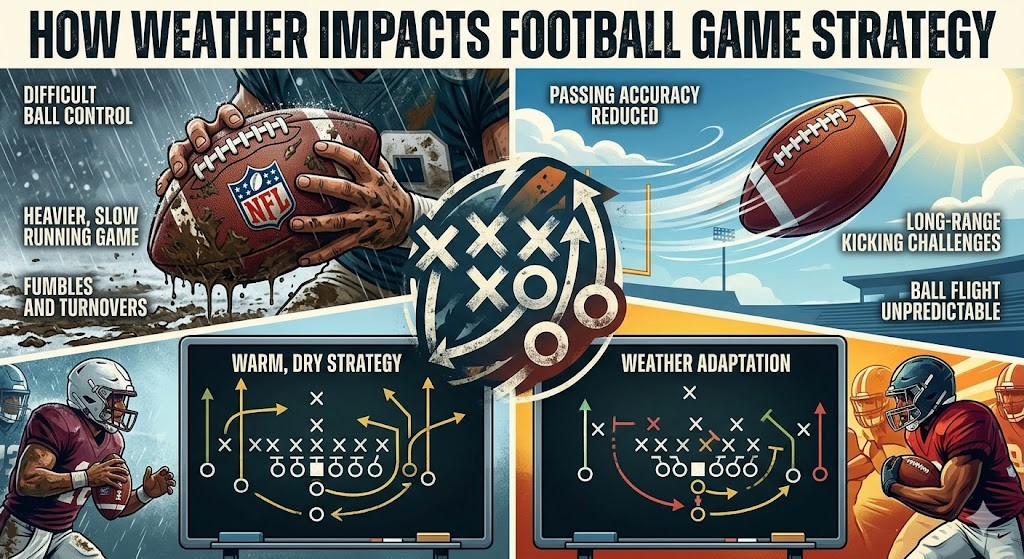
Rain makes the football slippery. Wind alters passing trajectories. Snow affects footing. Extreme temperatures impact endurance and concentration.
Because football depends so heavily on timing and execution, even small weather changes can create significant strategic adjustments.
Successful teams anticipate these challenges and prepare accordingly.
The ability to adapt often separates winning teams from losing ones.
Rain Changes Offensive Philosophy
Rain is one of the most common weather challenges in football.
Wet conditions make handling the football significantly more difficult.
Quarterbacks may struggle to grip the ball properly, reducing passing accuracy and velocity.
Receivers face challenges catching slick footballs.
Running backs must protect the ball carefully because fumbles become more likely.
As a result, many teams rely more heavily on the running game during rainy conditions.
Running plays reduce the risks associated with throwing and catching.
Coaches often simplify offensive schemes and focus on ball security.
The objective becomes minimizing mistakes while maintaining possession.
Ball Security Becomes a Priority
When weather conditions deteriorate, ball security becomes critical.
Turnovers can quickly change momentum and determine outcomes.
Players spend extra time practicing proper ball-handling techniques before games expected to feature rain or snow.
Running backs carry the ball with greater emphasis on protection.
Quarterbacks often use both hands when moving within the pocket.
Receivers concentrate on securing catches before attempting additional yardage.
Teams that protect the football effectively gain significant advantages in poor weather.
Many weather-affected games are decided by which team commits fewer turnovers.
Wind Has a Major Impact on Passing Games
Wind is often considered the most influential weather factor in football.
Strong winds affect passing accuracy, kicking distance, and punt placement.
Quarterbacks must adjust throwing mechanics and ball trajectories.
Deep passes become particularly difficult because wind can alter the football’s flight path dramatically.
Receivers must track the ball carefully and make adjustments during routes.
As wind speeds increase, teams frequently shorten passing routes and emphasize high-percentage throws.
Quick passes become more attractive than deep vertical attacks.
This adjustment helps reduce risk while maintaining offensive efficiency.
Wind Influences Defensive Strategy
Defenses also adjust when strong winds are present.
Knowing that offenses may rely more heavily on the running game, defensive coordinators often modify alignments and personnel packages.
Additional defenders may be positioned near the line of scrimmage.
Teams become more aggressive against rushing attacks.
Defensive backs may play closer to receivers because deep passes are less likely.
These strategic adjustments create entirely different game dynamics.
Weather affects both sides of the ball simultaneously.
Successful defenses anticipate offensive adaptations and respond accordingly.
Snow Creates Unique Challenges
Snow games are among football’s most memorable spectacles.
However, snow introduces significant strategic complications.
Footing becomes less predictable.
Players struggle with acceleration, cutting, and maintaining balance.
Offensive timing can be disrupted because receivers and quarterbacks must navigate slippery surfaces.
Defenders often face even greater challenges because reacting is generally harder than knowing where a play is going.
As a result, offenses sometimes gain advantages despite difficult conditions.
Teams frequently simplify playbooks and emphasize physical execution during snow games.
Running Games Often Thrive in Snow
While passing becomes more difficult in snow, running games can remain effective.
Offensive players know where they intend to go.
Defenders must react and change direction quickly.
On slippery surfaces, this reactive disadvantage becomes more pronounced.
Power-running attacks often succeed because they rely on physicality rather than precise timing.
Teams with strong offensive lines and physical running backs frequently perform well in snowy conditions.
Controlling the ground game also helps maintain possession and manage field position.
These factors make rushing attacks central to many snow-game strategies.
Cold Weather Affects Performance
Extreme cold influences both players and equipment.
Footballs become harder and less flexible.
This change affects grip, throwing mechanics, and kicking performance.
Players may experience reduced dexterity in their hands and fingers.
Muscles can tighten more quickly, increasing the importance of warmups and conditioning.
Coaches often rotate players more frequently to maintain energy and performance.
Teams accustomed to cold-weather environments sometimes gain advantages because they are more familiar with these conditions.
Experience matters significantly when temperatures drop.
Heat Creates Different Strategic Concerns
While cold weather receives considerable attention, extreme heat can be equally influential.
High temperatures increase fatigue and dehydration risks.
Players expend tremendous energy during football games.
Heat accelerates physical exhaustion and challenges recovery between plays.
Coaches often adjust practice schedules and hydration protocols before hot-weather games.
During competition, teams may rotate personnel more frequently.
Offensive strategies sometimes emphasize ball control to limit time spent defending.
Managing player energy becomes a critical aspect of game planning.
Heat requires both physical and strategic adjustments.
Humidity Increases Physical Demands
Humidity amplifies the effects of heat.
Sweat evaporates less efficiently, making it more difficult for athletes to regulate body temperature.
Players may tire more quickly during humid conditions.
Coaching staffs monitor hydration carefully and implement cooling strategies.
Substitutions become increasingly important.
Teams with superior conditioning often perform better in humid environments.
Physical preparation therefore becomes a strategic advantage.
The cumulative effects of heat and humidity can significantly influence second-half performance.
Weather Influences Special Teams
Special teams are often affected more dramatically by weather than any other phase of football.
Kicking and punting require precision and consistency.
Wind, rain, snow, and cold temperatures can alter outcomes substantially.
Field goal ranges may shrink during difficult conditions.
Punters must adjust technique and expectations.
Returners face challenges securing kicks and punts in poor weather.
Coaches frequently make different fourth-down decisions when weather reduces kicking reliability.
Special teams strategy becomes increasingly important as conditions worsen.
Field Conditions Matter
Weather impacts the playing surface itself.
Heavy rain can create muddy fields.
Snow and ice affect traction.
Even natural grass and artificial turf respond differently to weather conditions.
Field quality influences player movement and strategic decision-making.
Teams may favor straightforward approaches when footing is uncertain.
Complex route combinations and intricate timing plays become more difficult to execute.
Coaches often evaluate field conditions carefully before finalizing game plans.
The surface can be as important as the weather itself.
Preparation Begins Days Before Kickoff
Successful weather adaptation begins long before game day.
Coaching staffs monitor forecasts closely throughout the week.
Practice plans may be adjusted to simulate expected conditions.
Quarterbacks work on throwing wet footballs.
Receivers practice catches in rain.
Special teams units prepare for difficult kicking conditions.
Equipment managers also play important roles by preparing gear suited to the forecast.
Comprehensive preparation helps reduce surprises during competition.
The teams that prepare most effectively often gain valuable advantages.
Home-Field Advantage and Weather
Weather can enhance home-field advantage significantly.
Teams that regularly compete in certain climates become comfortable with local conditions.
Cold-weather teams often perform well during winter games.
Warm-weather teams may handle heat more effectively.
Familiarity with environmental challenges provides confidence and experience.
Visiting teams sometimes struggle to adapt quickly.
This advantage extends beyond players to coaching staffs and support personnel.
Understanding local weather patterns contributes to overall organizational success.
Psychological Effects of Bad Weather
Weather influences mental performance as well as physical execution.
Poor conditions can frustrate players and disrupt concentration.
Teams that maintain composure often perform better.
Mental toughness becomes especially important during difficult weather games.
Championship-caliber teams embrace challenges rather than complain about them.
They view adverse conditions as opportunities to gain advantages over less prepared opponents.
This mindset can influence performance significantly.
Football often rewards resilience as much as talent.
Historic Weather Games and Their Lessons
Football history contains numerous examples of weather dramatically shaping outcomes.
Snow games, windstorms, and freezing temperatures have produced memorable contests at every level.
These games reinforce the importance of adaptability.
Teams that adjust strategies effectively usually perform better than those attempting to execute normal game plans despite unusual conditions.
Historic weather games also demonstrate how preparation, discipline, and flexibility contribute to success.
The lessons remain relevant for modern teams.
Technology Helps Teams Prepare
Modern technology has improved weather preparation significantly.
Advanced forecasting provides detailed information about expected conditions.
Teams use analytics to evaluate how weather affects various strategies.
Equipment technology has also improved.
Players benefit from better footwear, gloves, clothing, and field-maintenance techniques.
These innovations help mitigate some weather-related challenges.
However, technology cannot eliminate weather’s influence entirely.
Adaptation remains essential.
Coaching Adjustments Define Success
Perhaps more than any other factor, weather highlights the importance of coaching.
Effective coaches recognize when conditions require strategic changes.
They adjust offensive schemes, defensive alignments, and special teams tactics accordingly.
Flexibility is critical.
Rigid game plans often fail when weather conditions change unexpectedly.
The best coaches understand how to maximize strengths while minimizing risks.
Their ability to adapt can determine outcomes in difficult environments.
Weather frequently becomes a coaching challenge as much as a player challenge.
Why Weather Will Always Matter
Despite advances in technology, training, and facilities, weather will always influence football.
The sport’s outdoor nature ensures environmental conditions remain relevant.
Every season presents new challenges.
Teams cannot control the weather, but they can control preparation and response.
This reality adds an element of unpredictability that makes football unique.
Fans appreciate the drama and difficulty that weather introduces.
The ability to overcome challenging conditions remains one of the sport’s defining characteristics.
Final Thoughts
Weather impacts football game strategy by influencing passing, running, defense, special teams, conditioning, and coaching decisions.
Rain increases the importance of ball security. Wind alters passing and kicking games. Snow changes footing and favors physical play. Heat and humidity challenge endurance and recovery.
Throughout the National Football League and every other level of competition, successful teams recognize that weather is a strategic factor rather than merely an obstacle.
Preparation, adaptability, and mental toughness allow teams to perform effectively regardless of conditions.
In the end, football is not played in perfect environments.
It is played in the real world, where weather can change everything.
That reality makes strategic flexibility one of the most valuable qualities a football team can possess.