
The Science of Basketball Shooting Mechanics
The Science of Basketball Shooting Mechanics
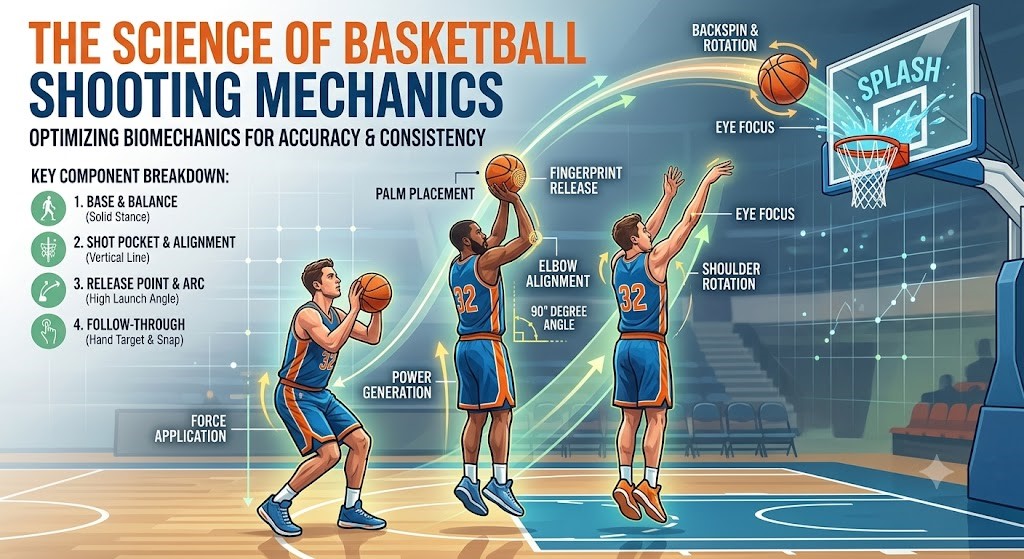
Basketball has evolved into one of the most skill-driven sports in the world, and no skill is more valuable than shooting. Whether it is a clutch three-pointer, a mid-range jumper, or a free throw with the game on the line, great shooters possess mechanics that combine physics, biomechanics, repetition, and mental discipline.
While some fans believe elite shooters are simply born with natural talent, sports science tells a different story. Consistent shooting is the result of precise body movements that can be learned, refined, and repeated through proper training. Every part of the shooting motion—from foot placement to follow-through—plays a role in determining whether the basketball finds the bottom of the net.
Modern coaches use biomechanics, video analysis, motion tracking, and performance analytics to help players develop more efficient shooting techniques. Understanding the science behind basketball shooting mechanics explains why some players become elite scorers while others struggle with consistency.
Shooting Is About Consistency
The greatest shooters in basketball history rarely rely on luck.
Instead, they develop repeatable mechanics that allow them to produce nearly identical shooting motions every time they release the ball.
Consistency reduces unnecessary variables.
Elite shooters strive to make every shot feel identical regardless of:
- Distance
- Defensive pressure
- Game situation
- Fatigue
- Arena environment
The fewer differences between one shot and the next, the greater the likelihood of long-term shooting success.
Consistency is the foundation upon which every great shooter builds their game.
Proper Footwork Creates Balance
Every successful jump shot begins with the feet.
Before the shooting motion even starts, players establish a balanced foundation.
Proper foot placement allows the body to remain stable throughout the shot.
Most coaches teach shooters to:
- Keep their feet shoulder-width apart
- Bend their knees slightly
- Distribute weight evenly
- Align their body with the basket
Balanced footwork improves both power generation and shooting accuracy.
Poor balance often leads to inconsistent releases and missed shots.
The Legs Generate Power
Many people assume shooting is primarily an upper-body movement.
In reality, the legs provide much of the power.
During the shooting motion, players bend their knees before extending upward.
This upward force transfers energy through the body.
Instead of forcing the shot with the arms, efficient shooters use their legs to generate smooth power.
Proper leg drive becomes especially important on:
- Three-point shots
- Deep-range attempts
- Late-game situations
- Long rebounds
- Shots taken while fatigued
Efficient power generation helps maintain consistent mechanics.
Energy Transfers Through the Kinetic Chain
Sports scientists often describe shooting as a kinetic chain.
Energy flows sequentially through multiple body segments.
The process generally follows this pattern:
- Legs generate force.
- Hips extend upward.
- Core stabilizes the body.
- Shoulders elevate.
- Elbow guides the shot.
- Wrist completes the release.
- Fingers direct the basketball.
Each movement builds upon the previous one.
If one part of the chain breaks down, shooting efficiency often declines.
The most effective shooters maximize this coordinated energy transfer.
Hand Placement Controls the Basketball
Correct hand placement plays a critical role in shooting accuracy.
The shooting hand rests beneath and slightly behind the basketball.
The guide hand stabilizes the ball without influencing the release.
Poor hand positioning can create unwanted spin or alter the shooting path.
Elite shooters develop consistent grips that allow the basketball to leave their fingertips smoothly.
Coaches often emphasize minimizing unnecessary guide-hand involvement.
Clean hand placement contributes to a repeatable release.
Elbow Alignment Improves Accuracy
One of the most recognizable features of great shooting mechanics is elbow alignment.
During the shooting motion, the elbow generally remains underneath the basketball.
This alignment promotes a straighter release path.
If the elbow drifts outward, the shot often moves off target.
Proper elbow positioning helps direct force toward the basket rather than sideways.
Small improvements in elbow alignment can significantly increase shooting consistency over time.
The Release Point Matters
The release point refers to where the basketball leaves the shooter’s hand.
Higher release points make shots more difficult to block.
However, the ideal release varies depending on the player’s height, body type, and shooting style.
Successful shooters prioritize:
- Consistency
- Comfort
- Balance
- Repeatability
Rather than copying another player’s exact form, athletes benefit most from refining mechanics that suit their own bodies.
Individual differences influence optimal release positions.
Wrist Snap Creates Proper Backspin
One of the most recognizable elements of shooting mechanics is the wrist snap.
As the ball leaves the fingertips, the wrist flexes naturally.
This action creates backspin.
Backspin offers several advantages:
- Softer contact with the rim
- Improved bounce characteristics
- Better touch
- Increased shooting consistency
A properly released basketball rotates smoothly backward through the air.
The familiar follow-through often reflects the quality of this wrist action.
Follow-Through Reinforces Good Mechanics
The follow-through does not cause a shot to go in.
Instead, it reflects the quality of the shooting motion that came before it.
Elite shooters often finish with:
- Fully extended shooting arm
- Relaxed wrist
- Fingers pointed toward the basket
- Balanced landing
Holding the follow-through encourages consistent habits.
Many coaches teach players to “reach into the basket” as a visualization technique.
Strong follow-through reinforces muscle memory developed through repetition.
Arc Increases Scoring Efficiency
The trajectory of a shot greatly influences its probability of success.
Shots with proper arc create larger effective entry angles into the basket.
A higher arc provides:
- More room for error
- Softer rim contact
- Better bounce opportunities
Flat shots reduce the margin for error.
Modern analytics have highlighted the importance of optimizing shooting arc.
Players frequently practice adjusting trajectory to maximize efficiency.
Rotation Stabilizes the Basketball
A properly shot basketball rotates with consistent backspin.
Stable rotation improves flight characteristics.
Uneven spin may indicate flaws in mechanics or release.
Sports scientists study ball rotation using high-speed cameras.
These analyses help coaches identify mechanical inconsistencies.
Consistent rotation contributes to predictable shot behavior.
Small improvements in release quality often produce measurable performance gains.
Muscle Memory Develops Through Repetition
Shooting excellence requires thousands of quality repetitions.
Each correctly executed shot strengthens neuromuscular patterns.
Over time, the body learns to reproduce efficient movement automatically.
This process is commonly referred to as muscle memory.
Although muscles themselves do not remember movements, the nervous system becomes increasingly efficient through repeated practice.
Purposeful repetition remains one of the most effective methods for improving shooting accuracy.
Practice Quality Matters More Than Quantity
Simply taking hundreds of shots each day is not enough.
Quality repetitions matter far more than total volume.
Players should focus on:
- Proper mechanics
- Balanced footwork
- Consistent release
- Correct follow-through
- Game-speed situations
Practicing poor mechanics reinforces bad habits.
Deliberate practice helps athletes improve more efficiently.
Modern shooting development emphasizes quality over sheer quantity.
Video Analysis Improves Technique
Technology has transformed shooting instruction.
High-speed video allows coaches to analyze every phase of the shooting motion.
Players can observe details that are impossible to notice in real time.
Video analysis identifies:
- Timing issues
- Elbow position
- Foot placement
- Release consistency
- Body alignment
Immediate visual feedback accelerates improvement.
Many professional organizations use advanced video systems daily.
Analytics Help Measure Shooting Efficiency
Modern basketball relies heavily on performance analytics.
Coaches evaluate more than field goal percentage.
Advanced metrics examine:
- Shot location
- Shot quality
- Release timing
- Shooting percentages by zone
- Defender proximity
These insights help players make smarter decisions.
Analytics also guide individualized shooting development plans.
Data-driven coaching has become a valuable tool at every level of basketball.
Fatigue Affects Shooting Mechanics
Late in games, fatigue often alters shooting form.
Tired legs reduce power generation.
Players may compensate by relying excessively on the upper body.
Mechanical changes often include:
- Flatter trajectories
- Reduced balance
- Slower releases
- Poor follow-through
Conditioning helps maintain proper mechanics throughout entire games.
Elite shooters train specifically to preserve technique under fatigue.
This preparation becomes especially important during close contests.
Mental Confidence Influences Shooting
Physical mechanics represent only part of successful shooting.
Confidence plays an equally important role.
Great shooters trust their preparation.
They remain committed to their mechanics even after missed shots.
Mental discipline allows players to avoid unnecessary adjustments during temporary shooting slumps.
Confidence encourages decisive decision-making.
Successful shooters understand that occasional misses are inevitable.
Consistency comes from trusting the process rather than reacting emotionally.
Shooting Off the Dribble Requires Additional Skills
Stationary shooting differs significantly from game shooting.
Modern players frequently shoot after:
- Dribble moves
- Screens
- Step-backs
- Pull-up jumpers
- Fast breaks
These situations require exceptional body control.
Players must quickly regain balance before releasing the ball.
Advanced shooting mechanics emphasize efficient transitions from movement into proper shooting form.
This ability separates many elite scorers from average shooters.
Great Shooters Continue Refining Their Mechanics
Even the best shooters constantly seek improvement.
Professional players regularly review film, work with shooting coaches, and refine small details.
Minor adjustments can produce significant long-term improvements.
Continuous refinement helps athletes adapt as their bodies, roles, and competition evolve.
The pursuit of better mechanics never truly ends.
Elite shooters view improvement as an ongoing process rather than a finished achievement.
The Future of Shooting Science
Advances in sports science continue transforming basketball training.
Motion-capture systems, wearable technology, artificial intelligence, and biomechanical analysis provide increasingly detailed information.
Future players may receive real-time feedback on every shot they take.
Training programs will likely become even more individualized.
Technology will continue helping athletes maximize efficiency while reducing injury risk.
The science of shooting will remain an essential part of basketball development.
Final Thoughts
Basketball shooting mechanics combine physics, biomechanics, repetition, and mental discipline into one of the sport’s most valuable skills. Great shooters develop consistent footwork, efficient energy transfer, balanced body positioning, smooth releases, and repeatable follow-throughs that allow them to perform under pressure.
Modern coaching methods continue improving through video analysis, advanced analytics, and sports science, giving players more opportunities than ever to refine their technique. While natural talent can provide an advantage, elite shooting is ultimately built through proper mechanics, purposeful practice, and unwavering consistency.
Ultimately, the science of basketball shooting demonstrates that accuracy is not the product of chance. It is the result of thousands of disciplined repetitions, sound biomechanics, and a commitment to continuous improvement—qualities that define the greatest shooters in basketball history.