
What Makes a Hall of Fame NFL Head Coach
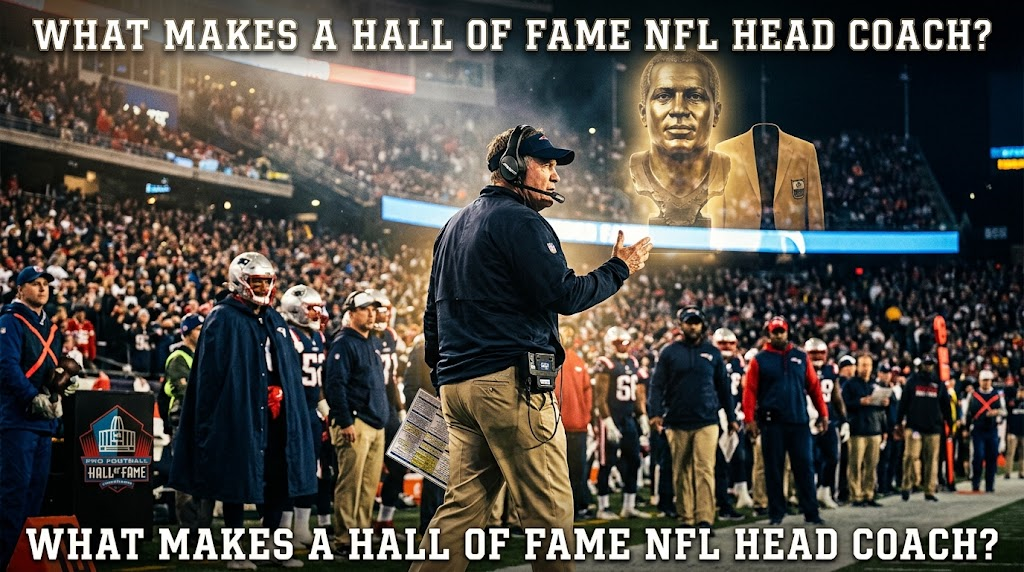
What Makes a Hall of Fame NFL Head Coach?
Becoming an NFL head coach is difficult.
Becoming a successful NFL head coach is even harder.
But becoming a Hall of Fame NFL head coach requires something far beyond simply winning games.
The National Football League has employed thousands of coaches throughout its history, yet only a small group have reached the level where their careers are remembered as defining eras in professional football. These coaches did more than compile winning records. They built teams, developed players, created lasting systems, adapted to changing circumstances, handled enormous pressure, and often influenced how the game itself was played.
Some won multiple championships.
Some built dynasties.
Some transformed struggling franchises.
Some revolutionized offensive or defensive strategy.
Some were exceptional at developing players and assistants.
And some did several of those things at the same time.
The Pro Football Hall of Fame’s coaching candidates are evaluated as part of a formal selection process, and the Hall has continued to modify that process to ensure that coaching candidates receive specific consideration. As of the 2026 revisions, a separate Coach subcommittee determines one Coach Candidate for consideration by the annual Selection Committee.
But statistics alone cannot explain what makes a coach legendary.
A coach may have hundreds of victories and still not have the same historical impact as another coach with fewer wins. Conversely, a coach may have an extraordinary influence on football despite not spending decades on the sideline.
So what actually separates a good NFL head coach from a Hall of Fame one?
The answer involves winning, leadership, innovation, adaptability, player development, organizational culture, longevity, and something that is much harder to measure:
Impact.
Winning Is the Foundation
Let’s start with the obvious.
A Hall of Fame head coach has to win.
Football is ultimately measured by results, and no amount of motivational speeches or tactical creativity can completely overcome years of losing.
That does not mean every Hall of Fame coach needs the same number of victories.
Context matters.
A coach who takes over a historically struggling franchise and turns it into a consistent contender may have a different résumé than a coach who inherits an established powerhouse.
A coach who spends 25 years in the league will naturally have more opportunities to accumulate victories than someone who coaches for 12 or 15 seasons.
But sustained success is almost always part of the conversation.
Consider some of the NFL’s legendary coaches.
Don Shula finished his career with 347 regular-season and postseason victories combined, according to NFL historical records, while Tom Landry led Dallas to 20 consecutive winning seasons. Chuck Noll won four Super Bowls with the Pittsburgh Steelers, while Bill Walsh won three in San Francisco during a much shorter head-coaching career.
Those careers were different.
Their accomplishments were not identical.
But each coach demonstrated sustained excellence.
That is the first major characteristic of a Hall of Fame coach.
Winning has to become a pattern rather than an occasional event.
Championships Matter
Regular-season success establishes credibility.
Championships establish legacy.
That does not mean a coach without multiple championships cannot be considered great. NFL history contains coaches whose teams were consistently competitive but never won the Super Bowl.
Still, championships matter because the postseason creates a different test.
A team can dominate over 17 regular-season games and lose immediately in the playoffs.
The best coaches understand that the postseason demands something different.
The margin for error becomes smaller.
The opponents become better.
Every mistake becomes magnified.
Weather can become a factor.
Injuries become more important.
Coaching adjustments become critical.
And eventually, one game determines whether a season continues.
A Hall of Fame coach often demonstrates an ability to prepare teams for those moments.
That is why NFL championship coaching is such an important part of evaluating legendary careers.
But Championships Alone Are Not Enough
If winning championships were the only requirement, evaluating coaches would be easy.
It isn’t.
A coach can win a Super Bowl because he inherited an extraordinary roster.
Another can win because a franchise has tremendous financial and organizational resources.
Another may win because of a generational quarterback.
Another may win once but fail to sustain success.
Meanwhile, another coach may build a team that consistently reaches the postseason but repeatedly encounters extremely difficult competition.
This is why the Hall of Fame conversation requires context.
A championship is extremely valuable evidence.
It is not the entire résumé.
The larger question is:
What did the coach actually contribute to the team’s success?
Building a Culture
Great coaches do not simply design plays.
They build cultures.
Culture sounds like a vague word until you see what it means inside an NFL organization.
A strong football culture can determine:
- How players prepare
- How veterans mentor younger players
- How players respond to adversity
- How teammates handle success
- How injured players remain involved
- How players accept coaching
- How accountability works
- How the organization responds after losses
- How players approach practice
- How the team handles pressure
A Hall of Fame coach establishes expectations that become part of the franchise’s identity.
The coach may eventually leave.
Players may retire.
Coordinators may move to other teams.
But the standards remain.
That is one of the clearest signs that a coach has had a lasting influence.
Leadership Is More Than Being Tough
Older generations of football sometimes associated great coaching with toughness alone.
A coach had to be demanding.
Players had to fear disappointing him.
Practices had to be physically and mentally demanding.
That style has produced successful teams.
But leadership in the modern NFL requires much more.
A head coach has to understand different personalities.
A 22-year-old rookie may respond differently than a 12-year veteran.
A star quarterback may require a different relationship than a backup linebacker.
A player returning from injury may need encouragement rather than confrontation.
A veteran leader may need autonomy.
A young player may need constant instruction.
The Hall of Fame coach understands that leadership is not one-size-fits-all.
The objective is to get the most from people.
How that happens can vary considerably.
The Ability to Develop Players
One of the most underrated qualities of a great head coach is player development.
A coach does not draft the finished product.
NFL players arrive with strengths and weaknesses.
Some are physically gifted but inexperienced.
Some are technically polished but lack confidence.
Some were overlooked by scouts.
Some need to change positions.
Some need to learn how to become professionals.
A great coaching staff can turn potential into production.
That is especially important for players who were not highly regarded coming out of college.
A Hall of Fame coach may have a long history of turning second-round picks into starters, late-round selections into important contributors, or undrafted players into legitimate NFL players.
Player development in the NFL is one of the clearest ways a coaching staff can create sustainable success.
Developing Quarterbacks Is Especially Important
Quarterback development deserves its own discussion.
The NFL is built around the quarterback position.
A great quarterback can elevate an organization.
But quarterbacks also require enormous amounts of coaching.
Footwork.
Pocket awareness.
Progression reads.
Protection identification.
Defensive recognition.
Timing.
Throwing mechanics.
Leadership.
Decision-making.
A Hall of Fame coach does not necessarily have to personally develop a Hall of Fame quarterback.
But the coach must understand how to build an offense that maximizes the quarterback’s abilities.
That means understanding the difference between asking a quarterback to do something and putting him in a position where he can succeed.
Tactical Innovation Can Change Football
Some coaches become legendary because they win.
Others become legendary because they change the way everyone else plays.
This is where innovation becomes important.
Football is constantly evolving.
Offenses develop new formations.
Defenses respond.
Offenses counter.
Defenses adjust again.
A coach who introduces a successful tactical concept can force the entire league to respond.
Bill Walsh’s West Coast offense became one of the most influential offensive systems in football history.
Paul Brown helped introduce organizational and tactical innovations that influenced professional football for decades.
Tom Landry’s defensive work helped shape the evolution of the 4-3 defense.
Other coaches transformed running games, passing attacks, defensive fronts, blitz packages, tempo, motion, or situational football.
That kind of influence goes beyond a team’s win-loss record.
It becomes part of football history.
Great Coaches Understand That Innovation Never Stops
Innovation is not simply inventing something new.
Sometimes innovation means taking an existing idea and applying it differently.
A coach may study college football and bring a concept to the NFL.
Another may borrow an idea from another professional team.
Another may notice a weakness in how defenses are responding to a particular formation.
The best coaches are constantly searching.
They watch film.
They study tendencies.
They talk to assistants.
They listen to players.
They examine data.
They experiment.
They question assumptions.
The Hall of Fame coach is rarely satisfied with the idea that something should be done a certain way simply because it has always been done that way.
Adaptability Separates Great Coaches From Good Ones
Every coach has a system.
The problem is that opponents eventually figure it out.
A successful NFL coach has to adapt.
If an offense becomes predictable, defenses attack it.
If a defense blitzes too frequently, quarterbacks adjust.
If a team relies too heavily on one player, opponents build game plans around stopping that player.
The coach has to respond.
This is particularly important over a long career.
The NFL of 1980 was not the NFL of 2000.
The NFL of 2000 was not the NFL of 2020.
Rules change.
Roster construction changes.
Free agency changes.
Player development changes.
Technology changes.
Offensive philosophy changes.
Defensive philosophy changes.
A coach who succeeds for decades must evolve with the sport.
Longevity Is Evidence of Excellence
One great season can be extraordinary.
Twenty great seasons are something entirely different.
Longevity creates opportunities for failure.
Eventually, injuries happen.
Star players retire.
Coordinators leave.
Draft picks fail.
Free agents depart.
Quarterbacks age.
Owners change.
General managers change.
Rules change.
Divisional competition changes.
Yet a Hall of Fame-level coach continues finding ways to compete.
That is why NFL coaching longevity matters so much.
A coach who maintains excellence over decades has demonstrated more than tactical ability.
He has demonstrated adaptability.
Sustained Success Is Harder Than a Breakthrough
A team can surprise the league for one season.
The following season is different.
Now everyone knows what to expect.
Opponents study the team’s tendencies.
Free agents become expensive.
Players receive attention.
Expectations rise.
The schedule becomes more difficult.
A coach who can respond to that pressure demonstrates something important.
He can build again.
This is one reason dynasties are so difficult to create.
Winning once is hard.
Winning repeatedly requires an organization capable of constantly rebuilding.
The head coach is central to that process.
Great Coaches Build Great Coaching Staffs
A head coach cannot do everything.
The NFL is too complicated.
A head coach needs offensive assistants, defensive assistants, special teams coaches, strength and conditioning personnel, analysts, scouts, and many other professionals.
That makes staff-building another important quality.
Great head coaches identify talented assistants.
They delegate responsibility.
They create accountability.
They encourage assistants to develop their own ideas.
And perhaps most importantly, they know when to listen.
A coach who insists on controlling every decision can eventually become overwhelmed.
A great head coach understands that leadership sometimes means allowing other people to lead.
The Coaching Tree Matters
The impact of a Hall of Fame coach often continues after the coach leaves.
Look at the number of successful coaches who emerge from influential coaching systems.
Assistants learn philosophies.
They learn organizational practices.
They learn how to structure practices.
They learn how to evaluate players.
They learn how to communicate.
Eventually, they become head coaches themselves.
This creates a coaching tree.
A coach’s influence can therefore extend across multiple franchises and multiple generations.
That is one of the strongest indicators that a coach changed football beyond his own team’s locker room.
Handling Star Players
NFL teams are full of talented personalities.
The best players are often confident.
They have been the best athletes on their teams for most of their lives.
They may have enormous contracts.
They may have national media attention.
They may have agents and endorsements.
A head coach cannot treat every player exactly the same.
At the same time, the coach cannot allow stars to operate outside team standards.
That balance is extremely difficult.
A Hall of Fame coach earns enough credibility that even elite players understand the expectations.
The coach knows when to challenge a star.
The coach knows when to defend a player publicly.
The coach knows when a private conversation is more effective than public criticism.
That is leadership.
Handling the Media
NFL head coaches live under extraordinary media pressure.
Every Sunday creates another story.
Every loss produces questions.
Every quarterback decision becomes a headline.
Every controversial penalty becomes a debate.
Every injury creates speculation.
A coach who loses control publicly can make a difficult situation worse.
The best coaches understand that media appearances are part of the job.
They protect their players.
They avoid unnecessary distractions.
They accept responsibility when appropriate.
They do not allow the media cycle to determine the team’s emotional state.
That skill becomes increasingly important as a coach’s profile grows.
Handling Adversity
Every NFL coach loses.
Every coach experiences injuries.
Every coach has players who disappoint.
Every coach makes decisions that turn out to be wrong.
The difference is how the coach responds.
A Hall of Fame coach does not need to avoid adversity.
He needs to handle it.
That means keeping the team focused when the starting quarterback is injured.
It means maintaining confidence after a three-game losing streak.
It means adjusting after a playoff disappointment.
It means preventing one bad season from destroying the organization.
The greatest coaches understand that adversity is inevitable.
They prepare for it.
Great Coaches Know When to Change
This is one of the hardest lessons in coaching.
A system that worked five years ago may not work today.
A coordinator who was perfect for the organization may no longer be the right fit.
A veteran player who was once indispensable may decline.
A favorite offensive concept may become outdated.
A coach who refuses to change can become trapped by his own success.
The best coaches understand that loyalty and stubbornness are not the same thing.
They can respect the past while changing the future.
Game Management Matters
Head coaches are responsible for hundreds of decisions during a season.
Some happen before kickoff.
Others happen in seconds.
Should the team go for fourth down?
Should the coach use a timeout?
Should the team challenge a ruling?
Should the offense attempt a two-point conversion?
Should the coach change the defensive personnel?
Should the team run the ball or pass?
Should the coach attempt a field goal?
These decisions are often judged by their results.
That can be misleading.
A decision can be strategically sound and still fail.
Likewise, a poor decision can occasionally work.
The greatest coaches understand probability, game situation, personnel, clock management, and momentum.
They make informed decisions rather than simply reacting emotionally.
Preparation Is the Hidden Part of Coaching Greatness
Fans see Sunday.
Coaches live in the days between Sundays.
That is where much of the work happens.
Film study.
Game planning.
Practice.
Meetings.
Player development.
Injury management.
Opponent preparation.
Situational football.
Special teams.
Communication.
A Hall of Fame coach creates a preparation process that gives players confidence.
Players should know what is coming.
They should understand their assignments.
They should recognize the opponent’s tendencies.
And when something unexpected happens, they should have enough preparation to react.
Great coaching often looks effortless on Sunday because the difficult work happened earlier in the week.
Situational Football Is Often the Difference
A team can be excellent for most of a game and still lose because it fails in critical situations.
Third down.
Red zone.
Two-minute offense.
Two-minute defense.
Goal line.
Short yardage.
Fourth down.
End-of-half situations.
End-of-game situations.
Overtime.
A Hall of Fame coach understands that these moments deserve specialized preparation.
The team does not simply practice plays.
It practices situations.
Players learn how the clock affects decisions.
They learn field-position strategy.
They learn what the opponent is likely to do.
They learn how the score changes the appropriate strategy.
Those details can determine championships.
The Ability to Win in Different Ways
One of the most impressive traits of legendary coaches is versatility.
A great team might win a shootout one week.
The next week, it might win a defensive struggle.
Another week, the running game carries the offense.
Another week, the quarterback throws for 400 yards.
Another week, special teams becomes the difference.
A Hall of Fame coach does not necessarily need one perfect formula.
He needs enough understanding to find the formula that works with the roster available.
That is especially important in the postseason.
Building Around Personnel
A coach has to understand the players he has.
This sounds simple.
It is not.
Suppose a team has an elite running back but an inexperienced quarterback.
A coach might structure the offense differently than if the team had a veteran quarterback and mediocre running game.
Suppose the defense has an exceptional pass rush but weak coverage.
The defensive system should reflect that.
Suppose the secondary is outstanding but the front seven struggles against the run.
The coach has to adjust.
The best coaches build systems around their personnel instead of forcing players into a predetermined system.
The Importance of Assistant Coaches
A Hall of Fame head coach often deserves credit for creating an environment where assistants can thrive.
The offensive coordinator may design much of the offense.
The defensive coordinator may build the defense.
The special teams coordinator may create field-position advantages.
Position coaches may develop individual players.
The head coach coordinates all of those pieces.
This is why a great head coach is often more like the CEO of a football organization than simply the person who calls plays.
He sets the vision.
He establishes standards.
He hires people.
He manages personalities.
He coordinates departments.
And he makes sure everyone is working toward the same objective.
Great Coaches Leave a Legacy
Eventually, every coach retires.
The wins stop.
The press conferences end.
The locker room changes.
Players move on.
But the legacy remains.
A Hall of Fame coach may be remembered for championships.
Another may be remembered for innovation.
Another may be remembered for leadership.
Another may be remembered for developing players.
Another may be remembered for transforming an organization.
The truly exceptional coaches are remembered for several of these things simultaneously.
Their influence becomes part of NFL history.
Comparing Different Eras Is Difficult
One of the biggest challenges in evaluating NFL coaches is comparing different eras.
The rules have changed.
The schedule has changed.
Free agency has changed.
The playoff format has changed.
Offensive statistics have changed dramatically.
Passing has become more prominent.
Defensive rules have changed.
Teams have changed.
Even the way players train has changed.
A coach who dominated in the 1970s faced a completely different environment than one who coached in the 2000s or 2020s.
Therefore, raw statistics should not always be viewed in isolation.
Context matters.
A Hall of Fame coach should be evaluated relative to the era in which he competed.
Why Championships Alone Cannot Define Greatness
This brings us back to one of the most important points.
The Super Bowl is the ultimate team championship.
But football is a team sport.
A head coach does not control every variable.
Players execute.
General managers build rosters.
Owners provide resources.
Scouts identify talent.
Coordinators design systems.
Injuries affect teams.
Officials make calls.
Weather changes games.
Sometimes a great team simply loses.
Therefore, championships are powerful evidence of coaching excellence, but they are not the only evidence.
The larger question is what the coach accomplished over the course of an entire career.
What About Coaches Who Never Won a Super Bowl?
This is where historical evaluation becomes especially interesting.
Some coaches produced sustained success without winning the Lombardi Trophy.
A coach might reach conference championship games repeatedly.
Another might consistently produce winning seasons.
Another might turn an expansion franchise into a contender.
Another might revolutionize football.
Another might leave behind an enormous coaching tree.
These accomplishments matter.
The Hall of Fame’s own history includes coaching candidates whose résumés vary significantly in length, championship totals, winning percentages, and organizational circumstances. The 2026 coaching pool, for example, included candidates ranging from two-time Super Bowl winners to coaches whose primary historical contributions involved longevity, innovation, or sustained competitiveness.
That illustrates an important principle:
There is no single formula for a Hall of Fame coaching career.
The Ability to Create an Identity
Great teams usually have an identity.
You know what they want to do.
Maybe they run the football.
Maybe they attack vertically through the passing game.
Maybe they dominate defensively.
Maybe they play extremely physical football.
Maybe they control the clock.
Maybe they create turnovers.
Maybe they play fast.
Whatever the identity is, the players understand it.
The coach has created a clear vision.
That identity can become associated with the coach himself.
Accountability Is Essential
A great coach cannot demand accountability from players while avoiding it himself.
Players notice hypocrisy immediately.
If a coach blames players after every loss but never accepts responsibility, credibility disappears.
A Hall of Fame coach understands that leadership sometimes requires saying:
“I got that wrong.”
That does not weaken authority.
It can strengthen it.
Players are more likely to trust a coach who is honest about mistakes.
Accountability must begin at the top.
Confidence Without Arrogance
NFL head coaches must project confidence.
Players want to believe that their coach knows what he is doing.
But confidence can become arrogance.
A coach who believes he is always right eventually stops listening.
The greatest coaches combine confidence with curiosity.
They know what they believe.
They also understand that another person might have a better idea.
That combination is extremely powerful.
The Hall of Fame Coach Understands People
Football is ultimately played by human beings.
That may be the most important fact of all.
A coach can know every defensive coverage and offensive formation in existence.
But if he cannot communicate with people, his knowledge has limited value.
Great coaches understand motivation.
They understand fear.
They understand confidence.
They understand competition.
They understand disappointment.
They understand ego.
They understand that players are people before they are statistics.
That human understanding can separate an excellent football mind from an extraordinary head coach.
The Ultimate Test: Sustained Impact
When evaluating whether a coach belongs among the greatest in NFL history, the ultimate question may be:
What changed because this coach was there?
Did the franchise become a consistent contender?
Did the coach create a championship culture?
Did the coach develop generations of players?
Did assistants become successful head coaches?
Did the coach introduce ideas that spread throughout football?
Did the coach remain successful as the league changed?
Did the coach establish standards that lasted after he left?
Did the coach create an era that fans still remember decades later?
Those questions help explain why Hall of Fame coaching is about more than wins.
The Modern NFL Makes Great Coaching Even More Difficult
Today’s NFL presents unique challenges.
Free agency constantly changes rosters.
Players have more control over their careers.
Salary-cap considerations affect roster construction.
Analytics influence decision-making.
Media coverage is constant.
Social media magnifies controversies.
Players come from increasingly diverse football backgrounds.
College offenses continue influencing professional schemes.
Rules change frequently.
And the league is filled with elite athletes capable of exposing weaknesses quickly.
A coach who succeeds in this environment has to adapt constantly.
That makes modern NFL coaching an extraordinarily demanding profession.
What the Hall of Fame Really Represents
The Pro Football Hall of Fame is not simply a museum of people who accumulated statistics.
It is intended to recognize individuals who made extraordinary contributions to professional football.
The Hall’s current selection materials emphasize that candidates are subjected to a rigorous selection process, and the organization has continued revising that process to maintain the significance of election. Under the current structure, coaches receive their own dedicated path through the selection process.
That is appropriate because coaching is fundamentally different from playing.
A player controls his position.
A head coach influences an entire organization.
That includes players, assistants, preparation, strategy, culture, personnel usage, and game management.
The scope of responsibility is enormous.
The Hall of Fame Coach Checklist
There is no official checklist that guarantees a coach will eventually be enshrined.
But when examining legendary NFL coaches, several characteristics repeatedly appear.
A Hall of Fame-caliber coach typically demonstrates:
Sustained Winning
The coach consistently produces competitive teams over a significant period.
Championship Success
The coach demonstrates an ability to win when the stakes are highest.
Innovation
The coach contributes ideas that influence how football is played.
Adaptability
The coach changes as players, rules, opponents, and strategies change.
Player Development
The coach consistently helps players reach or exceed their potential.
Leadership
The coach establishes standards and earns the trust of players and staff.
Staff Development
The coach helps develop assistants who become successful coaches themselves.
Organizational Culture
The coach establishes expectations that extend beyond individual seasons.
Game Management
The coach makes sound decisions in critical situations.
Preparation
The team consistently looks prepared for opponents and unexpected circumstances.
Resilience
The coach responds effectively to injuries, losing streaks, roster changes, and setbacks.
Long-Term Impact
The coach leaves a lasting mark on a franchise, a generation of players, or football itself.
The most legendary coaches tend to check many of these boxes.
Final Thoughts
So, what makes a Hall of Fame NFL head coach?
It starts with winning.
But it does not end there.
A truly great head coach builds something larger than a win-loss record.
He develops players.
He hires and develops assistants.
He creates a culture.
He establishes accountability.
He understands people.
He prepares relentlessly.
He adapts when opponents adjust.
He changes when the game changes.
He knows when to take risks.
He knows when to play conservatively.
He understands that football is about much more than drawing plays on a whiteboard.
And when the career is finally over, his influence remains.
That may be the clearest difference between a successful coach and a Hall of Fame coach.
A successful coach wins games.
A Hall of Fame coach changes the trajectory of a football organization—or sometimes the sport itself.
The NFL has produced legendary head coaches across every era, from pioneers who helped establish professional football’s strategic foundations to modern coaches who have transformed offensive systems, defensive philosophies, player development, and organizational culture.
Their methods may look completely different.
Their personalities may be completely different.
Their offensive and defensive philosophies may have little in common.
But the greatest share one characteristic:
They consistently find ways to make their teams better than they would have been without them.
That is the real measure of coaching greatness.
And that is what ultimately separates an NFL head coach from a coach whose name becomes part of football history.